
BuddhistCatholicContemplativeEvangelicalGeneral ChristianHinduJewishLatter-day SaintMuslimNew VisionsProgressive Christian
Beliefs
- Buddhist
- Catholic
- Contemplative
- Evangelical
- General Christian
- Hindu
- Jewish
- Latter-day Saint
- More Voices
- Muslim
- New Visions
- Pagan
- Progressive Christian
Topics
- Religion News
- Food and Religion
- Sports and Religion
- Religious Art
- Religious Music and Entertainment
- Religious Events
- History and Religion
- Style and Religion
- Politics and Religion
- Women in Religion
- Recreation Outdoors and Religion
- Business Finance and Religion
- Careers Workplace and Religion
- Education and Religion
- Family Parenting and Religion
- Health Fitness and Religion
- Home and Religion
- Relationships and Religion
- Technology and Religion
- Travel and Religion
Columnists
- Buddhist Columnists
- Business Finance and Religion Columnists
- Careers Workplace and Religion Columnists
- Catholic Columnists
- Contemplative Columnists
- Education and Religion Columnists
- Evangelists Columnists
- Family Parenting and Religion Columnists
- General Christian Columnists
- Health Fitness and Religion Columnists
- Hindu Columnists
- History and Religion Columnists
- Home and Religion Columnists
- Jewish Columnists
- More Voices Columnists
- Latter Day Columnists
- Muslim Columnists
- New Visions Columnists
- Nonreligious Columnists
- Pagan Columnists
- Politics and Religion Columnists
- Progressive Columnists
- Recreation Outdoors and Religion Columnists
- Relationships and Religion Columnists
- Religion News Columnists
- Religious Art Columnists
- Religious Events Columnists
- Religious Music and Entertainment Columnists
- Sports and Religion Columnists
- Style and Religion Columnists
- Technology and Religion Columnists
- Travel and Religion Columnists
- Women in Religion Columnists
Resource Library
- 2026 Calendar
- Library of World Religions
- The 100 Most Holy Places on Earth
- Patheos Answers
- Podcasts
- Videos
- Faith Leaders Database
- Anglican Episcopalian
- Bahai
- Baptist
- Buddhism
- Christianity
- Confucianism
- Eastern Orthodoxy
- Hinduism
- Holiness and Pentecostal
- ISKCON
- Islam
- Judaism
- Lutheran
- Methodist
- The Church of Jesus Christ of Latter-day Saints
- New Age
- Paganism
- Presbytarian and Reformed
- Protestantism
- Religion Behind the Scenes
- Roman Catholic
- Scientology
- Shia Islam
- Sikhism
- Sufism
- Sunni Islam
- Taoism
- Zen
- See all religions
Research Tools
 Ad-Free & Subscriber Log-In Subscription Support
Ad-Free & Subscriber Log-In Subscription Support
Follow Patheos 

- Trending:
- Forgiveness
- |
- Marriage
- |
- Consciousness
- |
- Death Penalty
- |
- Election
- |
- Halloween

- Home
- Progressive Christian
- History and Religion
- Review: The Deconstruction of Christianity ~Childers-Barnett
Review: The Deconstruction of Christianity ~Childers-Barnett
Last updated on: March 3, 2024 at 4:22 pm by Michael Camp
Review: The Deconstruction of Christianity ~Childers-Barnett 2024-03-03T16:22:13-08:00 Michael Camp
Patheos Explore the world's faith through different perspectives on religion and spirituality! Patheos has the views of the prevalent religions and spiritualities of the world.
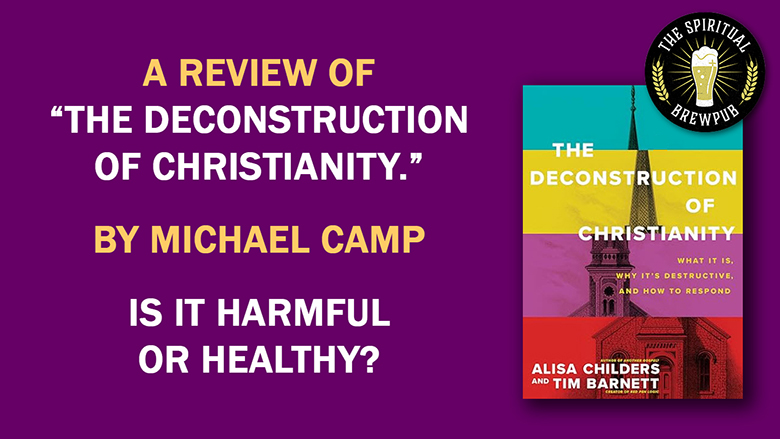
Image by Michael Camp
I have to admit. It was difficult to read this book, “The Deconstruction of Christianity: What It Is, Why It’s Destructive, and How to Respond.” It was downright frustrating. Why? Because of its many misrepresentations. Herein I have laid out what those are. I also mention a few things I liked about the book at the end. Enjoy!
Book Totally Misrepresents Faith Deconstruction and the Critiques of Evangelicalism
It may be that Childers and Barnett are sincere in their criticism of faith deconstruction, but if so, they are masters at totally missing the point. The book misrepresents what people go through who deconstruct, is shallow in its critiques, and is irresponsible in its outrageous claims. My colleagues Desimber Rose, Keith Giles, and Angela Herrington and I recently discussed the book here. Having been in evangelicalism for 25 years and deconstructed starting 20 years ago, here’s my response to Childers and Barnett’s assertions:
1 – They claim to have thoroughly researched faith deconstructionists
On what planet? They have cherry picked a few who either eventually come back to evangelicalism or are not representative of the movement. I didn’t recognize myself or all the people I support in faith deconstruction. There were a lot of strawman arguments. They were continually misstating what a deconstruction position is and then critiquing that misstated position.
2 – They claim deconstructionists are leaving “historic Christianity”
No, it’s actually the opposite. To the authors, historic Christianity is primarily what certain reformers taught. No, it goes back farther than that. They ignore swaths of historical analysis that goes back to the first century and the early church and doesn’t include Augustine, who seriously warped the message of Jesus. Anything called “Historic Christianity” that leaves out the early orthodox church fathers who supported universalism, or the early various views of the Bible (and even Luther’s honest view of it), the Eastern church, the evolution of the doctrine of inerrancy and hell, the evolution of the institution of church, and the scholarship on the original Hebrew and Greek languages is not a good study of history. This book leaves all that out.
3 – They say deconstructionists are just following their selfish desires (their own truth) and are rejecting biblical authority
To the authors, if you don’t believe in the inerrancy of the Bible, you are rejecting its authority. They ignore the history of how the Bible was compiled and the evidence that early believers (and Jesus) and even Luther didn’t treat the Bible as infallible. There’s a way of viewing the Bible that is not making it into an idol, like the authors do. Most deconstructionists don’t throw out the whole Bible as can be understood by hearing the conversation Tim Whitaker had with Peter Enns here. Faithful deconstructionists look at it through the lens of Jesus and what he said that matters most: Love sums up the scriptures and living a life of love fulfills what God desires. In other words, Jesus’ love ethic. These are the very things that both Jesus and Paul taught. This is not rejecting biblical authority. It’s discovering what’s contradictory in the scriptures, what scripture most likely means per the original languages and culture, and then what’s most important in them and focusing on that.
4 – They claim most faith deconstructionists were never saved and that they reject Jesus
Quite an audacious claim to know if people were never sincere in following Christ. It’s a way for them to ease their insecurities. If these deconstructionists were never true believers, we can ignore them. Here’s what one person said who went through my “Religious Deconstruction Workshop” that exposes harmful theology in evangelicalism: “Your Deconstruction Workshop has been a great help as I wade through all the thoughts and feelings I have repressed for so long… My God has gotten much bigger and I’m more in love with Jesus than ever. It is time that we reclaim Jesus!” The authors apparently haven’t met people like this and their claim that deconstructionists are mostly insincere questioners rings hallow. As Keith Giles says, “They conflate deconstruction with deconversion.” Occasionally, deconversion from all faith or faith in Christ happens. But in my experience, it doesn’t happen for the overwhelming majority of people who deconstruct. Jesus isn’t rejected. His love ethic and core teaching are reclaimed.
5 – They say deconstructionists don’t “doubt well.”
They admit it’s good and healthy to ask questions of one’s faith and that the church is not doing a good job thoroughly answering people’s questions, but then they don’t thoroughly answer the major questions! They claim any question-asking that leads to leaving their brand of evangelical faith is not good. They really don’t allow for good philosophical, linguistic, historical, and biblical questions. Thomas Oord also makes this case in his review. This is not healthy. Let people ask questions, find answers, and follow the evidence where it leads. Don’t insist only the authors’ view is the only “orthodox” view. Let people make up their own minds. And if they don’t land where you do, don’t demonize them.
6 – Don’t expect to see a refutation of the major claims that faith deconstructionists make
They don’t even lay them out, let alone try to respond to them. They ignore that deconstructionists have discovered that the terms “hell” and “eternal punishment” have been mistranslated in the Bible, that the Bible was compiled over centuries and there were many disputes and debates about what should be considered sacred scripture, that the doctrine of hell came from paganism not the OT or NT, that the prevailing view of the “church” its first 5 centuries was universalism, that the “church” or “ekkelsia” of the first few centuries didn’t look anything like modern church, that the penal substitutionary atonement view of the cross was not the original view (it was developed in the 11th and 16th centuries), that the Western original depravity/sin view espoused by evangelicals does not match the original or Eastern view, the case that the view of Jesus returning to earth 2,000 years later is not biblical, and that there is a huge body of literature and testimonies about spiritual abuse in conservative Christian churches that stems from harmful theology, etc, etc.
If Childers and Barnett had wrote a book that actually addressed the major objections of deconstructionists listed above in a fair way, that would be a good book, even if they still disagreed with the objections. But they didn’t do that. This book is extremely shallow in its response to The Great Evangelical Deconstruction.
What I Like About Childers’ and Barnett’s Book
It was hard to find something I liked, but there were a few things. I like that the authors did actually admit there are problems in the evangelical church. In a video with Sean McDowell, Barnett confesses he doesn’t like the doctrine of hell. That’s a honest statement. They also admit the church has not done a good job answering the questions that deconstructionists or other questioners have. They suggest that to improve, churches could have Q&A sessions after sermons or readings and address these questions with more thoughtful answers. That’s a good idea. Childers had a few things to say in critique of the Christian Contemporary Music (CCM) scene. How it is often legalistic and has been commercialized. This is good critique. The problem I have is, despite these good points, the authors totally downplay all these issues as minor. And, then say anyone who doesn’t agree with their position (that there are no major problems with evangelical theology and the inerrancy of the Bible and their view of Christian history) are promoting “doctrines of demons.” And any deconstruction leaders who critique their position are “wolves in sheep clothing.” Serious claims require serious evidence. People deconstructing evangelicalism have discovered serious evidence. But Childers and Barnett will have you ignore it and not think for yourself.
*The content critiqued here is from the book as well as a video promoting the book in an interview with Sean McDowell.
************
Michael Camp tends the Spiritual Brewpub, and its Podcast, which both help disillusioned or post-evangelicals uncover historical facts and insights that help them deconstruct, rethink, and rebuild a more authentic faith or spirituality. He is the author of Breaking Bad Faith: Exposing Myth and Violence in Popular Theology to Recover the Path of Peace. To get specific help deconstructing conservative Christianity and rebuilding healthy faith, see Michael’s Religious Deconstruction Workshop.
Evangelical
Family, Parenting and Religion

About Michael Camp
I spent twenty-five years in the evangelical movement as an ordained missionary to Muslims, a development worker in Africa, and a lay leader in independent, charismatic, and Baptist churches. Today, as an author, podcaster, speaker, Rotarian, theology nerd, and bad golfer, I help people find a more authentic spiritual path along Jesus’ subversive way of peace. I am also active in a Rotary Club in Bainbridge Island, WA, where I work with colleagues to help facilitate microfinance and development projects in Africa and Asia. You can read more about the author here.
Previous Post

January 12, 2024
10 Serious Problems with an Omnipotent God -Part 2
Next Post

April 13, 2024 Peacemaking in the Early Jesus Movement
Recent Comments
"Please, for others and myself, I ask why specifically you believe this is a great ..."
Amipotence: The Ghost Buster of Harmful ..."
"Thanks, Tom. I was honored to be included. Keep up the good work."
Amipotence: The Ghost Buster of Harmful ..."
"Great essay, Michael!"
Amipotence: The Ghost Buster of Harmful ..."
"Thanks for your support, Bob. God creates humanity because he/she is Love and wants to ..."
Solving the Problem of Evil and ..."
Browse Our Archives
Select a Category Amipotence Bible Christian History Deconstruction Early Church exvangelical Israel-Hamas War mental health New Testament Old Testament Omnipotent God peacemaking Personal Stories Philosophy Politics Rebuilding Faith Reconstructing Faith Redemptive violence Restorative justice spiritual abuse spirituality Uncategorized War Women in Church
Select a Month January 2025 December 2024 September 2024 April 2024 February 2024 January 2024 November 2023 October 2023 September 2023 August 2023 July 2023 June 2023 May 2023 April 2023
Follow Us!
TAKE THE
Religious Wisdom Quiz
Commanded to go to Nineveh, I fled in the opposite direction on a ship to Tarshish. Who am I?
Select your answer to see how you score.
Elijah Hosea Jonah Jeremiah
Books by This Author Books by Michael Camp
Related posts from The Spiritual Brewpub

Amipotence: The Ghost Buster of Harmful Doctrines

Solving the Problem of Evil and Other Harmful...
Why Follow Jesus (Christianity Optional)

9 Lies Faith Deconstruction Critics Tell
TRENDING AT PATHEOS Progressive Christian

Looking at the Largest Orthodox Cathedral on Earth
There is often a considerable amount of anger and, shall we...

The Problem with False Prophets
Miller’s Station UMC| 10/18/26| Anchor Verse: Jeremiah 23: 1, 9-23 I...

Emotion in Early Christianity by Andrew Crislip
Andrew Crislip’s Emotion in Early Christianity examines an often overlooked dimension of...

16 Spiritual Touchstones for a More Grounded Life
After decades of spiritual study, here are 16 principles I try...

Catholic Evangelization: Sharing Your Faith Every Day
Welcome back to the Graceful Awakening mini-series called, “From Faith to Mission.” ...

The Pillar of the Boatmen: the Ancient Monument...
The Pillar of the Boatmen is a Romano-Gaulish sculpture that dates from...
view all Progressive Christian blogs
What Are Your Thoughts?leave a comment
Ad-Free & Subscriber Log-In Subscription Support
- About Us
- 2026 Calendar
- Videos
- Podcasts
- Library of World Religions
- Faith In Media Tracker
- Advertise With Us
- Write for Us
- Privacy Policy
- Terms of Service
- Do Not Sell My Data
- Contact Us
- Radiant Digital
- Manage Newsletter Subscriptions
- Unsubscribe From Notifications
- Sitemap
Copyright 2008-2026, Patheos. All rights reserved.
Subscription Support Ad-Free & Subscriber Log-In
Follow Patheos