
BuddhistCatholicContemplativeEvangelicalGeneral ChristianHinduJewishLatter-day SaintMuslimNew VisionsProgressive Christian
Beliefs
- Buddhist
- Catholic
- Contemplative
- Evangelical
- General Christian
- Hindu
- Jewish
- Latter-day Saint
- More Voices
- Muslim
- New Visions
- Pagan
- Progressive Christian
Topics
- Religion News
- Food and Religion
- Sports and Religion
- Religious Art
- Religious Music and Entertainment
- Religious Events
- History and Religion
- Style and Religion
- Politics and Religion
- Women in Religion
- Recreation Outdoors and Religion
- Business Finance and Religion
- Careers Workplace and Religion
- Education and Religion
- Family Parenting and Religion
- Health Fitness and Religion
- Home and Religion
- Relationships and Religion
- Technology and Religion
- Travel and Religion
Columnists
- Buddhist Columnists
- Business Finance and Religion Columnists
- Careers Workplace and Religion Columnists
- Catholic Columnists
- Contemplative Columnists
- Education and Religion Columnists
- Evangelists Columnists
- Family Parenting and Religion Columnists
- General Christian Columnists
- Health Fitness and Religion Columnists
- Hindu Columnists
- History and Religion Columnists
- Home and Religion Columnists
- Jewish Columnists
- More Voices Columnists
- Latter Day Columnists
- Muslim Columnists
- New Visions Columnists
- Nonreligious Columnists
- Pagan Columnists
- Politics and Religion Columnists
- Progressive Columnists
- Recreation Outdoors and Religion Columnists
- Relationships and Religion Columnists
- Religion News Columnists
- Religious Art Columnists
- Religious Events Columnists
- Religious Music and Entertainment Columnists
- Sports and Religion Columnists
- Style and Religion Columnists
- Technology and Religion Columnists
- Travel and Religion Columnists
- Women in Religion Columnists
Resource Library
- 2026 Calendar
- Library of World Religions
- The 100 Most Holy Places on Earth
- Patheos Answers
- Podcasts
- Videos
- Faith Leaders Database
- Anglican Episcopalian
- Bahai
- Baptist
- Buddhism
- Christianity
- Confucianism
- Eastern Orthodoxy
- Hinduism
- Holiness and Pentecostal
- ISKCON
- Islam
- Judaism
- Lutheran
- Methodist
- The Church of Jesus Christ of Latter-day Saints
- New Age
- Paganism
- Presbytarian and Reformed
- Protestantism
- Religion Behind the Scenes
- Roman Catholic
- Scientology
- Shia Islam
- Sikhism
- Sufism
- Sunni Islam
- Taoism
- Zen
- See all religions
Research Tools
 Ad-Free & Subscriber Log-In Subscription Support
Ad-Free & Subscriber Log-In Subscription Support
Follow Patheos 

- Trending:
- Forgiveness
- |
- Marriage
- |
- Consciousness
- |
- Death Penalty
- |
- Election
- |
- Halloween
 The Shoeless Banshee: Meanderings Beyond the Pale
- Home
- Catholic
- Authentic Catholic Femininity: Another Disappointment
Authentic Catholic Femininity: Another Disappointment
Last updated on: November 10, 2019 at 12:42 am by Guest Contributor
Authentic Catholic Femininity: Another Disappointment 2019-11-10T00:42:46+00:00 Guest Contributor
Patheos Explore the world's faith through different perspectives on religion and spirituality! Patheos has the views of the prevalent religions and spiritualities of the world.
As a young stay-at-home mother in the rural Midwest, I find a lot of value in social media for the purpose of connecting with others and sharing information throughout the day.
Especially as the snow approaches, it can be very difficult to maintain friendships and feel connected to the outside world when you’re stuck inside with a toddler. Once my second baby arrives in February, it will be even harder to get out of the house for daily interaction with adults. That’s why I rely so much on Facebook groups and pages for that interaction. It’s self-care in a way for me. I’m a very social person, so being isolated for long periods of time is a struggle.
As I’ve grown and changed, both as a young Catholic and as a woman, certain groups I had previously joined proved to no longer be helpful or uplifting, so I joined others. In my experience, anything with “traditional womanhood” in the title is usually toxic. At this point in my life, I’ve decided that most Catholic groups formed especially for women and mothers no longer serve me. Too often, their online debates are a series of crash and burn discussions on modesty. Honestly, I have no time for that shit. I need genuinely uplifting content and a safe space to share myself, not other women bemoaning the “evil of leggings.”
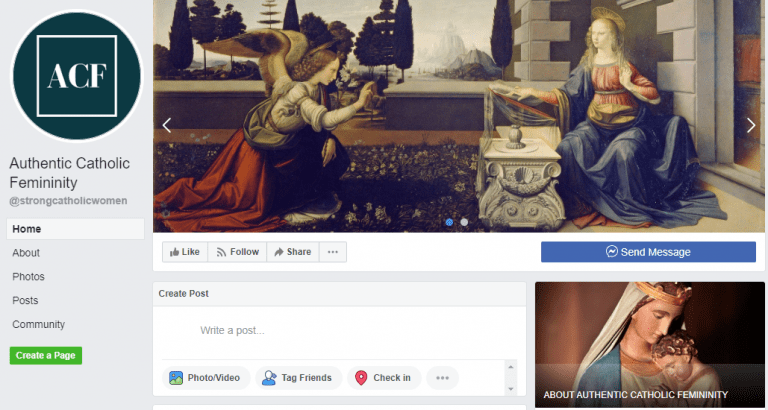
I had thought when I joined the Facebook group “Authentic Catholic Femininity” that I’d found what I needed.
Their “About Us” page reads:
We are a community of faithful Catholics who believe that being a woman is about more than just what you wear or how you speak. We embrace the fullness of Church teaching on womanhood and femininity and reject the puritanical and heretical ideals of misogyny. In short, just as there is no one way to be a man, there is no one way to be a woman.
We support women of every interest and walk of life: working women, stay-at-home mothers, unmarried women, widows, mothers and those without children, women in a traditional feminine role and those who consider themselves untraditional.
To quote St. John Paul the Great: “In all its expressions, womanhood is part of the essential heritage of mankind and of the Church herself.”
The community seemed down-to-earth and… well, authentic. I decided to give them a try and had no issue for months. I didn’t expect, then, when I pointed something out on the Feast of All Souls that things would go downhill so quickly.
This was the original post that caught my eye:
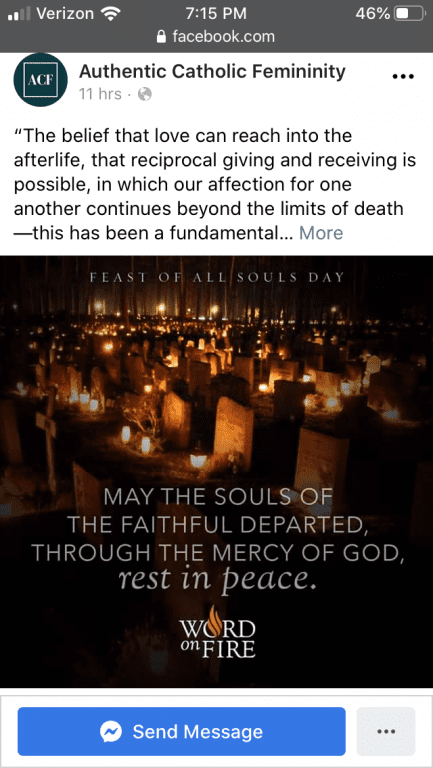
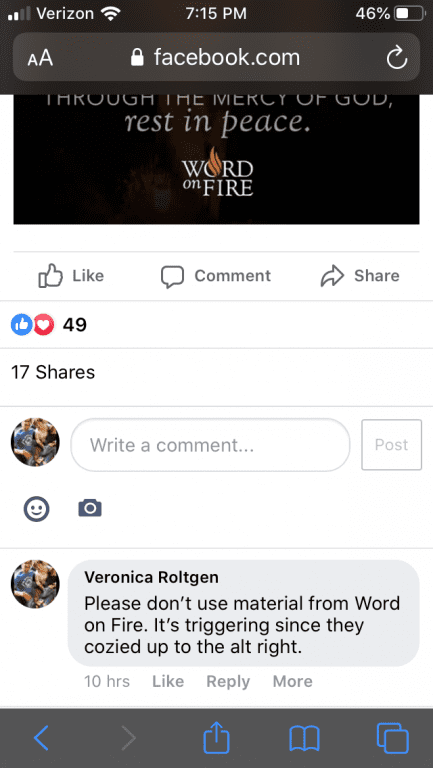
Appropriate for the solemn day, right? However, I noticed where they’d found the post: Bishop Barron’s “Word on Fire”. I made a small comment, not thinking anything of it other than perhaps they’d remove the post and replace it with another.
Hours later, I got a private message from an admin. It was clear from the beginning that they didn’t understand me:
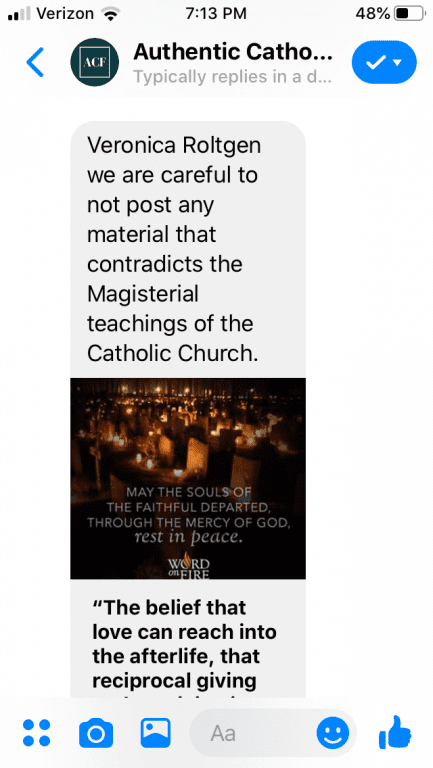
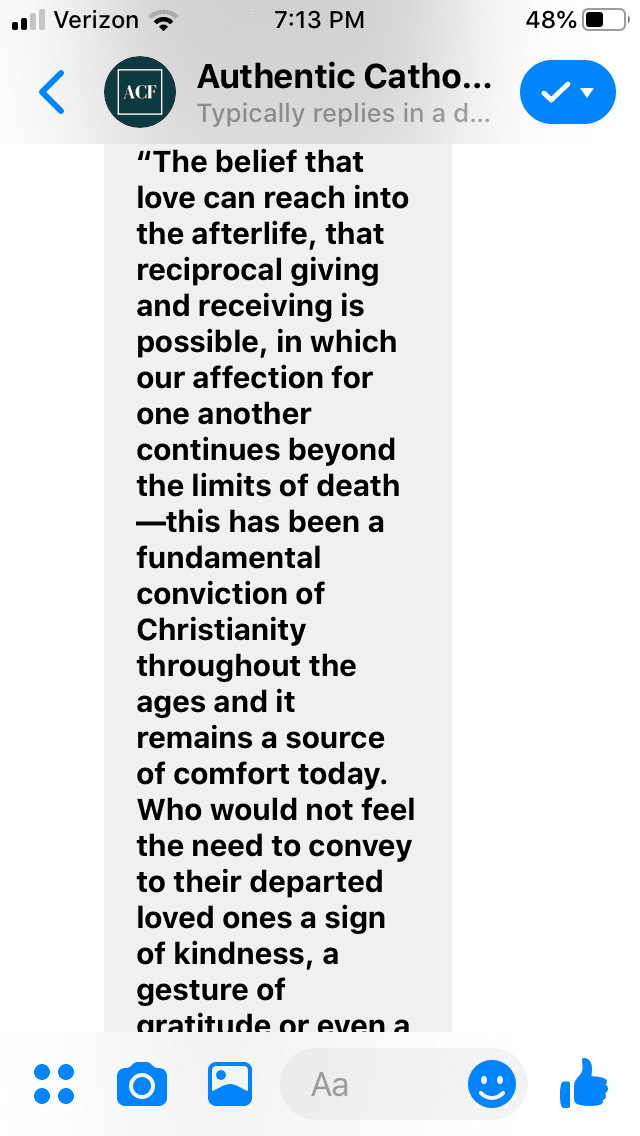
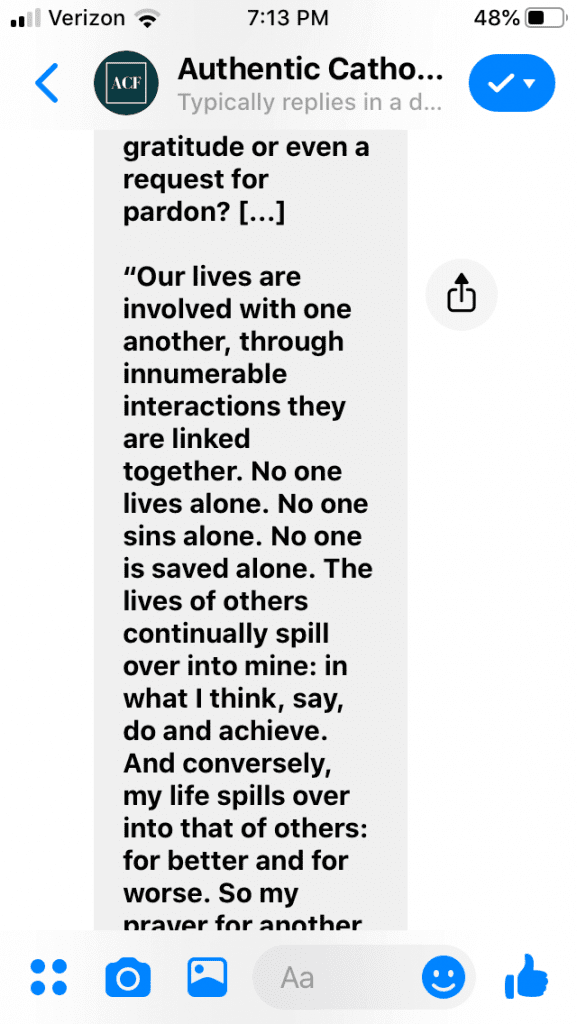
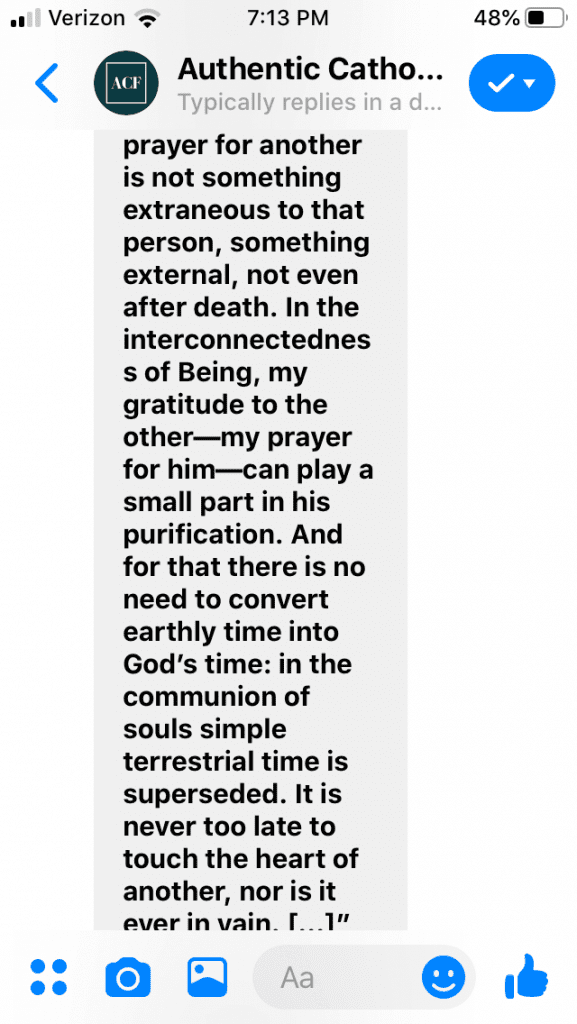
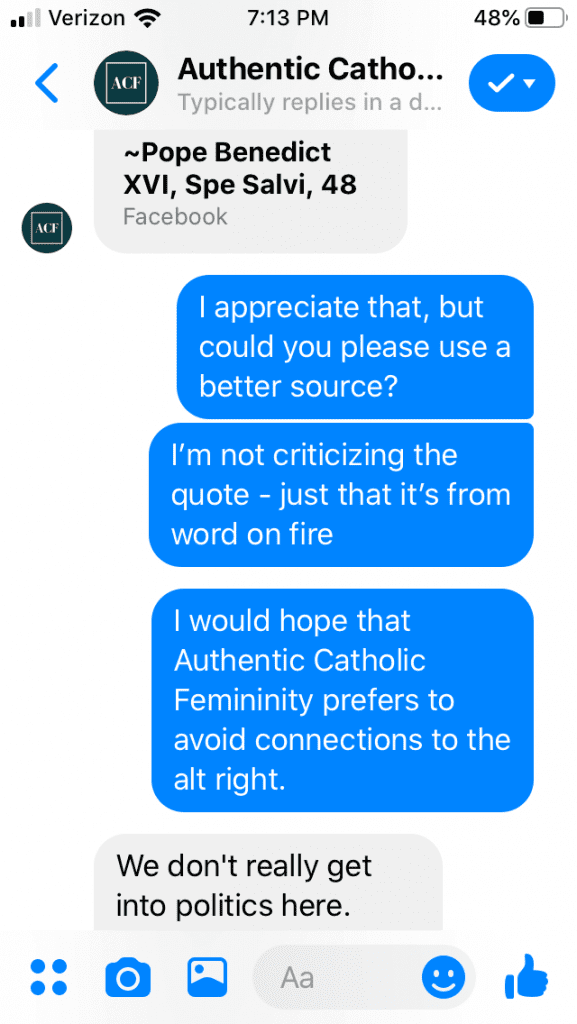
I mean, I may be a lowly layperson, but I do have a degree in theology. I don’t have any issue with the Church’s teaching on purgatory, so it was an amusing surprise to have Spe Salvi quoted at me.
They responded:
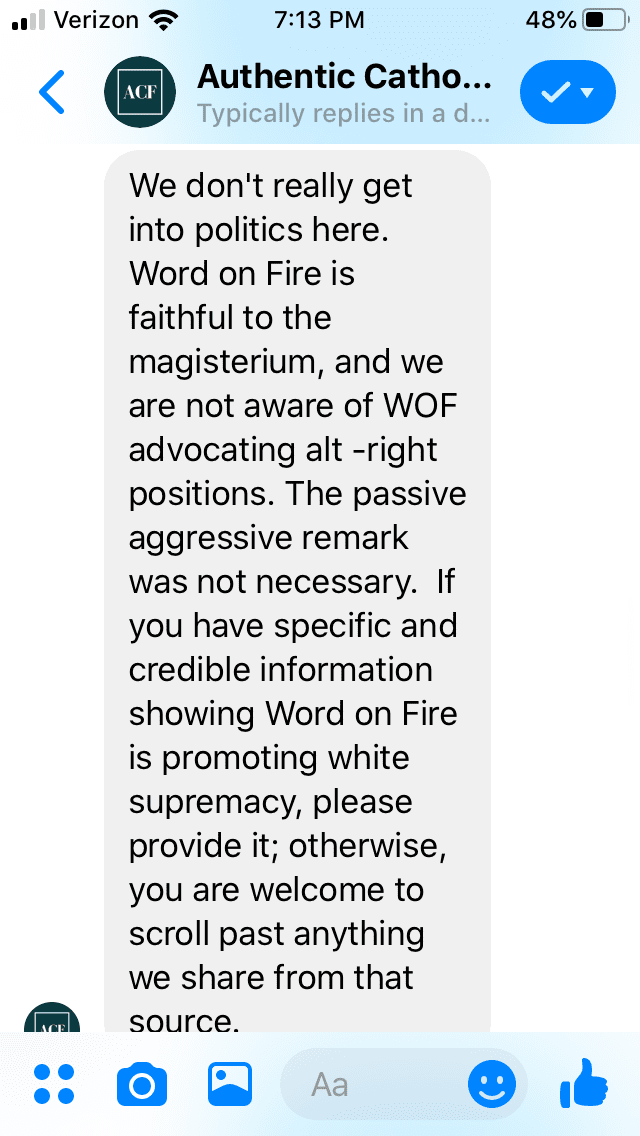
Well, that was interesting. I had just had a lesson on passive-aggressive behavior in my weekly therapy group, so it took me off guard that I’d come across that way. Honestly, I’d thought that I was being direct. I felt ashamed but used my learned therapy skills to try to clarify and to find what they asked me for: “credible information showing WOF is promoting white supremacy.” I replied and immediately began my search for the sources they’d asked me for.
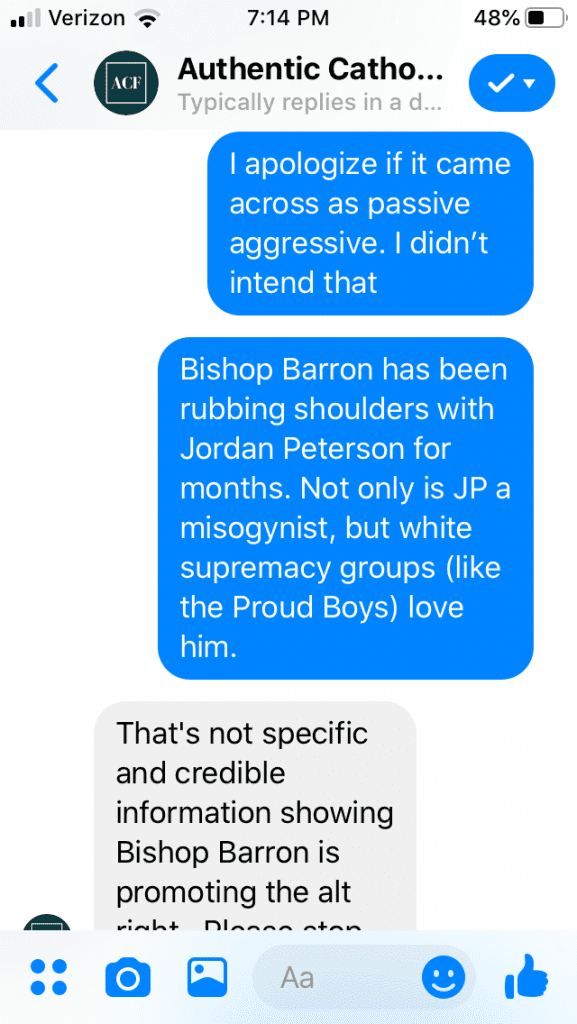
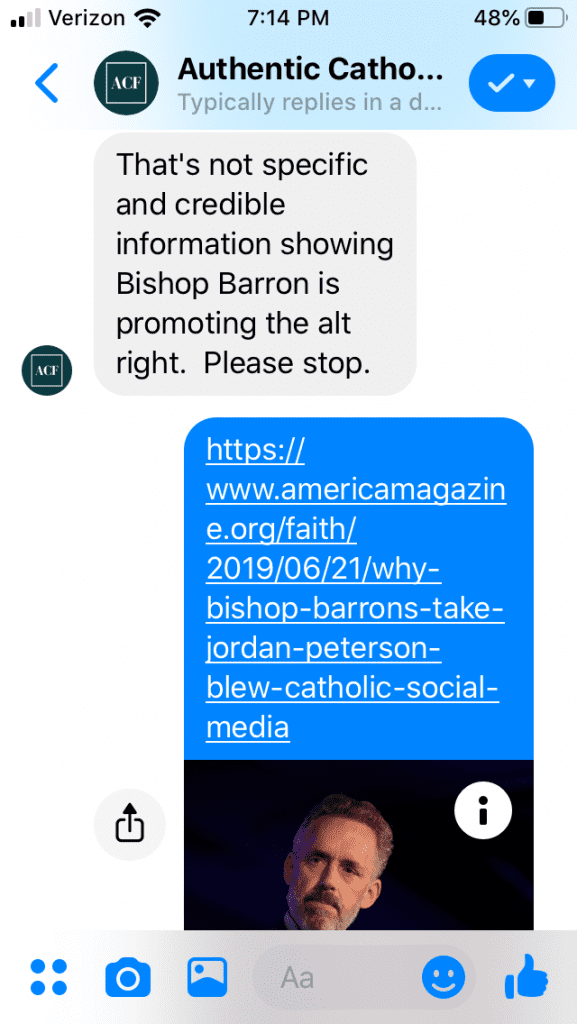
Having what I thought was a credible article, I sent it to them before I saw that they’d asked me to “please stop.”
What? I was so confused. I thought they had just requested that I pass along credible information to them. I scrolled back and checked. Yep, that’s what they’d asked me. Why were they now asking me to stop?
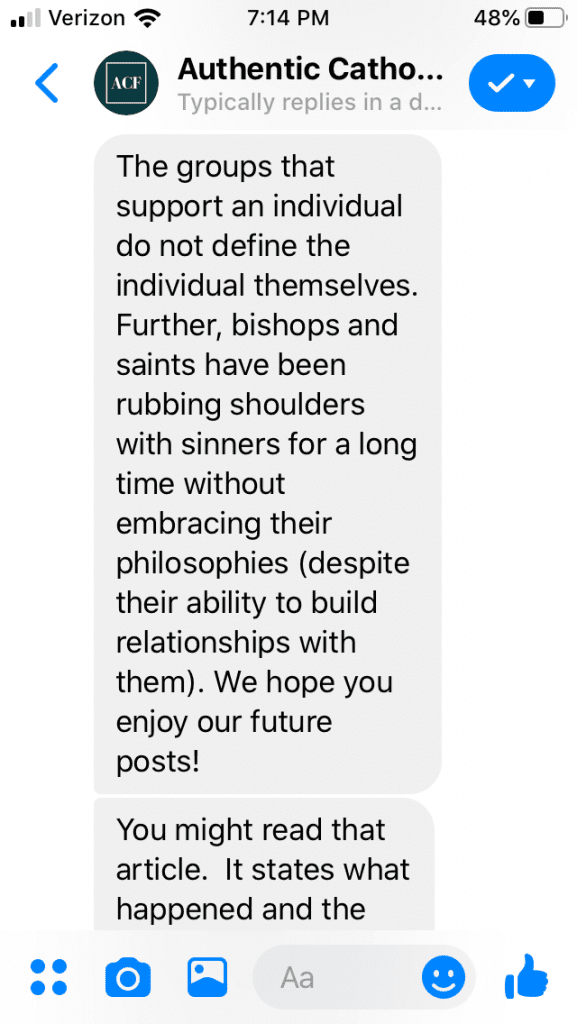
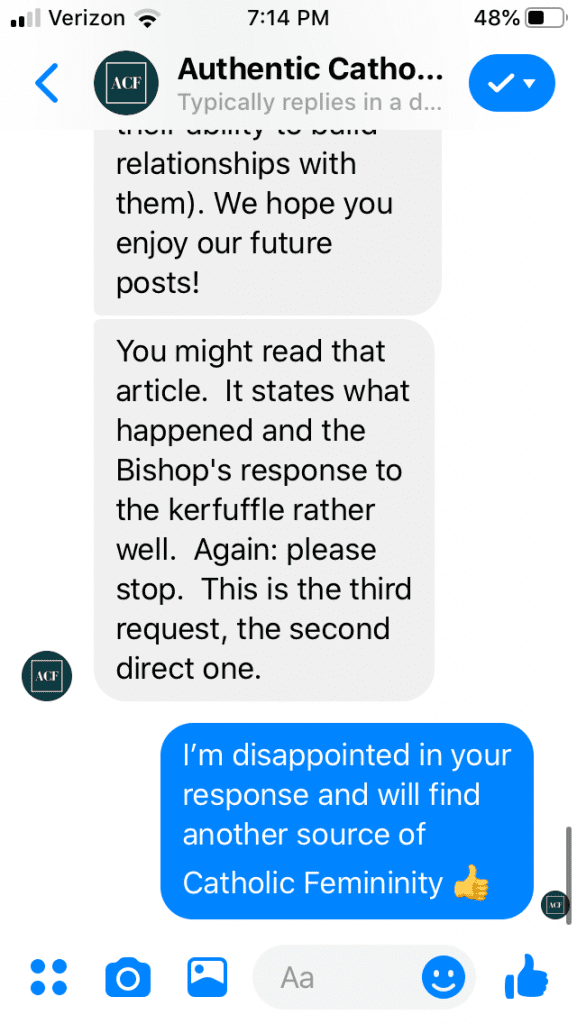
Ugh. I had so much more to say. I thought we were having a discussion, which was unfortunately cut short by the admin.
So, I would like to respond here:
A) I don’t completely agree with this statement: “bishops have been rubbing shoulders with sinners for a long time without embracing their philosophies.”
First of all, I said nothing explicitly about sin. We’re all sinners, the bishop included. I don’t presume to have any insight on Jordan Peterson’s spirituality or relationship with God. It’s not my business anyway. Yes, white supremacy and racism in general are sins. So is misogyny, and if a bishop is happily “rubbing shoulders” with someone who upholds this belief, it can be hurtful, confusing, even a trigger for those who’ve been victimized by misogyny in the Church.
Secondly, yes bishops are capable of dialogue with opposing philosophies without embracing them. However, church history provides many, many examples of bishops who weren’t. Take a glance at the Arian heresy, and you’ll see what I mean.
Also, there is a huge difference between clergy openly dialoguing with someone whose beliefs are harmful and clergy openly dialoguing while being clear to point out the harmful beliefs. Clear lines need to be drawn.
It brings to mind the White Wizard Saruman’s preoccupation with the Enemy in Tolkien’s Lord of the Rings. While he began as a good character who was mainly curious to gain more information on the Dark Lord, his downfall began when he failed to maintain clear boundaries in his study. Over time, he becomes drawn to the power of the Enemy and loses himself in it. It’s incredibly important, especially for self-proclaimed intellectuals like Bishop Barron, to stay grounded in the Truth when parsing through philosophies.
B) I did in fact read the article they suggested. You are very welcome to as well. Yes, it explains things well. However, the good bishop himself fails to explain why he’s so taken with a Canadian philosopher other than because he hopes to attract the “nones.” And the article doesn’t address Peterson’s troublesome misogyny. I was just in the middle of a search for another article to provide more information when I saw that they were again asking me to “please stop”. Not only that, but they seemed almost frantic that I stop. I’m not sure why, so I responded assertively the best way that I could. I’m disappointed and will no longer follow their page.
In any case, it’s a damn shame to lose one’s good opinion of yet another Catholic online community.
Previous Post

November 9, 2019
Musing Musically: Grace Lee reflects on "Rainbow"
Next Post

November 11, 2019 Tattoos, Symbols, and Personal Significance
Browse Our Archives
Select a Category Advent Art and Poetry Catholic Domestic Violence Easter Triduum Guest Contributions Humor Lent Meanderings from Mass Millennials leaving and staying Pop Culture Social Justic Uncategorized Unconventional Catholicism
Select a Month September 2020 August 2020 July 2020 June 2020 December 2019 November 2019 October 2019 July 2019 June 2019 May 2019 April 2019 March 2019 February 2019 January 2019 December 2018 November 2018 October 2018 September 2018 July 2018 June 2018 May 2018 April 2018 March 2018
Follow Us!
TAKE THE
Religious Wisdom Quiz
Who interpreted the "writing on the wall" for King Belshazzar?
Select your answer to see how you score.
Isaiah Daniel Ezekiel Jeremiah
Support this
Column


Related posts from The Shoeless Banshee: Meanderings Beyond the Pale

American Saints Who Were People of Color
The Shoeless Banshee: Meanderings Beyond the Pale

Broken Glass: When Domestic Violence Ends in Murder
The Shoeless Banshee: Meanderings Beyond the Pale
Mother of the Church, Mother of the Queer...
The Shoeless Banshee: Meanderings Beyond the Pale

The Shoeless Banshee: Meanderings Beyond the Pale
TRENDING AT PATHEOS Catholic

Rejecting Doom: Christian Hope And Human Action
Christianity is a religion of hope. We are to have hope and...

It’s What Comes From Within Which Matters
One of the most difficult things for us to understand is why...

Why I Choose the Eucharist Over the Sermon
Choose the Eucharist, Not the Sermon What are we supposed to get...

5 Design Elements Found in Spiritually Rooted Homes
Putting Spirituality Into Home Decor Our homes are more than our living...

Credo: A Story of God Told with the...
About 10 years ago, I began to imagine a personal "Credo" that...

The Anatomy of Divine Revelation in Catholic Thought
The claim that God has made Himself known to human beings is...
view all Catholic blogs
Ad-Free & Subscriber Log-In Subscription Support
- About Us
- 2026 Calendar
- Videos
- Podcasts
- Library of World Religions
- Faith In Media Tracker
- Advertise With Us
- Write for Us
- Privacy Policy
- Terms of Service
- Do Not Sell My Data
- Contact Us
- Radiant Digital
- Manage Newsletter Subscriptions
- Unsubscribe From Notifications
- Sitemap
Copyright 2008-2026, Patheos. All rights reserved.
Subscription Support Ad-Free & Subscriber Log-In
Follow Patheos