
BuddhistCatholicContemplativeEvangelicalGeneral ChristianHinduJewishLatter-day SaintMuslimNew VisionsProgressive Christian
Beliefs
- Buddhist
- Catholic
- Contemplative
- Evangelical
- General Christian
- Hindu
- Jewish
- Latter-day Saint
- More Voices
- Muslim
- New Visions
- Pagan
- Progressive Christian
Topics
- Religion News
- Food and Religion
- Sports and Religion
- Religious Art
- Religious Music and Entertainment
- Religious Events
- History and Religion
- Style and Religion
- Politics and Religion
- Women in Religion
- Recreation Outdoors and Religion
- Business Finance and Religion
- Careers Workplace and Religion
- Education and Religion
- Family Parenting and Religion
- Health Fitness and Religion
- Home and Religion
- Relationships and Religion
- Technology and Religion
- Travel and Religion
Columnists
- Buddhist Columnists
- Business Finance and Religion Columnists
- Careers Workplace and Religion Columnists
- Catholic Columnists
- Contemplative Columnists
- Education and Religion Columnists
- Evangelists Columnists
- Family Parenting and Religion Columnists
- General Christian Columnists
- Health Fitness and Religion Columnists
- Hindu Columnists
- History and Religion Columnists
- Home and Religion Columnists
- Jewish Columnists
- More Voices Columnists
- Latter Day Columnists
- Muslim Columnists
- New Visions Columnists
- Nonreligious Columnists
- Pagan Columnists
- Politics and Religion Columnists
- Progressive Columnists
- Recreation Outdoors and Religion Columnists
- Relationships and Religion Columnists
- Religion News Columnists
- Religious Art Columnists
- Religious Events Columnists
- Religious Music and Entertainment Columnists
- Sports and Religion Columnists
- Style and Religion Columnists
- Technology and Religion Columnists
- Travel and Religion Columnists
- Women in Religion Columnists
Resource Library
- 2026 Calendar
- Library of World Religions
- The 100 Most Holy Places on Earth
- Patheos Answers
- Podcasts
- Videos
- Faith Leaders Database
- Anglican Episcopalian
- Bahai
- Baptist
- Buddhism
- Christianity
- Confucianism
- Eastern Orthodoxy
- Hinduism
- Holiness and Pentecostal
- ISKCON
- Islam
- Judaism
- Lutheran
- Methodist
- The Church of Jesus Christ of Latter-day Saints
- New Age
- Paganism
- Presbytarian and Reformed
- Protestantism
- Religion Behind the Scenes
- Roman Catholic
- Scientology
- Shia Islam
- Sikhism
- Sufism
- Sunni Islam
- Taoism
- Zen
- See all religions
Research Tools
 Ad-Free & Subscriber Log-In Subscription Support
Ad-Free & Subscriber Log-In Subscription Support
Follow Patheos 

- Trending:
- Forgiveness
- |
- Marriage
- |
- Consciousness
- |
- Death Penalty
- |
- Election
- |
- Halloween
 The Shoeless Banshee: Meanderings Beyond the Pale
- Home
- Catholic
- The Burden of “Traditional Femininity”
The Burden of “Traditional Femininity”
Last updated on: April 19, 2019 at 4:27 am by Guest Contributor
The Burden of “Traditional Femininity” 2019-04-19T04:27:43+00:00 Guest Contributor
Patheos Explore the world's faith through different perspectives on religion and spirituality! Patheos has the views of the prevalent religions and spiritualities of the world.

Source: Rudolf Eickemeyer, photographer, via Wikipedia Commons
What comes to your mind when you hear the phrase “Traditional Femininity”?
Maybe it’s Doris Day’s 1960’s thirty-year-old chic, innocent but not naive radiance in career sheaths and adorable pillbox hat and gloves? Maybe it’s the 1950’s serene Grace Kelly with her elegant Dior or Helene Rose full-skirted gowns, heels, pearls or diamonds, sunglasses, and driving gloves. Or maybe it’s earlier. Like the 1940’s luminous Donna Reed in the more structured, Spartan wartime dress. Or 1930’s Ginger Rogers’s fantastical ballroom allure? Or even 1920’s fragile, doll-like Lillian Gish?
I’m sure there are some readers who envision only a plaster statue of the Virgin Mary, with glass downcast eyes, no exposed wrists or collarbones, and a small, delicately painted mouth. These varied visions all have something in common. For one, they are all idealizations of beauty and grace that appeal to Western—European or White American—standards. Secondly, they appeal to an upper class lifestyle that most women could not easily measure up to. Thirdly, none of these idealized women are over 45, or permitted to look it if they are. But the most important thing they have in common is that they are all varied and hence could not all possibly be the actual standard for “traditional.”
And that’s, of course, because they are not.
Could each of those women and their highly collaborated manufactured images hear you describe them as examples of a traditional feminine aesthetic, they would likely each scoff and say, “I’m Modern. This is a very new, very daring look.” Yes, even the statues of Our Lady have undergone countless fashion changes over the centuries. And in all probability, none of these renditions look anything like the unmanicured, unwaxed, unpainted, middle-aged brown woman of Nazareth that inspired all of them.
It is the same problem no matter how far back in history you go. Unlike the Sacred Tradition that informs our faith, tradition in aesthetics, fashion, etiquette, and deportment is largely myth.
There is no faithful adherence any more than there is truly any pure novelty.
Today I scrolled through an online shopping site that described a little black dress with bell sleeves as “classic” and a floral print romper as “a new trend.” Never mind that Audrey Hepburn’s popularization of the Little Black Dress didn’t occur until the sixties, and our current fascination with bell sleeves is a quirk recycled from the seventies. As for floral print rompers, they are as new any Frankensteinian cobbling of the nineties with the 2010’s can be expected to be.
Some might object, “Alright, maybe none of our mothers, grandmothers or great-grandmothers, or even great-great-grandmothers really were following a traditional formula for expressing their femininity. And perhaps none of them had the glitz and glamour of Hollywood fantasy. But they all were trying to be feminine! And that’s really all that we mean when we say “traditional femininity: that women should cherish their femininity and not try to look like or act like men.”
And how did our grandmothers and great-grandmothers manage this feat?
Were they constantly worrying that they weren’t real women or weren’t feminine enough” How would—and did—flappers respond to criticisms that they were unladylike and unfeminine? How did their daughters respond when their mothers told them they shouldn’t work in manufacturing plants because that was men’s work up until that point? And when their daughters fought for Civil Rights and workplace equality, do we really imagine that they never heard themselves described as unfeminine, as trying to be men?
The problem with these objections appealing to some vague ideal—an ideal that is supposedly universal, yet still as varied and in flux as the men who dream it—is that it is not only burdensome and unattainable, it is subversive.
If the very charm and power of femininity lies in the woman herself and in her self-cherishing, then it by necessity does not reside in, nor can be reduced to, what the man on the street would have it be. Even if all that the man on the street wants is for the woman to smile at him. If the woman herself naturally wants to walk about her business without glancing at, smiling at, or talking to strangers, then she is feminine as she does so. She is not more or less feminine if she quickens her pace to escape, laughs nervously, or blushes, or icily hails a cab, or scornfully flips the stranger off.
These are all feminine responses from feminine subjects.
However, if “traditional femininity” consists in women’s perceived use and pleasure to men, then none of our fore-mothers were respectably “feminine” according to this varied and fluctuating standard, either. All of them, all women, have had to go through their lives braving the displeasure of men, just as they braved the displeasure of other women and children.
This is part of being true to oneself. Even if one tries to jump through every social, cultural, political, and religious hoop to obtain optimal people-pleasing, inevitably the lesson from Aesop will be learned—the fable of the man, the boy, and the donkey is repackaged and recast each day under the title of “The Lady and Her Lipstick.”
And just as our fore-mothers did, all of our female—dare I say, feminine—descendants will learn to navigate their own path between fashion, love interests, muses, and themselves. And they will be likewise puzzled by each peer who claims that their choices are either somehow “traditionally feminine” or “unorthodox and unfeminine.”
Maria Mochow writes for The Christendom Advocacy and Support Coalition, a project by Dinah’s voice. She has a BA in English Language and Literature and resides in Virginia.
Image Credit: https://commons.wikimedia.org/wiki/File:Eickemeyer_nesbit.jpg#/media/File:Eickemeyer_nesbit.jpg
Previous Post

May 15, 2018
Pondering a Bittersweet Graduation
Next Post

May 23, 2018 (Not) Receiving as Protest
Browse Our Archives
Select a Category Advent Art and Poetry Catholic Domestic Violence Easter Triduum Guest Contributions Humor Lent Meanderings from Mass Millennials leaving and staying Pop Culture Social Justic Uncategorized Unconventional Catholicism
Select a Month September 2020 August 2020 July 2020 June 2020 December 2019 November 2019 October 2019 July 2019 June 2019 May 2019 April 2019 March 2019 February 2019 January 2019 December 2018 November 2018 October 2018 September 2018 July 2018 June 2018 May 2018 April 2018 March 2018
Follow Us!
TAKE THE
Religious Wisdom Quiz
What guards the Garden of Eden?
Select your answer to see how you score.
Cherubim Eagles Lions Serpents
Support this
Column


Related posts from The Shoeless Banshee: Meanderings Beyond the Pale

The Shoeless Banshee: Meanderings Beyond the Pale

Trauma Survivors Have Had It With Hallmark-esque Christmas...
The Shoeless Banshee: Meanderings Beyond the Pale
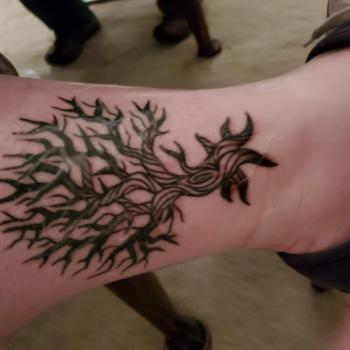
Tattoos, Symbols, and Personal Significance
The Shoeless Banshee: Meanderings Beyond the Pale

The Shoeless Banshee: Meanderings Beyond the Pale
TRENDING AT PATHEOS Catholic

Rejecting Doom: Christian Hope And Human Action
Christianity is a religion of hope. We are to have hope and...

It’s What Comes From Within Which Matters
One of the most difficult things for us to understand is why...

Why I Choose the Eucharist Over the Sermon
Choose the Eucharist, Not the Sermon What are we supposed to get...

5 Design Elements Found in Spiritually Rooted Homes
Putting Spirituality Into Home Decor Our homes are more than our living...

Credo: A Story of God Told with the...
About 10 years ago, I began to imagine a personal "Credo" that...

The Anatomy of Divine Revelation in Catholic Thought
The claim that God has made Himself known to human beings is...
view all Catholic blogs
Ad-Free & Subscriber Log-In Subscription Support
- About Us
- 2026 Calendar
- Videos
- Podcasts
- Library of World Religions
- Faith In Media Tracker
- Advertise With Us
- Write for Us
- Privacy Policy
- Terms of Service
- Do Not Sell My Data
- Contact Us
- Radiant Digital
- Manage Newsletter Subscriptions
- Unsubscribe From Notifications
- Sitemap
Copyright 2008-2026, Patheos. All rights reserved.
Subscription Support Ad-Free & Subscriber Log-In
Follow Patheos