
BuddhistCatholicContemplativeEvangelicalGeneral ChristianHinduJewishLatter-day SaintMuslimNew VisionsProgressive Christian
Beliefs
- Buddhist
- Catholic
- Contemplative
- Evangelical
- General Christian
- Hindu
- Jewish
- Latter-day Saint
- More Voices
- Muslim
- New Visions
- Pagan
- Progressive Christian
Topics
- Religion News
- Food and Religion
- Sports and Religion
- Religious Art
- Religious Music and Entertainment
- Religious Events
- History and Religion
- Style and Religion
- Politics and Religion
- Women in Religion
- Recreation Outdoors and Religion
- Business Finance and Religion
- Careers Workplace and Religion
- Education and Religion
- Family Parenting and Religion
- Health Fitness and Religion
- Home and Religion
- Relationships and Religion
- Technology and Religion
- Travel and Religion
Columnists
- Buddhist Columnists
- Business Finance and Religion Columnists
- Careers Workplace and Religion Columnists
- Catholic Columnists
- Contemplative Columnists
- Education and Religion Columnists
- Evangelists Columnists
- Family Parenting and Religion Columnists
- General Christian Columnists
- Health Fitness and Religion Columnists
- Hindu Columnists
- History and Religion Columnists
- Home and Religion Columnists
- Jewish Columnists
- More Voices Columnists
- Latter Day Columnists
- Muslim Columnists
- New Visions Columnists
- Nonreligious Columnists
- Pagan Columnists
- Politics and Religion Columnists
- Progressive Columnists
- Recreation Outdoors and Religion Columnists
- Relationships and Religion Columnists
- Religion News Columnists
- Religious Art Columnists
- Religious Events Columnists
- Religious Music and Entertainment Columnists
- Sports and Religion Columnists
- Style and Religion Columnists
- Technology and Religion Columnists
- Travel and Religion Columnists
- Women in Religion Columnists
Resource Library
- 2026 Calendar
- Library of World Religions
- The 100 Most Holy Places on Earth
- Patheos Answers
- Podcasts
- Videos
- Faith Leaders Database
- Anglican Episcopalian
- Bahai
- Baptist
- Buddhism
- Christianity
- Confucianism
- Eastern Orthodoxy
- Hinduism
- Holiness and Pentecostal
- ISKCON
- Islam
- Judaism
- Lutheran
- Methodist
- The Church of Jesus Christ of Latter-day Saints
- New Age
- Paganism
- Presbytarian and Reformed
- Protestantism
- Religion Behind the Scenes
- Roman Catholic
- Scientology
- Shia Islam
- Sikhism
- Sufism
- Sunni Islam
- Taoism
- Zen
- See all religions
Research Tools
 Ad-Free & Subscriber Log-In Subscription Support
Ad-Free & Subscriber Log-In Subscription Support
Follow Patheos 

- Trending:
- Forgiveness
- |
- Marriage
- |
- Consciousness
- |
- Death Penalty
- |
- Election
- |
- Halloween
 The Rule and the Raven
- Home
- Catholic
- The resurrection of the word.
The resurrection of the word.
Last updated on: May 14, 2018 at 12:54 pm by Anne Carpenter
The resurrection of the word. 2018-05-14T12:54:41-08:00 Anne Carpenter
Patheos Explore the world's faith through different perspectives on religion and spirituality! Patheos has the views of the prevalent religions and spiritualities of the world.
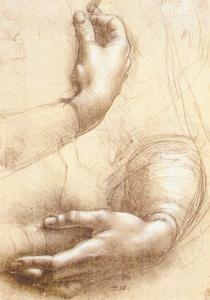
“Study of hands,” Leonardo da Vinci (WikiArt)
I was in the full arrogance of youth, and I wrote a poem. A friend had sent me a different poem, one quite modern in tone and style, complaining to me of its non-sense. I provided a quick study of its flaws – and then – I adopted its theme and wrote an entirely different poem. It took a few minutes. To this day, it remains my friend’s favorite poem of mine.
Such arrogance! That I could imagine writing a superior poem than a real poet, and so quickly. But I was young, in the middle of a Master’s program, and I was discovering poetry. I was discovering that I was good at it. Not that I know whether the poem was in fact better than the original. Only that I could play with language in a way that felt like breathing. (Like very frustrating, difficult, effortless, breathless…breathing.)
Describing the intensity and immensity, the thrill of an entire universe – poetry – coming alive seems near impossible to me now. I can hardly say how excited I was. Quite apart from my theological studies, a friend of mine slowly fed me poetry until I was consumed by it. Not just consumed by being able to read it, but being able to do it. It was…like tasting lightning. All crackling ozone and energy.
At first I learned to write in hospital beds. Though I’d been aware of a certain talent with words before then, I could not be bothered. I retreated to my mind only when my body became less reliable. When the immediacy of youth gave way to the anxieties of adolescence.
I wrote and wrote and wrote. Stories, mainly. Sprawling things that somehow always featured characters inches from what they could never have (such is the world from the hospital bed), and a million fight scenes. Mostly fight scenes. Basically an action movie, but in words. Mind you, none of it was any good. The point was that I was writing. Over and over and over. New experiments with syntax, with shades of feeling, with vocabulary. Over and over. When people ask me how to become good at writing, I often answer, “By writing.” (How frustrating.)
I was a keen reader, and as interested in form as in content. History books and fantasy novels and theology: those were my whole thing. (The first theology book I ever read: The Problem of Pain.) I felt drawn to stronger writers, and I’d mimic them closely. I became attached to Roger Ebert not because I cared what he thought of movies, but because he was a good writer. He had an economy of language and a sense of how sentences lean against each other in shape and concept. So I read him. And read, and read.
But I hated poetry. Intensely.
How that came around for me is a story of another time. The point for now is that I found a form of writing that came rather naturally, or that I was in any case willing to work very hard to arrive at as if by nature. Poetry is more suited to my idiosyncratic syntax, my balance of clauses, my interest in rhythm. I was never very good at stories, really.
What I loved most was being able to play. I loved being just good enough to be able to really play, and by “play” I mean that practiced and ceremonial way that children have of discovering rules in the middle of a moment. Voicing the addition or subtraction. Re-shaping the play at hand in a with a sudden insight. “I’m a pirate now, and you’re my first mate.” You know, that sort of thing. That negotion in the midst of what is already under way.
That was how I wrote: always in the middle of some experiment or another, often stacking experiments in a mess of extravagance and ruin. The classroom and books were places for rigor, order, and the sheer intimidation of formal learning. Poetry was the one place I could really play.
Suffering brought a sudden end to much of it, though I retained the habitus of idiosyncratically beautiful writing. But I had begun lately to come alive. Which is why it was so nice, such a sudden gift to have the time and the energy (dear God, the energy!) to write on the Met Gala. The editor of Notre Dame’s Church Life Journal asked me if I would. I agreed, if only because I knew Artur wouldn’t hold me to a genre. He would not expect actual pop commentary. It was in itself a silly topic that required nothing but what I brought to it. So. I could, for once, play. I could play with ideas that had nothing to do with existential angst and the suffocation of depression. No, I could really and freely play with words.
It was the sheer grace of writing.
And so I wrote.
And may God grant me more.
Previous Post

May 5, 2018
Chapter 1: How he made a broken sieve whole and sound.
Next Post
June 29, 2018 Self, suspended
Browse Our Archives
Select a Category Uncategorized
Select a Month June 2018 May 2018 March 2018 August 2017 May 2017 April 2017 March 2017 February 2017 January 2017 December 2016 November 2016 October 2016 September 2016 August 2016 July 2016 June 2016 May 2016 April 2016 March 2016 February 2016
Follow Us!
TAKE THE
Religious Wisdom Quiz
Which Persian king allowed Ezra to take Jewish exiles and gifts to Jerusalem?
Select your answer to see how you score.
Cyrus Nebuchadnezzar Darius Artaxerxes
Related posts from The Rule and the Raven
Chapter 1: How he made a broken sieve...
And I, when I am lifted up, will...
A Meditation on Prayer. Plus the Virgin Mary...
TRENDING AT PATHEOS Catholic

Creation, Preservation, and Teleology in Catholic Theology
As I write this, it is very early Monday morning. Like millions...

The Parable Of The Sower And The Word...
One of Christ’s most famous parables is that of the sower who...

Rejecting Doom: Christian Hope And Human Action
Christianity is a religion of hope. We are to have hope and...

Why I Choose the Eucharist Over the Sermon
Choose the Eucharist, Not the Sermon What are we supposed to get...

5 Design Elements Found in Spiritually Rooted Homes
Putting Spirituality Into Home Decor Our homes are more than our living...

Credo: A Story of God Told with the...
About 10 years ago, I began to imagine a personal "Credo" that...
view all Catholic blogs
Ad-Free & Subscriber Log-In Subscription Support
- About Us
- 2026 Calendar
- Videos
- Podcasts
- Library of World Religions
- Faith In Media Tracker
- Advertise With Us
- Write for Us
- Privacy Policy
- Terms of Service
- Do Not Sell My Data
- Contact Us
- Radiant Digital
- Manage Newsletter Subscriptions
- Unsubscribe From Notifications
- Sitemap
Copyright 2008-2026, Patheos. All rights reserved.
Subscription Support Ad-Free & Subscriber Log-In
Follow Patheos