
BuddhistCatholicContemplativeEvangelicalGeneral ChristianHinduJewishLatter-day SaintMuslimNew VisionsProgressive Christian
Beliefs
- Buddhist
- Catholic
- Contemplative
- Evangelical
- General Christian
- Hindu
- Jewish
- Latter-day Saint
- More Voices
- Muslim
- New Visions
- Pagan
- Progressive Christian
Topics
- Religion News
- Food and Religion
- Sports and Religion
- Religious Art
- Religious Music and Entertainment
- Religious Events
- History and Religion
- Style and Religion
- Politics and Religion
- Women in Religion
- Recreation Outdoors and Religion
- Business Finance and Religion
- Careers Workplace and Religion
- Education and Religion
- Family Parenting and Religion
- Health Fitness and Religion
- Home and Religion
- Relationships and Religion
- Technology and Religion
- Travel and Religion
Columnists
- Buddhist Columnists
- Business Finance and Religion Columnists
- Careers Workplace and Religion Columnists
- Catholic Columnists
- Contemplative Columnists
- Education and Religion Columnists
- Evangelists Columnists
- Family Parenting and Religion Columnists
- General Christian Columnists
- Health Fitness and Religion Columnists
- Hindu Columnists
- History and Religion Columnists
- Home and Religion Columnists
- Jewish Columnists
- More Voices Columnists
- Latter Day Columnists
- Muslim Columnists
- New Visions Columnists
- Nonreligious Columnists
- Pagan Columnists
- Politics and Religion Columnists
- Progressive Columnists
- Recreation Outdoors and Religion Columnists
- Relationships and Religion Columnists
- Religion News Columnists
- Religious Art Columnists
- Religious Events Columnists
- Religious Music and Entertainment Columnists
- Sports and Religion Columnists
- Style and Religion Columnists
- Technology and Religion Columnists
- Travel and Religion Columnists
- Women in Religion Columnists
Resource Library
- 2026 Calendar
- Library of World Religions
- The 100 Most Holy Places on Earth
- Patheos Answers
- Podcasts
- Videos
- Faith Leaders Database
- Anglican Episcopalian
- Bahai
- Baptist
- Buddhism
- Christianity
- Confucianism
- Eastern Orthodoxy
- Hinduism
- Holiness and Pentecostal
- ISKCON
- Islam
- Judaism
- Lutheran
- Methodist
- The Church of Jesus Christ of Latter-day Saints
- New Age
- Paganism
- Presbytarian and Reformed
- Protestantism
- Religion Behind the Scenes
- Roman Catholic
- Scientology
- Shia Islam
- Sikhism
- Sufism
- Sunni Islam
- Taoism
- Zen
- See all religions
Research Tools
 Ad-Free & Subscriber Log-In Subscription Support
Ad-Free & Subscriber Log-In Subscription Support
Follow Patheos 

- Trending:
- Forgiveness
- |
- Marriage
- |
- Consciousness
- |
- Death Penalty
- |
- Election
- |
- Halloween
 The Rule and the Raven
- Home
- Catholic
- And I, when I am lifted up, will draw all things to myself
And I, when I am lifted up, will draw all things to myself
Last updated on: March 12, 2018 at 4:38 pm by Anne Carpenter
And I, when I am lifted up, will draw all things to myself 2018-03-12T16:38:27-08:00 Anne Carpenter
Patheos Explore the world's faith through different perspectives on religion and spirituality! Patheos has the views of the prevalent religions and spiritualities of the world.
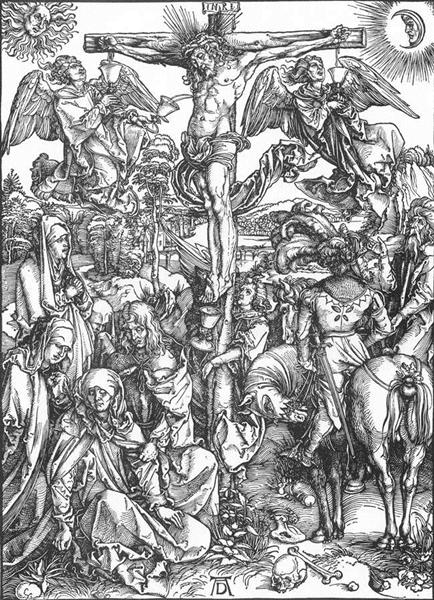
“Crucifixion,” Albrecht Durer (Wikimedia)
Anger against another person, Jesus says, is liable to judgment (Mt 5:22). What happens in the heart already participates in the future that does not yet exist. In the Synoptics especially, the heart is this vast landscape where shadows rise up into possibility, for good and for ill. These shadows then shape the movement of what is to come. For Maurice Blondel, these prefigurements are themselves part of the complex totality we call “action.” He says that the “science of action” includes its preconditions, ranging from the fact of existence, to the body that is, to the mind that considers, to the action itself – and well past it. Action is movement in a river, a gesture in the midst of a world already in motion, of a life already being lived. Each action flows one into another, and the whole of it, the entire inescapable current pulling between one decision and another, is itself “action.”
I still keep trying to pull at the threads of my life, hoping to discover the first key moment that led to the discord between my sister and me. I keep thinking I started it – I must have, I was the one who was more explicitly angry – but then we were already sisters to one another in a way that would allow, that could allow, the gnarled tree to grow between us. Does it even matter? What do I think understanding it would do? I almost wish that each question I ask myself could somehow unbind the mesh of history. Freeing us from the tangle. But the horror of the past is that it is dead. There is no undoing it. She is the one who said this, I was the one who did that, etc., etc. We are together the tangled chord.
I wonder if I’d have done anything different, if the self that I was could have done anything different. I wonder if she as she was could have. In truth, I will never know.
What emerges from a person, says Christ, is what defiles them. Not the external things. We seem to carry the knots of our lives with us, never quite put them down. So when we face God, we face him with each ragged relation of our lives. These broken and frayed things are more definitive than what we bring to the altar. “If you bring your gift to the altar, and there recall that your brother has anything against you, leave your gift there at the altar, go first and be reconciled with your brother, and then come and offer your gift” (Mt 5:23-24).
When I was a kid, I used to think forgiveness takes an instant. But the truth is that forgiveness is something like instant for God – transcending all time means all mercy is already given – and something like every instant for me. We offer mercy imperfectly and repeatedly, a new mercy in each new moment. Peter has to repeat his love for Christ all over again even though he’s already answered the question, “Simon, son of Jonah, do you love me?” (Jn 21:15-19). As mercy is available to receive in every moment, so also we offer it. We must forgive not seven, but seventy-seven times (Mt 18:21). I’m assuming that number is Bible for “forgive as often as God, which means always.”
I wonder what it will be like at the end of all things, when we face the altar of God with the ruptures we could not overcome. Ruptures beyond our power, or beyond our narrowness, or beyond the tiny cosmos of an individual life. I am sure that Christ, the great reconciler, will gather each broken thread together. I am not so sure what that will look like for me. Will we look at it together? Will he judge me then? “Nor does the Father judge, but he has given all judgment to his Son” (Jn 5:22), who only judges according to the will of the the one who sent him (Jn 5:30). And yet, “I do not judge anyone” (Jn 8:15). Is the judgment left to me? Will the scales drop from my eyes, and will I be the judge of the real self that I finally see?
I do not imagine that good deeds make up for bad ones. They repair the echo of the deed, the reverberation that continues into the present, in a way, but the deed is still done in the dead past. (Yes, there is memory, I know, but even that is the life of a ghost.) There is only one for whom that past is alive, and that one is the God who sees all time from beginning to end, the the Trinity for whom every moment in time is always also now. All of me, every action of mine, already stands before the Trinity’s eternal present. And there is nothing that the Triune God will not forgive (except the sin against the Spirit, whatever that is).
The Council of Trent (session VI) says that grace already leads me to the grace of the future, preparing me for what will be. Building in me the “second” grace that is my acceptance of grace – which is also a grace. Mercy makes himself known by making the making of our knowing. It’s…confusing. Point is the whole thing happens without my merit. But I am comforted at the knowledge that God already prepares in me the healing of relationships that he will demand of me, and he will make his own demand to be.
The Council also says that the formal cause (Aristotle: “the form, the acount of what-is-to-be”) of justification is the justice of God. This grace is given not due to God’s justice in se, “not that thereby He Himself is just,” but rather by the justice of God that makes us just. Whatever that means. Perhaps something like the knowledge that God has of me as one who is reconciled, that “now” of me that already is – to God, anyway – that God knows and, since knowledge and action are not separate in God, that God makes to be. That self is already made-to-be, and even now God’s making-to-be works to make me so.
That self will be, by the very nature of redemption, reconciled to my sister. And she to me. Whatever we do or fail to do, whether we go on to the end in rupture and ruin, God will reconcile (has reconciled, is reconciling) all things to himself. It, the reconciliation itself, will be our judgment. That could be double-sided: if I defy the reconciliation that God wills, or if I allow myself to be led into it. God’s will is the same regardless.
It comforts me, as action continues its web with me and without me, to know that God remembers, two who are sisters to each other. Whatever else will be, whether tragedy or comedy, those two will always be what God wills-to-be.
Previous Post
August 15, 2017
A Meditation on Prayer. Plus the Virgin Mary Appears at Some Point.
Next Post

May 5, 2018 Chapter 1: How he made a broken sieve whole and sound.
Browse Our Archives
Select a Category Uncategorized
Select a Month June 2018 May 2018 March 2018 August 2017 May 2017 April 2017 March 2017 February 2017 January 2017 December 2016 November 2016 October 2016 September 2016 August 2016 July 2016 June 2016 May 2016 April 2016 March 2016 February 2016
Follow Us!
TAKE THE
Religious Wisdom Quiz
In 1 Peter, what does Peter say Sarah called Abraham?
Select your answer to see how you score.
Master Father My beloved Lord
Related posts from The Rule and the Raven
Chapter 1: How he made a broken sieve...
A Meditation on Prayer. Plus the Virgin Mary...
TRENDING AT PATHEOS Catholic

Rejecting Doom: Christian Hope And Human Action
Christianity is a religion of hope. We are to have hope and...

It’s What Comes From Within Which Matters
One of the most difficult things for us to understand is why...

Why I Choose the Eucharist Over the Sermon
Choose the Eucharist, Not the Sermon What are we supposed to get...

5 Design Elements Found in Spiritually Rooted Homes
Putting Spirituality Into Home Decor Our homes are more than our living...

Credo: A Story of God Told with the...
About 10 years ago, I began to imagine a personal "Credo" that...

The Anatomy of Divine Revelation in Catholic Thought
The claim that God has made Himself known to human beings is...
view all Catholic blogs
Ad-Free & Subscriber Log-In Subscription Support
- About Us
- 2026 Calendar
- Videos
- Podcasts
- Library of World Religions
- Faith In Media Tracker
- Advertise With Us
- Write for Us
- Privacy Policy
- Terms of Service
- Do Not Sell My Data
- Contact Us
- Radiant Digital
- Manage Newsletter Subscriptions
- Unsubscribe From Notifications
- Sitemap
Copyright 2008-2026, Patheos. All rights reserved.
Subscription Support Ad-Free & Subscriber Log-In
Follow Patheos