
BuddhistCatholicContemplativeEvangelicalGeneral ChristianHinduJewishLatter-day SaintMuslimNew VisionsProgressive Christian
Beliefs
- Buddhist
- Catholic
- Contemplative
- Evangelical
- General Christian
- Hindu
- Jewish
- Latter-day Saint
- More Voices
- Muslim
- New Visions
- Pagan
- Progressive Christian
Topics
- Religion News
- Food and Religion
- Sports and Religion
- Religious Art
- Religious Music and Entertainment
- Religious Events
- History and Religion
- Style and Religion
- Politics and Religion
- Women in Religion
- Recreation Outdoors and Religion
- Business Finance and Religion
- Careers Workplace and Religion
- Education and Religion
- Family Parenting and Religion
- Health Fitness and Religion
- Home and Religion
- Relationships and Religion
- Technology and Religion
- Travel and Religion
Columnists
- Buddhist Columnists
- Business Finance and Religion Columnists
- Careers Workplace and Religion Columnists
- Catholic Columnists
- Contemplative Columnists
- Education and Religion Columnists
- Evangelists Columnists
- Family Parenting and Religion Columnists
- General Christian Columnists
- Health Fitness and Religion Columnists
- Hindu Columnists
- History and Religion Columnists
- Home and Religion Columnists
- Jewish Columnists
- More Voices Columnists
- Latter Day Columnists
- Muslim Columnists
- New Visions Columnists
- Nonreligious Columnists
- Pagan Columnists
- Politics and Religion Columnists
- Progressive Columnists
- Recreation Outdoors and Religion Columnists
- Relationships and Religion Columnists
- Religion News Columnists
- Religious Art Columnists
- Religious Events Columnists
- Religious Music and Entertainment Columnists
- Sports and Religion Columnists
- Style and Religion Columnists
- Technology and Religion Columnists
- Travel and Religion Columnists
- Women in Religion Columnists
Resource Library
- 2026 Calendar
- Library of World Religions
- The 100 Most Holy Places on Earth
- Patheos Answers
- Podcasts
- Videos
- Faith Leaders Database
- Anglican Episcopalian
- Bahai
- Baptist
- Buddhism
- Christianity
- Confucianism
- Eastern Orthodoxy
- Hinduism
- Holiness and Pentecostal
- ISKCON
- Islam
- Judaism
- Lutheran
- Methodist
- The Church of Jesus Christ of Latter-day Saints
- New Age
- Paganism
- Presbytarian and Reformed
- Protestantism
- Religion Behind the Scenes
- Roman Catholic
- Scientology
- Shia Islam
- Sikhism
- Sufism
- Sunni Islam
- Taoism
- Zen
- See all religions
Research Tools
 Ad-Free & Subscriber Log-In Subscription Support
Ad-Free & Subscriber Log-In Subscription Support
Follow Patheos 

- Trending:
- Forgiveness
- |
- Marriage
- |
- Consciousness
- |
- Death Penalty
- |
- Election
- |
- Halloween
 The Rule and the Raven
- Home
- Catholic
- A Meditation on Prayer. Plus the Virgin Mary Appears at Some Point.
A Meditation on Prayer. Plus the Virgin Mary Appears at Some Point.
Last updated on: August 16, 2017 at 8:31 am by Anne Carpenter
A Meditation on Prayer. Plus the Virgin Mary Appears at Some Point. 2017-08-16T08:31:06-08:00 Anne Carpenter
Patheos Explore the world's faith through different perspectives on religion and spirituality! Patheos has the views of the prevalent religions and spiritualities of the world.
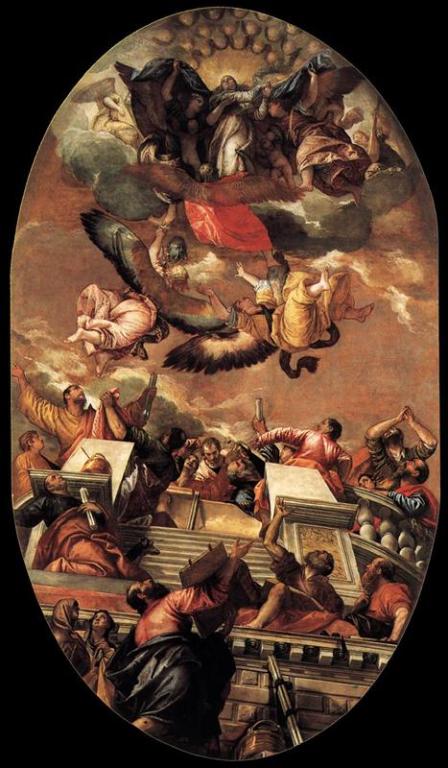
Paolo Veronese, “Assumption”
I have a ridiculously hard time praying. I probably feel like most people, who, “Instead of fluent conversation…can only manage a few, halting, scraps of the heavenly idiom” (Hans Urs’ von Balthasar, Prayer). The broken phrases are probably a little bit different and a little bit the same for everyone: snatches of the liturgy, mangled Scripture passages, and plenty of incoherent mumbling. Throw in some saint references and you have a Catholic.
Sometimes it’s just, “Please help,” and I don’t even know what I’m asking for help with; other times it’s, “Thank you”; still other times it’s, “Fuck you anyway.” My struggle to pray is bound up in more rage and shame than other folks, maybe. (I don’t really know about others. Jesus can see into our hearts; I cannot.) Either way, for me, even showing up to Mass is a huge deal. Darkening the doorway of a church is an immensity to me, and not only out of a sense of God’s sacred inscrutability, but rather moreso because I am afraid of enduring God’s disapproval.
At the same time, I love church stuff. I love liturgies and things. Ritual is awesome, particularly because I’m crap at prayer-words anyway. The rhythms of the hour, of the seasons, are deeply comforting to me. They ground me and console me, make me feel more myself. I love church things, and so I fight with myself. (We are such messes, humans.)
It is my general habit to assume that everything is my fault. I’d make a good case study for scrupulosity, but I’m not actually all that scrupulous. My feelings are much too generalized for that. I don’t agonize over specific actions of mine so much as I agonize over existing. It’s not Hamlet, “To be or not to be?”, and it’s not Heidegger, “Why is there something rather than nothing?”, but Heidegger is closer. It’s something like, “Why do I exist and is that good?”
My faith tells me that all that exists was made by God, and that it is good. Hellenistic philosophy tells me that all that “is” is in some way good, or rather, participates in the Good. So, I exist basically because God decided that I would, and it is good that I exist. That’s not really where my prayers and questions rest, though: in the assent of faith and in the operation of reason. Those are fine. At the general level, anyway. Faith and reason indicate to me that my worries are in some manner misplaced or mishappen, but they don’t automatically straighten me out or soothe me into a place where prayer is easier. Where I can face God without trembling.
It is perhaps a lack of self-knowledge (the saints usually begin with that). I do not know myself as I really am, and so I do not have much of a sense of what I should actually tremble over – let alone knowing myself and the world through God’s eyes, which is the height of prayer.
Teresa of Avila says in her Interior Castle, “through our own fault, we do not understand ourselves, or know who we are. … [Y]ou must understand that there are many ways of ‘being’ in a place. Many souls remain in the outer court of the castle [of their own soul], which is the place occupied by the guards; they are not interested in entering it, and have no idea what there is in that wonderful place, or who dwells in it, or even how many rooms it has.” Teresa gives us an image of a person who doesn’t really know how to dwell within themselves, or how to search themselves. They’re sitting there like normal, having lunch or something, but they’re also stuck “outside” of themselves.
That could be me. I remember first reading Interior Castle, reading that first chapter on being outside of your own soul – out there with the guards and the lizards – and I shut the book in despair for about a week before being able to continue. She calls the castle “delightful” and “beautiful,” and I was all scowly about it because no I’m not beautiful. I’d kind of make an awesome Lutheran (because of total depravity, which I don’t believe in, but I act like it’s true sometimes).
It is perhaps that I do not quite know how to desire God. I do desire God, and we all do rather helplessly. (For Bernard Lonergan, the desire to know and the desire for God are the same. So, good luck not desiring God somehow or other.) I’m also pretty confused most of the time, which is putting it lightly. I don’t even really know how to want things. I worry more that they’ll be taken away, and so I try not to want them at all.
Sometimes we – or I – see the will as this thing that we need to kick into place. Yell at it until it works right. “No, stop wanting ice cream! Want some broccoli, dammit!” Penance or corrections (or yelling) become the way we try to make our little paths straight. But, Catherine of Siena says, our emphasis should be on virtue, and on penance only with attention to virtue. In her Dialogue, God the Father puts it like this: “Penance should be but the means to increase virtue according to the needs of the individual, and according to what the soul sees she can do in the measure of her own possibility. Otherwise, if the soul place her foundation on penance she will contaminate her own perfection, because her penance will not be done in the light of knowledge of herself and of My goodness, with discretion, and she will not seize hold of My truth; neither loving that which I love, nor hating that which I hate.”
There we go with self-knowledge again. These people with their interior castles and inner mirrors and whatever. So annoyingly, wonderfully consistent. (And inconsistent, but I don’t really want to talk about the different conceptions of the self over the centuries.) The point is that wanting is hard for us, but we can’t beat ourselves into submission. We have to know who we are to better learn what we want, and we have to draw nearer to God to learn even better what He wants. The whole dynamic assumes that God is there to help, since we’re devastatingly mediocre at this.
All of that reminds me of something that I ask sometimes in prayer, when I’m being honest: “Do you want to help me, Lord?” I believe this and I know this at some level, and I also do not. This is partly because I can never, ever understand God. It is also because I am very small and narrow, and I have been hurt very much, and it is hard for me to imagine being helped by anyone. It is hard to trust what we cannot imagine. Of course, I cannot imagine God. All the same, I must in some way learn how to lift my heart in such a way that allows me trust.
This brings us to today, as I sat before Mass for the Solemnity of the Assumption – one of my favorite days – texting a friend of mine whom I love and trust very much. I suppose I should’ve been praying, but I had a question I couldn’t answer myself. I tried to put it as a child would, since that is the only way I know how to short-circuit my theological training so I don’t start theorizing everything to death. So I said, “What do you think about receiving Eucharist? I want to be close to Jesus, but I don’t know.” (I never know. It’s a whole thing.) We traded little notes back and forth, my friend and I, and I sat in that pew in the back of the church, holding onto the fragile, shaky little whisper that I just wanted to see Jesus. Ultimately, my friend said, “The Eucharist is a gift Jesus wants to give you, you know. He wants to give himself to you, whether or not you’re worthy.”
Which might be the thing that I forget most often, that I find the hardest to comprehend, that makes prayer so frustrating and difficult: that God wants to give us things, and that it is good to receive them. Maybe Mary knew that best. Look at how she makes a long list of God’s gifts:
The Mighty One has done great things for me,
and holy is his name.
His mercy is from age to age
to those who fear him.
He has shown might with his arm,
dispersed the arrogant of mind and heart.
He has thrown down the rulers from their thrones
but lifted up the lowly.
The hungry he has filled with good things;
the rich he has sent away empty.
He has helped Israel his servant,
remembering his mercy,
according to his promise to our fathers,
to Abraham and to his descendants forever. (Luke 1:49-55)
So, I might be an idiot at prayer and locked outside my own castle (tapping on the window, wondering if anyone is home), but I can at least be there. I can exist and be an idiot creature that receives things from God. I am already there anyway. I’m often receiving gifts quite badly, dropping stuff all over, but it’s something. And maybe it’s a way of starting to really pray.
Previous Post
August 1, 2017
You have a free will, but are you free?
Next Post

March 12, 2018 And I, when I am lifted up, will draw all things to myself
Browse Our Archives
Select a Category Uncategorized
Select a Month June 2018 May 2018 March 2018 August 2017 May 2017 April 2017 March 2017 February 2017 January 2017 December 2016 November 2016 October 2016 September 2016 August 2016 July 2016 June 2016 May 2016 April 2016 March 2016 February 2016
Follow Us!
TAKE THE
Religious Wisdom Quiz
Who refused to defile himself with the king's food and wine?
Select your answer to see how you score.
Obadiah Joel Ezekiel Daniel
Related posts from The Rule and the Raven
Chapter 1: How he made a broken sieve...
And I, when I am lifted up, will...
TRENDING AT PATHEOS Catholic

Creation, Preservation, and Teleology in Catholic Theology
As I write this, it is very early Monday morning. Like millions...

The Parable Of The Sower And The Word...
One of Christ’s most famous parables is that of the sower who...

Rejecting Doom: Christian Hope And Human Action
Christianity is a religion of hope. We are to have hope and...

Why I Choose the Eucharist Over the Sermon
Choose the Eucharist, Not the Sermon What are we supposed to get...

5 Design Elements Found in Spiritually Rooted Homes
Putting Spirituality Into Home Decor Our homes are more than our living...

Credo: A Story of God Told with the...
About 10 years ago, I began to imagine a personal "Credo" that...
view all Catholic blogs
Ad-Free & Subscriber Log-In Subscription Support
- About Us
- 2026 Calendar
- Videos
- Podcasts
- Library of World Religions
- Faith In Media Tracker
- Advertise With Us
- Write for Us
- Privacy Policy
- Terms of Service
- Do Not Sell My Data
- Contact Us
- Radiant Digital
- Manage Newsletter Subscriptions
- Unsubscribe From Notifications
- Sitemap
Copyright 2008-2026, Patheos. All rights reserved.
Subscription Support Ad-Free & Subscriber Log-In
Follow Patheos