
BuddhistCatholicContemplativeEvangelicalGeneral ChristianHinduJewishLatter-day SaintMuslimNew VisionsProgressive Christian
Beliefs
- Buddhist
- Catholic
- Contemplative
- Evangelical
- General Christian
- Hindu
- Jewish
- Latter-day Saint
- More Voices
- Muslim
- New Visions
- Pagan
- Progressive Christian
Topics
- Religion News
- Food and Religion
- Sports and Religion
- Religious Art
- Religious Music and Entertainment
- Religious Events
- History and Religion
- Style and Religion
- Politics and Religion
- Women in Religion
- Recreation Outdoors and Religion
- Business Finance and Religion
- Careers Workplace and Religion
- Education and Religion
- Family Parenting and Religion
- Health Fitness and Religion
- Home and Religion
- Relationships and Religion
- Technology and Religion
- Travel and Religion
Columnists
- Buddhist Columnists
- Business Finance and Religion Columnists
- Careers Workplace and Religion Columnists
- Catholic Columnists
- Contemplative Columnists
- Education and Religion Columnists
- Evangelists Columnists
- Family Parenting and Religion Columnists
- General Christian Columnists
- Health Fitness and Religion Columnists
- Hindu Columnists
- History and Religion Columnists
- Home and Religion Columnists
- Jewish Columnists
- More Voices Columnists
- Latter Day Columnists
- Muslim Columnists
- New Visions Columnists
- Nonreligious Columnists
- Pagan Columnists
- Politics and Religion Columnists
- Progressive Columnists
- Recreation Outdoors and Religion Columnists
- Relationships and Religion Columnists
- Religion News Columnists
- Religious Art Columnists
- Religious Events Columnists
- Religious Music and Entertainment Columnists
- Sports and Religion Columnists
- Style and Religion Columnists
- Technology and Religion Columnists
- Travel and Religion Columnists
- Women in Religion Columnists
Resource Library
- 2026 Calendar
- Library of World Religions
- The 100 Most Holy Places on Earth
- Patheos Answers
- Podcasts
- Videos
- Faith Leaders Database
- Anglican Episcopalian
- Bahai
- Baptist
- Buddhism
- Christianity
- Confucianism
- Eastern Orthodoxy
- Hinduism
- Holiness and Pentecostal
- ISKCON
- Islam
- Judaism
- Lutheran
- Methodist
- The Church of Jesus Christ of Latter-day Saints
- New Age
- Paganism
- Presbytarian and Reformed
- Protestantism
- Religion Behind the Scenes
- Roman Catholic
- Scientology
- Shia Islam
- Sikhism
- Sufism
- Sunni Islam
- Taoism
- Zen
- See all religions
Research Tools
 Ad-Free & Subscriber Log-In Subscription Support
Ad-Free & Subscriber Log-In Subscription Support
Follow Patheos 

- Trending:
- Forgiveness
- |
- Marriage
- |
- Consciousness
- |
- Death Penalty
- |
- Election
- |
- Halloween
 The Rule and the Raven
- Home
- Catholic
- You have a free will, but are you free?
You have a free will, but are you free?
Last updated on: January 16, 2018 at 10:38 am by Anne Carpenter
You have a free will, but are you free? 2018-01-16T10:38:29-08:00 Anne Carpenter
Patheos Explore the world's faith through different perspectives on religion and spirituality! Patheos has the views of the prevalent religions and spiritualities of the world.
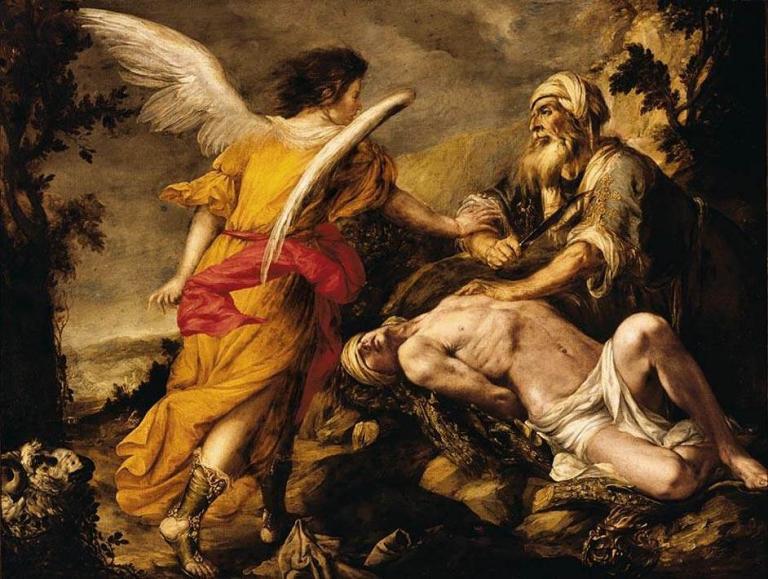
“The Sacrifice of Isaac,”
Juan de Valdes Leal (Wikimedia)
There is a difference between having a will and the ability to use it. Mostly we collapse this distinction and assume that having freedom means we can use it. To put it more colloquially: all I need to do is decide to do something, and then I can do it. But Christianity has never understood freedom this way, and there are all kinds of ordinary experiences that affirm the Christian view rather than this other one.
Freedom is a tricky thing to figure out. One of my favorite philosophers, Maurice Blondel, wrote hundreds of pages on what he called “the science of action.” He insists that he needs to talk about action rather than just freedom because, for one thing, being serious philosophers means we’re not sure that freedom exists until we’re done thinking it through; second, action definitely happens, even if we’re not free at all. To make everything even more complicated, Blondel points out that we can’t even know where an action begins or ends. You think your action started when you decided to do something? Well, what produced that decision? Was it instead when you started to do the actual thing? But what led to that, and while we’re at it, where did your thought stop and your doing begin? Did they? So human action, you see, is a tricky thing. Let alone freedom. (There are two versions of his original book, no less, since he spent decades reworking the first one.)
Blondel takes pains to show how free actions emerge from “determined” (or non-free) systems. There all kinds of dynamic but rigid systems operating, say, within my body. My heart pumps blood, and I don’t really control that at all except in some kind of secondary way; I certainly don’t control the duplication of cells in my skin. These are determined systems. They’re not free, have no founding “decision” and no decision internal to their operations. I don’t even get much a say in those things – often I get no say at all. And yet I rely on them fundamentally before I take any action, and I continue to rely on them as I act.
For Blondel, all these non-free systems do not imply that freedom is impossible. For many people of his time and today, it does. Determinism is that pernicious idea that every dynamic that we see at any time is already determined by some law or another. It was already determined. Because one thing is set in stone and cannot be changed, all things are that way. Blondel points out that this is an assumption. There is nothing within the law of photosynthesis, say, that tells us that everything has to follow rules just like photosynthesis does. So for Blondel human action, particularly free action, is this remarkable phenomenon that emerges from what is determined, and yet that is not (entirely) determined by what it emerges from.
We can see already how any action that we take is bound up in a dynamic mesh of freedom and non-freedom. People point this out in very simple ways when they say something like, “I don’t know how to do that.” It’s not that I don’t have the freedom to assemble a car engine; it’s that I have no idea how, and so I can’t. Or the toddler who doesn’t have a word for how they feel: the emotion is real, very real, but they are not free to say what it is. In more complicated ways, conversations about privilege and discrimination are built on the idea that not everyone has the same set of opportunities, which means they don’t get the decisions other people do.
Phenomena like addiction and mental illness push us even harder on these ideas. Here, things like want to and can’t get tragically ripped apart, and it is frequently quite difficult to understand. The addict might want to stop using; the addict is also really terrible at stopping, and just can’t seem to. We like to blame the addict, but we also need to ask: how free is this person right now? Or the person suffering from severe anxiety who can’t walk into a room: they probably want to go into that room, but they are also probably so afraid that going into that room seems like facing death. Sure, it doesn’t look like death to you, which makes it easy to hop in and out of the room. But if did look like death, your freedom would tremble before it. You wouldn’t be so free anymore. Your options have changed, because now you’ve got to deal with all this fear.
Catholic moral tradition has for centuries distinguished between someone’s freedom and their responsibility. It recognizes, in various ways, that someone who does something might be under duress, or might be ignorant, or might be any number of things that affects the kinds of options they’re able to take. This doesn’t mean everything we do gets an excuse or wiped away like nothing, but it does mean that we’re not these invincible little islands of freedom that remain unaffected by the world around us.
It is something argued that Mary, because she was perfect and full of grace – at least according to Catholics – was less free than the rest of us, because there was so little chance she’d sin. She wasn’t going to say No to God. Come on! So she wasn’t really free. Thinking like this sees freedom as a set of options, and my freedom is determined by whether I feel like I can equally choose between these options. That is, it is true, one kind of freedom. (Sometimes called “negative freedom”: freedom means not being forced.) Another kind is the quickness and immediacy with which I make a decision: if I see someone hurt, how long does it take me to stop and ask if they’re okay? How closely do I pay attention when I ask? The more I practice doing this, the better I will get at it, and – on this account of freedom – the more free I will be to make that decision. It comes more naturally to me, and its ease is a sign of my freedom. (This is called “positive freedom”: freedom to do something.) Mary was free in this way.
I think we dislike things like addiction, mental illness, and sin because they challenge the basic idea that I can just go and decide to do something, and that doing it is just as simple as deciding, when really neither deciding nor doing are simple at all. It’s terrifying to see the truth in others, but perhaps even more so to see it in ourselves: to understand the ways that we are not free, even while we still have freedom. But if this is what it means to be human, does it always have to be bad that we are not-free as well as free? Does it always have to come down to blame or to weakness, as if it’s my freedom’s fault that I’m also not free?
To open my eyes at all brings it to dramatic light. When I wake up in the morning, what options lie before me, and how many pass me by because I don’t see them in the first place? How many things will never be placed into my hands because they can’t be, because they won’t be, because I was someplace else? Is that my fault, or is it some impossible blend of decision, limitation, and guilt?
And yet I have freedom that is not entirely determined by the things that determine it.
Previous Post

May 27, 2017
And so you leave.
Next Post
August 15, 2017 A Meditation on Prayer. Plus the Virgin Mary Appears at Some Point.
Browse Our Archives
Select a Category Uncategorized
Select a Month June 2018 May 2018 March 2018 August 2017 May 2017 April 2017 March 2017 February 2017 January 2017 December 2016 November 2016 October 2016 September 2016 August 2016 July 2016 June 2016 May 2016 April 2016 March 2016 February 2016
Follow Us!
TAKE THE
Religious Wisdom Quiz
Who spoke to the burning bush?
Select your answer to see how you score.
Joseph Miriam Aaron Moses
Related posts from The Rule and the Raven
Chapter 1: How he made a broken sieve...
And I, when I am lifted up, will...
TRENDING AT PATHEOS Catholic

The Parable Of The Sower And The Word...
One of Christ’s most famous parables is that of the sower who...

Rejecting Doom: Christian Hope And Human Action
Christianity is a religion of hope. We are to have hope and...

Why I Choose the Eucharist Over the Sermon
Choose the Eucharist, Not the Sermon What are we supposed to get...

5 Design Elements Found in Spiritually Rooted Homes
Putting Spirituality Into Home Decor Our homes are more than our living...

Credo: A Story of God Told with the...
About 10 years ago, I began to imagine a personal "Credo" that...

The Anatomy of Divine Revelation in Catholic Thought
The claim that God has made Himself known to human beings is...
view all Catholic blogs
Ad-Free & Subscriber Log-In Subscription Support
- About Us
- 2026 Calendar
- Videos
- Podcasts
- Library of World Religions
- Faith In Media Tracker
- Advertise With Us
- Write for Us
- Privacy Policy
- Terms of Service
- Do Not Sell My Data
- Contact Us
- Radiant Digital
- Manage Newsletter Subscriptions
- Unsubscribe From Notifications
- Sitemap
Copyright 2008-2026, Patheos. All rights reserved.
Subscription Support Ad-Free & Subscriber Log-In
Follow Patheos