
BuddhistCatholicContemplativeEvangelicalGeneral ChristianHinduJewishLatter-day SaintMuslimNew VisionsProgressive Christian
Beliefs
- Buddhist
- Catholic
- Contemplative
- Evangelical
- General Christian
- Hindu
- Jewish
- Latter-day Saint
- More Voices
- Muslim
- New Visions
- Pagan
- Progressive Christian
Topics
- Religion News
- Food and Religion
- Sports and Religion
- Religious Art
- Religious Music and Entertainment
- Religious Events
- History and Religion
- Style and Religion
- Politics and Religion
- Women in Religion
- Recreation Outdoors and Religion
- Business Finance and Religion
- Careers Workplace and Religion
- Education and Religion
- Family Parenting and Religion
- Health Fitness and Religion
- Home and Religion
- Relationships and Religion
- Technology and Religion
- Travel and Religion
Columnists
- Buddhist Columnists
- Business Finance and Religion Columnists
- Careers Workplace and Religion Columnists
- Catholic Columnists
- Contemplative Columnists
- Education and Religion Columnists
- Evangelists Columnists
- Family Parenting and Religion Columnists
- General Christian Columnists
- Health Fitness and Religion Columnists
- Hindu Columnists
- History and Religion Columnists
- Home and Religion Columnists
- Jewish Columnists
- More Voices Columnists
- Latter Day Columnists
- Muslim Columnists
- New Visions Columnists
- Nonreligious Columnists
- Pagan Columnists
- Politics and Religion Columnists
- Progressive Columnists
- Recreation Outdoors and Religion Columnists
- Relationships and Religion Columnists
- Religion News Columnists
- Religious Art Columnists
- Religious Events Columnists
- Religious Music and Entertainment Columnists
- Sports and Religion Columnists
- Style and Religion Columnists
- Technology and Religion Columnists
- Travel and Religion Columnists
- Women in Religion Columnists
Resource Library
- 2026 Calendar
- Library of World Religions
- The 100 Most Holy Places on Earth
- Patheos Answers
- Podcasts
- Videos
- Faith Leaders Database
- Anglican Episcopalian
- Bahai
- Baptist
- Buddhism
- Christianity
- Confucianism
- Eastern Orthodoxy
- Hinduism
- Holiness and Pentecostal
- ISKCON
- Islam
- Judaism
- Lutheran
- Methodist
- The Church of Jesus Christ of Latter-day Saints
- New Age
- Paganism
- Presbytarian and Reformed
- Protestantism
- Religion Behind the Scenes
- Roman Catholic
- Scientology
- Shia Islam
- Sikhism
- Sufism
- Sunni Islam
- Taoism
- Zen
- See all religions
Research Tools
 Ad-Free & Subscriber Log-In Subscription Support
Ad-Free & Subscriber Log-In Subscription Support
Follow Patheos 

- Trending:
- Forgiveness
- |
- Marriage
- |
- Consciousness
- |
- Death Penalty
- |
- Election
- |
- Halloween
 The Rule and the Raven
- Home
- Catholic
- Glory of the Lord, vol. I: “Introduction” (An Existential Introduction)
Glory of the Lord, vol. I: “Introduction” (An Existential Introduction)
Last updated on: September 30, 2016 at 10:16 am by Anne Carpenter
Glory of the Lord, vol. I: “Introduction” (An Existential Introduction) 2016-09-30T10:16:59-08:00 Anne Carpenter
Patheos Explore the world's faith through different perspectives on religion and spirituality! Patheos has the views of the prevalent religions and spiritualities of the world.
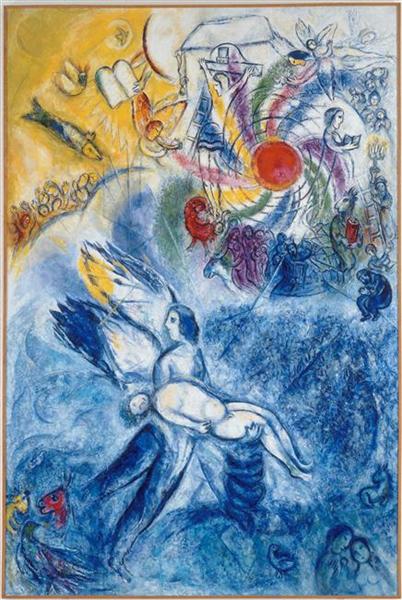
Marc Chagall, “The Creation of Man” (WikiArt)
I am writing this to help my students, and I thought I’d share:
The Mass of the Holy Spirit begins the academic year at nearly every Catholic college. It is fitting, after all: the Spirit is the one who gives wisdom and zeal, the one whose gifts animate the life of the Church. The Spirit is the breath (ruach, pneuma) of God, filling Adam’s lungs (Gen 2:7) and raising Christ from the dead (Rm 8:11). And we of the universities, though we use many of our natural powers as we ask our thousands of questions, we need the Spirit because we cannot break open the seals of creation (cf. Rev 6).
My specific task during Mass was to read the second reading, from Saint Paul, which began, “The Spirit scrutinizes everything, even the depths of God. Among human beings, who knows what pertains to a person except the spirit of the person that is within? Similarly, no one knows what pertains to God except the Spirit of God.” (1 Cor 2:10-1).
I thought immediately of theology, of the scarlet on the academic hood around my neck. I felt a kind of vertigo, as if the earth had dropped away for a moment, and I stood at the precipice of understanding just how profoundly theology relies on the Spirit. How desperately unwitting, how much nonsense theology is, without the Spirit of the Father to give it words.
But this is very hard for us to see, hard to remember, and Balthasar argues that this is in part because we have lost beauty. Without beauty, he says, religion becomes horrific (18), and creation is rendered “an indigestible symbol of fear and anguish” (19). Beauty has this way of holding together the wholeness of things (17), and its absence leaves us in the hollows of “expressionlessness,” like “dry wood” (24). I can see how this is so when we treat religion like it is a stranglehold we desperately need to escape, like some kind of clawing ancient power – and how could religion not be this to us if all religion can do is tell us truths and prod us to act good? The chapel on campus becomes the foothold of an invasion instead of the entryway to eternal mystery.
Beauty, Balthasar says, is both form and splendor (19-20). In German, this is Gestalt and Glanz. The first, form, is partly drawn from Thomas Aquinas and is partly modern: form is the animating principle of a thing, what gives it life and a direction (a telos); form is also what we recognize when we perceive a thing, what makes that thing that thing and not another. Splendor is the mystery of the depths of being (Sein), of existence, which “shines forth” from what we perceive. Splendor is this “more” that we know when we know things. With beauty, “We are confronted simultaneously with both the figure and that which shines forth from the figure, making it into a worthy, a love-worthy thing” (20).
So in both religion and the world, there is a certain attractiveness (splendor) that draws us near and leads us on. There is also a specificity, a uniqueness (form), in each thing that we draw near to. In other words, we yearn to know the world, and this yearning is not only a perception of the world’s goodness, but it is also a perception of the delightfulness of truth. The joy of questions and their answers.
I think sometimes of the outrage at injustice that seethes across campus like the breath of a great, slumbering dragon that wakes then falls to sleep again. We are disgusted at the evils of the world and on campus, though we each name quite different things. But it is hard to sustain this fierce gaze into the darkness without an accompanying sense of the whole that lies broken before us. So it is that determination and despair seize us in equal measures. I imagine it as if we flinch away: we do not want to see beauty broken, to really feel that loss, so we decide ahead of time that the world is not beautiful in any case. Or, if it is, that is merely your opinion.
Because it is much harder to see the world as a place of both joy and suffering, to know that these often exist side-by-side in a single person.
Balthasar is perhaps too dramatic or extreme when he says that we have lost beauty, or when I repeat him. I grant that this may be so. But I do not think he is wrong, and I think there is something of a biblical sense of loss in his words. I mean that there is something rather tattered and lost about the world and about us, right there alongside our happiness. For Balthasar, we do not want to perceive this. I think that is also true.
The deepest beauty – which we also struggle to see – is the glory of God. God’s glory is entirely different than the beauty of the world, and they are linked only by the tenuous thread of analogy. What is most remarkable, for Balthasar, is that God enters the world and, using the form of the world, shows us his glory (30-32). And this is the beginning of theology, and theological aesthetics.
Previous Post
September 23, 2016
Notes from a failed saint
Next Post

October 23, 2016 Out of the many things we lack.
Browse Our Archives
Select a Category Uncategorized
Select a Month June 2018 May 2018 March 2018 August 2017 May 2017 April 2017 March 2017 February 2017 January 2017 December 2016 November 2016 October 2016 September 2016 August 2016 July 2016 June 2016 May 2016 April 2016 March 2016 February 2016
Follow Us!
TAKE THE
Religious Wisdom Quiz
What was the name of Saul's son who ruled Israel except Judah after Saul died?
Select your answer to see how you score.
Jonathan Mephibosheth Abner Ish-bosheth
Related posts from The Rule and the Raven


A Galaxy Haunted (by the Jedi)

When what is holy is used for what...
The Power of Memory (In Politics)
TRENDING AT PATHEOS Catholic

Creation, Preservation, and Teleology in Catholic Theology
As I write this, it is very early Monday morning. Like millions...

The Parable Of The Sower And The Word...
One of Christ’s most famous parables is that of the sower who...

Rejecting Doom: Christian Hope And Human Action
Christianity is a religion of hope. We are to have hope and...

Why I Choose the Eucharist Over the Sermon
Choose the Eucharist, Not the Sermon What are we supposed to get...

5 Design Elements Found in Spiritually Rooted Homes
Putting Spirituality Into Home Decor Our homes are more than our living...

Credo: A Story of God Told with the...
About 10 years ago, I began to imagine a personal "Credo" that...
view all Catholic blogs
Ad-Free & Subscriber Log-In Subscription Support
- About Us
- 2026 Calendar
- Videos
- Podcasts
- Library of World Religions
- Faith In Media Tracker
- Advertise With Us
- Write for Us
- Privacy Policy
- Terms of Service
- Do Not Sell My Data
- Contact Us
- Radiant Digital
- Manage Newsletter Subscriptions
- Unsubscribe From Notifications
- Sitemap
Copyright 2008-2026, Patheos. All rights reserved.
Subscription Support Ad-Free & Subscriber Log-In
Follow Patheos