
BuddhistCatholicContemplativeEvangelicalGeneral ChristianHinduJewishLatter-day SaintMuslimNew VisionsProgressive Christian
Beliefs
- Buddhist
- Catholic
- Contemplative
- Evangelical
- General Christian
- Hindu
- Jewish
- Latter-day Saint
- More Voices
- Muslim
- New Visions
- Pagan
- Progressive Christian
Topics
- Religion News
- Food and Religion
- Sports and Religion
- Religious Art
- Religious Music and Entertainment
- Religious Events
- History and Religion
- Style and Religion
- Politics and Religion
- Women in Religion
- Recreation Outdoors and Religion
- Business Finance and Religion
- Careers Workplace and Religion
- Education and Religion
- Family Parenting and Religion
- Health Fitness and Religion
- Home and Religion
- Relationships and Religion
- Technology and Religion
- Travel and Religion
Columnists
- Buddhist Columnists
- Business Finance and Religion Columnists
- Careers Workplace and Religion Columnists
- Catholic Columnists
- Contemplative Columnists
- Education and Religion Columnists
- Evangelists Columnists
- Family Parenting and Religion Columnists
- General Christian Columnists
- Health Fitness and Religion Columnists
- Hindu Columnists
- History and Religion Columnists
- Home and Religion Columnists
- Jewish Columnists
- More Voices Columnists
- Latter Day Columnists
- Muslim Columnists
- New Visions Columnists
- Nonreligious Columnists
- Pagan Columnists
- Politics and Religion Columnists
- Progressive Columnists
- Recreation Outdoors and Religion Columnists
- Relationships and Religion Columnists
- Religion News Columnists
- Religious Art Columnists
- Religious Events Columnists
- Religious Music and Entertainment Columnists
- Sports and Religion Columnists
- Style and Religion Columnists
- Technology and Religion Columnists
- Travel and Religion Columnists
- Women in Religion Columnists
Resource Library
- 2026 Calendar
- Library of World Religions
- The 100 Most Holy Places on Earth
- Patheos Answers
- Podcasts
- Videos
- Faith Leaders Database
- Anglican Episcopalian
- Bahai
- Baptist
- Buddhism
- Christianity
- Confucianism
- Eastern Orthodoxy
- Hinduism
- Holiness and Pentecostal
- ISKCON
- Islam
- Judaism
- Lutheran
- Methodist
- The Church of Jesus Christ of Latter-day Saints
- New Age
- Paganism
- Presbytarian and Reformed
- Protestantism
- Religion Behind the Scenes
- Roman Catholic
- Scientology
- Shia Islam
- Sikhism
- Sufism
- Sunni Islam
- Taoism
- Zen
- See all religions
Research Tools
 Ad-Free & Subscriber Log-In Subscription Support
Ad-Free & Subscriber Log-In Subscription Support
Follow Patheos 

- Trending:
- Forgiveness
- |
- Marriage
- |
- Consciousness
- |
- Death Penalty
- |
- Election
- |
- Halloween
 The Rule and the Raven
- Home
- Catholic
- Notes from a failed saint
Notes from a failed saint
Last updated on: September 23, 2016 at 11:43 am by Anne Carpenter
Notes from a failed saint 2016-09-23T11:43:18-08:00 Anne Carpenter
Patheos Explore the world's faith through different perspectives on religion and spirituality! Patheos has the views of the prevalent religions and spiritualities of the world.
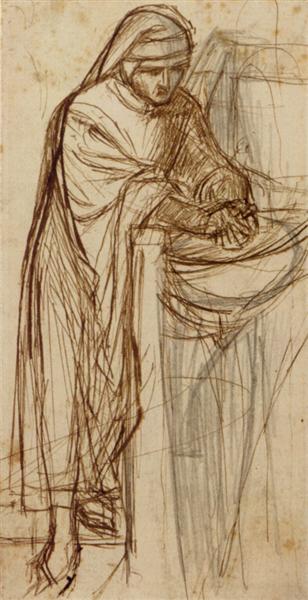
Dante Gabriel Rossetti, “Sketch for Dante at Verona”
For whatever reason, I always thought I had to live up to the extreme and miraculous circumstances of my birth. I was born twelve weeks early, weighed two pounds, almost died but didn’t. Could have been profoundly impaired (physically, mentally), but wasn’t. My mom always said that God kept me alive for a reason.
She’s right. It’s hard to question mothers about these matters. “All things are subject to divine providence, not only in general, but even in their own individual selves,” says Thomas Aquinas (Summa Theologica, Prima Pars, q. 22).
And I thought I had to become someone to fulfill God’s will for me. This immense and incomprehensible will that had kept me alive for reasons that, ultimately, I will never know. So I tried to be a saint. Tried and absolutely failed.
I was a deeply religious child. Most children are in their way. In adolescence, this became more complex and more perplexed. I suffered profoundly, which was a deep threat to my understanding of the world as essentially good and essentially loved by God. And always, I wondered what it was God wanted with me, that I suffered so much and had been chosen to live. I worried, even. Worried about what God wanted, since it wasn’t clear to me, and since so far it had seemed to mean so much pain.
The saints often suffer. Was that for me? And, God, why – when I suffer so poorly, so spitefully, so impatiently? Suffering seemed as much a path to Hell as to Heaven, and indeed I think it can be. Suffering in itself doesn’t have comprehensibility, meaning. It can soften a person or embitter them just as well. Poverty is this way, too. We need a certain wisdom about the Gospel virtues we end up living.
I read a lot of the saints. I’ve read more Christian mystical literature than I ever really admit, always preferring the words of saints over others. When Hans Urs von Balthasar surrendered theological (even philosophical!) authority to the saints, I readily followed him. I hoped that their words would help me make sense of myself.
But I was never quite like the saints. Holiness was hard for me, and its wisdom did not live in me. Much as I tried, I was – to borrow from Thérèse of Lisieux – so very, very small, and sainthood is so very big. My many sins proved my smallness to me.
I was, and I am, no great testament to my miraculous escape from death.
When my mother calls me her hero sometimes, or when my dad calls me wise, I sometimes shudder. I am not a hero and I am not wise. I’m ordinary. I’m just a normal human who has suffered a lot, and who is ordinary in even suffering. My life has twisted me as much as healed me. I’m deeply flawed, and I’m sometimes quite compassionate, insightful. I’m angry. I’m loving. Basically, I am the usual mess. I cannot be anyone’s hero. I will fail at that, and I have.
It made me miserable. Often makes me miserable even now.
But I can be ordinary. I can be small. I can be a normal bad Catholic who’s trying to be good. There is sainthood in this, too – the sainthood of quite ordinary saints, who often go nameless. They are remembered by the Church in her praise of all saints, but forgotten by history, even the forgotten by the history of the Church.
I can be that. I can be forgotten.
The greatness of Thérèse was her smallness, and her great gift to the Church is how she shines with it. She lets the small ones of the Church be smaller than her, clinging safely to her cloak. The key to spiritual life is humility, and it is arrogance to imagine being great. Greatness is a gift, always.
A friend said to me, recently, that it is perhaps much more the case that I am living up to my birth as I am now, since God knows and loves me as I am now, and works to change me as I am now. I liked this so much better than being special or chosen. I am small, and God can do good things for small people too.
Previous Post
August 30, 2016
Forgiveness takes time.
Next Post
September 30, 2016 Glory of the Lord, vol. I: "Introduction" (An Existential Introduction)
Browse Our Archives
Select a Category Uncategorized
Select a Month June 2018 May 2018 March 2018 August 2017 May 2017 April 2017 March 2017 February 2017 January 2017 December 2016 November 2016 October 2016 September 2016 August 2016 July 2016 June 2016 May 2016 April 2016 March 2016 February 2016
Follow Us!
TAKE THE
Religious Wisdom Quiz
What is the main lesson of the Parable of the Rich Fool?
Select your answer to see how you score.
Life does not consist in possessions Laziness is bad Eat, drink and be merry Money solves problems
Related posts from The Rule and the Raven

A Galaxy Haunted (by the Jedi)
When what is holy is used for what...
The Power of Memory (In Politics)
TRENDING AT PATHEOS Catholic

The Parable Of The Sower And The Word...
One of Christ’s most famous parables is that of the sower who...

Rejecting Doom: Christian Hope And Human Action
Christianity is a religion of hope. We are to have hope and...

Why I Choose the Eucharist Over the Sermon
Choose the Eucharist, Not the Sermon What are we supposed to get...

5 Design Elements Found in Spiritually Rooted Homes
Putting Spirituality Into Home Decor Our homes are more than our living...

Credo: A Story of God Told with the...
About 10 years ago, I began to imagine a personal "Credo" that...

The Anatomy of Divine Revelation in Catholic Thought
The claim that God has made Himself known to human beings is...
view all Catholic blogs
Ad-Free & Subscriber Log-In Subscription Support
- About Us
- 2026 Calendar
- Videos
- Podcasts
- Library of World Religions
- Faith In Media Tracker
- Advertise With Us
- Write for Us
- Privacy Policy
- Terms of Service
- Do Not Sell My Data
- Contact Us
- Radiant Digital
- Manage Newsletter Subscriptions
- Unsubscribe From Notifications
- Sitemap
Copyright 2008-2026, Patheos. All rights reserved.
Subscription Support Ad-Free & Subscriber Log-In
Follow Patheos