
BuddhistCatholicContemplativeEvangelicalGeneral ChristianHinduJewishLatter-day SaintMuslimNew VisionsProgressive Christian
Beliefs
- Buddhist
- Catholic
- Contemplative
- Evangelical
- General Christian
- Hindu
- Jewish
- Latter-day Saint
- More Voices
- Muslim
- New Visions
- Pagan
- Progressive Christian
Topics
- Religion News
- Food and Religion
- Sports and Religion
- Religious Art
- Religious Music and Entertainment
- Religious Events
- History and Religion
- Style and Religion
- Politics and Religion
- Women in Religion
- Recreation Outdoors and Religion
- Business Finance and Religion
- Careers Workplace and Religion
- Education and Religion
- Family Parenting and Religion
- Health Fitness and Religion
- Home and Religion
- Relationships and Religion
- Technology and Religion
- Travel and Religion
Columnists
- Buddhist Columnists
- Business Finance and Religion Columnists
- Careers Workplace and Religion Columnists
- Catholic Columnists
- Contemplative Columnists
- Education and Religion Columnists
- Evangelists Columnists
- Family Parenting and Religion Columnists
- General Christian Columnists
- Health Fitness and Religion Columnists
- Hindu Columnists
- History and Religion Columnists
- Home and Religion Columnists
- Jewish Columnists
- More Voices Columnists
- Latter Day Columnists
- Muslim Columnists
- New Visions Columnists
- Nonreligious Columnists
- Pagan Columnists
- Politics and Religion Columnists
- Progressive Columnists
- Recreation Outdoors and Religion Columnists
- Relationships and Religion Columnists
- Religion News Columnists
- Religious Art Columnists
- Religious Events Columnists
- Religious Music and Entertainment Columnists
- Sports and Religion Columnists
- Style and Religion Columnists
- Technology and Religion Columnists
- Travel and Religion Columnists
- Women in Religion Columnists
Resource Library
- 2026 Calendar
- Library of World Religions
- The 100 Most Holy Places on Earth
- Patheos Answers
- Podcasts
- Videos
- Faith Leaders Database
- Anglican Episcopalian
- Bahai
- Baptist
- Buddhism
- Christianity
- Confucianism
- Eastern Orthodoxy
- Hinduism
- Holiness and Pentecostal
- ISKCON
- Islam
- Judaism
- Lutheran
- Methodist
- The Church of Jesus Christ of Latter-day Saints
- New Age
- Paganism
- Presbytarian and Reformed
- Protestantism
- Religion Behind the Scenes
- Roman Catholic
- Scientology
- Shia Islam
- Sikhism
- Sufism
- Sunni Islam
- Taoism
- Zen
- See all religions
Research Tools
 Ad-Free & Subscriber Log-In Subscription Support
Ad-Free & Subscriber Log-In Subscription Support
Follow Patheos 

- Trending:
- Forgiveness
- |
- Marriage
- |
- Consciousness
- |
- Death Penalty
- |
- Election
- |
- Halloween
 The Rule and the Raven
- Home
- Catholic
- Theology. Poetry. Theological Poetics.
Theology. Poetry. Theological Poetics.
Last updated on: May 29, 2016 at 8:39 pm by Anne Carpenter
Theology. Poetry. Theological Poetics. 2016-05-29T20:39:59-08:00 Anne Carpenter
Patheos Explore the world's faith through different perspectives on religion and spirituality! Patheos has the views of the prevalent religions and spiritualities of the world.
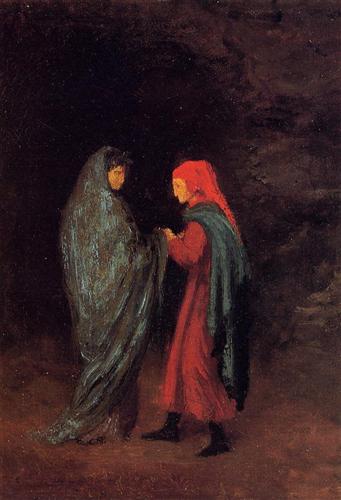
“Dante and Virgil At the Entrance to Hell,” Edgar Degas
So, I wrote this book called Theo-Poetics: Hans Urs von Balthasar and the Risk of Art and Being. It is essentially a scholarly exploration of Balthasar’s theological “style” or method, and I proceed through his oeuvre in order to indicate a relatively basic thesis, though one quite difficult to perform: Balthasar conducts theology under the strictures of philosophy and the arts. In other words, he has two modes of theology that he flickers between and often writes in simultaneously: the metaphysical and the “poetic.”
I want to review this informally since – also informally – there has been some confusion over what I am, and am not, articulating. If this isn’t your thing, forgive me my obscurity.
To be clear: this is about one aspect of the book, not all of it, though a rather key aspect.
The thesis of the book, for one thing, lays out the groundwork for appropriating and critiquing Balthasar in his own terms. It allows his readers to understand what he is saying and how, which is often a point of perplexity and controversy in scholarship and elsewhere. Conservative and liberal scholars have expressed wide-ranging and cutting criticisms of his work. I essentially turn back to Balthasar and ask how he means what he means, which would give us access to what he means in the first place, and it is exactly there that he is lost or redeemed.
“Words mean what they say,” Alyssa Lyra Pitstick writes near the end of her severe critique of Balthasar in Light in Darkness. The book is one of the more famous critiques of his theology. Words mean what they say, Pitstick argues, so if we take Balthasar at his word, he is simply heretical. My book never quite directly addresses her, but my work asks itself, Do words mean what they say?
It’s a useful question to ask. It is also just the one to ask considering critiques of Balthasar from other corners. So much so that students are frequently taught this suspicion, making such a negative interpretation of Balthasar a tradition and a legacy. But is it fair or accurate? If it isn’t, then how do people walk away from him with these wildly different reads of him?
“So be it; if I have been cast aside as a hopeless conservative by the tribe of the left, then I now know what sort of dung-heap I have been dumped upon by the right. But back to matters of substance.”
Hans Urs von Balthasar, Dare We Hope?
Well then, back to it: do words mean what they say?
For Balthasar, the answer is basically, “Yes and no.” Yes, because he does think that words have meaning – quite powerfully so – and No, because he does not think that words have only one meaning. Words are not identical with meaning. This is why we can lie with words. More importantly, this is also why our words can speak truly of the infinite God.
A human word cannot be identical with, cannot summarize, God. It would have to be infinite for that, and there is only one infinite Word who is identical with God. Human words, therefore, function via analogy. (And if that Word were to become flesh and speak with human words…oh. What a wonder that would be.)
Balthasar is interested in more than human language, however. Or rather, he “plays” with what language can do. He speculates according to the iron laws of classical metaphysics, and does so with keen logic and consistency. (I am, if anything, usually hellbent on proving that most of all.) He also speculates using images, metaphors, repetitions. This latter form of speculation is not strictly metaphysical – and not not metaphysical, since it presupposes metaphysics – but is what I call poetic. We could arguably pick another word for this second mode of theology. Perhaps “symbolic” or “sacramental” or (to push you, dear reader) aesthetic-dramatic.
In my book, I chose to highlight poetry for a number of reasons. One was because much of Balthasar’s more image-intensive theories often imitate the “laws” of poetry: ambiguous, vulnerable, precise. (Yes, I said precise.) Another is because Balthasar often uses poets and their works to reflect on theology, including writing about their poems in the middle of a book (dammit, Theo-Drama V!), or quoting poems, and even standing against poems. Words are meaningful, which means that poetry has theological implications – for good and for ill. Finally, I chose to do this because I am also good at poetry. I’m good at philosophy and I’m good at poetry, which helps me to navigate between the two in Balthasar and then explain it to others.
Hopefully more clearly than he does. Sometimes, he isn’t clear at all. Thus the world’s perpetual confusion toward him.
For Balthasar, borrowing from poetry (and the other arts) enables theology to perform speculation that it could not otherwise. At the same time, theology needs philosophy, and theology is not poetry. Balthasar’s theology uses language in ways that are analogous to poetry, but the two are not the same. Poetry is a realm with its own interior structures and gifts, with horizons that are proper to it and known intimately within it. In other words, poets have full command of their poetry as artists. At the same time, poets do not command the meaning of their poems – not entirely – which is what allows theology to ask theological questions of poetry and through poetry. In other words, poets are not theologians, and vice versa. For Balthasar – and for me – this is good: it allows poets freedom. It allows poetry to be its own “thing.” And it allows the same for theology.
So, Balthasar’s theology is often (though not always) poetic. Poetry-like. But he’s not a poet – God, no, have you read Heart of the World? I itch to hone that monstrous thing down into lean muscle, because it’s pudgy and extravagant – and at the same time poetry ought not be confused with theology. It’s theological. Theology-like.
Notice the centrality of analogy here, and how it allows for delicate navigation between ideas and perspectives. It takes keen attention to analogy to understand Balthasar. He is incredibly demanding as a thinker and an author. My book, then, basically attends to this demand. It outlines the demand itself and it describes the fundamental themes of his theology through it.
Well, the book covers one of his demanding demands. There are others (like my favorite lately).
I think that, sometimes, my direction has disappointed some readers of my book. They perhaps wanted poetry – which I do partially provide – or they wanted an exploration of the concept of poesis. And so on. But Balthasar does not work out of poetry itself, however amenable it is to him, and so neither do I. Despite being something of a poet myself, I do not ask literary questions of poems. Or again, despite the complex history of poesis, I do not explore it. “Theological poetics” is, instead, a kind of short-hand for what is ultimately a rather sweeping set of insights about the nature of theology and theological speculation. These are Balthasar’s insights, which I do the work of offering.
It would be unfair to critique my book for being something that it is not. Essentially for not being a book someone else could write. My book isn’t that book. Just as it would be unfair to take Balthasar literally, whatever that would mean, and then critique him for it. Or to assume that he is not writing with metaphysical seriousness, and then complain that he is not metaphysically serious. I lament that my book title seems to lead readers astray so horribly, or maybe annoyingly (?). Still, I suppose the hybridic nature of Balthasar’s work already invites such confusions – the very ones I attempt to correct, as I explained here and in the book.
These days, I’d gladly surrender the title or the term “theo-poetics” if asked. I’d be happy to do so. I don’t particularly care, after all: it’s the theory, not the term, that matters. So I’d readily give up the words if that were, ultimately, what it would take to be clearer.
But of course…that would be an irony.
Do words mean what they say? Yes, and so much more.
Previous Post
May 24, 2016
Dialectical Traditionalism
Next Post
June 14, 2016 The (Universal) Self-Relativizing Tradition
Browse Our Archives
Select a Category Uncategorized
Select a Month June 2018 May 2018 March 2018 August 2017 May 2017 April 2017 March 2017 February 2017 January 2017 December 2016 November 2016 October 2016 September 2016 August 2016 July 2016 June 2016 May 2016 April 2016 March 2016 February 2016
Follow Us!
TAKE THE
Religious Wisdom Quiz
What does "Redeemer" mean?
Select your answer to see how you score.
One who gives One who conquers One who judges One who buys back
Related posts from The Rule and the Raven
A Galaxy Haunted (by the Jedi)
When what is holy is used for what...
The Power of Memory (In Politics)
TRENDING AT PATHEOS Catholic

Creation, Preservation, and Teleology in Catholic Theology
As I write this, it is very early Monday morning. Like millions...

The Parable Of The Sower And The Word...
One of Christ’s most famous parables is that of the sower who...

Rejecting Doom: Christian Hope And Human Action
Christianity is a religion of hope. We are to have hope and...

Why I Choose the Eucharist Over the Sermon
Choose the Eucharist, Not the Sermon What are we supposed to get...

5 Design Elements Found in Spiritually Rooted Homes
Putting Spirituality Into Home Decor Our homes are more than our living...

Credo: A Story of God Told with the...
About 10 years ago, I began to imagine a personal "Credo" that...
view all Catholic blogs
Ad-Free & Subscriber Log-In Subscription Support
- About Us
- 2026 Calendar
- Videos
- Podcasts
- Library of World Religions
- Faith In Media Tracker
- Advertise With Us
- Write for Us
- Privacy Policy
- Terms of Service
- Do Not Sell My Data
- Contact Us
- Radiant Digital
- Manage Newsletter Subscriptions
- Unsubscribe From Notifications
- Sitemap
Copyright 2008-2026, Patheos. All rights reserved.
Subscription Support Ad-Free & Subscriber Log-In
Follow Patheos