
BuddhistCatholicContemplativeEvangelicalGeneral ChristianHinduJewishLatter-day SaintMuslimNew VisionsProgressive Christian
Beliefs
- Buddhist
- Catholic
- Contemplative
- Evangelical
- General Christian
- Hindu
- Jewish
- Latter-day Saint
- More Voices
- Muslim
- New Visions
- Pagan
- Progressive Christian
Topics
- Religion News
- Food and Religion
- Sports and Religion
- Religious Art
- Religious Music and Entertainment
- Religious Events
- History and Religion
- Style and Religion
- Politics and Religion
- Women in Religion
- Recreation Outdoors and Religion
- Business Finance and Religion
- Careers Workplace and Religion
- Education and Religion
- Family Parenting and Religion
- Health Fitness and Religion
- Home and Religion
- Relationships and Religion
- Technology and Religion
- Travel and Religion
Columnists
- Buddhist Columnists
- Business Finance and Religion Columnists
- Careers Workplace and Religion Columnists
- Catholic Columnists
- Contemplative Columnists
- Education and Religion Columnists
- Evangelists Columnists
- Family Parenting and Religion Columnists
- General Christian Columnists
- Health Fitness and Religion Columnists
- Hindu Columnists
- History and Religion Columnists
- Home and Religion Columnists
- Jewish Columnists
- More Voices Columnists
- Latter Day Columnists
- Muslim Columnists
- New Visions Columnists
- Nonreligious Columnists
- Pagan Columnists
- Politics and Religion Columnists
- Progressive Columnists
- Recreation Outdoors and Religion Columnists
- Relationships and Religion Columnists
- Religion News Columnists
- Religious Art Columnists
- Religious Events Columnists
- Religious Music and Entertainment Columnists
- Sports and Religion Columnists
- Style and Religion Columnists
- Technology and Religion Columnists
- Travel and Religion Columnists
- Women in Religion Columnists
Resource Library
- 2026 Calendar
- Library of World Religions
- The 100 Most Holy Places on Earth
- Patheos Answers
- Podcasts
- Videos
- Faith Leaders Database
- Anglican Episcopalian
- Bahai
- Baptist
- Buddhism
- Christianity
- Confucianism
- Eastern Orthodoxy
- Hinduism
- Holiness and Pentecostal
- ISKCON
- Islam
- Judaism
- Lutheran
- Methodist
- The Church of Jesus Christ of Latter-day Saints
- New Age
- Paganism
- Presbytarian and Reformed
- Protestantism
- Religion Behind the Scenes
- Roman Catholic
- Scientology
- Shia Islam
- Sikhism
- Sufism
- Sunni Islam
- Taoism
- Zen
- See all religions
Research Tools
 Ad-Free & Subscriber Log-In Subscription Support
Ad-Free & Subscriber Log-In Subscription Support
Follow Patheos 

- Trending:
- Forgiveness
- |
- Marriage
- |
- Consciousness
- |
- Death Penalty
- |
- Election
- |
- Halloween
 The Rule and the Raven
- Home
- Catholic
- Mary After the Resurrection
Mary After the Resurrection
Last updated on: April 27, 2016 at 6:27 pm by Anne Carpenter
Mary After the Resurrection 2016-04-27T18:27:03-08:00 Anne Carpenter
Patheos Explore the world's faith through different perspectives on religion and spirituality! Patheos has the views of the prevalent religions and spiritualities of the world.
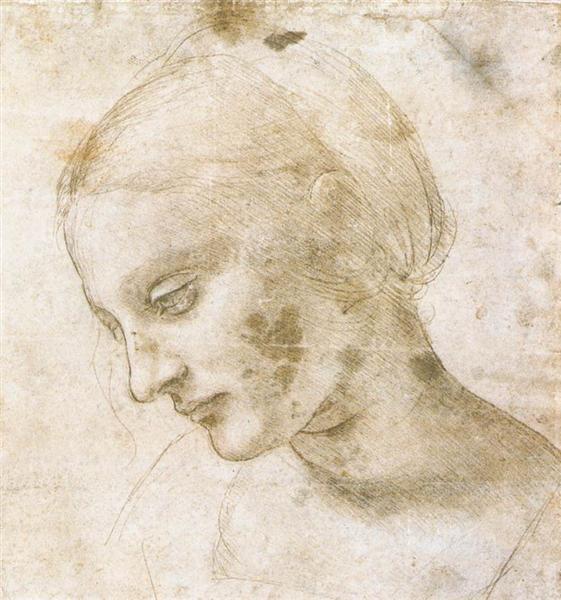
“Study of a Woman,” Leonardo da Vinci
I’ve tried to imagine what it was like for the Virgin Mary to see the resurrected Christ. It’s a thoroughly hidden moment, either not important to the Gospels or too important for words. (I’d guess both are true.) That doesn’t stop me from trying to picture her first sight of the him after the Resurrection. She’d have been so different from the others who saw him, and still so like them.
I imagine Mary throwing herself into her son’s arms. Immediately. Holding him so tight that her hands shook. Squeezing her eyes shut against tears and burying her nose in his neck, feeling the soft warm skin she once cradled and smelling the boy who was – who is – her little one. Loving and believing. “My son, my son.”
The Gospels recount with amusing honesty how Jesus’ disciples reacted to his Resurrection: not a soul thinks it’s really him, or finds it anything less than terrifying, or imagines that it’s possible to resurrect at all. Christianity is a religion with the struggles of faith built into its very heart. Nobody “gets” it at first. But Mary, Mary is different: Mary wraps him up and wraps him close, and he bends down to let her, holds his diminutive mother in his arms. As it was in the beginning, so it always will be.
The Gospels never tell us what Jesus’ Resurrection was like for his mother. We are never allowed into that moment when they first saw each other, when he appeared in some impossible way, and it stands before us as an open secret: they must have met, but we don’t know. We don’t know any of it. So much of Jesus’ childhood, of his adulthood, is like this. His life is filled with those things that were, that are, that we also do not know.
It is very likely that Mary did not know about the Resurrection before it happened. At least, not in any easily thematized way. Many stories many centuries later playfully surmise that she must have guessed, that she knew God’s heart and so also God’s plan. Almost as if she stuck around Jerusalem with the Apostles to say, “Duh. He told you so.” But of the many glories that Christians attribute to faith – especially her faith – secret knowledge (gnosis) is not one of them. It is likely that she did not know. Romano Guardini says that it is very, very important to remember that Mary is a creature of faith.
When she did learn of his Resurrection, surely we know that she believed. No other reaction is possible to imagine from her. Mary is the one who believes without hesitation. She is the one who doesn’t flinch. This is the same woman who looked right into the eyes of an angel and agreed to be the mother of God’s only son. It is not that faith is easy or even serene for her: we see her shiver through his death and ask Gabriel how some things can happen. It is that her faith is brave enough to trust.
And I don’t imagine that she was blind, that Mary’s mind stuttered to a halt and that she leapt off a cliff. Faith is astounding to the Christian tradition, is counterintuitive and “foolish” (1 Cor), but it is not insane and it is not unfeeling. “I believe, Lord!” says a man in the Gospel of Mark. “Help my unbelief!” (9:24). Karl Rahner talks about a kind of Vorgriff, a fore-grasp, a knowing before we properly know.
The rest of Mary’s life after his Resurrection continues on in obscurity. According to tradition, she stays with one of his disciples, John, in a town called Ephesus. Early stories recall that Luke came to visit her to ask about Jesus’ childhood, which is why Luke’s Gospel says the most. It is said that he was an artist, and that he painted her likeness in order to paint her son’s.
She could not have said everything about Jesus even if she’d wanted to, and I doubt she wanted to. Surely there were many things about him she left unsaid, left to be reflected on in her heart (Lk 2:19, 51). It isn’t selfish of Mary to have kept memories of Jesus to herself. As if she thought, “Ha! This one is only for me!” It is simply that faith is intimate, and there are intimacies that only God knows how to share. She understood this in some way. She lived with it always. This is the necessary attitude that Mary taught to the early Church, the one willing to reflect on Christ for ages upon ages without knowing quite how to say everything, yet that some things must be said.
Hers is also the heart that had to learn most how to let him go. In a thousand different ways, many familiar to any parent watching their child grow away from them, and many her own. She watched him grow and she also watched him die, and even after the Resurrection she watched him leave again. Off to his father’s house again. I can’t imagine that she fathomed what that means or why he was always leaving, but she knew how to let him. This is important for Christian hearts. It’s the ground of forgiveness, of change, of patience and a thousand other things. Letting go.
I like the ordinariness of her life after the Resurrection. I like imagining the quiet mundane as well as the heroic, especially since faith is so much of the former. Maybe she loved going to the well to get some water. Maybe she grew old and withered and beautiful, and John had to walk with her to the well to make sure she didn’t fall. She’d still be determined to go. Always going. “Here I am, Lord. Your servant is listening” (cf. 1 Sam 3).
There is glory at the end of her life, and for that there are many other words. For now, I like imagining the moment when she saw him again after the Resurrection. The way she knew him and held him and believed.
Previous Post

April 14, 2016
Prayer and Mental Illness
Next Post
May 6, 2016 The Unrequited Beautiful
Browse Our Archives
Select a Category Uncategorized
Select a Month June 2018 May 2018 March 2018 August 2017 May 2017 April 2017 March 2017 February 2017 January 2017 December 2016 November 2016 October 2016 September 2016 August 2016 July 2016 June 2016 May 2016 April 2016 March 2016 February 2016
Follow Us!
TAKE THE
Religious Wisdom Quiz
How many fish were caught in the miraculous catch in John?
Select your answer to see how you score.
150 100 153 200
Related posts from The Rule and the Raven

A Galaxy Haunted (by the Jedi)
When what is holy is used for what...
The Power of Memory (In Politics)
TRENDING AT PATHEOS Catholic

The Parable Of The Sower And The Word...
One of Christ’s most famous parables is that of the sower who...

Rejecting Doom: Christian Hope And Human Action
Christianity is a religion of hope. We are to have hope and...

Why I Choose the Eucharist Over the Sermon
Choose the Eucharist, Not the Sermon What are we supposed to get...

5 Design Elements Found in Spiritually Rooted Homes
Putting Spirituality Into Home Decor Our homes are more than our living...

Credo: A Story of God Told with the...
About 10 years ago, I began to imagine a personal "Credo" that...

The Anatomy of Divine Revelation in Catholic Thought
The claim that God has made Himself known to human beings is...
view all Catholic blogs
Ad-Free & Subscriber Log-In Subscription Support
- About Us
- 2026 Calendar
- Videos
- Podcasts
- Library of World Religions
- Faith In Media Tracker
- Advertise With Us
- Write for Us
- Privacy Policy
- Terms of Service
- Do Not Sell My Data
- Contact Us
- Radiant Digital
- Manage Newsletter Subscriptions
- Unsubscribe From Notifications
- Sitemap
Copyright 2008-2026, Patheos. All rights reserved.
Subscription Support Ad-Free & Subscriber Log-In
Follow Patheos