
BuddhistCatholicContemplativeEvangelicalGeneral ChristianHinduJewishLatter-day SaintMuslimNew VisionsProgressive Christian
Beliefs
- Buddhist
- Catholic
- Contemplative
- Evangelical
- General Christian
- Hindu
- Jewish
- Latter-day Saint
- More Voices
- Muslim
- New Visions
- Pagan
- Progressive Christian
Topics
- Religion News
- Food and Religion
- Sports and Religion
- Religious Art
- Religious Music and Entertainment
- Religious Events
- History and Religion
- Style and Religion
- Politics and Religion
- Women in Religion
- Recreation Outdoors and Religion
- Business Finance and Religion
- Careers Workplace and Religion
- Education and Religion
- Family Parenting and Religion
- Health Fitness and Religion
- Home and Religion
- Relationships and Religion
- Technology and Religion
- Travel and Religion
Columnists
- Buddhist Columnists
- Business Finance and Religion Columnists
- Careers Workplace and Religion Columnists
- Catholic Columnists
- Contemplative Columnists
- Education and Religion Columnists
- Evangelists Columnists
- Family Parenting and Religion Columnists
- General Christian Columnists
- Health Fitness and Religion Columnists
- Hindu Columnists
- History and Religion Columnists
- Home and Religion Columnists
- Jewish Columnists
- More Voices Columnists
- Latter Day Columnists
- Muslim Columnists
- New Visions Columnists
- Nonreligious Columnists
- Pagan Columnists
- Politics and Religion Columnists
- Progressive Columnists
- Recreation Outdoors and Religion Columnists
- Relationships and Religion Columnists
- Religion News Columnists
- Religious Art Columnists
- Religious Events Columnists
- Religious Music and Entertainment Columnists
- Sports and Religion Columnists
- Style and Religion Columnists
- Technology and Religion Columnists
- Travel and Religion Columnists
- Women in Religion Columnists
Resource Library
- 2026 Calendar
- Library of World Religions
- The 100 Most Holy Places on Earth
- Patheos Answers
- Podcasts
- Videos
- Faith Leaders Database
- Anglican Episcopalian
- Bahai
- Baptist
- Buddhism
- Christianity
- Confucianism
- Eastern Orthodoxy
- Hinduism
- Holiness and Pentecostal
- ISKCON
- Islam
- Judaism
- Lutheran
- Methodist
- The Church of Jesus Christ of Latter-day Saints
- New Age
- Paganism
- Presbytarian and Reformed
- Protestantism
- Religion Behind the Scenes
- Roman Catholic
- Scientology
- Shia Islam
- Sikhism
- Sufism
- Sunni Islam
- Taoism
- Zen
- See all religions
Research Tools
 Ad-Free & Subscriber Log-In Subscription Support
Ad-Free & Subscriber Log-In Subscription Support
Follow Patheos 

- Trending:
- Forgiveness
- |
- Marriage
- |
- Consciousness
- |
- Death Penalty
- |
- Election
- |
- Halloween
 The Rule and the Raven
- Home
- Catholic
- Catholic Mourning
Catholic Mourning
Last updated on: March 22, 2016 at 2:00 pm by Anne Carpenter
Catholic Mourning 2016-03-22T14:00:49-08:00 Anne Carpenter
Patheos Explore the world's faith through different perspectives on religion and spirituality! Patheos has the views of the prevalent religions and spiritualities of the world.
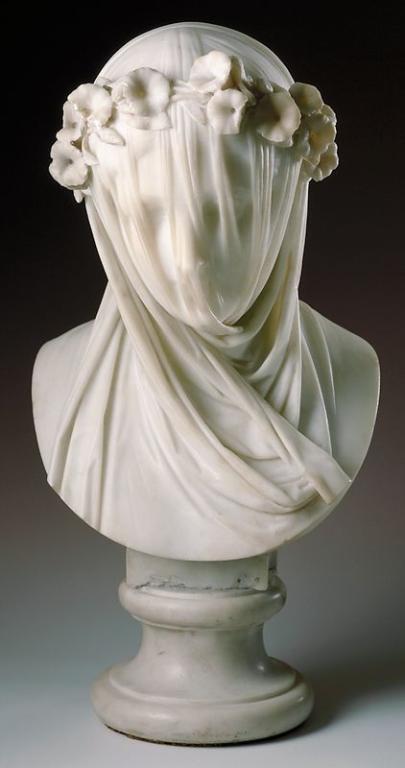
“Veiled Lady,” Raffaelo Monti (from the Minneapolis Institute of Art)
Now is the week when all the statues in churches are veiled. Crucifixes covered over. Saints look on only in outlines. I always imagine a stark moment in a ballet or a play, when a woman raises her shawl from her shoulders – stretching it wide like wings – and closes it over her head, grave in mourning. The silent collapse of what might have been.
I can’t fathom where I got the image. Something about Gregory of Nyssa’s commentary on the Song of Songs haunts my consciousness, but I have no copy with me. The Bride is covered by a veil (cf. 4:1-3, 6:7).
And this is a relief, since I hardly know how to stare down my own guilt and loss – they are not the same – without flinching. I don’t particularly want anyone to see. But this practice is more than a kind of privatization of shame (which by its nature isn’t private anyway). A veil is a surrender of control over meaning. This week, holy things are veiled as if to gesture toward their obscurity, by which I mean their immensity. This is the one week that the Church surrenders her images save the barest ones: hearing the words of Scripture, kissing a cross, washing feet. Even the tabernacles are emptied, and light itself flees the churches.
Isn’t it like G.M. Hopkins says? He describes the cry – the prayer – of that nun lashed to the mast of the Deutschland with her sisters as it sinks in a terrible storm.
Ah, touched in your bower of bone
Are you! turned for an exquisite smart,
Have you! make words break from me here all alone,
Do you!—mother of being in me, heart.
O unteachably after evil, but uttering truth,
Why, tears! is it? tears; such a melting, a madrigal start!
Never-eldering revel and river of youth,
What can it be, this glee? the good you have there of your own?
The nun’s joy and Hopkins’s wounded joy somehow bind themselves together in that moment, in her all-surrendering prayer as death swallows her in the dark. But even this is Christ’s dark somehow. It is as if he could wrest futility from itself.
Ground of being, and granite of it: past all
Grasp God, throned behind
Death with a sovereignty that heeds but hides, bodes but abides;
…
Our passion-plungèd giant risen,
The Christ of the Father compassionate, fetched in the storm of his strides.
It is something like this. A touch to bone or a welling from the deep, and the Church allows the enormity to be at times speechless and sightless, to be as naked as He was. Rilke says in his Duino Elegies, “Wer saß nicht bang vor seines Herzens Vorhang?” Who hasn’t sat afraid before the curtain of their heart?
For Gregory, the veil has to be removed. But the time for that hasn’t arrived. (It will in the flickering form of a single light. Then the whole Church wakens in a song.) And even then, true knowledge of God is a luminous dark.
Christians mourn strangely. The coffin is draped in purple or white, the first a sign of the cross that makes forgiveness possible and the second a sign of the resurrection. What a way to mourn: to call a death an immensity, to call death a sign of God’s compassion. A funeral is neither a retreat to (imaginary) bliss nor a disintegration into despair. Instead the strange weight of death settles over the church like a veil, all tears and concealment threaded with dignity and relief. A veil is not nothing. It also isn’t everything.
Can the Church herself die, and can we then mourn her? I wonder and tremble at the possibility, and sometimes think of Holy Week as a funeral. A death not unlike that nun’s: a prayer-cry surrender in the sundering dark. Christ’s dark.
There is a way in which the Church cannot die. Her life is the Spirit’s, who knows no death. But this says nothing of her members, who can whither cut from the vine. This says nothing of the way the Church lives her eternal life. In Hans Urs von Balthasar’s Heart of the World, Christ says to the Church,
The source of your life, O Church, is both a demand and a promise. … Bind yourself to me so irrevocably that I will be able to descend to hell with you; and then I will bind you to myself so irrevocably that, with me, you will be able to ascend to very heaven. … I will spare you no extremity – not the heights and not the depths – for I wish to have no secret from you. Where I am, there you too are to be (198-99).
So it is that the Church lives the whole reality of the cross, both the mournful death and the unveiling of new life. There is a way that she dies and rises in Christ, but also in her members. Even to become a member is to die: in baptism, the old Adam passes away and the New rises. Once a priest said to me, “Your baptism is still trying to kill you. Working to make the old Adam in you die.” Baptism is God’s permanent touch, even to the soul that dies a spiritual death.
Which is, again, so very strange. That a sacramental character can remain even in one who succumbs to total despair. But no darkness isn’t Christ’s.
And I wonder if Christ – or how Christ – is present when I watch the structures of the Church die. I mean when parishes close, when communities fade, when sheep leave the fold. Or as I watch the Brothers at Saint Mary’s slowly die. Should I remain at the college, I will eventually watch them all die. There are so few already, and though I try to leave the end to God, I do see one in sight.
Who will teach me how to mourn this? Who will bear the veil with me? To be Catholicism in all the dignity of her mysterious vanishing in the tide. Something does die as the Brothers do, and I know this too is Christ’s. I just don’t know quite how, or how to bear its weight. I know that every death is a sign of the resurrection, but this is one I have learned no songs for. I never even knew them in their prime. Weirdly, I mourn the death of that too. For me and for them. I’d have liked to know it.
I am not worried about the fate of the Church. This isn’t a comment on the fate of Catholicism at the college, though of course that will irrevocably change (and has). I am wondering how to live in the midst of a death that is too much for me to understand. I want to be able to talk about it, to mourn. To cry and to hope. I am so tired of the rush to fix or to fight.
I think this too of my own losses and my own sin – and these are not the same. Who will teach me to mourn them?
As deep calls to deep, and the saints look on from behind their veils.
Previous Post
March 6, 2016
Stereoscopic Memory (On Beauty and Ugliness)
Next Post

March 28, 2016 To lose and to gain. (Upon my grandmother's death.)
Browse Our Archives
Select a Category Uncategorized
Select a Month June 2018 May 2018 March 2018 August 2017 May 2017 April 2017 March 2017 February 2017 January 2017 December 2016 November 2016 October 2016 September 2016 August 2016 July 2016 June 2016 May 2016 April 2016 March 2016 February 2016
Follow Us!
TAKE THE
Religious Wisdom Quiz
In order to please God you need …
Select your answer to see how you score.
Houses To go to the Temple Faith Hope
Related posts from The Rule and the Raven

A Galaxy Haunted (by the Jedi)
When what is holy is used for what...
The Power of Memory (In Politics)
TRENDING AT PATHEOS Catholic

Creation, Preservation, and Teleology in Catholic Theology
As I write this, it is very early Monday morning. Like millions...

The Parable Of The Sower And The Word...
One of Christ’s most famous parables is that of the sower who...

Rejecting Doom: Christian Hope And Human Action
Christianity is a religion of hope. We are to have hope and...

Why I Choose the Eucharist Over the Sermon
Choose the Eucharist, Not the Sermon What are we supposed to get...

5 Design Elements Found in Spiritually Rooted Homes
Putting Spirituality Into Home Decor Our homes are more than our living...

Credo: A Story of God Told with the...
About 10 years ago, I began to imagine a personal "Credo" that...
view all Catholic blogs
Ad-Free & Subscriber Log-In Subscription Support
- About Us
- 2026 Calendar
- Videos
- Podcasts
- Library of World Religions
- Faith In Media Tracker
- Advertise With Us
- Write for Us
- Privacy Policy
- Terms of Service
- Do Not Sell My Data
- Contact Us
- Radiant Digital
- Manage Newsletter Subscriptions
- Unsubscribe From Notifications
- Sitemap
Copyright 2008-2026, Patheos. All rights reserved.
Subscription Support Ad-Free & Subscriber Log-In
Follow Patheos