
BuddhistCatholicContemplativeEvangelicalGeneral ChristianHinduJewishLatter-day SaintMuslimNew VisionsProgressive Christian
Beliefs
- Buddhist
- Catholic
- Contemplative
- Evangelical
- General Christian
- Hindu
- Jewish
- Latter-day Saint
- More Voices
- Muslim
- New Visions
- Pagan
- Progressive Christian
Topics
- Religion News
- Food and Religion
- Sports and Religion
- Religious Art
- Religious Music and Entertainment
- Religious Events
- History and Religion
- Style and Religion
- Politics and Religion
- Women in Religion
- Recreation Outdoors and Religion
- Business Finance and Religion
- Careers Workplace and Religion
- Education and Religion
- Family Parenting and Religion
- Health Fitness and Religion
- Home and Religion
- Relationships and Religion
- Technology and Religion
- Travel and Religion
Columnists
- Buddhist Columnists
- Business Finance and Religion Columnists
- Careers Workplace and Religion Columnists
- Catholic Columnists
- Contemplative Columnists
- Education and Religion Columnists
- Evangelists Columnists
- Family Parenting and Religion Columnists
- General Christian Columnists
- Health Fitness and Religion Columnists
- Hindu Columnists
- History and Religion Columnists
- Home and Religion Columnists
- Jewish Columnists
- More Voices Columnists
- Latter Day Columnists
- Muslim Columnists
- New Visions Columnists
- Nonreligious Columnists
- Pagan Columnists
- Politics and Religion Columnists
- Progressive Columnists
- Recreation Outdoors and Religion Columnists
- Relationships and Religion Columnists
- Religion News Columnists
- Religious Art Columnists
- Religious Events Columnists
- Religious Music and Entertainment Columnists
- Sports and Religion Columnists
- Style and Religion Columnists
- Technology and Religion Columnists
- Travel and Religion Columnists
- Women in Religion Columnists
Resource Library
- 2026 Calendar
- Library of World Religions
- The 100 Most Holy Places on Earth
- Patheos Answers
- Podcasts
- Videos
- Faith Leaders Database
- Anglican Episcopalian
- Bahai
- Baptist
- Buddhism
- Christianity
- Confucianism
- Eastern Orthodoxy
- Hinduism
- Holiness and Pentecostal
- ISKCON
- Islam
- Judaism
- Lutheran
- Methodist
- The Church of Jesus Christ of Latter-day Saints
- New Age
- Paganism
- Presbytarian and Reformed
- Protestantism
- Religion Behind the Scenes
- Roman Catholic
- Scientology
- Shia Islam
- Sikhism
- Sufism
- Sunni Islam
- Taoism
- Zen
- See all religions
Research Tools
 Ad-Free & Subscriber Log-In Subscription Support
Ad-Free & Subscriber Log-In Subscription Support
Follow Patheos 

- Trending:
- Forgiveness
- |
- Marriage
- |
- Consciousness
- |
- Death Penalty
- |
- Election
- |
- Halloween
 The Rule and the Raven
- Home
- Catholic
- Excerpt: Maurice Blondel, L’Action (1893)
Excerpt: Maurice Blondel, L’Action (1893)
Last updated on: March 3, 2016 at 11:35 am by Anne Carpenter
Excerpt: Maurice Blondel, L’Action (1893) 2016-03-03T11:35:38-08:00 Anne Carpenter
Patheos Explore the world's faith through different perspectives on religion and spirituality! Patheos has the views of the prevalent religions and spiritualities of the world.
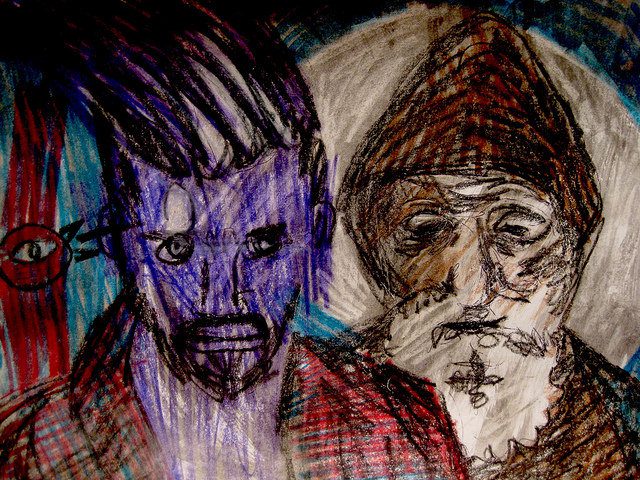
“Bird At Your Ear,” by Bill Rogers (one of my favorite artists I call friend)
Yes or no, does human life make sense, and does man have a destiny? I act, but without even knowing what action is, without having wished to live, without knowing exactly either who I am or even if I am. This appearance of being which flutters about within me, these light and evanescent actions of a shadow, bear in them, I am told, an eternally weighty responsibility, and that, even at the price of blood, I cannot buy nothingness because for me it is no longer. Supposedly, then, I am condemned to life, condemned to death, condemned to eternity! Why and by what right, if I did not know it and did not will it?
I shall make a clean breast of it. If there is something to be seen, I need to see it. Perhaps I will learn whether this phantom I am to myself, with this universe I bear in my gaze, with science and its magic, with the strange dream of consciousness, has any solidity. I shall no doubt discover what is hidden in my acts, at that very depth where, without myself, in spite of myself, I undergo being and become attached to it. I will know whether I have a sufficient knowledge and will concerning the present and the future never to sense any tyranny in them, whatever they may be.
The problem is inevitable; man resolves it inevitably; and this solution, true or false, but voluntary at the same time as necessary, each one bears it in his actions. That is why we must study action: the very meaning of the word and the richness of its contents will unfold little by little. It is good to propose to man all the exigencies of life, all the hidden fulness of his works, to strengthen within him, along with the force to affirm and to believe, the courage to act.
I.
To take stock of the immediate evidence, action, in my life, is a fact, the most general and the most constant of al, the expression within me of a universal determinism; it is produced even without me. More than a fact, it is a necessity, which no doctrine denies since such a denial would require a supreme effort, which no man avoids since suicide is still an act; action is produced even in spite of me. More than a necessity, action often appears to me as an obligation; it has to be produced by me, even when it requires of me a painful choice, a sacrifice, a death. Not only do I use up my bodily life in action, but I am forever putting down feelings and desires that would lay claim to everything, each for itself. We do not go forward, we do not learn, we do not enrich ourselves except by closing off for ourselves all roads but one and by impoverishing ourselves of all that we might have known or gained otherwise. Is there a more subtle regret than that of the adolescent obliged, on entering life, to limit his curiosity as if with blinders? Each determination cuts off an infinity of possible acts. No one escapes this natural mortification.
Will I at least have the power to stop? No, we have to go forward. To suspend my decision in order to renounce nothing? No, I must commit myself under pain of losing everything; I must compromise myself. I have no right to wait or else I no longer have the power to choose. If I do not act out of my own movement, there is something in me or outside of me that acts without me; and what acts without me ordinarily acts against me; and what acts without me ordinarily acts against me. Peace is a defeat; action leaves no more room for delay than death. Head, heart, hands, I must therefore give them over willingly or else they are taken from me. If I withhold my free dedication, I fall into slavery; no on gets along without idols: neither pious folk nor even the most libertine. A scholastic or partisan prejudice, a watch-word, a worldly compromise, a sensual delight, and it is enough for all repose to be lost, all freedom to be sacrificed. And that is often the reason why we live and why we die!
Will I be left the hope of guiding myself, if I will to, in the fulness of light, and of governing myself only according to my ideas? No. Practice, which tolerates no delay, never entails a perfect clarity; the complete analysis of it is not possible for a finite mind. Any rule of life that would be grounded only on a philosophical theory and abstract principles would be temerarious. I cannot put off acting until all the evidence has appeared, and all evidence that shines before the mind is partial. Pure knowledge is never enough to move us because it does not take hold of us in our entirety. In every act, there is an act of faith.
—
Translated by Olivia Blanchette, University of Notre Dame Press (c) 1984
Previous Post
February 25, 2016
A Theory on Catholics and the Bible
Next Post

March 6, 2016 Stereoscopic Memory (On Beauty and Ugliness)
Browse Our Archives
Select a Category Uncategorized
Select a Month June 2018 May 2018 March 2018 August 2017 May 2017 April 2017 March 2017 February 2017 January 2017 December 2016 November 2016 October 2016 September 2016 August 2016 July 2016 June 2016 May 2016 April 2016 March 2016 February 2016
Follow Us!
TAKE THE
Religious Wisdom Quiz
What food did Elijah eat in the wilderness?
Select your answer to see how you score.
Fish and honey Figs and wine Manna Bread and meat
Related posts from The Rule and the Raven
Metaxu. The Between. (On existence in the wake...
Theology. Poetry. Theological Poetics.

TRENDING AT PATHEOS Catholic

The Parable Of The Sower And The Word...
One of Christ’s most famous parables is that of the sower who...

Rejecting Doom: Christian Hope And Human Action
Christianity is a religion of hope. We are to have hope and...

Why I Choose the Eucharist Over the Sermon
Choose the Eucharist, Not the Sermon What are we supposed to get...

5 Design Elements Found in Spiritually Rooted Homes
Putting Spirituality Into Home Decor Our homes are more than our living...

Credo: A Story of God Told with the...
About 10 years ago, I began to imagine a personal "Credo" that...

The Anatomy of Divine Revelation in Catholic Thought
The claim that God has made Himself known to human beings is...
view all Catholic blogs
Ad-Free & Subscriber Log-In Subscription Support
- About Us
- 2026 Calendar
- Videos
- Podcasts
- Library of World Religions
- Faith In Media Tracker
- Advertise With Us
- Write for Us
- Privacy Policy
- Terms of Service
- Do Not Sell My Data
- Contact Us
- Radiant Digital
- Manage Newsletter Subscriptions
- Unsubscribe From Notifications
- Sitemap
Copyright 2008-2026, Patheos. All rights reserved.
Subscription Support Ad-Free & Subscriber Log-In
Follow Patheos