
BuddhistCatholicContemplativeEvangelicalGeneral ChristianHinduJewishLatter-day SaintMuslimNew VisionsProgressive Christian
Beliefs
- Buddhist
- Catholic
- Contemplative
- Evangelical
- General Christian
- Hindu
- Jewish
- Latter-day Saint
- More Voices
- Muslim
- New Visions
- Pagan
- Progressive Christian
Topics
- Religion News
- Food and Religion
- Sports and Religion
- Religious Art
- Religious Music and Entertainment
- Religious Events
- History and Religion
- Style and Religion
- Politics and Religion
- Women in Religion
- Recreation Outdoors and Religion
- Business Finance and Religion
- Careers Workplace and Religion
- Education and Religion
- Family Parenting and Religion
- Health Fitness and Religion
- Home and Religion
- Relationships and Religion
- Technology and Religion
- Travel and Religion
Columnists
- Buddhist Columnists
- Business Finance and Religion Columnists
- Careers Workplace and Religion Columnists
- Catholic Columnists
- Contemplative Columnists
- Education and Religion Columnists
- Evangelists Columnists
- Family Parenting and Religion Columnists
- General Christian Columnists
- Health Fitness and Religion Columnists
- Hindu Columnists
- History and Religion Columnists
- Home and Religion Columnists
- Jewish Columnists
- More Voices Columnists
- Latter Day Columnists
- Muslim Columnists
- New Visions Columnists
- Nonreligious Columnists
- Pagan Columnists
- Politics and Religion Columnists
- Progressive Columnists
- Recreation Outdoors and Religion Columnists
- Relationships and Religion Columnists
- Religion News Columnists
- Religious Art Columnists
- Religious Events Columnists
- Religious Music and Entertainment Columnists
- Sports and Religion Columnists
- Style and Religion Columnists
- Technology and Religion Columnists
- Travel and Religion Columnists
- Women in Religion Columnists
Resource Library
- 2026 Calendar
- Library of World Religions
- The 100 Most Holy Places on Earth
- Patheos Answers
- Podcasts
- Videos
- Faith Leaders Database
- Anglican Episcopalian
- Bahai
- Baptist
- Buddhism
- Christianity
- Confucianism
- Eastern Orthodoxy
- Hinduism
- Holiness and Pentecostal
- ISKCON
- Islam
- Judaism
- Lutheran
- Methodist
- The Church of Jesus Christ of Latter-day Saints
- New Age
- Paganism
- Presbytarian and Reformed
- Protestantism
- Religion Behind the Scenes
- Roman Catholic
- Scientology
- Shia Islam
- Sikhism
- Sufism
- Sunni Islam
- Taoism
- Zen
- See all religions
Research Tools
 Ad-Free & Subscriber Log-In Subscription Support
Ad-Free & Subscriber Log-In Subscription Support
Follow Patheos 

- Trending:
- Forgiveness
- |
- Marriage
- |
- Consciousness
- |
- Death Penalty
- |
- Election
- |
- Halloween
 The Rule and the Raven
- Home
- Catholic
- Tradition, Tradition, Tradition
Tradition, Tradition, Tradition
Last updated on: February 18, 2016 at 7:41 am by Anne Carpenter
Tradition, Tradition, Tradition 2016-02-18T07:41:09-08:00 Anne Carpenter
Patheos Explore the world's faith through different perspectives on religion and spirituality! Patheos has the views of the prevalent religions and spiritualities of the world.
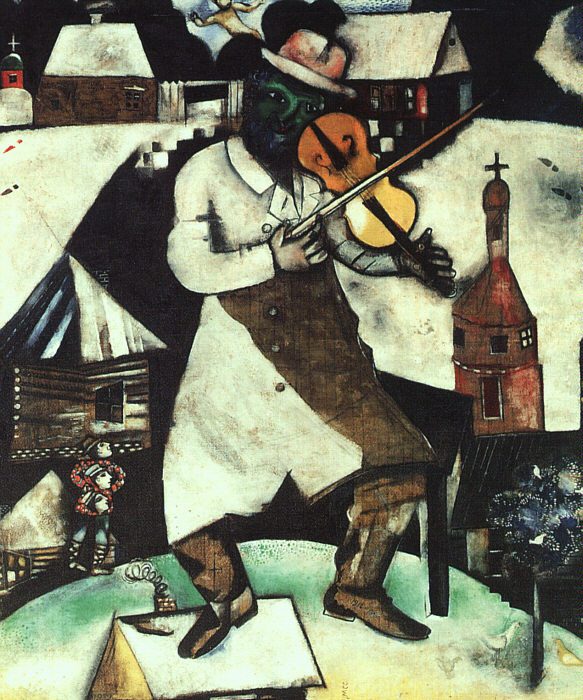
“Fiddler on the Roof,” Marc Chagall
I’ve been thinking a lot about the nature of time. And history. And truth. Most of all, I’ve been thinking about tradition. Tradition is where most of my recent work has centered and it is therefore a recurring theme when I look at almost anything. My fixation tends to be on tradition as a kind of “memory” or “remembering,” and I do this for various reasons, mainly relating to the kinds of questions I’m asking. I want to know about tradition’s consistency and plasticity – that strange dual quality unique to tradition – through time, and, as Augustine noted long ago, memory is one of the primary ways that we become aware of time. A simpler way to think of it is this: what on earth does it mean for Catholicism to be historical? To be in history and subject to history?
Most options so far tend to be reductive in one of two ways: reducing tradition to truth or reducing it to history. Here I borrow from Maurice Blondel‘s thought. Both options are bad, Blondel insists in History and Dogma, because the first leads to an incoherent fideism and the second leads to an equally incoherent “determinism.” By this latter word, Blondel means the idea that what happened in history had to have happened that way simply because it happened that way. Determinism is incoherent in several respects, one of which is that nothing about history tells us that it has to have happened the that way it did. Saying that a thing happened is not the same as saying that it must have happened.
And why would we care? At least in part because faith comes to us through history. The supernatural gift transcends time, of course, but it is given to us in the midst of our own history and as a part of a community with a shared history. This community, the Church, has ways of speaking and acting that are firmly rooted in the mess that is human history. Indeed, God himself enters human history.
Which is awesome. And terrifying, because it makes Christianity incredibly complex.
A couple of months ago, I was in a big meeting about Catholic colleges and their missions. We discussed what we considered “necessary” to these missions, those things that we could not do without. At one point, we struggled with what to consider a part of a specifically Catholic inheritance. (This is a struggle on all Catholic college campuses.) Another faculty member pointed out that the Catholic Church has looked like vastly different things over its two thousand years.
The professor then insisted that we could not, therefore, define “Catholic” or “Catholic Church.”
I was…unconvinced…by this logic, we’ll say. My position was not, however, completely against every statement. It is true that the Catholic Church has looked vastly different over time. Very much so. And yet the very fact that I can write that sentence and make sense of it means that there is a single form that I can see consistently and therefore call “different.” How, after all, can I say that this thing in this century is the Catholic Church, and that this very different thing much later is also the Catholic Church without them both being the Catholic Church somehow? Or else I have two Catholic Churches, which is possible. But then I’d have to explain when one ceased to be the other, which creates a historical problem that does not seem to actually appear in history.
It’s an open question whether the Christians of the earliest centuries would recognize the Church of many centuries after, but I’m also not sure that’s a good question. I do not know if it is self-coherent to make whether the past would recognize its future a condition of the future’s authenticity or consistency. I don’t know if that makes any more sense than it would to ask my child-self if she recognizes my adult self, and making that a condition for whether I am me. It makes history weirdly impermeable and contextless, judged only by a specific point in time, when the whole point of history is change and context.
Here in part I’m attempting to be more consistent in my “post-modernity” (hyper-modernity?) than the postmoderns. So if I am to take history seriously as a disruption of meaning (change), I also have to take it seriously as a mediator of meaning (consistency). The one does not make sense without the other. Disruption of what, after all?
Moreover, isn’t disruption meaning too?
I definitely want to be serious about history as change, disruption, and destabilization. I want to be serious when I say that Christian faith participates in exactly that. I am so serious about this that it means thinking it all the way through rather than halting at history as “what happened” and “what changed.” (Which is itself an odd conflation of time and history, but anyway. I need to focus.)
Blondel forwards the idea of tradition as the mediation between truth and history. That is, one of the major forms of Catholic self-understanding over time occupies a “suspension” of sorts – I’m borrowing from Erich Przywara now – persisting between truth and history. Tradition is neither truth nor history, but it mediates the two. A non-identical inverse relation is also true: neither truth nor history are tradition, but tradition is the mediation of the two. (Non-identically inverse because I can’t say “mediation of the two is tradition,” because that’s not necessarily the case. Przywara has a lot of these asymmetrical relations as well, and I am basically mimicking what he taught me in different key.)
If tradition is a suspension of some kind – and who knows whether I’ll be pleased with this word tomorrow – then that means it is capable of being both flexible and inflexible. In fact, to be itself, it must be both. Tradition, particularly because it is verbal (it is an action, a “handing over”), is a between that spans subject and object, truth and history. (I did something deliberately weird there. Oh my God, I need to stop meta-commenting.)
Again. Who cares?
If any of this is true, it means that the typical ways we talk about the past and the present – and the future – don’t work very well. That is, they don’t do much work for theology. (We’re all wrong! Yay!) Think of it this way: in some respects, the concept of time underneath what I am suggesting is a turn toward a “Gregory of Nyssa-ish” Augustine. (I might hate that phrase tomorrow.) This would be, yes, a turn to the past. But it is also not a turn to the past. It couldn’t be called a turn to the past. Not because it isn’t historical – wrong question – but because pastness doesn’t work like that. Not in tradition.
In other words, impasses that force theologians into a choice between the past and the present are false dilemmas. Flawed assumptions lead us into unreal – or I might mean incoherent, or both – dilemmas. And, perhaps oddly, it is the past that arrives to show us a way forward in the present – by being present.
In tradition.
Probably.
Alright, I’m climbing off this limb now.
—
**all above is the pure speculation of a simple theologian, and in no way a description of Catholic doctrine
Previous Post
February 15, 2016
Might have. Never could have at all.
Next Post

February 19, 2016 Come As You Are
Browse Our Archives
Select a Category Uncategorized
Select a Month June 2018 May 2018 March 2018 August 2017 May 2017 April 2017 March 2017 February 2017 January 2017 December 2016 November 2016 October 2016 September 2016 August 2016 July 2016 June 2016 May 2016 April 2016 March 2016 February 2016
Follow Us!
TAKE THE
Religious Wisdom Quiz
Who led the Israelites into battle against Jericho?
Select your answer to see how you score.
Joshua Gideon David Moses
Related posts from The Rule and the Raven

A Galaxy Haunted (by the Jedi)

When what is holy is used for what...

The Power of Memory (In Politics)
TRENDING AT PATHEOS Catholic

The Parable Of The Sower And The Word...
One of Christ’s most famous parables is that of the sower who...

Rejecting Doom: Christian Hope And Human Action
Christianity is a religion of hope. We are to have hope and...

Why I Choose the Eucharist Over the Sermon
Choose the Eucharist, Not the Sermon What are we supposed to get...

5 Design Elements Found in Spiritually Rooted Homes
Putting Spirituality Into Home Decor Our homes are more than our living...

Credo: A Story of God Told with the...
About 10 years ago, I began to imagine a personal "Credo" that...

The Anatomy of Divine Revelation in Catholic Thought
The claim that God has made Himself known to human beings is...
view all Catholic blogs
Ad-Free & Subscriber Log-In Subscription Support
- About Us
- 2026 Calendar
- Videos
- Podcasts
- Library of World Religions
- Faith In Media Tracker
- Advertise With Us
- Write for Us
- Privacy Policy
- Terms of Service
- Do Not Sell My Data
- Contact Us
- Radiant Digital
- Manage Newsletter Subscriptions
- Unsubscribe From Notifications
- Sitemap
Copyright 2008-2026, Patheos. All rights reserved.
Subscription Support Ad-Free & Subscriber Log-In
Follow Patheos