
BuddhistCatholicContemplativeEvangelicalGeneral ChristianHinduJewishLatter-day SaintMuslimNew VisionsProgressive Christian
Beliefs
- Buddhist
- Catholic
- Contemplative
- Evangelical
- General Christian
- Hindu
- Jewish
- Latter-day Saint
- More Voices
- Muslim
- New Visions
- Pagan
- Progressive Christian
Topics
- Religion News
- Food and Religion
- Sports and Religion
- Religious Art
- Religious Music and Entertainment
- Religious Events
- History and Religion
- Style and Religion
- Politics and Religion
- Women in Religion
- Recreation Outdoors and Religion
- Business Finance and Religion
- Careers Workplace and Religion
- Education and Religion
- Family Parenting and Religion
- Health Fitness and Religion
- Home and Religion
- Relationships and Religion
- Technology and Religion
- Travel and Religion
Columnists
- Buddhist Columnists
- Business Finance and Religion Columnists
- Careers Workplace and Religion Columnists
- Catholic Columnists
- Contemplative Columnists
- Education and Religion Columnists
- Evangelists Columnists
- Family Parenting and Religion Columnists
- General Christian Columnists
- Health Fitness and Religion Columnists
- Hindu Columnists
- History and Religion Columnists
- Home and Religion Columnists
- Jewish Columnists
- More Voices Columnists
- Latter Day Columnists
- Muslim Columnists
- New Visions Columnists
- Nonreligious Columnists
- Pagan Columnists
- Politics and Religion Columnists
- Progressive Columnists
- Recreation Outdoors and Religion Columnists
- Relationships and Religion Columnists
- Religion News Columnists
- Religious Art Columnists
- Religious Events Columnists
- Religious Music and Entertainment Columnists
- Sports and Religion Columnists
- Style and Religion Columnists
- Technology and Religion Columnists
- Travel and Religion Columnists
- Women in Religion Columnists
Resource Library
- 2026 Calendar
- Library of World Religions
- The 100 Most Holy Places on Earth
- Patheos Answers
- Podcasts
- Videos
- Faith Leaders Database
- Anglican Episcopalian
- Bahai
- Baptist
- Buddhism
- Christianity
- Confucianism
- Eastern Orthodoxy
- Hinduism
- Holiness and Pentecostal
- ISKCON
- Islam
- Judaism
- Lutheran
- Methodist
- The Church of Jesus Christ of Latter-day Saints
- New Age
- Paganism
- Presbytarian and Reformed
- Protestantism
- Religion Behind the Scenes
- Roman Catholic
- Scientology
- Shia Islam
- Sikhism
- Sufism
- Sunni Islam
- Taoism
- Zen
- See all religions
Research Tools
 Ad-Free & Subscriber Log-In Subscription Support
Ad-Free & Subscriber Log-In Subscription Support
Follow Patheos 

- Trending:
- Forgiveness
- |
- Marriage
- |
- Consciousness
- |
- Death Penalty
- |
- Election
- |
- Halloween
 The Rule and the Raven
- Home
- Catholic
- A Theologian Afraid of God
A Theologian Afraid of God
Last updated on: February 5, 2016 at 6:17 pm by Anne Carpenter
A Theologian Afraid of God 2016-02-05T18:17:52-08:00 Anne Carpenter
Patheos Explore the world's faith through different perspectives on religion and spirituality! Patheos has the views of the prevalent religions and spiritualities of the world.
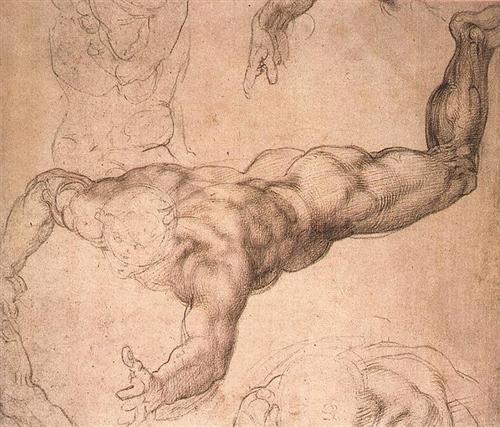
“Study for the Last Judgement,” Michelangelo
I am afraid of God. I don’t know where else to begin except where I am, and this is where I am. Afraid of God. I don’t mean “fear of the Lord” fear, the awe rooted in the true law of God. I mean something like the terror that snaps a mouth shut: “They said nothing to anyone, for they were afraid” (Mk 16:8).
It’s something of an irony, since I’ve given everything I could to God – including a career. Since I’ve always tried to draw close to God – even when I didn’t think there was one. But it isn’t an intellectual irony, this very real fear. I don’t think God is to be feared. I think God is to be loved, worshipped. It’s more like an ingrained pattern, a muscle memory, that has me shivering before the Trinity.
This is my most profound fear: that I will stand before the Son of the Father and that he will reject me. Not because I didn’t try or didn’t love, but because of me. Because of something inherently wrong with me that I could not fix because it would undo me entirely, violently. Like pulling a rib out of my own chest. Enough to fix the image and kill me at the same time. I am afraid that there are things about me that God will never, ever accept – and that I wish he would.
It is as if my world splits across an impossible chasm: the goodness of God as merciful, and the goodness of God as a demand. “Be perfect, just as your heavenly Father is perfect” (Mt 5:48). And I could pause here to explain nature and grace. I could correct exactly this kind of agony with the unexpected brilliance of the Council of Trent. the command – the law – to be perfect is at once something to be followed and something given. In fact, it’s given first. Augustine says, “Lord, command what you will; and give what you command.”
But that doesn’t soothe me. I cannot calm myself. The theologian in me cannot coax the rest of me into settling down. I tremble when I enter a church, stripped by the beauty of everything I love – and that I miss, since I fear it too. The symbols remind me of my own failure.
I do mean sin. I don’t mean sin.
It doesn’t matter what, exactly, I think God and his Church (and the world) would reject in me. It’s malleable enough to be diffuse. A perplexity rather than a thought. “There is in finite things a fear that they will be burst asunder by God,” Hans Urs von Balthasar writes in Heart of the World (139). He writes in the voice of a simple sinner all too aware of his smallness and frailty. How easy it would be to overcome this man. I fear something like this from everyone.
I know what it means to be forced to do something against my will – even violently. And so it is sometimes hard to imagine that the justice given by Christ will not cut the same artery, killing me to save me. This is not what I believe. It’s what I fear.
Balthasar has Christ respond to the sinner: “As a small root cracks the heaviest stones apart, so have I softly caused your prison walls to waver” (142). Softly.
This is the vision of God in Balthasar that drew me to him first: he seemed to know what it meant to be forced, and worried over how it is that God can draw us near to him without hurting us. He reflected on this with a sort of iron compassion, unwilling to compromise what is harsh as he sought the mercy of Christ. Balthasar is many things, but never sentimental. He is often made so because he wrote beautifully, but sentimental beauty is manipulative and controlling out of its own insincerity. It cannot mean what it says because it can only slide toward what is softest.
Balthasar hates sentimentality.
The first time I read Balthasar was during my undergraduate studies in a Christology and soteriology class. I am sure that I keep re-shaping this memory. Technically, I had already read his book on Maximus the Confessor, but I didn’t realize these were the same person. Maximus was my obsession- and in that book, in Balthasar’s book, we have a Maximus concerned with human freedom and God’s freedom as they encounter each other. I came to this concern again in the first passage I read from Balthasar, which was from Theo-Drama V. It is some of his most difficult and controversial work.
For Balthasar, Christ descends to hell on Holy Saturday. In fact, beneath hell. Balthasar claims that it is really only the Son who can know what it means to be forsaken of the Father, and so he “descends” to a place “below” even the worst sinner. This provokes many people against Balthasar. I myself wrestle with what it means. But look what happens to freedom:
[A]nyone who tries to choose complete forsakenness…finds himself confronted by a figure of someone even “more absolutely” forsaken than himself. We should consider, therefore, “whether it is still not open to God to encounter the sinner who has turned away from him…and indeed in such a way that it becomes clear to the one who has turned away from God that: this One beside me who has been forsaken by God (like myself) has been abandoned by God for my sake. Now there can be no more talk of doing violence to freedom if God appears to the one who has chosen [absolute loneliness]…and shows himself to be as the one who is still lonelier than the sinner” (Balthasar quotes himself here. TD V, 312; “Eschatology in Outline”).
Softly.
I am afraid of God. I can’t seem to argue myself out of it, or even seize the fear enough not to tremble in church. It is a terrible contradiction, some kind of cross-purpose: love and terror persisting against one another. After all, how could God not terrify me when I know he wants to draw near to me – that’s what he wants most – and drawing near is exactly what hurt?
Don’t come here and make me. Please. Don’t make me anything at all.
And still.
I have the wild hope that God has already taken root…
Previous Post

June 29, 2018
Self, suspended
Next Post
February 14, 2016 On what is real.
Browse Our Archives
Select a Category Uncategorized
Select a Month June 2018 May 2018 March 2018 August 2017 May 2017 April 2017 March 2017 February 2017 January 2017 December 2016 November 2016 October 2016 September 2016 August 2016 July 2016 June 2016 May 2016 April 2016 March 2016 February 2016
Follow Us!
TAKE THE
Religious Wisdom Quiz
Jesus was baptized in the water of which river?
Select your answer to see how you score.
Gihon Jordan Nile Euphrates
Related posts from The Rule and the Raven
When what is holy is used for what...
The Power of Memory (In Politics)

Glory of the Lord, vol. I: "Introduction" (An...
TRENDING AT PATHEOS Catholic

Creation, Preservation, and Teleology in Catholic Theology
As I write this, it is very early Monday morning. Like millions...

The Parable Of The Sower And The Word...
One of Christ’s most famous parables is that of the sower who...

Rejecting Doom: Christian Hope And Human Action
Christianity is a religion of hope. We are to have hope and...

Why I Choose the Eucharist Over the Sermon
Choose the Eucharist, Not the Sermon What are we supposed to get...

5 Design Elements Found in Spiritually Rooted Homes
Putting Spirituality Into Home Decor Our homes are more than our living...

Credo: A Story of God Told with the...
About 10 years ago, I began to imagine a personal "Credo" that...
view all Catholic blogs
Ad-Free & Subscriber Log-In Subscription Support
- About Us
- 2026 Calendar
- Videos
- Podcasts
- Library of World Religions
- Faith In Media Tracker
- Advertise With Us
- Write for Us
- Privacy Policy
- Terms of Service
- Do Not Sell My Data
- Contact Us
- Radiant Digital
- Manage Newsletter Subscriptions
- Unsubscribe From Notifications
- Sitemap
Copyright 2008-2026, Patheos. All rights reserved.
Subscription Support Ad-Free & Subscriber Log-In
Follow Patheos