
BuddhistCatholicContemplativeEvangelicalGeneral ChristianHinduJewishLatter-day SaintMuslimNew VisionsProgressive Christian
Beliefs
- Buddhist
- Catholic
- Contemplative
- Evangelical
- General Christian
- Hindu
- Jewish
- Latter-day Saint
- More Voices
- Muslim
- New Visions
- Pagan
- Progressive Christian
Topics
- Religion News
- Food and Religion
- Sports and Religion
- Religious Art
- Religious Music and Entertainment
- Religious Events
- History and Religion
- Style and Religion
- Politics and Religion
- Women in Religion
- Recreation Outdoors and Religion
- Business Finance and Religion
- Careers Workplace and Religion
- Education and Religion
- Family Parenting and Religion
- Health Fitness and Religion
- Home and Religion
- Relationships and Religion
- Technology and Religion
- Travel and Religion
Columnists
- Buddhist Columnists
- Business Finance and Religion Columnists
- Careers Workplace and Religion Columnists
- Catholic Columnists
- Contemplative Columnists
- Education and Religion Columnists
- Evangelists Columnists
- Family Parenting and Religion Columnists
- General Christian Columnists
- Health Fitness and Religion Columnists
- Hindu Columnists
- History and Religion Columnists
- Home and Religion Columnists
- Jewish Columnists
- More Voices Columnists
- Latter Day Columnists
- Muslim Columnists
- New Visions Columnists
- Nonreligious Columnists
- Pagan Columnists
- Politics and Religion Columnists
- Progressive Columnists
- Recreation Outdoors and Religion Columnists
- Relationships and Religion Columnists
- Religion News Columnists
- Religious Art Columnists
- Religious Events Columnists
- Religious Music and Entertainment Columnists
- Sports and Religion Columnists
- Style and Religion Columnists
- Technology and Religion Columnists
- Travel and Religion Columnists
- Women in Religion Columnists
Resource Library
- 2026 Calendar
- Library of World Religions
- The 100 Most Holy Places on Earth
- Patheos Answers
- Podcasts
- Videos
- Faith Leaders Database
- Anglican Episcopalian
- Bahai
- Baptist
- Buddhism
- Christianity
- Confucianism
- Eastern Orthodoxy
- Hinduism
- Holiness and Pentecostal
- ISKCON
- Islam
- Judaism
- Lutheran
- Methodist
- The Church of Jesus Christ of Latter-day Saints
- New Age
- Paganism
- Presbytarian and Reformed
- Protestantism
- Religion Behind the Scenes
- Roman Catholic
- Scientology
- Shia Islam
- Sikhism
- Sufism
- Sunni Islam
- Taoism
- Zen
- See all religions
Research Tools
 Ad-Free & Subscriber Log-In Subscription Support
Ad-Free & Subscriber Log-In Subscription Support
Follow Patheos 

- Trending:
- Forgiveness
- |
- Marriage
- |
- Consciousness
- |
- Death Penalty
- |
- Election
- |
- Halloween

- Home
- Catholic
- History and Religion
- Thomas Aquinas on the Morality of War
Thomas Aquinas on the Morality of War
Last updated on: April 8, 2026 at 9:01 am by Barbara O'Brien
Thomas Aquinas on the Morality of War 2026-04-08T09:01:26-05:00 Barbara O'Brien
Patheos Explore the world's faith through different perspectives on religion and spirituality! Patheos has the views of the prevalent religions and spiritualities of the world.
Saint Thomas Aquinas (Tommaso d’Aquino, 1224/25-1275) developed precepts about the morality of war that influence international law to this day. Now the saint’s writings on war are relevant to current events, as Christian views on war have been in the news,
Recently U.S. Secretary of Defense Pete Hegseth led a prayer service in the Pentagon that drew what appeared to be a rebuke from Pope Leo XIV. Invoking the war in Iran, the Secretary prayed for every round to find its mark, and for “overwhelming violence of action against those who deserve no mercy.” The prayer concluded, “We ask these things with bold confidence in the mighty and powerful name of Jesus Christ.”
A few days later, Pope Leo spoke to the incompatibility of Christianity with the glorification of war. In his Palm Sunday homily, the pontiff said, “Brothers and sisters, this is our God: Jesus, King of Peace, who rejects war, whom no one can use to justify war. He does not listen to the prayers of those who wage war, but rejects them, saying: ‘Even though you make many prayers, I will not listen: your hands are full of blood.'”
On Easter Sunday President Trump expressed confidence that God is on his side in the Iran conflict. I’m not sure Saint Thomas Aquinas would agree. Many consider Thomas Aquinas to be Catholicism’s greatest theologian. Let’s consider what he had to say about war.
Saint Thomas Aquinas on War
Saint Thomas Aquinas was one of the giants of western philosophy and theology. Aquinas was born in Sicily, where his parents owned a modest feudal domain. When Tommaso was five years old his parents placed him in a nearby Benedictine monastery where an uncle was abbot. A clash between Emperor Frederick II and Pope Gregory IX caused the monastery to close in 1239. Young Tommaso was then sent to a studium generale — a medieval university — in Naples. It’s believed he began his formal study of philosophy there. He also chose to join the Dominican order. The Dominicans must have recognized his intellectual gifts and sent him to the University of Paris to continue his education. He would spend much of the rest of his life in Paris, producing masterpieces of theology.
One of those masterpieces was the Summa Theologiae, a compendium of the theological teachings of the Church. And in a section of the Summa Aquinas wrote about war. You can read that section online here. Is war always sinful? he asked. Can war be just? Is killing in war the same as murder? In answering these questions, Aquinas explored many perspectives and often seemed to be arguing with himself. Aquinas consulted the Gospels and many earlier philosophers. You’ll notice that Aquinas quoted Saint Augustine of Hippo (354-430) in several places. Here is an earlier column on Saint Augustine’s just war theory that addresses many of the same issues.
To judge the morality of going to war, Aquinas said, circumstances and intentions must be considered carefully. Especially intentions. War is sinful, he said. But sometimes it is unavoidable. War is just and lawful when it is conducted under three conditions: First, it must be declared by a sovereign power, the head of government. Second, one’s cause must be just. If an adversary attacks and plunders other countries, that adversary “should be attacked because they deserve it ” Needless to say, attacking other countries to seize their territory or wealth is not a just cause. And third, a just war requires rightful intentions, the intentions to do good and not evil. Here Aquinas quotes Augustine — “The passion for inflicting harm, the cruel thirst for vengeance, an unpacific and relentless spirit, the fever of revolt, the lust of power, and such like things, all these are rightly condemned in war.” Any selfish intention, including a desire for personal aggrandizement, would be condemned.
“Those who wage just wars intend peace,” Aquinas wrote.
A Note on Intentions
Several centuries and a whole lot of history have passed since Saint Thomas Aquinas wrote the Summa Theologiae. And if you study that history, you realize nearly every group of people who chose to go to war persuaded themselves that they were justified, that they were the “good guys,” and that God was on their side. Nearly every atrocity in human history began with the thought, “I’m a good person,” followed by “his hatred of me is evil, but my hatred of him is justified.” As soon as we identify ourselves as “good” and the Other, whoever they are, as “evil,” we’re well on the way to giving ourselves a cosmic permission slip to do whatever we want to be rid of them. People are seduced into evil because they don’t recognize evil as evil. They mistake it for justice, or righteousness, or even God’s Will. Intentions must be infused with humility and a willingness to consider that maybe God is not on our side. I’m not seeing a lot of that in Washington right now.
Gunpowder was introduced to Europe during Aquinas’s lifetime, but cannons weren’t used in a European war until about 60 years after Aquinas died. War was mostly hand-to-hand combat in his day. He dedicated a section of his comments on war to a discussion of whether it is lawful to use ambushes and other subterfuge in war. This seems almost quaint. Aquinas also addressed fighting on holy days: “[I]t is lawful to carry on a war on holy days, provided there be need for doing so: because it would be to tempt God, if notwithstanding such a need, one were to choose to refrain from fighting. However, as soon as the need ceases, it is no longer lawful to fight on a holy day.” I take that to mean if people must fight to defend themselves on a holy day, that is permissible. Otherwise, no.
Aquinas also discouraged clergy from taking up arms, even in a just cause. “Prelates ought to withstand not only the wolf who brings spiritual death upon the flock, but also the pillager and the oppressor who work bodily harm; not, however, by having recourse themselves to material arms, but by means of spiritual weapons, according to the saying of the Apostle (2 Corinthians 10:4): ‘The weapons of our warfare are not carnal, but mighty through God.’ Such are salutary warnings, devout prayers, and, for those who are obstinate, the sentence of excommunication.”
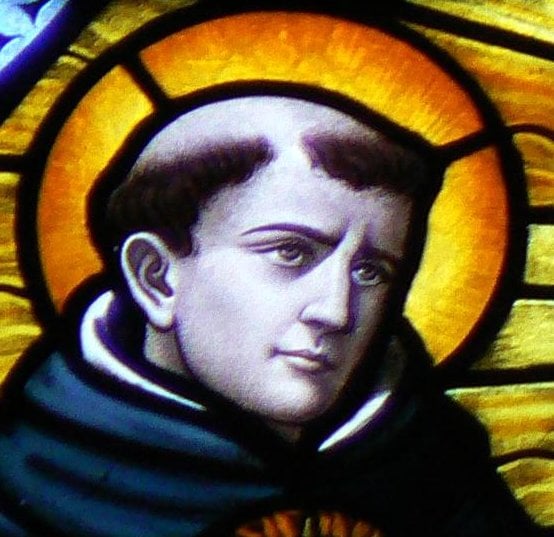
Trained glass portrait of Saint Thomas Aquinas. Source: Wikimedia Commons, CC BY-SA 2.0 license
Catholic

About Barbara O'Brien
Barbara is the author of The Circle of the Way: A Concise History of Zen from the Buddha to the Modern World (Shambhala, 2019). You can read more about the author here.
Previous Post

March 26, 2026
A Goddess Who Swapped Bodies to Prove Gender Is an Illusion
Next Post
April 9, 2026 What Was the Avignon Papacy and Why Is It in the News?
Recent Comments
"Thank you for this grounded, deeply necessary perspective. Shifting our framework from moralistic binaries to ..."
What You May Not Know About ..."
"Nonviolence is the weapon of the mighty and the strong. Violence is the weapon of ..."
Thomas Aquinas on the Morality of ..."
"Regarding Barbara O'Brien's article "Is Empathy a Weakness?" My answer in song is an emphatic ..."
""A government, which to bigotry gives no sanction." How far our government has fallen from ..."
George Washington’s Letter to Touro Synagogue
Browse Our Archives
Select a Category Buddhism Christianity Daoism Hinduism Indigenous religions Islam Judaism Mysticism New Age Origins of religion Paganism Popes Popular Religious Movements Protestantism Psychology and religion Religion and current events Religion and folklore Religion and News Media Religion and politics Religious Art and Music Religious Freedom Religious mistakes Religious philosophy Religious scriptures Religious Violence science and religion Spiritualism Technology and religion The Catholic Church The Dalai Lama The Reformation Uncategorized
Select a Month September 2026 August 2026 July 2026 June 2026 April 2026 March 2026 February 2026 January 2026 December 2025 November 2025 October 2025 September 2025 August 2025 July 2025 June 2025 May 2025 April 2025 March 2025 February 2025 January 2025 December 2024 November 2024 October 2024 September 2024 August 2024 July 2024 June 2024 May 2024 April 2024 March 2024 February 2024 January 2024 December 2023 November 2023 October 2023 September 2023 August 2023 July 2023 June 2023 May 2023 April 2023 March 2023 February 2023 January 2023 December 2022 November 2022 October 2022 September 2022 August 2022
Follow Us!
TAKE THE
Religious Wisdom Quiz
What does Proverbs say about a soft answer?
Select your answer to see how you score.
It starts a fight It brings wealth It is useless It turns away wrath
Related posts from The Religious History Nerd

I Watched the Towers Fall. Here's What You...

Barring Mamdani From 9/11 Lets the Enemy Win

Is 'Separation of Church and State' Really a...

The President and the Pope: An Unprecedented Rift
TRENDING AT PATHEOS History and Religion

Janie Learns the Way of the Cross: A...
Teaching children about Jesus' Passion can be challenging. Many parents and educators...

Looking For Good Catholic Writing - October 2026
He alone extends the heavens, and he walks upon the waves of...

In "Irreplaceable," our book on vocation and technology, Trevor Sutton and I...

I was strolling through the top floor of the brand new Parthenon...

What Does Gêvâh Mean For Kimberley Guifoyle &...
This week, a lot of the news is focused on Kimberly Guilfoyle....

INNER CIRCLE: Profound Mystery (Of Christ In All...
Ephesians 5:31-32 “For this reason, a man will leave his father and...
view all History and Religion blogs
What Are Your Thoughts?leave a comment
Ad-Free & Subscriber Log-In Subscription Support
- About Us
- 2026 Calendar
- Videos
- Podcasts
- Library of World Religions
- Faith In Media Tracker
- Advertise With Us
- Write for Us
- Privacy Policy
- Terms of Service
- Do Not Sell My Data
- Contact Us
- Radiant Digital
- Manage Newsletter Subscriptions
- Unsubscribe From Notifications
- Sitemap
Copyright 2008-2026, Patheos. All rights reserved.
Subscription Support Ad-Free & Subscriber Log-In
Follow Patheos