
BuddhistCatholicContemplativeEvangelicalGeneral ChristianHinduJewishLatter-day SaintMuslimNew VisionsProgressive Christian
Beliefs
- Buddhist
- Catholic
- Contemplative
- Evangelical
- General Christian
- Hindu
- Jewish
- Latter-day Saint
- More Voices
- Muslim
- New Visions
- Pagan
- Progressive Christian
Topics
- Religion News
- Food and Religion
- Sports and Religion
- Religious Art
- Religious Music and Entertainment
- Religious Events
- History and Religion
- Style and Religion
- Politics and Religion
- Women in Religion
- Recreation Outdoors and Religion
- Business Finance and Religion
- Careers Workplace and Religion
- Education and Religion
- Family Parenting and Religion
- Health Fitness and Religion
- Home and Religion
- Relationships and Religion
- Technology and Religion
- Travel and Religion
Columnists
- Buddhist Columnists
- Business Finance and Religion Columnists
- Careers Workplace and Religion Columnists
- Catholic Columnists
- Contemplative Columnists
- Education and Religion Columnists
- Evangelists Columnists
- Family Parenting and Religion Columnists
- General Christian Columnists
- Health Fitness and Religion Columnists
- Hindu Columnists
- History and Religion Columnists
- Home and Religion Columnists
- Jewish Columnists
- More Voices Columnists
- Latter Day Columnists
- Muslim Columnists
- New Visions Columnists
- Nonreligious Columnists
- Pagan Columnists
- Politics and Religion Columnists
- Progressive Columnists
- Recreation Outdoors and Religion Columnists
- Relationships and Religion Columnists
- Religion News Columnists
- Religious Art Columnists
- Religious Events Columnists
- Religious Music and Entertainment Columnists
- Sports and Religion Columnists
- Style and Religion Columnists
- Technology and Religion Columnists
- Travel and Religion Columnists
- Women in Religion Columnists
Resource Library
- 2026 Calendar
- Library of World Religions
- The 100 Most Holy Places on Earth
- Patheos Answers
- Podcasts
- Videos
- Faith Leaders Database
- Anglican Episcopalian
- Bahai
- Baptist
- Buddhism
- Christianity
- Confucianism
- Eastern Orthodoxy
- Hinduism
- Holiness and Pentecostal
- ISKCON
- Islam
- Judaism
- Lutheran
- Methodist
- The Church of Jesus Christ of Latter-day Saints
- New Age
- Paganism
- Presbytarian and Reformed
- Protestantism
- Religion Behind the Scenes
- Roman Catholic
- Scientology
- Shia Islam
- Sikhism
- Sufism
- Sunni Islam
- Taoism
- Zen
- See all religions
Research Tools
 Ad-Free & Subscriber Log-In Subscription Support
Ad-Free & Subscriber Log-In Subscription Support
Follow Patheos 

- Trending:
- Forgiveness
- |
- Marriage
- |
- Consciousness
- |
- Death Penalty
- |
- Election
- |
- Halloween

- Home
- General Christian
- History and Religion
- Of DNA and Religion
Of DNA and Religion
Last updated on: November 26, 2025 at 3:00 pm by Barbara O'Brien
Of DNA and Religion 2025-11-26T15:00:21-06:00 Barbara O'Brien
Patheos Explore the world's faith through different perspectives on religion and spirituality! Patheos has the views of the prevalent religions and spiritualities of the world.
Religion and the science of DNA may seem to have nothing in common. But in fact, since the discovery of DNA in 1953, some religious traditions have grappled with many new concerns, such as the morality of genetic engineering. It’s also been proposed that there is a “God gene” that predisposes some people toward spirituality. The recent death of James Watson, a co-discoverer of DNA, made me wonder how much religion has struggled with Watson’s groundbreaking work. So let’s take a look.
Religion and science in general have a complicated relationship. In particular, conservative factions within the Abrahamic religions — Judaism, Christianity, and Islam — have sometimes clashed with science. Most of us have heard about the Catholic Church’s objections to the model of the solar system proposed by Nicolaus Copernicus (1473–1543). Note that these objections have evaporated. Indeed, the Catholic Church these days is very proud of Monsignor Georges Lemaître (1894-1966), a priest and physicist who proposed the Big Bang theory. But elsewhere in Christianity many heels are dug in against accepting evolution.
Nearly all of the religious commentary on DNA that I could find was from Christians who have embraced DNA as proof of God’s creating hand. See, for example, “How DNA Reveals God’s Design” by Dr. Alan Gillen, a professor of biology at Liberty University. Liberty is the private evangelical university in Lynchburg, Virginia, founded by Jerry Falwell, Sr. The article is hosted on a website called Answers in Genesis, an organization founded by the anti-evolution activist (and biblical literalist) Ken Ham. Exactly why Ken Ham doesn’t also see God’s creating hand in the complex processes of evolution, I cannot say. You’ll have to ask him. Note also that DNA provides compelling corroboration of evolution science; see “How DNA Confirms Evolutionary Relationships” in Science News Today (August 5, 2025).
DNA, Religion, and Genetics in Medicine
In recent years medicine has been using genetics in several ways. I found an article at the U.S. National Library of Medicine that provides a good overview. “Current developments of gene therapy in human diseases” (2024 Aug 16) explains that gene therapy is being used to treat a wide range of genetic and acquired diseases. See also “Genetic Testing and the Christian Faith: Navigating the Tension Responsibly” by Kelli Swan at Biologos (February 27, 2019). Swan is a genetics counselor and a Christian, and she explains in simple language how genetic medicine is enhancing people’s lives. “God created us all with a unique genetic code and, as a genetic counselor, I love having even just a small glimpse into the complexity of life God designed,” Swan writes. But she also notes that “people who self-identify as Christian may be less likely to pursue genetic testing, especially in a prenatal context. … Additionally, medical providers who identify as Christian may be less likely to offer genetic testing to their patients.” This may indicate some discomfort with genetics. Christians who oppose pregnancy termination may avoid genetic testing or genetic counseling. But Swan argues that even if you oppose abortion, knowledge that your baby will be born with a medical challenge can help you prepare.
One of the most prominent Christian advocates for genetics in medicine is the physician-scientist Francis Collins. Collins identified the genes connected to a number of diseases. He was director of the National Human Genome Research Institute from 1993 to 2008 and director of the National Institutes of Health from 2009 to 2021. He also authored a book, published in 2006, titled The Language of God: A Scientist Presents Evidence for Belief. “The God of the Bible is also the God of the genome,” Collins writes. “He can be worshipped in the cathedral or in the laboratory. His creation is majestic, awesome, intricate and beautiful—and it cannot be at war with itself. Only we imperfect humans can start such battles. And only we can end them.” Collins also makes an argument for theistic evolution, which is the position that “evolution is real, but that it was set in motion by God” and is under the direction of God.
Much current theology draws a line between therapeutic and enhancing gene editing. In 2002 the Vatican proposed that “Germ line genetic engineering with a therapeutic goal in man would in itself be acceptable” (“Communion and Stewardship: Human Persons Created in the Image of God*). But even so, the Vatican continued, experimenting with human DNA to develop such techniques, especially on living embryos, is problematic. Likewise, the Vatican said, using genetics to create enhance capabilities in a healthy individual is morally unacceptable.
What About the God Gene?
The God Gene hypothesis was first proposed by a geneticist named Dean Hamer in a 2004 book, The God Gene: How Faith is Hardwired into our Genes. The hypothesis is based on studies in behavioral genetics, neurobiology, and psychology. Hamer proposed that genetic factors can predispose us — or not — to be open to spiritual experiences. Note that the hypothesis does not assert that genetics cause people to believe in God. As I understand it, the hypothetical God Gene works through neurotransmitters such as dopamine and serotonin, which affect our moods and could be responsible for self-transcendence and other spiritual experiences. Hamer also contributes to the ongoing spiritualty versus religion argument by proposing that spirituality is a personality trait with a potential genetic basis, while religion is a product of human culture.
Hamer’s hypothesis has not been scientifically tested, as far as I know, and it has been met with considerable skepticism from science. (Although if you have a science or teaching background you might enjoy “Experimenting with Spirituality: Analyzing The God Gene in a Nonmajors Laboratory Course” at NIH,) Still, it gets talked about a lot. The primary objection is that spirituality is too complex a phenomenon to be attributed to any one factor. Of course, it also may be true that some of us do have more active neurotransmitters. But I’d like to think that anyone could have a spiritual experience.
Other Religions
I’ve been focusing on Christianity because nearly all of the accessible online English language discussions of genetics and religion that I could find are from a Christian perspective. I imagine, but cannot say for certain, that the concerns posed by Christianity have counterparts in Judaism and Islam.
I did find one essay on Hindu views on genetic engineering. With the caveat that the author may not speak for all of Hinduism, the essay supports genetic medicine to cure disease but not genetic enhancement. It cautions against using genetic engineering for personal or commercial gain.
As a practicing Buddhist of several years I can’t say that genetic science poses any particular challenge within Buddhism, which has no creator God. The Buddha spoke often of the importance of addressing suffering; medical procedures that reduce suffering would seem unobjectionable. However, I can imagine that somewhere on the planet there may be a hyper-conservative monk who argues that genetic diseases are the fruit of karma and people should just live with them. But that would be a minority opinion.
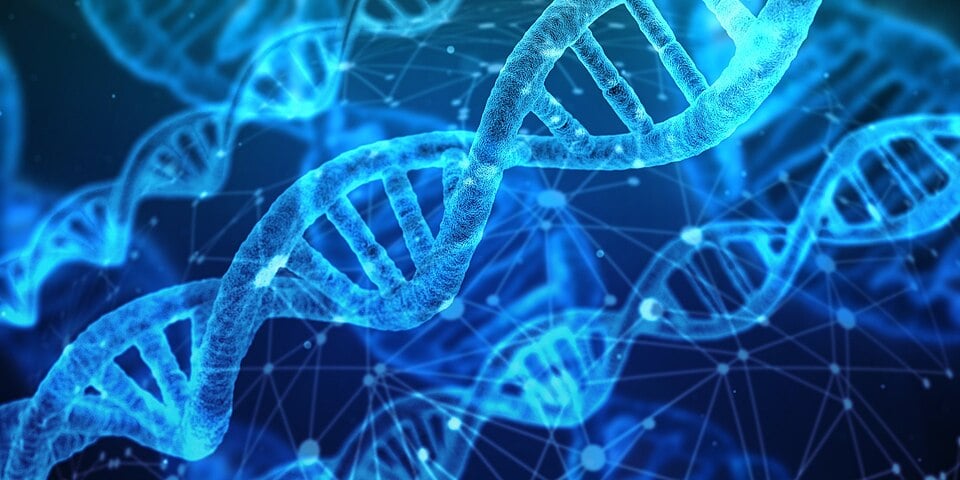
DNA strands. Source: Wikimedia commons, public domain.
General Christian
Health, Fitness and Religion
Previous Post

October 30, 2025
Of Ghosts and Religion
Next Post

December 15, 2025 The Reindeer Rule: Christmas and the Constitution
Recent Comments
"Thank you for this grounded, deeply necessary perspective. Shifting our framework from moralistic binaries to ..."
What You May Not Know About ..."
"Nonviolence is the weapon of the mighty and the strong. Violence is the weapon of ..."
Thomas Aquinas on the Morality of ..."
"Regarding Barbara O'Brien's article "Is Empathy a Weakness?" My answer in song is an emphatic ..."
""A government, which to bigotry gives no sanction." How far our government has fallen from ..."
George Washington’s Letter to Touro Synagogue
Browse Our Archives
Select a Category Buddhism Christianity Daoism Hinduism Indigenous religions Islam Judaism Mysticism New Age Origins of religion Paganism Popes Popular Religious Movements Protestantism Psychology and religion Religion and current events Religion and folklore Religion and News Media Religion and politics Religious Art and Music Religious Freedom Religious mistakes Religious philosophy Religious scriptures Religious Violence science and religion Spiritualism Technology and religion The Catholic Church The Dalai Lama The Reformation Uncategorized
Select a Month September 2026 August 2026 July 2026 June 2026 April 2026 March 2026 February 2026 January 2026 December 2025 November 2025 October 2025 September 2025 August 2025 July 2025 June 2025 May 2025 April 2025 March 2025 February 2025 January 2025 December 2024 November 2024 October 2024 September 2024 August 2024 July 2024 June 2024 May 2024 April 2024 March 2024 February 2024 January 2024 December 2023 November 2023 October 2023 September 2023 August 2023 July 2023 June 2023 May 2023 April 2023 March 2023 February 2023 January 2023 December 2022 November 2022 October 2022 September 2022 August 2022
Follow Us!
TAKE THE
Religious Wisdom Quiz
Who did God give the Ten Commandments to?
Select your answer to see how you score.
Abraham Joshua Noah Moses
Related posts from The Religious History Nerd

I Watched the Towers Fall. Here's What You...

Barring Mamdani From 9/11 Lets the Enemy Win

Is 'Separation of Church and State' Really a...

The President and the Pope: An Unprecedented Rift
TRENDING AT PATHEOS History and Religion

Swimfan: Forgotten Aughts Pleasures
This is a recovery effort. In 2002, My Big Fat Greek Wedding...

Top Three Anti-Catholic Lies About Catholicism
This is my initial transcript for the video, "THE 3 WORST...

Pope Leo Celebrates Mass for Nurses & Docs...
I don't have any idea how he did it, but Pope Leo...

The Sermon on the Mount, Part I: Matthew...
The Sermon on the Mount, Part I (Matthew 4:12-5:12) St. Matthew moves...

What's up from Crossway: Reviewing some of their latest A few weeks...

Janie Learns the Way of the Cross: A...
Teaching children about Jesus' Passion can be challenging. Many parents and educators...
view all History and Religion blogs
What Are Your Thoughts?leave a comment
Ad-Free & Subscriber Log-In Subscription Support
- About Us
- 2026 Calendar
- Videos
- Podcasts
- Library of World Religions
- Faith In Media Tracker
- Advertise With Us
- Write for Us
- Privacy Policy
- Terms of Service
- Do Not Sell My Data
- Contact Us
- Radiant Digital
- Manage Newsletter Subscriptions
- Unsubscribe From Notifications
- Sitemap
Copyright 2008-2026, Patheos. All rights reserved.
Subscription Support Ad-Free & Subscriber Log-In
Follow Patheos