
BuddhistCatholicContemplativeEvangelicalGeneral ChristianHinduJewishLatter-day SaintMuslimNew VisionsProgressive Christian
Beliefs
- Buddhist
- Catholic
- Contemplative
- Evangelical
- General Christian
- Hindu
- Jewish
- Latter-day Saint
- More Voices
- Muslim
- New Visions
- Pagan
- Progressive Christian
Topics
- Religion News
- Food and Religion
- Sports and Religion
- Religious Art
- Religious Music and Entertainment
- Religious Events
- History and Religion
- Style and Religion
- Politics and Religion
- Women in Religion
- Recreation Outdoors and Religion
- Business Finance and Religion
- Careers Workplace and Religion
- Education and Religion
- Family Parenting and Religion
- Health Fitness and Religion
- Home and Religion
- Relationships and Religion
- Technology and Religion
- Travel and Religion
Columnists
- Buddhist Columnists
- Business Finance and Religion Columnists
- Careers Workplace and Religion Columnists
- Catholic Columnists
- Contemplative Columnists
- Education and Religion Columnists
- Evangelists Columnists
- Family Parenting and Religion Columnists
- General Christian Columnists
- Health Fitness and Religion Columnists
- Hindu Columnists
- History and Religion Columnists
- Home and Religion Columnists
- Jewish Columnists
- More Voices Columnists
- Latter Day Columnists
- Muslim Columnists
- New Visions Columnists
- Nonreligious Columnists
- Pagan Columnists
- Politics and Religion Columnists
- Progressive Columnists
- Recreation Outdoors and Religion Columnists
- Relationships and Religion Columnists
- Religion News Columnists
- Religious Art Columnists
- Religious Events Columnists
- Religious Music and Entertainment Columnists
- Sports and Religion Columnists
- Style and Religion Columnists
- Technology and Religion Columnists
- Travel and Religion Columnists
- Women in Religion Columnists
Resource Library
- 2026 Calendar
- Library of World Religions
- The 100 Most Holy Places on Earth
- Patheos Answers
- Podcasts
- Videos
- Faith Leaders Database
- Anglican Episcopalian
- Bahai
- Baptist
- Buddhism
- Christianity
- Confucianism
- Eastern Orthodoxy
- Hinduism
- Holiness and Pentecostal
- ISKCON
- Islam
- Judaism
- Lutheran
- Methodist
- The Church of Jesus Christ of Latter-day Saints
- New Age
- Paganism
- Presbytarian and Reformed
- Protestantism
- Religion Behind the Scenes
- Roman Catholic
- Scientology
- Shia Islam
- Sikhism
- Sufism
- Sunni Islam
- Taoism
- Zen
- See all religions
Research Tools
 Ad-Free & Subscriber Log-In Subscription Support
Ad-Free & Subscriber Log-In Subscription Support
Follow Patheos 

- Trending:
- Forgiveness
- |
- Marriage
- |
- Consciousness
- |
- Death Penalty
- |
- Election
- |
- Halloween

- Home
- Buddhism
- History and Religion
- The Statue That Survived the Hiroshima Bomb
The Statue That Survived the Hiroshima Bomb
Last updated on: August 4, 2025 at 8:52 am by Barbara O'Brien
The Statue That Survived the Hiroshima Bomb 2025-08-04T08:52:49-05:00 Barbara O'Brien
Patheos Explore the world's faith through different perspectives on religion and spirituality! Patheos has the views of the prevalent religions and spiritualities of the world.
The statue stood on Hijirigaoka, a hill overlooking the Japanese city of Hiroshima. When the first atomic bomb fell on August 6, 1945, the statue was only a mile from the epicenter of the blast. Everything around it was obliterated. But the statue, of the revered Buddhist priest Shinran (1173-1262), remained intact. And it still stands today, but not in Japan. Today Shinran’s bronze eyes keep watch over a block on Riverside Drive in Manhattan, New York City. And here is the statue’s story.
The Hiroshima statue was one of six identical bronze statues of Shinran, who founded the Jodo Shinshu school of Buddhism. The statues were cast under the direction of Seiichi Hirose, a metalworks industrialist from Osaka. The Shinran statues, each 15 feet tall and weighing 1,300 pounds, were installed in six different Japanese cities in 1937 and 1938. They depict Shinran wearing the traditional robes and straw hat and sandals of a pilgrim. During World War II three of the six statues were seized by the government of Japan and melted down so that the bronze could be re-purposed for the war effort. The Hiroshima statue was left alone.
And then the bomb fell. Reddish burn marks are still visible on the statue, on the face and robes. I understand a tiny bit of radiation can be detected in the statue to this day, but not enough to harm anyone.
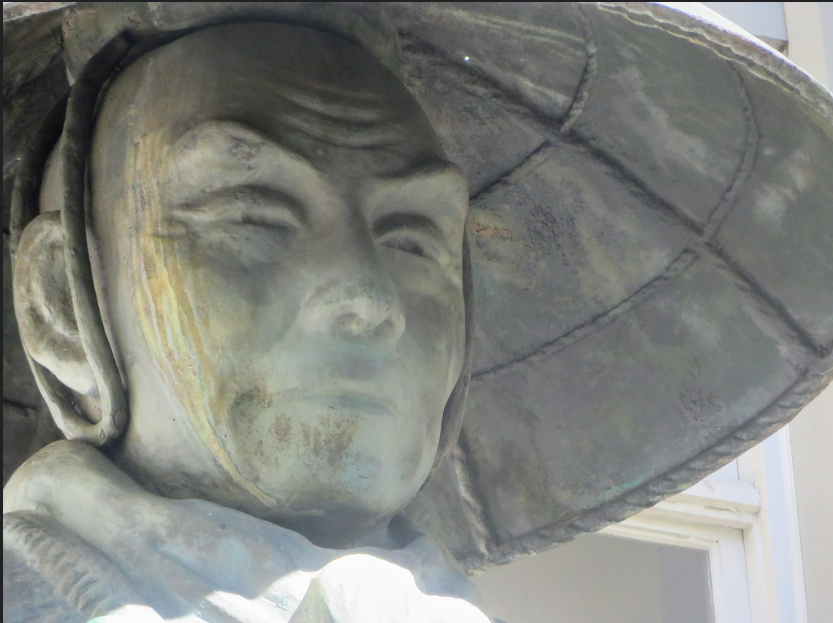
Face of the statue of Shinran Shonin that survived the Hiroshima bomb. Source: Janine and Jim Eden, Flckr, CC BY 2.0.
How Shinran’s Hiroshima Statue Came to New York
After the war, Seiichi Hirose chose to give the Hiroshima statue to what was then called the American Buddhist Academy in New York City (today it is called the American Buddhist Study Center) and the New York Buddhist Church, a Jodo Shinshu temple. Both were led by the Rev. Hozen Seki. The two men both intended the statue to be a gesture of peace, compassion, and harmony. So it was that in 1955 the statue was placed in an enormous wooden crate and shipped to New York City.
The statue was formally unveiled on September 11, 1955. The keynote speaker at the ceremony was D. T. Suzuki, whose prolific writings helped introduce Zen Buddhism to the West. Here is a little of what Suzuki said.
The present state of things as we are facing everywhere politically, economically, morally, intellectually, and spiritually is no doubt the result of our past thoughts and deeds we have committed as human beings through[out] the whole length of history, through aeons of existence, not only individually but collectively—let me repeat, collectively. As such, we are, every one of us, responsible for the present world situation filled with [its] awesome forebodings. The bombing of Hiroshima was not, after all, the doing of the American armies, but the doing of mankind as a whole, and as such, we, not only the Japanese and Americans but the whole world, are to be held responsible for the wholesale slaughter witnessed ten years ago.
This reminds me of something my first Zen teacher, the late John Daido Loori, used to say. Referring to whatever messiness was going on in the world, he’d remind us, “You are totally responsible for everything, the whole catastrophe.” This isn’t normally the way we sort reality in our heads, I know, but it’s consistent with Buddhist teaching. It’s one of those things you have to live with for a while to appreciate. After a time we stop viewing ourselves as either a winner or loser, perpetrator or victim, good guy or bad guy. We’re all responsible. We’re all in this mess together.
About Shinran and Jodo Shinshu Buddhism
Jodo Shinshu Buddhism, often called Shin Buddhism for short, is part of the Pure Land tradition of Buddhism. Pure Land originated in 5th century China and is the most common form of Buddhism in east Asia today. It is sometimes also called Amidism because of its focus on the Buddha Amitabha. Jodo Shinshu is known as a path of faith, but this is not faith in the sense of mere belief. It is a path of liberation that is centered on shinjin, a word that has no English equivalent. It is described as “deep trust in the heart-mind.” This reminds me a bit of the definition of faith offered by the Christian theologian Paul Tillich: “Faith is the state of being ultimately concerned,” Tillich wrote in his book Dynamics of Faith (1956). “Faith as ultimate concern is an act of the total personality. It happens in the center of the personal life and includes all its elements.” That may be approaching the neighborhood of shinjin.
Shinran Shonin (shonin is an honorific title, not a surname) was ordained a novice monk at the age of nine after the death of his parents. After his ordination he entered the great Tendai monastery Enryakuji, which I’ve written about before. Honen (1133-1212) was another Tendai monk who also had practiced for a time at Enryakuji. At some point Honen left for a smaller temple in Kyoto where he could focus on Pure Land. Honen kept Amitabha’s name in mind at all times, a practice supported by chanting the nembutsu for long periods of time. In 1201 Shinran left Enryakuji to become a disciple of Honen.
In 1206 two of Honen’s other students were accused of spending the night in the women’s quarters of the Emperor’s palace. The two were executed, and Honen and his other students were driven into exile. Shinran never saw Honen again.
Shinran found himself at the age of 35 alone and de-frocked. He’d been a monk since the age of 9, remember. However, he adjusted well enough to find a wife, Eshinni, with whom he would have six children. He was pardoned in 1211, but as a married man he couldn’t go back to being a monk. So he forged a radically different path. He and his family moved to the Kanto region, the central part of Japan’s main island of Honshu. And he began to teach a form of Buddhism that focused on households and not just monasteries. He broke with Honen’s doctrine of many recitations of the nembutsu and taught that the strength of shinjin was more important than the number of recitations. He spent much of the rest of his life traveling and teaching in people’s homes. The school of Buddhism he founded, Jodo Shinshu, is the largest in Japan.
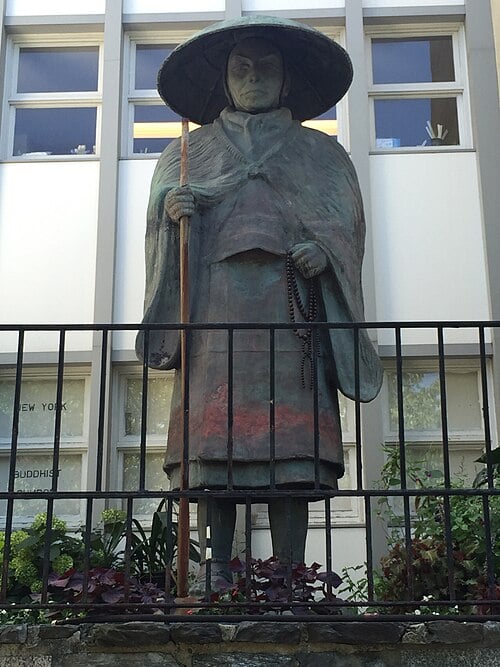
The statue of Shinran that survived Hiroshima in its current location on Riverside Drive, Manhattan. Source: Wikimedia Commons, by RegentsPark, CC BY-SA 4.0 license.
Buddhism
Education and Religion
Previous Post
July 27, 2025
Why Cambodia and Thailand Are Fighting Over a Hindu Temple
Next Post
September 1, 2025 The Ancient Origins of the Great Flood Story
Recent Comments
"Thank you for this grounded, deeply necessary perspective. Shifting our framework from moralistic binaries to ..."
What You May Not Know About ..."
"Nonviolence is the weapon of the mighty and the strong. Violence is the weapon of ..."
Thomas Aquinas on the Morality of ..."
"Regarding Barbara O'Brien's article "Is Empathy a Weakness?" My answer in song is an emphatic ..."
""A government, which to bigotry gives no sanction." How far our government has fallen from ..."
George Washington’s Letter to Touro Synagogue
Browse Our Archives
Select a Category Buddhism Christianity Daoism Hinduism Indigenous religions Islam Judaism Mysticism New Age Origins of religion Paganism Popes Popular Religious Movements Protestantism Psychology and religion Religion and current events Religion and folklore Religion and News Media Religion and politics Religious Art and Music Religious Freedom Religious mistakes Religious philosophy Religious scriptures Religious Violence science and religion Spiritualism Technology and religion The Catholic Church The Dalai Lama The Reformation Uncategorized
Select a Month September 2026 August 2026 July 2026 June 2026 April 2026 March 2026 February 2026 January 2026 December 2025 November 2025 October 2025 September 2025 August 2025 July 2025 June 2025 May 2025 April 2025 March 2025 February 2025 January 2025 December 2024 November 2024 October 2024 September 2024 August 2024 July 2024 June 2024 May 2024 April 2024 March 2024 February 2024 January 2024 December 2023 November 2023 October 2023 September 2023 August 2023 July 2023 June 2023 May 2023 April 2023 March 2023 February 2023 January 2023 December 2022 November 2022 October 2022 September 2022 August 2022
Follow Us!
TAKE THE
Religious Wisdom Quiz
Which Jewish festival commemorates the defeat of Haman?
Select your answer to see how you score.
Passover Pentecost Purim Booths
Related posts from The Religious History Nerd

Sarvastivada: An Extinct Buddhist Sect That's Still With...
A Goddess Who Swapped Bodies to Prove Gender...
The Beat Zen Movement: When Zen Became Cool
TRENDING AT PATHEOS History and Religion

Swimfan: Forgotten Aughts Pleasures
This is a recovery effort. In 2002, My Big Fat Greek Wedding...

Top Three Anti-Catholic Lies About Catholicism
This is my initial transcript for the video, "THE 3 WORST...

Pope Leo Celebrates Mass for Nurses & Docs...
I don't have any idea how he did it, but Pope Leo...

The Sermon on the Mount, Part I: Matthew...
The Sermon on the Mount, Part I (Matthew 4:12-5:12) St. Matthew moves...

What's up from Crossway: Reviewing some of their latest A few weeks...

Janie Learns the Way of the Cross: A...
Teaching children about Jesus' Passion can be challenging. Many parents and educators...
view all History and Religion blogs
What Are Your Thoughts?leave a comment
Ad-Free & Subscriber Log-In Subscription Support
- About Us
- 2026 Calendar
- Videos
- Podcasts
- Library of World Religions
- Faith In Media Tracker
- Advertise With Us
- Write for Us
- Privacy Policy
- Terms of Service
- Do Not Sell My Data
- Contact Us
- Radiant Digital
- Manage Newsletter Subscriptions
- Unsubscribe From Notifications
- Sitemap
Copyright 2008-2026, Patheos. All rights reserved.
Subscription Support Ad-Free & Subscriber Log-In
Follow Patheos