
BuddhistCatholicContemplativeEvangelicalGeneral ChristianHinduJewishLatter-day SaintMuslimNew VisionsProgressive Christian
Beliefs
- Buddhist
- Catholic
- Contemplative
- Evangelical
- General Christian
- Hindu
- Jewish
- Latter-day Saint
- More Voices
- Muslim
- New Visions
- Pagan
- Progressive Christian
Topics
- Religion News
- Food and Religion
- Sports and Religion
- Religious Art
- Religious Music and Entertainment
- Religious Events
- History and Religion
- Style and Religion
- Politics and Religion
- Women in Religion
- Recreation Outdoors and Religion
- Business Finance and Religion
- Careers Workplace and Religion
- Education and Religion
- Family Parenting and Religion
- Health Fitness and Religion
- Home and Religion
- Relationships and Religion
- Technology and Religion
- Travel and Religion
Columnists
- Buddhist Columnists
- Business Finance and Religion Columnists
- Careers Workplace and Religion Columnists
- Catholic Columnists
- Contemplative Columnists
- Education and Religion Columnists
- Evangelists Columnists
- Family Parenting and Religion Columnists
- General Christian Columnists
- Health Fitness and Religion Columnists
- Hindu Columnists
- History and Religion Columnists
- Home and Religion Columnists
- Jewish Columnists
- More Voices Columnists
- Latter Day Columnists
- Muslim Columnists
- New Visions Columnists
- Nonreligious Columnists
- Pagan Columnists
- Politics and Religion Columnists
- Progressive Columnists
- Recreation Outdoors and Religion Columnists
- Relationships and Religion Columnists
- Religion News Columnists
- Religious Art Columnists
- Religious Events Columnists
- Religious Music and Entertainment Columnists
- Sports and Religion Columnists
- Style and Religion Columnists
- Technology and Religion Columnists
- Travel and Religion Columnists
- Women in Religion Columnists
Resource Library
- 2026 Calendar
- Library of World Religions
- The 100 Most Holy Places on Earth
- Patheos Answers
- Podcasts
- Videos
- Faith Leaders Database
- Anglican Episcopalian
- Bahai
- Baptist
- Buddhism
- Christianity
- Confucianism
- Eastern Orthodoxy
- Hinduism
- Holiness and Pentecostal
- ISKCON
- Islam
- Judaism
- Lutheran
- Methodist
- The Church of Jesus Christ of Latter-day Saints
- New Age
- Paganism
- Presbytarian and Reformed
- Protestantism
- Religion Behind the Scenes
- Roman Catholic
- Scientology
- Shia Islam
- Sikhism
- Sufism
- Sunni Islam
- Taoism
- Zen
- See all religions
Research Tools
 Ad-Free & Subscriber Log-In Subscription Support
Ad-Free & Subscriber Log-In Subscription Support
Follow Patheos 

- Trending:
- Forgiveness
- |
- Marriage
- |
- Consciousness
- |
- Death Penalty
- |
- Election
- |
- Halloween

- Home
- Buddhism
- History and Religion
- The Dalai Lama’s 90th Birthday and What Happens Next
The Dalai Lama’s 90th Birthday and What Happens Next
Last updated on: July 3, 2025 at 10:07 am by Barbara O'Brien
The Dalai Lama’s 90th Birthday and What Happens Next 2025-07-03T10:07:49-05:00 Barbara O'Brien
Patheos Explore the world's faith through different perspectives on religion and spirituality! Patheos has the views of the prevalent religions and spiritualities of the world.
His Holiness the 14th Dalai Lama will be 90 years old on July 6, 2025. Celebrations of this auspicious event have already begun. I am not aware that the Dalai Lama has any particular health problems other than growing more frail. He may have a few years left. But his passing, when it comes, will not just be a sad day for Tibetan Buddhists. It will set off a messy power struggle between the government of China and Tibetan Buddhism over the identity of the next Dalai Lama.
On June 2, the Dalai Lama issued a statement saying there will be a reborn 15th Dalai Lama, and that he would be recognized by members of the Gaden Phrodrang Trust, which is the office of the Dalai Lama. China’s foreign ministry responded, saying that the Dalai Lama’s rebirth “must be approved by the central government.” Further, the ministry said, “The Chinese government implements a policy of freedom of religious belief, but there are regulations on religious affairs and methods for managing the reincarnation of Tibetan living Buddhas.” Here I want to explain the issue and why the world may someday have two Dalai Lamas — the one chosen by the Chinese Communist Party, and the one chosen by Tibetan Buddhism in exile.
Beijing has spent many years building its case that the Chinese Communist Party, and no one else, has the authority to recognize the next Dalai Lama. Tibetan Buddhists in exile disagree. Tibetan Buddhists in Tibet no doubt disagree also, but they don’t have the freedom to say so. Even to possess a photograph of the Dalai Lama can get one sentenced to prison. Beijing wants to control Tibetan Buddhism in order to better control Tibet. The leaders of China since Mao Zedong have believed that compliant and loyal high lamas will result in compliant and loyal Tibetans who do not stage uprisings every decade or so. And so, the government has taken control of the recognition of tulkus, or reborn Tibetan masters. In 2007 China’s Department of Religious Affairs even issued an order mandating that no one may claim recognition as a tulku without government approval. There is an official procedure for applying for recognition. So you can’t be reborn in China without a license.
Dalai Lamas and How to Recognize Them
Westerners are often confused about exactly what a Dalai Lama is. I’ve addressed the role of the Dalai Lama at length before; see especially “The First Dalai Lama.” They were never “god-kings,” as you may have heard. Although they have been revered as masters of the Buddha’s teachings, as heads of state most of the past Dalai Lamas were figureheads with limited power. And they really aren’t considered to be gods. But in Tibetan culture the Dalai Lama is something like the living embodiment of Tibet — its culture its history, its people — and of Tibetan Buddhism itself.
You may notice that I’m not using the word reincarnation in this essay. Reincarnation as it is usually understood — the transmigration of an individual soul into a new body to live another life — is not a Buddhist teaching. Many English-speaking Buddhists prefer to use the term rebirth instead of reincarnation for that reason. Certainly, you can find lay Buddhists who believe in the transmigration of souls, and also Buddhists who use the word reincarnation and mean something else by it. But the Buddha denied there is such a thing as an immortal, individual soul or autonomous essence of self that inhabits a body, so nothing “transmigrates.” Yet there is rebirth. The Tibetans usually explain rebirth as a continuation of consciousness rather than as a soul moving into a new body. As a Zen student, my understanding is that this consciousness is neither you nor not-you.
I’ve read biographies of the Dalai Lamas that describe how they were recognized, and this has been accomplished in many different ways. It appears to be a highly mystical process that involves rituals, astrology, pilgrimages to sacred sites, and the interpretations of dreams and omens. And sometimes Dalai Lamas leave clues. For example, one clue to the identity of the 7th Dalai Lama was a poem written by the 6th Dalai Lama. (The life stories of these two Dalai Lamas are wild; check them out.) Likely candidates are then examined to see if they exhibit some spark of Dalai Lama consciousness.
Rebirth and the Chinese Communist Party
In 1995 a small Tibetan boy was identified as the 11th Panchen Lama, the second-highest lama in Tibet. Shortly after that Chinese authorities “disappeared” the boy and his entire family. They have not been seen since. And then Beijing chose another boy to be Panchen Lama. The now-adult faux Panchen Lama has yet to be accepted as legitimate by Tibetans. However, establishing a Party-loyal Panchen Lama is essential to Beijing’s very long-term plan to claim sole authority to name the next Dalai Lama. The Dalai and Panchen lamas are of the same school, and traditionally they have been involved in recognizing the rebirths of each other. But today’s statement from the Dalai lama does not mention the Panchen Lama. The participation of a Panchen Lama is not essential to recognizing a new Dalai Lama.
The other part of Beijing’s claim involves the Golden Urn. I’ve written about the Golden Urn before; please see “The Golden Urn and the Succession of Dalai Lamas.” The Golden Urn has its own wild story that I’m not seeing in today’s news anywhere, but you can read all about it in my earlier post. Very briefly, in the 18th century a dispute between two high lamas who happened to be brothers broke out that escalated into a nasty war between Tibet and Nepal. The Qianlong Emperor of China (1711 – 1799), who was anxious to keep peace on his western border, sent troops to settle the matter. And then he demanded some reforms in Tibetan Buddhism. Among these was to choose the tulkus of high lamas by a kind of lottery. Candidates’ names were to be written on ivory slips and then drawn from an urn donated to Tibet for this purpose by the Emperor. However, historians doubt very much the Tibetans took this suggestion seriously. It’s believed the Golden Urn’s use was enforced for only a few decades. It’s certain it was not used to choose the Thirteenth and Fourteenth Dalai Lamas.
But the Chinese Communist Party insists that the Golden Urn lottery is the only legitimate way to choose a Dalai Lama. And someday when the Fourteenth’s time has ended, the faux Panchen Lama will be summoned to draw slips with names of Tibetan boys from the Golden Urn. The candidates will no doubt be sons of loyal Communist Party members. And Beijing will proclaim that the lottery winner is the 15th Dalai Lama. For another good analysis, see “The Golden Urn” from The Economist, 21 March 2015.
The 14th Dalai Lama
His Holiness Tenzin Gyatso, the 14th Dalai Lama, was born on July 6, 1935, to a farming family in the eastern Tibetan province of Amdo. He was recognized as the tulku of the 13th Dalai Lama in 1937. He was four years old when he was taken to Lhasa, the capitol of Tibet, and ceremonially enthroned. He spent the rest of his childhood in Potala, the main palace, and Norbulingka. the summer palace. While this sounds very posh, I understand most of his time would have been spent in studies of Buddhist scriptures and commentaries, plus learning all the elaborate rituals and other practices of his school of Buddhism.
Since the time of the 5th Dalai Lama, the Dalai Lamas had been the de jure heads of state of Tibet. While they were children the government was run by regents and sometimes by military leaders. And in fact even as adults most of the Dalai Lamas after the Great Fifth were figureheads and not the real political power in Tibet. The Thirteenth Dalai Lama had been a rare exception. Through the centuries many of the Dalai Lamas had a priest-and-patron relationship with emperors of China, and it was through that relationship that the emperors often meddled in Tibetan affairs related to Buddhism. But most academic scholars of Tibet will tell you that Tibet was not part of China or even a colony or possession of China. The last Chinese imperial dynasty fell in 1911, and the Republic of China was established in 1912. The 13th Dalai Lama issued a “declaration of independence” to clarify that at no time was Tibet ever a possession of China. With the end of the Qing dynasty, whatever relationship that existed between Tibet and China had faded “like a rainbow in the sky.”
Chinese leader Mao Zedong sent an army to take control of Tibet in 1950, when the young Dalai Lama was 15 years old. A few short weeks later, the Dalai Lama was invested with the authority to govern. The long-cloistered adolescent was suddenly a head of state and facing a monumental crisis. He chose to be cautious. For the next few years, he chose to accept Chinese oversight and work with Mao to modernize Tibet. But matters took a dark and violent turn in 1959, and the young Dalai Lama was forced into exile. I wrote about this in much more detail a few weeks ago; see “When the Dalai Lama Escaped Tibet.” Since 1959 the 14th Dalai Lama has lived in Dharamshala, Himachal Pradesh, India. A great many other Tibetans, including monks and the high lamas of major schools of Tibetan Buddhism, have also left Tibet. His Holiness formally relinquished any claim to political power in 2011, saying he preferred that Tibet be ruled by democratically elected leaders.
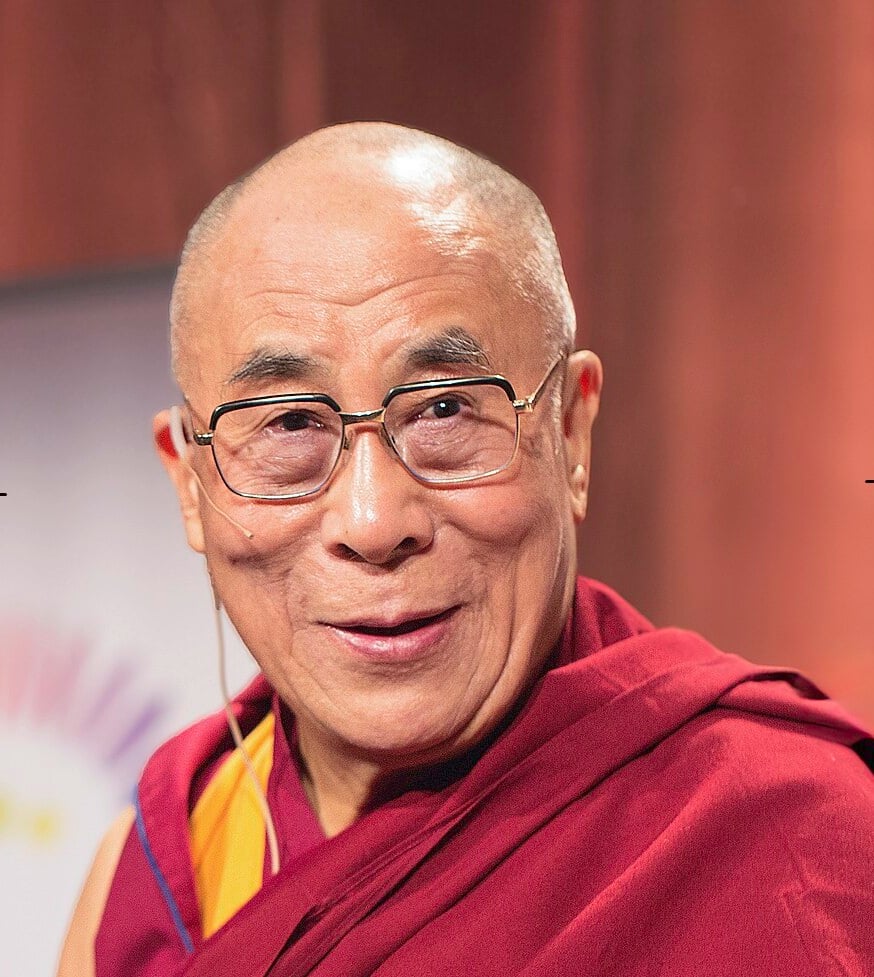
His Holiness the Dalai Lama in 2012. Photograph by Christopher Michel. Source: Wikimedia Commons, Creative Commons Attribution-Share Alike 4.0 International license.
Buddhism
Religion News
Previous Post
June 26, 2025
The Ten Commandments: Back to School?
Next Post
July 20, 2025 What Became of the Conversos of Spain?
Recent Comments
"Thank you for this grounded, deeply necessary perspective. Shifting our framework from moralistic binaries to ..."
What You May Not Know About ..."
"Nonviolence is the weapon of the mighty and the strong. Violence is the weapon of ..."
Thomas Aquinas on the Morality of ..."
"Regarding Barbara O'Brien's article "Is Empathy a Weakness?" My answer in song is an emphatic ..."
""A government, which to bigotry gives no sanction." How far our government has fallen from ..."
George Washington’s Letter to Touro Synagogue
Browse Our Archives
Select a Category Buddhism Christianity Daoism Hinduism Indigenous religions Islam Judaism Mysticism New Age Origins of religion Paganism Popes Popular Religious Movements Protestantism Psychology and religion Religion and current events Religion and folklore Religion and News Media Religion and politics Religious Art and Music Religious Freedom Religious mistakes Religious philosophy Religious scriptures Religious Violence science and religion Spiritualism Technology and religion The Catholic Church The Dalai Lama The Reformation Uncategorized
Select a Month September 2026 August 2026 July 2026 June 2026 April 2026 March 2026 February 2026 January 2026 December 2025 November 2025 October 2025 September 2025 August 2025 July 2025 June 2025 May 2025 April 2025 March 2025 February 2025 January 2025 December 2024 November 2024 October 2024 September 2024 August 2024 July 2024 June 2024 May 2024 April 2024 March 2024 February 2024 January 2024 December 2023 November 2023 October 2023 September 2023 August 2023 July 2023 June 2023 May 2023 April 2023 March 2023 February 2023 January 2023 December 2022 November 2022 October 2022 September 2022 August 2022
Follow Us!
TAKE THE
Religious Wisdom Quiz
Who said: "If we confess our sins, he is faithful and just and will forgive us our sins"?
Select your answer to see how you score.
Peter Jesus John Paul
Related posts from The Religious History Nerd

I Watched the Towers Fall. Here's What You...

Barring Mamdani From 9/11 Lets the Enemy Win

Sarvastivada: An Extinct Buddhist Sect That's Still With...

Is 'Separation of Church and State' Really a...
TRENDING AT PATHEOS History and Religion

Emotion in Early Christianity by Andrew Crislip
Andrew Crislip’s Emotion in Early Christianity examines an often overlooked dimension of...

16 Spiritual Touchstones for a More Grounded Life
After decades of spiritual study, here are 16 principles I try...

Catholic Evangelization: Sharing Your Faith Every Day
Welcome back to the Graceful Awakening mini-series called, “From Faith to Mission.” ...

The Pillar of the Boatmen: the Ancient Monument...
The Pillar of the Boatmen is a Romano-Gaulish sculpture that dates from...

In one sense walking into Westminster Abbey is like walking down the...

'Super Scam Me' Exposes AI Jon Bon Jovi...
Leslie Pickett believed she was in a relationship with Jon Bon Jovi....
view all History and Religion blogs
What Are Your Thoughts?leave a comment
Ad-Free & Subscriber Log-In Subscription Support
- About Us
- 2026 Calendar
- Videos
- Podcasts
- Library of World Religions
- Faith In Media Tracker
- Advertise With Us
- Write for Us
- Privacy Policy
- Terms of Service
- Do Not Sell My Data
- Contact Us
- Radiant Digital
- Manage Newsletter Subscriptions
- Unsubscribe From Notifications
- Sitemap
Copyright 2008-2026, Patheos. All rights reserved.
Subscription Support Ad-Free & Subscriber Log-In
Follow Patheos