
BuddhistCatholicContemplativeEvangelicalGeneral ChristianHinduJewishLatter-day SaintMuslimNew VisionsProgressive Christian
Beliefs
- Buddhist
- Catholic
- Contemplative
- Evangelical
- General Christian
- Hindu
- Jewish
- Latter-day Saint
- More Voices
- Muslim
- New Visions
- Pagan
- Progressive Christian
Topics
- Religion News
- Food and Religion
- Sports and Religion
- Religious Art
- Religious Music and Entertainment
- Religious Events
- History and Religion
- Style and Religion
- Politics and Religion
- Women in Religion
- Recreation Outdoors and Religion
- Business Finance and Religion
- Careers Workplace and Religion
- Education and Religion
- Family Parenting and Religion
- Health Fitness and Religion
- Home and Religion
- Relationships and Religion
- Technology and Religion
- Travel and Religion
Columnists
- Buddhist Columnists
- Business Finance and Religion Columnists
- Careers Workplace and Religion Columnists
- Catholic Columnists
- Contemplative Columnists
- Education and Religion Columnists
- Evangelists Columnists
- Family Parenting and Religion Columnists
- General Christian Columnists
- Health Fitness and Religion Columnists
- Hindu Columnists
- History and Religion Columnists
- Home and Religion Columnists
- Jewish Columnists
- More Voices Columnists
- Latter Day Columnists
- Muslim Columnists
- New Visions Columnists
- Nonreligious Columnists
- Pagan Columnists
- Politics and Religion Columnists
- Progressive Columnists
- Recreation Outdoors and Religion Columnists
- Relationships and Religion Columnists
- Religion News Columnists
- Religious Art Columnists
- Religious Events Columnists
- Religious Music and Entertainment Columnists
- Sports and Religion Columnists
- Style and Religion Columnists
- Technology and Religion Columnists
- Travel and Religion Columnists
- Women in Religion Columnists
Resource Library
- 2026 Calendar
- Library of World Religions
- The 100 Most Holy Places on Earth
- Patheos Answers
- Podcasts
- Videos
- Faith Leaders Database
- Anglican Episcopalian
- Bahai
- Baptist
- Buddhism
- Christianity
- Confucianism
- Eastern Orthodoxy
- Hinduism
- Holiness and Pentecostal
- ISKCON
- Islam
- Judaism
- Lutheran
- Methodist
- The Church of Jesus Christ of Latter-day Saints
- New Age
- Paganism
- Presbytarian and Reformed
- Protestantism
- Religion Behind the Scenes
- Roman Catholic
- Scientology
- Shia Islam
- Sikhism
- Sufism
- Sunni Islam
- Taoism
- Zen
- See all religions
Research Tools
 Ad-Free & Subscriber Log-In Subscription Support
Follow Patheos 

- Trending:
- Advent
- |
- Forgiveness
- |
- Thanksgiving
- |
- Election
- |
- Seasonal Holidays
- |
- Marriage

- Home
- Jewish
- History and Religion
- The Ten Commandments: Back to School?
The Ten Commandments: Back to School?
Last updated on: June 27, 2025 at 12:16 pm by Barbara O'Brien
The Ten Commandments: Back to School? 2025-06-27T12:16:12-05:00 Barbara O'Brien
Patheos Explore the world's faith through different perspectives on religion and spirituality! Patheos has the views of the prevalent religions and spiritualities of the world.
The crusade to enshrine the Ten Commandments in U.S. public schools reached a couple of landmarks in the past few days. Last week a panel of three federal appellate judges found Louisiana’s Ten Commandments law unconstitutional. A few hours after the Louisiana ruling was announced, Gov. Greg Abbott signed a nearly identical bill into law in Texas. This week lawsuits to stop the Texas bill are being filed. And many of these lawsuits are being filed by religious people, including Christian clergy. Here I want to look at the way these bills violate the free exercise of religion. And note that neither of these bills differs significantly from one passed in Kentucky in 1978 and declared unconstitutional by the U.S. Supreme Court in 1980.
Both states’ laws stipulate that the Ten Commandments must be prominently displayed in every primary and secondary public school classroom, no exceptions allowed. Both laws stipulate that the Commandments must be displayed so they can easily be read from any seat in the classroom. Further, both states have determined the precise wording of the Commandments. In both cases this wording appears to be condensed from the King James version of Exodus 20:1-17, with all the “thees” and “thous” intact.
Why Do Some Religious People Object to Ten Commandments in Schools?
I realize that many folks don’t see the harm. But many of the people who brought suits against the Louisiana law, and who are preparing suits against the Texas law, are religious people who say it violates their freedom of religion. One suit brought by a group of Christian and Nation of Islam faith leaders and families called the Texas law “a threat to the soul of both our democracy and our faith.” “The government should govern; the Church should minister,” the lawsuit said. These families don’t want the government teaching their children about religion.
Many religious people have problems with the state-sanctioned wording of the Ten Commandments. There are two versions of the Ten Commandments recorded in the Torah, in Exodus chapter 20 and in Deuteronomy chapter 5. These are very similar but not identical, and when you add variations in translations, the differences get bigger. Further, there are endless subtle variations in how these scriptures are interpreted. There is an accepted Jewish version of the Commandments that differs somewhat from most Christian versions. And the Catholic version differs from most Protestant versions. One of the objections to the Louisiana law, coming from both Jewish rabbis and Christian ministers, was that the official state version of the Commandments differed from the Commandments they wanted to teach their children.
Note that the Quran of Islam does not present a version of the Ten Commandments. Muslims say many verses in the Quran present the same teachings. Other major religions, such as Hinduism, Buddhism, and Sikhism, have their own moral codes with different emphases. Speaking for Buddhists, I can say the “God” parts of the Commandments are unacceptable for most of us. Note that some members of the Texas legislature offered an amendment that would have allowed the moral codes of other religions to be displayed in classrooms as well. This was voted down.
When a branch of government decides on an “official” version of scripture to teach children, this seems to me to be an obvious violation of the establishment clause of the First Amendment of the U.S. Constitution. It’s right up there with government deciding which prayers children should pray. This is a matter for childrens’ parents to decide, not government.
The Ten Commandments as Covenant
Father Richard J. Clifford, S.J., is a professor emeritus of Old Testament studies at Boston College. In the July/August 2025 issue of the Jesuit magazine America, he explains “Why the Ten Commandments should not be posted in public school classrooms.” Father Clifford writes that “the Bible itself contains the most powerful argument against making the Ten Commandments a moral guide for all citizens.” Understanding this requires looking at the context, the story of how God gave the Commandments to Moses and his people.
Father Clifford writes that, in context, it’s clear that “the Ten Commandments are the textual expression of a solemn covenant, a legal agreement, between the Lord and the people.” They were not intended for the Egyptians or other people mentioned in Exodus. And, Father Clifford explains, they were not intended to be universal laws given to everybody. In Jewish tradition there are universal laws given to everybody, such as the commands God gave Noah after the Flood. But in context the Ten Commandments were part of an agreement between God and the people Moses led out of Egypt, and no one else.
I realize a lot of Christians will disagree with this, and it’s not my place here to decide who is correct. But do be aware that there is a biblical argument that it’s wrong to push the Ten Commandments as binding on all human beings.
The Ten Commandments in American History?
The people who want the Ten Commandments displayed in every classroom argue that the Commandments are the basis of U.S. laws and were a vital part of U.S. history. This is nonsense. As I argued in an earlier post, The Ten Commandments and the Origins of Law, the Ten Commandments were not the first legal code in human history. In fact, some historians argue that the Commandments themselves were influenced by the earlier Law Code of Hammurabi, who reigned in Babylon from 1792 to 1758 BCE. And we have fragments of other law codes that are even older. U.S. law grew out of English law, and English law had many origins. Some of these include the laws of the old (and pagan) Roman Empire, for example. The English laws introduced into the North American colonies mostly developed from Norman law, which itself was influenced by Viking law. There is simply no historical dotted line going directly from the Ten Commandments to U.S. law.
As far as U.S. history is concerned, there’s no question Christianity was a significant influence. But the Ten Commandments don’t belong exclusively to Christians — they’re from Jewish scripture, folks. And speaking as an American history nerd, I just don’t see the Ten Commandments as having any unique place in U.S. history. As far as American history is concerned, the Commandments are just one small thread in a huge and complex tapestry. If I were to choose one text to enshrine in every classroom, I’d suggest Lincoln’s Gettysburg Address, or the opening section of the Declaration of Independence. Or even the preamble to the Constitution.
These new laws will no doubt end up with the Supreme Court eventually. How the current Court will rule is impossible to predict.
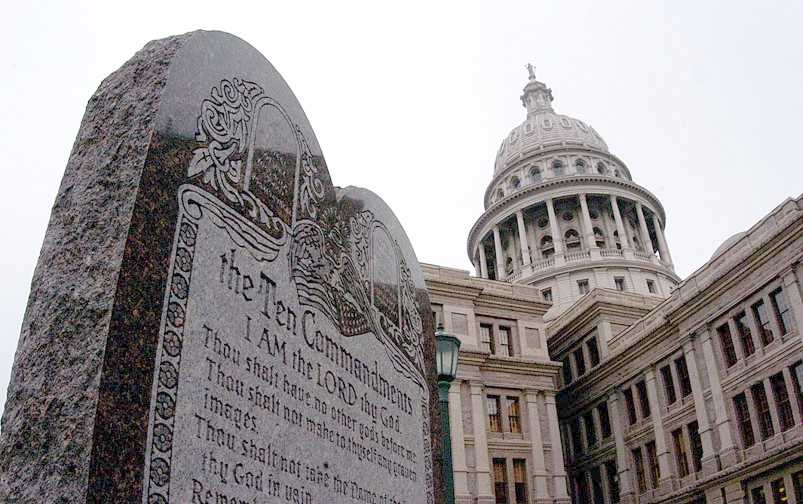
A Ten Commandments display outside the Texas state capitol building in Austin. Source: Public Domain Image from Texas Attorney General’s website news release, courtesy Wikimedia Commons.
Jewish
General Christian
Education and Religion
Previous Post

June 11, 2025
Religious Orientation: Are You Intrinsic or Extrinsic?
Next Post

July 2, 2025 The Dalai Lama's 90th Birthday and What Happens Next
Recent Comments
"Evil is indeed hard to pin down to any source other then what is reflected ..."
"Thank you for this grounded, deeply necessary perspective. Shifting our framework from moralistic binaries to ..."
What You May Not Know About ..."
"Nonviolence is the weapon of the mighty and the strong. Violence is the weapon of ..."
Thomas Aquinas on the Morality of ..."
"Regarding Barbara O'Brien's article "Is Empathy a Weakness?" My answer in song is an emphatic ..."
Browse Our Archives
Select a Category Buddhism Christianity Daoism Hinduism Indigenous religions Islam Jaina Judaism Mysticism New Age Origins of religion Paganism Popes Popular Religious Movements Protestantism Psychology and religion Religion and current events Religion and folklore Religion and News Media Religion and politics Religious Art and Music Religious Freedom Religious mistakes Religious philosophy Religious scriptures Religious Violence science and religion Spiritualism Technology and religion The Catholic Church The Dalai Lama The Reformation Uncategorized
Select a Month November 2026 October 2026 September 2026 August 2026 July 2026 June 2026 April 2026 March 2026 February 2026 January 2026 December 2025 November 2025 October 2025 September 2025 August 2025 July 2025 June 2025 May 2025 April 2025 March 2025 February 2025 January 2025 December 2024 November 2024 October 2024 September 2024 August 2024 July 2024 June 2024 May 2024 April 2024 March 2024 February 2024 January 2024 December 2023 November 2023 October 2023 September 2023 August 2023 July 2023 June 2023 May 2023 April 2023 March 2023 February 2023 January 2023 December 2022 November 2022 October 2022 September 2022 August 2022
Follow Us!
TAKE THE
Religious Wisdom Quiz
How many days did God take to create the world?
Select your answer to see how you score.
Six Seven Ten Five
Related posts from The Religious History Nerd

I Watched the Towers Fall. Here's What You...

Barring Mamdani From 9/11 Lets the Enemy Win

Is 'Separation of Church and State' Really a...
The President and the Pope: An Unprecedented Rift
TRENDING AT PATHEOS History and Religion

More Than a Meal: A Messianic Thanksgiving
A Messianic Thanksgiving What if Thanksgiving became more than a meal to...

The Darkening of the Sun, Moon, and Stars
The darkening of the sun and moon and the falling of stars...

Gratitude as the Parent of All Virtues
Giving thanks stems from gratitude. Cicero said that gratitude is the parent...

Make Thanksgiving Bring Family Closer
Written by Dr. David K. Ewen from Eternal Truth Bible College Start...

Ghosts, Spirits, and Wizards in Post-Puritan New England
As it is Thanksgiving, I have a seasonal post concerned with New...

Here are two Thanksgiving columns that I originally wrote for the...
view all History and Religion blogs
What Are Your Thoughts?leave a comment
Ad-Free & Subscriber Log-In Subscription Support
- About Us
- 2026 Calendar
- Videos
- Podcasts
- Library of World Religions
- Faith In Media Tracker
- Advertise With Us
- Write for Us
- Privacy Policy
- Terms of Service
- Do Not Sell My Data
- Contact Us
- Radiant Digital
- Manage Newsletter Subscriptions
- Unsubscribe From Notifications
- Sitemap
Copyright 2008-2026, Patheos, part of the Radiant Digital network of media brands. All rights reserved.
Subscription Support Ad-Free & Subscriber Log-In
Follow Patheos