
BuddhistCatholicContemplativeEvangelicalGeneral ChristianHinduJewishLatter-day SaintMuslimNew VisionsProgressive Christian
Beliefs
- Buddhist
- Catholic
- Contemplative
- Evangelical
- General Christian
- Hindu
- Jewish
- Latter-day Saint
- More Voices
- Muslim
- New Visions
- Pagan
- Progressive Christian
Topics
- Religion News
- Food and Religion
- Sports and Religion
- Religious Art
- Religious Music and Entertainment
- Religious Events
- History and Religion
- Style and Religion
- Politics and Religion
- Women in Religion
- Recreation Outdoors and Religion
- Business Finance and Religion
- Careers Workplace and Religion
- Education and Religion
- Family Parenting and Religion
- Health Fitness and Religion
- Home and Religion
- Relationships and Religion
- Technology and Religion
- Travel and Religion
Columnists
- Buddhist Columnists
- Business Finance and Religion Columnists
- Careers Workplace and Religion Columnists
- Catholic Columnists
- Contemplative Columnists
- Education and Religion Columnists
- Evangelists Columnists
- Family Parenting and Religion Columnists
- General Christian Columnists
- Health Fitness and Religion Columnists
- Hindu Columnists
- History and Religion Columnists
- Home and Religion Columnists
- Jewish Columnists
- More Voices Columnists
- Latter Day Columnists
- Muslim Columnists
- New Visions Columnists
- Nonreligious Columnists
- Pagan Columnists
- Politics and Religion Columnists
- Progressive Columnists
- Recreation Outdoors and Religion Columnists
- Relationships and Religion Columnists
- Religion News Columnists
- Religious Art Columnists
- Religious Events Columnists
- Religious Music and Entertainment Columnists
- Sports and Religion Columnists
- Style and Religion Columnists
- Technology and Religion Columnists
- Travel and Religion Columnists
- Women in Religion Columnists
Resource Library
- 2026 Calendar
- Library of World Religions
- The 100 Most Holy Places on Earth
- Patheos Answers
- Podcasts
- Videos
- Faith Leaders Database
- Anglican Episcopalian
- Bahai
- Baptist
- Buddhism
- Christianity
- Confucianism
- Eastern Orthodoxy
- Hinduism
- Holiness and Pentecostal
- ISKCON
- Islam
- Judaism
- Lutheran
- Methodist
- The Church of Jesus Christ of Latter-day Saints
- New Age
- Paganism
- Presbytarian and Reformed
- Protestantism
- Religion Behind the Scenes
- Roman Catholic
- Scientology
- Shia Islam
- Sikhism
- Sufism
- Sunni Islam
- Taoism
- Zen
- See all religions
Research Tools
 Ad-Free & Subscriber Log-In Subscription Support
Ad-Free & Subscriber Log-In Subscription Support
Follow Patheos 

- Trending:
- Forgiveness
- |
- Marriage
- |
- Consciousness
- |
- Death Penalty
- |
- Election
- |
- Halloween

- Home
- Buddhism
- History and Religion
- Buddhist Holidays in December: A Short and Confusing Guide
Buddhist Holidays in December: A Short and Confusing Guide
Last updated on: December 3, 2024 at 6:29 pm by Barbara O'Brien
Buddhist Holidays in December: A Short and Confusing Guide 2024-12-03T18:29:55-06:00 Barbara O'Brien
Patheos Explore the world's faith through different perspectives on religion and spirituality! Patheos has the views of the prevalent religions and spiritualities of the world.
The world’s many religions observe many holy days in December other than Christmas and Hanukkah. One December Buddhist holiday is Bodhi Day, which commemorates the enlightenment of the Buddha. (Bodhi is a Sanskrit word that means “awakening.”) Just about any web search will tell you that Bodhi Day is December 8.
But before you send a Happy Bodhi Day card to your Thai friends, note that this particular date and holiday generally applies only to Japanese Buddhism. In some parts of Asia the holiday is on the eighth day of the twelfth lunar month, and (as I write this) the next time that happens will be January 7, 2025. And in other parts of Asia the Buddha’s enlightenment is commemorated some time in the spring, along with his birthday and passing into final nirvana (parinirvana).
Japan adopted the Gregorian calendar in 1873 as part of the Meiji Restoration and chose standard calendar dates for special Buddhist days. It may be that Buddhists in other places are moving in the direction of fixed calendar dates also, but it hasn’t yet been done officially, I don’t believe.
Observing Bodhi Day
In the Japanese Zen tradition the day is called Rohatsu, which I understand means “the eighth day of the twelfth month.” In Zen monasteries around the world there will be a week-long, and silent, intensitve meditation retreat leading up to Rohatsu. Participants will meditate through the night of December 7-8. I have done Rohatsu retreats, and they do give new meaning to the word “intensive.” If this sounds like something you’d like to try, be advised you will need some less-intensive experience with Zen practice and retreats first. It’s not for beginners.
Bodhi Day is observed in a variety of ways in other traditions. It’s a time for studying and chanting sutras (scriptures), careful observance of Buddhist Precepts, and kindness toward all beings. The Buddha’s enlightenment is the foundation of the tradition, so Bodhi Day is a time to rededicate ourselves to living as the Buddha taught us to live. For more on the Buddha’s awakening, or enlightenment, please see “How Many Days Did Buddha Sit Under the Bodhi Tree?” See also “Shakyamuni’s Enlightenment & Ours: A Zen Priest Reflects on Bodhi Day” by James Ford.
Bodhi Day, Whenever
It’s also the case that Bodhi Day, whenever it’s held, is a strictly Mahayana holy day. Mahayana is the dominant form of Buddhism in east Asia — China, Korea, Taiwan, Japan. Vietnam is mostly Mahayana but has some Theravada also. Theravada Buddhism is the dominant form in Sri Lanka, Myanmar, Laos, Thailand, and Cambodia. The third major classification is Vajrayana, which takes in Tibetan Buddhism and a few other schools. See “The Quest for Original Buddhism” for a brief explanation of how these three divisions developed.
The Theravadins have folded all the primary events of the Buddha’s life into one really big holiday, called Vesak or Wesak. This commemorates the birth, enlightenment, and death — or passing into final Nirvana — of the Buddha. Vesak is the only Buddhist holiday recognized by the United Nations, so it’s a big deal. Vesak happens during the full moon of the fourth lunar month, which falls in the spring. The next Vesak is May 11 or 12, 2025, depending on country. In southeast Asian countries Vesak is both cultural and religious, and it is often a public holiday. Vesak is observed in a rich variety of ways. Temples and homes often are decorated with lights; people send Vesak cards to each other.
Tibetan Buddhists also observe the Buddha’s birth, enlightenment, and death all together in a holiday called Saga Dawa. The Tibetan lunar calendar doesn’t always line up with the rest of Asia, and Saga Dawa is often — although not always, I don’t think — a month after Vesak. Saga Dawa 2025 is on June 11.
Getting Back to December
There is another December Buddhist holiday called Unduvap Poya or Sanghamitta Day, which is observed by Buddhists in Sri Lanka. This one falls on December 15 in 2024. Unduvap Poya is determined by a lunar calendar, so the calendar date changes from year to year, but it seems to often fall in December. I understand some Buddhists who have moved away from Sri Lanka are now combining Unduvap Poya with Christmas.
Unduvap Poya commemorates the arrival in Sri Lanka of Princess Sanghamitta, daughter of Emperor Ashoka of India. The Princess, an ordained nun, came to establish a Buddhist nuns’ order in Sri Lanka. She also brought a sapling of the original Bodhi Tree under which the Buddha was sitting when he realized enlightenment. An ancient tree in Anuradhapura, Sri Lanka, is believed to be the tree that grew from that sapling, planted about 245 BCE.
And in Tibet …
Tibetan Buddhism appears to have several special days in December, all determined by lunar calendar. I see that Lama Tsongkhapa Day is on December 25 in 2024. Lama Tsongkhapa Losang Drakpa (1357–1419) was one of the great teachers of Tibet, and the day commemorates his passing into final nirvana. There is also a Dakini Day on December 25 to celebrate dakinis, iconic characters — sometimes called goddesses — who embody divinity and enlightenment in feminine form. There are several Dakini Days every year, I believe.
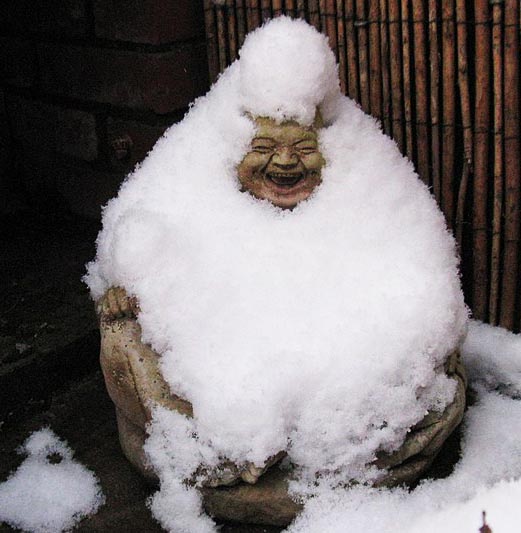
A laughing Buddha in the snow. Photo by S. Rae. Source: Wikimedia Commons, cc-by-2.0. license.
Buddhism
Religious Events
Previous Post

November 26, 2024
Abraham Lincoln's Thanksgiving
Next Post
December 6, 2024 Was There a Historical Buddha?
Recent Comments
"Thank you for this grounded, deeply necessary perspective. Shifting our framework from moralistic binaries to ..."
What You May Not Know About ..."
"Nonviolence is the weapon of the mighty and the strong. Violence is the weapon of ..."
Thomas Aquinas on the Morality of ..."
"Regarding Barbara O'Brien's article "Is Empathy a Weakness?" My answer in song is an emphatic ..."
""A government, which to bigotry gives no sanction." How far our government has fallen from ..."
George Washington’s Letter to Touro Synagogue
Browse Our Archives
Select a Category Buddhism Christianity Daoism Hinduism Indigenous religions Islam Judaism Mysticism New Age Origins of religion Paganism Popes Popular Religious Movements Protestantism Psychology and religion Religion and current events Religion and folklore Religion and News Media Religion and politics Religious Art and Music Religious Freedom Religious mistakes Religious philosophy Religious scriptures Religious Violence science and religion Spiritualism Technology and religion The Catholic Church The Dalai Lama The Reformation Uncategorized
Select a Month September 2026 August 2026 July 2026 June 2026 April 2026 March 2026 February 2026 January 2026 December 2025 November 2025 October 2025 September 2025 August 2025 July 2025 June 2025 May 2025 April 2025 March 2025 February 2025 January 2025 December 2024 November 2024 October 2024 September 2024 August 2024 July 2024 June 2024 May 2024 April 2024 March 2024 February 2024 January 2024 December 2023 November 2023 October 2023 September 2023 August 2023 July 2023 June 2023 May 2023 April 2023 March 2023 February 2023 January 2023 December 2022 November 2022 October 2022 September 2022 August 2022
Follow Us!
TAKE THE
Religious Wisdom Quiz
What does Paul tell the Philippians to work out with fear and trembling?
Select your answer to see how you score.
Your calling Your salvation Your ministry Your faith
Related posts from The Religious History Nerd

Sarvastivada: An Extinct Buddhist Sect That's Still With...
A Goddess Who Swapped Bodies to Prove Gender...
TRENDING AT PATHEOS History and Religion

The Iron Gates and the Lion of the...
Yesterday, I didn't finish my report about, well, yesterday. So I'll...

Dolly Parton’s Last Song Wins Dove Award with...
Bluegrass band The Grascals, speaking on the red carpet at the 57th...

The Image: On the Horror of Capitalism and...
The Image Then went the Pharisees, and took counsel how they might...

We are approaching the date of our new American national holiday: October...

Letters on Living the Faith by C.S. Lewis
Most of us met C.S. Lewis as a public intellectual. Mere Christianity....

When Halloween Unmasks Married Hearts
Written by Dr. David K. Ewen from Eternal Truth Bible College Behind...
view all History and Religion blogs
What Are Your Thoughts?leave a comment
Ad-Free & Subscriber Log-In Subscription Support
- About Us
- 2026 Calendar
- Videos
- Podcasts
- Library of World Religions
- Faith In Media Tracker
- Advertise With Us
- Write for Us
- Privacy Policy
- Terms of Service
- Do Not Sell My Data
- Contact Us
- Radiant Digital
- Manage Newsletter Subscriptions
- Unsubscribe From Notifications
- Sitemap
Copyright 2008-2026, Patheos. All rights reserved.
Subscription Support Ad-Free & Subscriber Log-In
Follow Patheos