
BuddhistCatholicContemplativeEvangelicalGeneral ChristianHinduJewishLatter-day SaintMuslimNew VisionsProgressive Christian
Beliefs
- Buddhist
- Catholic
- Contemplative
- Evangelical
- General Christian
- Hindu
- Jewish
- Latter-day Saint
- More Voices
- Muslim
- New Visions
- Pagan
- Progressive Christian
Topics
- Religion News
- Food and Religion
- Sports and Religion
- Religious Art
- Religious Music and Entertainment
- Religious Events
- History and Religion
- Style and Religion
- Politics and Religion
- Women in Religion
- Recreation Outdoors and Religion
- Business Finance and Religion
- Careers Workplace and Religion
- Education and Religion
- Family Parenting and Religion
- Health Fitness and Religion
- Home and Religion
- Relationships and Religion
- Technology and Religion
- Travel and Religion
Columnists
- Buddhist Columnists
- Business Finance and Religion Columnists
- Careers Workplace and Religion Columnists
- Catholic Columnists
- Contemplative Columnists
- Education and Religion Columnists
- Evangelists Columnists
- Family Parenting and Religion Columnists
- General Christian Columnists
- Health Fitness and Religion Columnists
- Hindu Columnists
- History and Religion Columnists
- Home and Religion Columnists
- Jewish Columnists
- More Voices Columnists
- Latter Day Columnists
- Muslim Columnists
- New Visions Columnists
- Nonreligious Columnists
- Pagan Columnists
- Politics and Religion Columnists
- Progressive Columnists
- Recreation Outdoors and Religion Columnists
- Relationships and Religion Columnists
- Religion News Columnists
- Religious Art Columnists
- Religious Events Columnists
- Religious Music and Entertainment Columnists
- Sports and Religion Columnists
- Style and Religion Columnists
- Technology and Religion Columnists
- Travel and Religion Columnists
- Women in Religion Columnists
Resource Library
- 2026 Calendar
- Library of World Religions
- The 100 Most Holy Places on Earth
- Patheos Answers
- Podcasts
- Videos
- Faith Leaders Database
- Anglican Episcopalian
- Bahai
- Baptist
- Buddhism
- Christianity
- Confucianism
- Eastern Orthodoxy
- Hinduism
- Holiness and Pentecostal
- ISKCON
- Islam
- Judaism
- Lutheran
- Methodist
- The Church of Jesus Christ of Latter-day Saints
- New Age
- Paganism
- Presbytarian and Reformed
- Protestantism
- Religion Behind the Scenes
- Roman Catholic
- Scientology
- Shia Islam
- Sikhism
- Sufism
- Sunni Islam
- Taoism
- Zen
- See all religions
Research Tools
 Ad-Free & Subscriber Log-In Subscription Support
Ad-Free & Subscriber Log-In Subscription Support
Follow Patheos 

- Trending:
- Forgiveness
- |
- Marriage
- |
- Consciousness
- |
- Death Penalty
- |
- Election
- |
- Halloween

- Home
- General Christian
- History and Religion
- The Thanksgiving Myth
The Thanksgiving Myth
Last updated on: November 23, 2024 at 6:54 am by Barbara O'Brien
The Thanksgiving Myth 2024-11-23T06:54:49-06:00 Barbara O'Brien
Patheos Explore the world's faith through different perspectives on religion and spirituality! Patheos has the views of the prevalent religions and spiritualities of the world.
The Thanksgiving myth is the Thanksgiving story that we Americans were taught in school as history. But the story as commonly told isn’t exactly true. And for some Native Americans, Thanksgiving is a day of mourning.
The traditional story is about the Pilgrims, who had sailed to the New World from Europe. Their ship the Mayflower landed in Cape Cod, Massachusetts, in November 1620. The Pilgrims struggled to survive the winter, but they received help from the local Native Americans. The Native Americans also taught the newcomers how to succcessfully raise crops in the New World. And in the fall of 1621 the Pilgrims and Native Americans enjoyed a harvest feast together, which was the First Thanksgiving.
This story has been celebrated every fall in American schools with songs and pageants and classrooms decorated with crayon drawings of turkeys. The 19th century illustration below, with a helpful Native American offering what might be corn (or possibly a pie?) to a family of newly arrived Pilgrims is emblematic of the myth. The real story is more complicated and much darker.
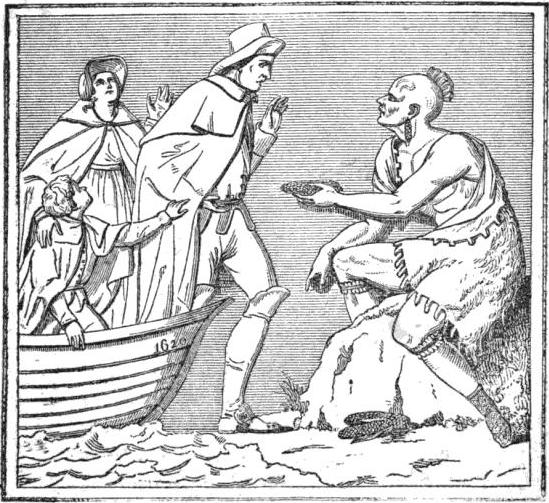
“Landing of the Pilgrims,” an 1848 illustration by Gilbert and Gibbons. Source: Wikimedia Commons, public domain.
The Thanksgiving Myth: The Pilgrims
The Pilgrims were members of the English Separatist Church. They had separated from the Church of England, which they believed to be corrupt. The Church of England was the established church of England, however, and citizens were supposed to attend its services and follow its teachings. Those who refused were subject to fines and imprisonment. So the Separatists/Pilgrims left England to find religious freedom and moved to … the Dutch Republic. The Dutch Republic was something of a haven for people of minority religions at the time. The Thanksgiving myth tells us that the Pilgrims came to the New World to find religious freedom, but in fact they had already found it.
Note that the Pilgrims were part of a larger movement that also included the Puritans, another group who would settle in Massachusettss. The major difference between the Pilgrims and Puritans was that the Puritans hoped to reform — or purify — the Church of England rather than separate from it.
The Pilgrims left the Dutch Republic because they found Dutch culture too permissive, and also because they were having a hard time earning a living. But sailing to the territory claimed by England in North America was a major enterprise that required a land patent, or grant, from the King’s government. It also required investors. These eventually were obtained. The original Pilgrim colonists set sail in two ships, but when one proved to be unsound a smaller group crossed the Atlantic on just one, the Mayflower. Of the 102 colonists who endured the cramped voyage aboard the Mayflower, only 35 were actual Pilgrims. The remainder were hired by the company sponsoring the voyage to protect the company’s investments.
They called their new home Plymouth.
The Thanksgiving Myth: The Wampanoag
The Wampanoag people are the Native Americans in our story. From the website of the National Museum of the American Indian:
The Wampanoag were a people with a sophisticated society who had occupied the region for thousands of years. They had their own government, their own religious and philosophical beliefs, their own knowledge system, and their own culture. They were also a people for whom giving thanks was a part of daily life.
When the Mayflower landed there were many Wampanoag communities in the region, each with its own sachem or chief. And they had already crossed paths with the English. In 1614, about 20 Wampanoag men had been lured onto a ship and then captured and sold into slavery in Spain. One man, Tisquantum, who was called Squanto by the English, was able to return in 1619. He found that two-thirds of his people had been killed by an epidemic after contact with the English. Historians believe the disease was either smallpox or yellow fever, previously unknown in North America.
As the Pilgrims and company men came ashore and struggled through their first winter, the Wampanoag watched from a distance. Half of the English died that winter, of starvation, disease, and cold. But then the Great Sachem or Massasoit, Ousamequin, made a fateful decision. He needed to keep peace with, and possibly defend his people from, a neighboring indigenous nation, the Narragansetts. And there were too few of his people remaining for defense. The English had firearms. Perhaps they would be allies. So it was that Ousamequin made contact with the English in the spring of 1621.
A Harvest Feast, Then War
With the help and advice of the Wampanoag the newcomers did have a successful harvest in the fall of 1621. And they organized a celebratory feast. But they did not invite the Wampanoag. During the celebration some Englishmen fired muskets, and soon a party of Wampanoag warriors arrived, armed for battle. When they realized the English neighbors were having a party, the warriors brought more food — venison, fish, eels, possibly cranberries — and joined in. There is no record of roast turkey consumed that day, however. And there is no record the feast was called “Thanksgiving” at the time.
The feast may have been the high point of the Wampanoag-English relationship. Over the next few years more settlers from Europe arrived, causing more encroachment on tribal lands. After the The Pequot War (1636-1638) several New England colonies, including Plymouth and Massachusetts Bay, formed a confederation for defense against Native Americans. The colonials began to treat all Native Americans as an enemy.
In 1675 Plymouth Colony judged three Wampanoag men guilty of murder, and hanged them. This enflamed the Wampanoag against the English. The new Great Sachem, Metacom, began leading raids against the colonists. Metacom was known more widely as Philip, sometimes King Philip. The war between the colonists and the Wampanoag is called King Philip’s War, and it’s considered among the bloodiest conflicts in the recorded history of North America. The end result was the decimation of the Wampanoag and other indigenous people.
The Making of the Myth
In his book This Land Is Their Land: The Wampanoag Indians, Plymouth Colony, and the Troubled History of Thanksgiving, historian David Silverman wrote there was little remembrance of the 1621 harvest feast until the 19th century. In 1841 a Unitarian minister and amateur historian, the Rev. Alexander Young, learned of the harvest feast and inclluded a description of it in a book called Chronicles of the Pilgrim Fathers. And the Rev. Young called the harvest feast “Thanksgiving.” The story, or a version of it, became more widely known. President Abraham Lincoln made Thanksgiving a national holidy in 1863.
Still, according to Silverman, the Thanksgiving story of the 1621 feast didn’t become the big deal it is now until late in the 19th century and into the early 20th century. This was a time in which unprecedented numbers of immigrants were coming to the U.S., many of them Catholics and Jews. This was also when the Indian Wars were coming to a close. The old stock White Protestants seized the Thanksgiving story as an essential part of America’s founding, in part as a way to underscore WASP — White Anglo-Sason Protestant — supremacy. And this was a story of Native Americans welcoming the noble and Protestant Pilgrims and practically inviting the Pilgrims to take over the land.
So it was that American schoolchildren ever after have spent a large part of every November rehearsing Thanksgiving pageants and decorating their classrooms with crayon turkeys.
Postscript
The Wampanoag did not disappear. Parts of the Wampanoag nation have found themselves fighting for recognition as tribes, however. Just this month the Herring Pond Wampanoag Tribe, which is headquartered in Plymouth, received state recognition as a historic and continually present Indigenous tribe. You can read about it at “Healey grants Herring Pond Wampanoag Tribe state recognition” by Katie Cole at Vermont Public.
General Christian
Religious Events
Previous Post
November 15, 2024
Ashoka's Edict on Religious Tolerance
Next Post
November 26, 2024 Abraham Lincoln's Thanksgiving
Recent Comments
"Thank you for this grounded, deeply necessary perspective. Shifting our framework from moralistic binaries to ..."
What You May Not Know About ..."
"Nonviolence is the weapon of the mighty and the strong. Violence is the weapon of ..."
Thomas Aquinas on the Morality of ..."
"Regarding Barbara O'Brien's article "Is Empathy a Weakness?" My answer in song is an emphatic ..."
""A government, which to bigotry gives no sanction." How far our government has fallen from ..."
George Washington’s Letter to Touro Synagogue
Browse Our Archives
Select a Category Buddhism Christianity Daoism Hinduism Indigenous religions Islam Judaism Mysticism New Age Origins of religion Paganism Popes Popular Religious Movements Protestantism Psychology and religion Religion and current events Religion and folklore Religion and News Media Religion and politics Religious Art and Music Religious Freedom Religious mistakes Religious philosophy Religious scriptures Religious Violence science and religion Spiritualism Technology and religion The Catholic Church The Dalai Lama The Reformation Uncategorized
Select a Month September 2026 August 2026 July 2026 June 2026 April 2026 March 2026 February 2026 January 2026 December 2025 November 2025 October 2025 September 2025 August 2025 July 2025 June 2025 May 2025 April 2025 March 2025 February 2025 January 2025 December 2024 November 2024 October 2024 September 2024 August 2024 July 2024 June 2024 May 2024 April 2024 March 2024 February 2024 January 2024 December 2023 November 2023 October 2023 September 2023 August 2023 July 2023 June 2023 May 2023 April 2023 March 2023 February 2023 January 2023 December 2022 November 2022 October 2022 September 2022 August 2022
Follow Us!
TAKE THE
Religious Wisdom Quiz
Which chapter of Genesis recounts the genealogy from Adam to Noah?
Select your answer to see how you score.
Genesis 10 Genesis 5 Genesis 2 Genesis 7
Related posts from The Religious History Nerd

I Watched the Towers Fall. Here's What You...

Barring Mamdani From 9/11 Lets the Enemy Win

Is 'Separation of Church and State' Really a...

The President and the Pope: An Unprecedented Rift
TRENDING AT PATHEOS History and Religion

Methodist Central Hall and Westminster Abbey
Situated on the same square is Methodist Central Hall and Westminster Abbey. ...

57th Dove Awards Honor Dolly Parton, Crown New...
On gospel music’s biggest night, the 57th annual GMA Dove Awards honored...

The First Eucharistic Controversy: Christ’s Real Presence
For Catholics, the Eucharist is the source and summit of the Christian...

What a Stop Sign Can Teach Us About...
How to Make a Decision When You Can't Hear God Main point:...

Archdiocese Hosts Military Marriage Retreat in Germany
RASTATT, Germany — The transient military lifestyle, with its frequent deployments and...

Nearly every morning, I make the drive to Detroit with my high-school-age...
view all History and Religion blogs
What Are Your Thoughts?leave a comment
Ad-Free & Subscriber Log-In Subscription Support
- About Us
- 2026 Calendar
- Videos
- Podcasts
- Library of World Religions
- Faith In Media Tracker
- Advertise With Us
- Write for Us
- Privacy Policy
- Terms of Service
- Do Not Sell My Data
- Contact Us
- Radiant Digital
- Manage Newsletter Subscriptions
- Unsubscribe From Notifications
- Sitemap
Copyright 2008-2026, Patheos. All rights reserved.
Subscription Support Ad-Free & Subscriber Log-In
Follow Patheos