
BuddhistCatholicContemplativeEvangelicalGeneral ChristianHinduJewishLatter-day SaintMuslimNew VisionsProgressive Christian
Beliefs
- Buddhist
- Catholic
- Contemplative
- Evangelical
- General Christian
- Hindu
- Jewish
- Latter-day Saint
- More Voices
- Muslim
- New Visions
- Pagan
- Progressive Christian
Topics
- Religion News
- Food and Religion
- Sports and Religion
- Religious Art
- Religious Music and Entertainment
- Religious Events
- History and Religion
- Style and Religion
- Politics and Religion
- Women in Religion
- Recreation Outdoors and Religion
- Business Finance and Religion
- Careers Workplace and Religion
- Education and Religion
- Family Parenting and Religion
- Health Fitness and Religion
- Home and Religion
- Relationships and Religion
- Technology and Religion
- Travel and Religion
Columnists
- Buddhist Columnists
- Business Finance and Religion Columnists
- Careers Workplace and Religion Columnists
- Catholic Columnists
- Contemplative Columnists
- Education and Religion Columnists
- Evangelists Columnists
- Family Parenting and Religion Columnists
- General Christian Columnists
- Health Fitness and Religion Columnists
- Hindu Columnists
- History and Religion Columnists
- Home and Religion Columnists
- Jewish Columnists
- More Voices Columnists
- Latter Day Columnists
- Muslim Columnists
- New Visions Columnists
- Nonreligious Columnists
- Pagan Columnists
- Politics and Religion Columnists
- Progressive Columnists
- Recreation Outdoors and Religion Columnists
- Relationships and Religion Columnists
- Religion News Columnists
- Religious Art Columnists
- Religious Events Columnists
- Religious Music and Entertainment Columnists
- Sports and Religion Columnists
- Style and Religion Columnists
- Technology and Religion Columnists
- Travel and Religion Columnists
- Women in Religion Columnists
Resource Library
- 2026 Calendar
- Library of World Religions
- The 100 Most Holy Places on Earth
- Patheos Answers
- Podcasts
- Videos
- Faith Leaders Database
- Anglican Episcopalian
- Bahai
- Baptist
- Buddhism
- Christianity
- Confucianism
- Eastern Orthodoxy
- Hinduism
- Holiness and Pentecostal
- ISKCON
- Islam
- Judaism
- Lutheran
- Methodist
- The Church of Jesus Christ of Latter-day Saints
- New Age
- Paganism
- Presbytarian and Reformed
- Protestantism
- Religion Behind the Scenes
- Roman Catholic
- Scientology
- Shia Islam
- Sikhism
- Sufism
- Sunni Islam
- Taoism
- Zen
- See all religions
Research Tools
 Ad-Free & Subscriber Log-In Subscription Support
Ad-Free & Subscriber Log-In Subscription Support
Follow Patheos 

- Trending:
- Forgiveness
- |
- Marriage
- |
- Consciousness
- |
- Death Penalty
- |
- Election
- |
- Halloween

- Home
- Buddhism
- History and Religion
- Zen and the Martial Arts: A Short History
Zen and the Martial Arts: A Short History
Last updated on: August 21, 2024 at 7:13 pm by Barbara O'Brien
Zen and the Martial Arts: A Short History 2024-08-21T19:13:37-05:00 Barbara O'Brien
Patheos Explore the world's faith through different perspectives on religion and spirituality! Patheos has the views of the prevalent religions and spiritualities of the world.
Everyone knows that Zen and the martial arts go together, right? Well, sorta kinda. In some places. But not as much as you might think.
This is not to say that there is no connection at all between Zen and the martial arts. Zen is the Japanese name of a school of Buddhism that originated in China, where it is called Chan. According to legend if not well-documented history, Chan began in the fabled Shaolin Temple of China at the beginning of the 6th century, give or take. The Shaolin Temple is a real place that really truly is known for martial arts training and its own style of kung fu. See “A Brief History of China’s Shaolin Temple” for details.
The Buddhist temples of long-ago China were often targeted by bandits, and it was the responsibility of the resident monks of all Buddhist schools to defend them. The Shaolin Temple monks took defense preparation further and made martial arts practice part of their Buddhist monastic training. They were so famous as warriors they were sometimes called upon to defend dynasties and rid the coast of China of pirates. But there is no evidence this emphasis on martial arts was replicated to the same degree in other Chan temples in China.
Zen and the Martial Arts in Japan
Although Buddhism reached Japan in the 6th century, the Chan tradition didn’t arrive in Japan until the late 12th and 13th centuries. And in Japan it became known as Zen. (There is also Korean Zen, called Seon or Sŏn, and Vietnamese Zen, called Thiền. Note that there are historical connections between martial arts and Korean Buddhism, but these date to at least a couple of centuries before the Chan school was introducted to the Korean peninsula. If there is any special connection between Buddhism and Vietnamese martial arts, I have not found mention of it anywhere.)
The introduction of Zen to Japan closely coincided with the ascension of the first shogun in 1192. From 1192 to 1868 the shoguns, hereditary military dictators, were the real power in Japan. There was also a succession of emperors, who were greatly revered but who had little say in the actual government. And during the rule of the shoguns the samurai were the nobility, at the top of the social, cultural, and political hierachies. Samurai were not just fighters but also people born into a hereditary military class. Everyone born into a samurai family, including the women and children, were part of that class. It was rare — but not utterly impossible — for someone not born a samurai to become one.
It’s recorded that, at least for a time, many samurai supported Zen temples and practiced with Zen teachers, most often of the Rinzai school. (Rinzai and Soto Zen are the two oldest and largest schools of Zen in Japan.) It’s also true that some ordained Zen monks were known to be masters of Japanese martial arts, such as kendo, the art of swords, and kyudo, the art of archery. However, in Japan these martial arts are more associated with Shinto than with Zen. Indeed, there is evidence that most of the connection between the martial arts and Zen came through the influence of Shinto. And through the centuries it has been more common for Zen monks to take up poetry, painting, gardening, and the tea ceremony than martial arts.
A Note on Mushin
One bit of Zen teaching that really did imprint itself on Japanese martial arts is mushin, which literally means “no mind.” Mushin is from the Chinese wuxin, a term that turns up in Chan texts beginning in about the 7th century. Wuxin also appears in the 4th century BCE Daoist classic the Zhuangzi, so it has deep Chinese roots. Mushin is the state of being so completely absorbed in what you are doing that you become the activity. You don’t have to think about it, in other words.
Mushin is closely related to what sports psychologists call flow. Per Wikipedia, “flow is characterized by the complete absorption in what one does, and a resulting transformation in one’s sense of time. Flow is the melting together of action and consciousness.” Which is a fine definition of mushin, I say. The sports psychologists seem to believe they invented this, but it’s mushin. And the teaching of mushin has long permeated Asian martial arts. Zen students are encouraged to cultivate mushin in all activities. Such mental cultivation prepares the mind for breakthroughs in understanding.
A Note About the Sohei
The Sohei are sometimes defined as Japanese Buddhist warrior monks. Whether they were really monks is aguable, however. As in China, temples in Japan were sometimes targeted by bandits and needed to be defended. In about the 10th century the big temple complex Enryakuji, featured in the last post, began to hire mercentaries to defend it. These mercenaries were required to live in the temples and dress as monks, shaved head and all, and keep the monastic schedule. This was possibly so that they caused no disturbance. But it’s not clear whether they took monastic vows.
Soon other temples began to hire mercenaries also. Before long these mercenaries amounted to the temples’ own private armies. Today’s historians say they weren’t so much monks as hired thugs. And their duties went beyond temple defense. Disputes between temples sometimes were settled by combat. It was not unheard of for sohei to be dispatched to a rival temple to burn it down. During the the Genpei War (1180–1185), the Buddhist establishment favored the Minamoto clan against its rival and sent sohei to fight for the Minamoto. The practice of Buddhist temples hiring mercenaries was ended by the Shogun Tokugawa Ieyasu in 1603. But that’s another long story.
I bring up the sohei because I’ve run into commentary recently that assumes the sohei were Zen monks who were martial arts masters. They were not. In fact, I’ve found no mention of a Zen temple in Japan that made use of sohei at all. I believe most of the temples that used them were of the Tendai school.
A Myth Is Born
Zen was first introduced to the West in the World Parliament of Religions in Chicago, 1893. One of the attendees was a Rinzai Zen master named Soyen Shaku. As a result of that visit, one of Soyen Shaku’s students named D.T. Suzuki (1870-1966) moved to LaSalle, Illinois, in 1897 to work for a publisher there and translate Buddhist and other Asian texts into English. Over the next several decades Suzuki’s many books, articles, and lectures on Zen helped to introduce Zen to the wider world. A handful of other Zen teachers and scholars also came to the U.S. in the early 20th century.
Among the first books about Zen published in English was Religion of the Samurai: A Study of Zen Philosophy and Discipline in China and Japan (1913), written by Nukariya Kaiten (1867–1934), a Soto Zen priest and university professor who gave lectures at Harvard. The book describes Soto Zen as catering almost exclusively to samurai. D.T. Suzuki also released a book called Zen and the Samurai, which “explores Zen Buddhism as it applies to the life of the warrior,” according to the publisher. Readers learned that samurai warriors practiced Zen to be able to face death, and that the famous Code of Bushido that guided the lives of samurai was influenced by Zen.
Um, not so much. Soto Zen certainly received patronage from the samurai class but was never exclusively or even mostly associated with the samurai. More recent historians tell us that samurai who practiced Buddhism at all followed many different schools, not just Zen. And if there is any influence of Zen in the Code of Bushido I don’t see it, and I’ve been a Zen student since 1988. The thing sounds more Confucian than Zen to me.
How Did This Happen?
The introduction of Zen to the West coincided with the the Meiji period (1868–1912). In 1867 the last Shogun resigned and returned governing power to the Emperor. The young Meiji emperor quickly transformed Japan into a modern nation that could compete with the western powers. Feudalism was rapidly replaced by industrialization. The economy, banking system, and other institutions were brought into line with western practices. And the samurai class was abolished. Within a single generation Japan was utterly transformed. It was a remarkable accomplishment. Yet, understandably, the militaristic culture that was suddenly gone was remembered with romantic nostalia.
The Meiji era was devastating to Japanese Buddhism. As I wrote in an earlier post,
Further, the government saw Japan’s Buddhist institutions as obstacles to modernization and began to suppress Buddhism. Many clergy were forcibly laicized, and monastery lands were confiscated. This touched off a series of violent attacks on temples, led by nativists and others resentful of Buddhism’s privileged position during the Tokugawa shogunate. Many temples were destroyed, along with the art in them. Although this violent period was short lived, it had long-term effects. [“How the Meiji Period Changed Japanese Buddhism“]
It was not long after this period that people like Nukariya Kaiten and D.T. Suzuki were, shall we say, over-selling the connections between samurai martial arts and Zen Buddhism. The events in their recent past probably made them feel Zen needed defending. Again, I’m not saying there were no connections at all, just that martial arts weren’t as big a deal to Japanese Zen as the books claimed. And as time went on there were more books, such as the best-seller Zen and the Art of Archery by Eugen Herrigel (1948). Readers of that book might be surprised to learn that the archery master Awa Kenzo, who plays a central role in the book, had no formal connection to Zen. And the philosophy expressed in the book isn’t all that zennish.
Conclusion
Basically, the connection between Zen and the martial arts became much enhanced in popular imagination over what it actually was. See also “A Not-So Brief History of Zen and Samurai” for some nerdy details on the subject. For more on the history of Zen in Japan, and elsewhere, see my book The Circle of the Way: A Concise History of Zen from the Buddha to the Modern World, published by Shambhala.
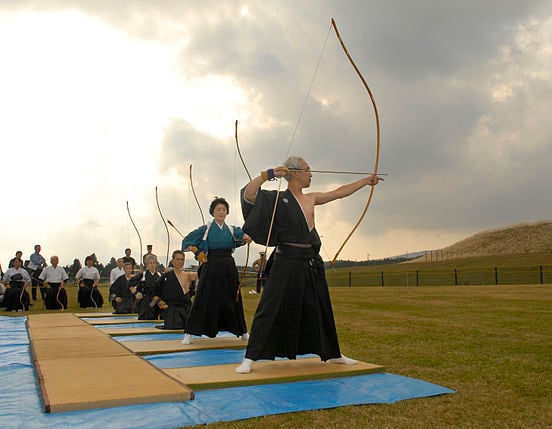
Members of the Gotemba Kyudo Association demonstrate Kyudo, or “the way of archery.” Source: Wikimedia Commons, public domain.
Buddhism
Sports and Religion
Previous Post
August 1, 2024
The Marathon Monks of Japan
Next Post

September 11, 2024 Civil Religion: A Short History
Recent Comments
"Thank you for this grounded, deeply necessary perspective. Shifting our framework from moralistic binaries to ..."
What You May Not Know About ..."
"Nonviolence is the weapon of the mighty and the strong. Violence is the weapon of ..."
Thomas Aquinas on the Morality of ..."
"Regarding Barbara O'Brien's article "Is Empathy a Weakness?" My answer in song is an emphatic ..."
""A government, which to bigotry gives no sanction." How far our government has fallen from ..."
George Washington’s Letter to Touro Synagogue
Browse Our Archives
Select a Category Buddhism Christianity Daoism Hinduism Indigenous religions Islam Judaism Mysticism New Age Origins of religion Paganism Popes Popular Religious Movements Protestantism Psychology and religion Religion and current events Religion and folklore Religion and News Media Religion and politics Religious Art and Music Religious Freedom Religious mistakes Religious philosophy Religious scriptures Religious Violence science and religion Spiritualism Technology and religion The Catholic Church The Dalai Lama The Reformation Uncategorized
Select a Month September 2026 August 2026 July 2026 June 2026 April 2026 March 2026 February 2026 January 2026 December 2025 November 2025 October 2025 September 2025 August 2025 July 2025 June 2025 May 2025 April 2025 March 2025 February 2025 January 2025 December 2024 November 2024 October 2024 September 2024 August 2024 July 2024 June 2024 May 2024 April 2024 March 2024 February 2024 January 2024 December 2023 November 2023 October 2023 September 2023 August 2023 July 2023 June 2023 May 2023 April 2023 March 2023 February 2023 January 2023 December 2022 November 2022 October 2022 September 2022 August 2022
Follow Us!
TAKE THE
Religious Wisdom Quiz
What does "Jezreel" mean?
Select your answer to see how you score.
God sows God defends God reigns God fights
Related posts from The Religious History Nerd

Sarvastivada: An Extinct Buddhist Sect That's Still With...

A Goddess Who Swapped Bodies to Prove Gender...

The Beat Zen Movement: When Zen Became Cool
TRENDING AT PATHEOS History and Religion

Emotion in Early Christianity by Andrew Crislip
Andrew Crislip’s Emotion in Early Christianity examines an often overlooked dimension of...

16 Spiritual Touchstones for a More Grounded Life
After decades of spiritual study, here are 16 principles I try...

Catholic Evangelization: Sharing Your Faith Every Day
Welcome back to the Graceful Awakening mini-series called, “From Faith to Mission.” ...

The Pillar of the Boatmen: the Ancient Monument...
The Pillar of the Boatmen is a Romano-Gaulish sculpture that dates from...

In one sense walking into Westminster Abbey is like walking down the...

'Super Scam Me' Exposes AI Jon Bon Jovi...
Leslie Pickett believed she was in a relationship with Jon Bon Jovi....
view all History and Religion blogs
What Are Your Thoughts?leave a comment
Ad-Free & Subscriber Log-In Subscription Support
- About Us
- 2026 Calendar
- Videos
- Podcasts
- Library of World Religions
- Faith In Media Tracker
- Advertise With Us
- Write for Us
- Privacy Policy
- Terms of Service
- Do Not Sell My Data
- Contact Us
- Radiant Digital
- Manage Newsletter Subscriptions
- Unsubscribe From Notifications
- Sitemap
Copyright 2008-2026, Patheos. All rights reserved.
Subscription Support Ad-Free & Subscriber Log-In
Follow Patheos