
BuddhistCatholicContemplativeEvangelicalGeneral ChristianHinduJewishLatter-day SaintMuslimNew VisionsProgressive Christian
Beliefs
- Buddhist
- Catholic
- Contemplative
- Evangelical
- General Christian
- Hindu
- Jewish
- Latter-day Saint
- More Voices
- Muslim
- New Visions
- Pagan
- Progressive Christian
Topics
- Religion News
- Food and Religion
- Sports and Religion
- Religious Art
- Religious Music and Entertainment
- Religious Events
- History and Religion
- Style and Religion
- Politics and Religion
- Women in Religion
- Recreation Outdoors and Religion
- Business Finance and Religion
- Careers Workplace and Religion
- Education and Religion
- Family Parenting and Religion
- Health Fitness and Religion
- Home and Religion
- Relationships and Religion
- Technology and Religion
- Travel and Religion
Columnists
- Buddhist Columnists
- Business Finance and Religion Columnists
- Careers Workplace and Religion Columnists
- Catholic Columnists
- Contemplative Columnists
- Education and Religion Columnists
- Evangelists Columnists
- Family Parenting and Religion Columnists
- General Christian Columnists
- Health Fitness and Religion Columnists
- Hindu Columnists
- History and Religion Columnists
- Home and Religion Columnists
- Jewish Columnists
- More Voices Columnists
- Latter Day Columnists
- Muslim Columnists
- New Visions Columnists
- Nonreligious Columnists
- Pagan Columnists
- Politics and Religion Columnists
- Progressive Columnists
- Recreation Outdoors and Religion Columnists
- Relationships and Religion Columnists
- Religion News Columnists
- Religious Art Columnists
- Religious Events Columnists
- Religious Music and Entertainment Columnists
- Sports and Religion Columnists
- Style and Religion Columnists
- Technology and Religion Columnists
- Travel and Religion Columnists
- Women in Religion Columnists
Resource Library
- 2026 Calendar
- Library of World Religions
- The 100 Most Holy Places on Earth
- Patheos Answers
- Podcasts
- Videos
- Faith Leaders Database
- Anglican Episcopalian
- Bahai
- Baptist
- Buddhism
- Christianity
- Confucianism
- Eastern Orthodoxy
- Hinduism
- Holiness and Pentecostal
- ISKCON
- Islam
- Judaism
- Lutheran
- Methodist
- The Church of Jesus Christ of Latter-day Saints
- New Age
- Paganism
- Presbytarian and Reformed
- Protestantism
- Religion Behind the Scenes
- Roman Catholic
- Scientology
- Shia Islam
- Sikhism
- Sufism
- Sunni Islam
- Taoism
- Zen
- See all religions
Research Tools
 Ad-Free & Subscriber Log-In Subscription Support
Ad-Free & Subscriber Log-In Subscription Support
Follow Patheos 

- Trending:
- Forgiveness
- |
- Marriage
- |
- Consciousness
- |
- Death Penalty
- |
- Election
- |
- Halloween

- Home
- General Christian
- History and Religion
- What Does “Teaching the Bible” Really Mean?
What Does “Teaching the Bible” Really Mean?
Last updated on: July 7, 2024 at 7:35 pm by Barbara O'Brien
What Does “Teaching the Bible” Really Mean? 2024-07-07T19:35:03-05:00 Barbara O'Brien
Patheos Explore the world's faith through different perspectives on religion and spirituality! Patheos has the views of the prevalent religions and spiritualities of the world.
“Teaching the Bible” — what does that mean? Now that the state of Oklahoma had decided that the Bible must be taught in all schools — and not just as literature — we may want to think very specifically about what “teaching the Bible” entails. And we also need to discuss whether it should be taught to all American children, both Christian and non-Christian. This policy is likely to spread to many other states, so if you live in the U.S. don’t assume it won’t touch you and your family if you don’t live in Oklahoma.
On June 27, Oklahoma State Superintendent of Public Instruction Ryan Walters issued a directive saying that all Oklahoma schools are required to incorporate the Bible and the Ten Commandments in their curriculums, in grades 5 through 12, effective immediately. Teachers who refuse to comply will lose their license to teach. This is from the memo issued by Walters to announce the policy:
The Bible is one ofthe most historically significant books and a comerstone of Western civilization, along with the Ten Commandments. They will be referenced as an appropriate study of history, civilization, ethics, comparative religion, or the ike, as well as for their substantial influence on our nation’s founders and the foundational principles of our Consiitution. This is not merely an educational directive but a crucial step in ensuring our students grasp the core values and historical context of our country.
Someone might inform Ryan Walters that the Ten Commandments are part of the Bible, not a separate text, but let’s go on …
When Teaching the Bible, Exactly What Is Taught?
What, precisely, are Oklahoma teachers supposed to teach regarding the Bible? From his memo, and from subsequent interviews, it appears Ryan Walters’s primary concern is that children be taught how the Bible was a significant influence on the nation’s founding, including its laws and government. For example, Walters said this in a PBS interview:
We have issued this guidance, and we are issuing additional guidance to classroom on specificity in the upcoming weeks. So we have standards that are in place that talk about that our teachers are to teach the role religion played in the classroom. We have since seen that they are not doing that. They are not talking about in their classroom the role that the Bible played in American history.
The role the Bible played in American history? Not just religion, but the Bible specifically?
So we will be offering additional guidance to districts that they will have to comply with, which is to ensure the teaching of our standards and the role the Bible played in American history, dating back pre-Constitution, whether it’s Mayflower Compact, the pilgrims, all the way up through Martin Luther King Jr. and civil rights movement, where he repeatedly quotes the Bible as a directive for what he’s trying to do there.
Quotes from the Bible do turn up in American historical documents, speeches, and events from time to time, And Christianity did play a role in American history, because Christianity has been the dominant religion from the Colonial period to today. It’s also fair to say the Bible is part of America’s religious and cultural fabric. But it’s one thing to teach how religious movements and institutions impacted American history and culture, and something else entirely to teach scripture. And I question whether Ryan Walters has thought this out clearly.
About the Mayflower Compact
Let’s look at one of Walters’s examples, the Mayflower Compact. The Mayflower Compact was composed and adopted in 1620 by Pilgrim men aboard the ship Mayflower after it had landed in Massachusetts. The Compact was intended to provide the Pilgrims with some semblance of civil government in a place with no courts or constables. The Mayblower Compact was the first document establishing some sort of self-government in the North American colonies, which does give it historical significance.
And here is the Mayflower Compact.
In the name of God, Amen. We whose names are underwritten, the loyal subjects of our dread sovereign lord King James, by the grace of God, of Great Britain, France, and Ireland King, Defender of the Faith, etc.
Having undertaken, for the glory of God, and advancement of the Christian faith, and honor of our king and country, a voyage to plant the first colony in the northern parts of Virginia, do by these presents solemnly and mutually in the presence of God and one of another, covenant, and combine ourselves together into a civil body politic, for our better ordering and preservation, and furtherance of the ends aforesaid; and by virtue hereof to enact, constitute, and frame such just and equal laws, ordinances, acts, constitutions, offices from time to time, as shall be thought most meet and convenient for the general good of the colony: unto which we promise all due submission and obedience. In witness whereof we have hereunder subscribed our names; Cape Cod, the 11th of November, in the year of the reign of our sovereign lord King James, of England, France and Ireland eighteenth and of Scotland fifty-fourth, Anno Domini 1620.
That’s all of it, not counting signatures. And there is nothing in it specifically about or from the Bible. If you use your imagination you might be able to connect “advancement of the Christian faith” to Matthew 28:19 (“Therefore go and make disciples of all nations, baptizing them in the name of the Father and of the Son and of the Holy Spirit,”), but that’s all I’ve got. So exactly how does one “teach the Bible” about the Mayflower Compact?
About the Pilgrims
The Pilgrims were English Calvinists who wanted separation from the established Church of England. After spending some time exiled in Holland, they traveled to the British colonies in North America to establish their own Congregationalist mini-theocracy. The Pilgrims were just one of many groups, some religious and some not, who settled in North America during the colonial period. The most significant thing to know about the Pilgrims was that they were the co-originators of the holiday of Thanksgiving, which is why American elementary schools spend an inordinate amount of time on the Pilgrims while ignoring other groups.
If teachers are to “teach the Bible” about the Pilgrims, how do you do that without bringing up why they weren’t getting along with the (also Christian) Church of England? I actually did not know, so I looked it up. Basically, the Pilgrims thought the Church of England was still too much like the Catholic Church. Church of England rituals and hierarchies were based on those of the Catholic Church, and the Pilgrims believed these were against the teachings of the Bible. I suspect Catholics disagree. When the Pilgrims refused to take part in Church of England services, officials had them arrested and jailed. The Church of England was the “established,” or official, church. Apparently opting out was not an option. This began the Pilgrims’ long journey to find their own place where they could worship as they chose.
A great many people came to the North American colonies to flee religious persecution in Europe. I hope it hasn’t escaped Ryan Walters’s attention that the people doing the persecuting also were Christians. Huguenots fleeing anti-Protestant violence in France began arriving in 1624. A group of Sephardic Jews fleeing the Inquisition arrived in 1654. Catholics also fled to the New World to escape persecution from Protestants. And there were Quakers; and the Puritans, who get confused with the Pilgrims but showed up a bit later; and Mennonites, and many other groups, all with similar stories. There were also Muslims in Colonial America, most but not all enslaved Africans. Their stories deserve telling, too. But none of those stories are in the Bible.
Where Does the Bible Come In?
So if I were a teacher, and I was supposed to teach students about colonial America from the Bible, what do I teach? I’m honestly stumped. Somewhere in the Oklahoma Department of Education there must be people frantically thumbing through Bibles to come up with guidelines for what part of the Bible is supposed to correlate to what part of American history. Good luck with that.
The Library of Congress has a page on America as a Religious Refuge that discusses the many groups of people who fled to the New World escaping religious persecution. Some of this persecution was brutal. People were being executed by their governments as heretics. By the 17th century the Reformation was winding down, but violence continued. The LoC says,
The religious persecution that drove settlers from Europe to the British North American colonies sprang from the conviction, held by Protestants and Catholics alike, that uniformity of religion must exist in any given society. This conviction rested on the belief that there was one true religion and that it was the duty of the civil authorities to impose it, forcibly if necessary, in the interest of saving the souls of all citizens.
And this was why many people in the American colonies began to come around to the idea that maybe government should get out of the religion business. Among these was Roger Williams (1603-1683), who was expelled from the Puritan colony in Massachusetts Bay for being infufficiently Puritan. Williams would go on to establish the first Baptist church in the New World and found the colony of Rhode Island, where everyone was free to worship as they wished. In 1644 Williams called for a “wall or hedge of separation” between the secular world and sacred church. Williams’s ideas about religious freedom caught on and became a model in other colonies and, eventually, in the early United States. As James Madision wrote in a letter in 1803, “The purpose of separation of church and state is to keep forever from these shores the ceaseless strife that has soaked the soil of Europe in blood for centuries.
But that’s not in the Bible, either.
The Oklahoma Can of Worms
In the Antebellum period people both for and against slavery did cite the Bible to support their positions, and so here there is a clear connection to the Bible. The Abolitionist movement that opposed slavery was primarily a Christian movement, and the Abolitionists were fond of quoting from the book of Exodus. But Christian ministers in slave states more often quoted Saint Paul’s Letter to the Ephesians, 6:5, “Slaves, obey your earthly masters with fear and trembling, in singleness of heart, as you obey Christ.” I’m not sure if that’s the sort of “teaching the Bible” Ryan Walters had in mind.
As much as Ryan Walters may believe otherwise, American law was not based on the Ten Commandments. Not even close. Further, the Constitution was deliberately written to be a secular document; see “The Myth of the Christian Nation.” More than anything else the founders wanted to prevent the new nation from falling into tyranny, including religious tyranny. The Declaration of Independence is not specifically about Christianity, either. But I do look forward to the guidelines the worker bees in the Oklahoma Department of Education will eventually produce. They are bound to be very creative.
The Bible is one of the most important scriptures in all of human civilization, and as such it is a deep reservoir of religious teachings best appreciated in a religious context. And one suspects Ryan Walters may eventually realize he has opened an industrial-size can of worms, and regret it.
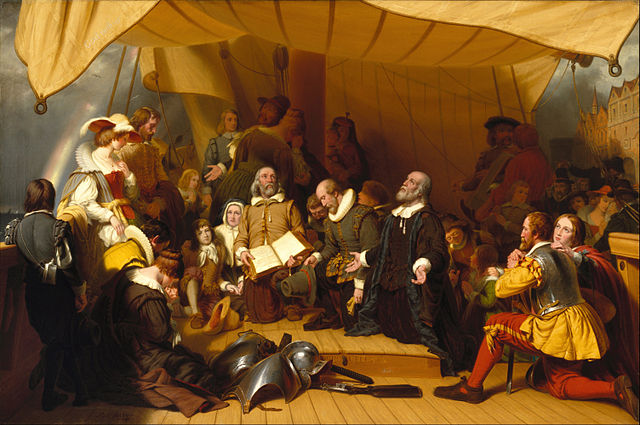
Embarkation of the Pilgrims, painted in 1857 by Robert Walter Weir. Source: Wikimedia Commons, public domain
General Christian
Previous Post
July 2, 2024
God and the Declaration of Independence
Next Post

July 10, 2024 Religious Liberty and Josh Hawley
Recent Comments
"Thank you for this grounded, deeply necessary perspective. Shifting our framework from moralistic binaries to ..."
What You May Not Know About ..."
"Nonviolence is the weapon of the mighty and the strong. Violence is the weapon of ..."
Thomas Aquinas on the Morality of ..."
"Regarding Barbara O'Brien's article "Is Empathy a Weakness?" My answer in song is an emphatic ..."
""A government, which to bigotry gives no sanction." How far our government has fallen from ..."
George Washington’s Letter to Touro Synagogue
Browse Our Archives
Select a Category Buddhism Christianity Daoism Hinduism Indigenous religions Islam Judaism Mysticism New Age Origins of religion Paganism Popes Popular Religious Movements Protestantism Psychology and religion Religion and current events Religion and folklore Religion and News Media Religion and politics Religious Art and Music Religious Freedom Religious mistakes Religious philosophy Religious scriptures Religious Violence science and religion Spiritualism Technology and religion The Catholic Church The Dalai Lama The Reformation Uncategorized
Select a Month September 2026 August 2026 July 2026 June 2026 April 2026 March 2026 February 2026 January 2026 December 2025 November 2025 October 2025 September 2025 August 2025 July 2025 June 2025 May 2025 April 2025 March 2025 February 2025 January 2025 December 2024 November 2024 October 2024 September 2024 August 2024 July 2024 June 2024 May 2024 April 2024 March 2024 February 2024 January 2024 December 2023 November 2023 October 2023 September 2023 August 2023 July 2023 June 2023 May 2023 April 2023 March 2023 February 2023 January 2023 December 2022 November 2022 October 2022 September 2022 August 2022
Follow Us!
TAKE THE
Religious Wisdom Quiz
What did Moses do after breaking the tablets?
Select your answer to see how you score.
Destroyed the calf Left the camp Returned to Sinai for new tablets Fasted for 30 days
Related posts from The Religious History Nerd

I Watched the Towers Fall. Here's What You...

Barring Mamdani From 9/11 Lets the Enemy Win

Is 'Separation of Church and State' Really a...

The President and the Pope: An Unprecedented Rift
TRENDING AT PATHEOS History and Religion

57th Dove Awards Honor Dolly Parton, Crown New...
On gospel music’s biggest night, the 57th annual GMA Dove Awards honored...

The First Eucharistic Controversy: Christ’s Real Presence
For Catholics, the Eucharist is the source and summit of the Christian...

What a Stop Sign Can Teach Us About...
How to Make a Decision When You Can't Hear God Main point:...

Archdiocese Hosts Military Marriage Retreat in Germany
RASTATT, Germany — The transient military lifestyle, with its frequent deployments and...

Nearly every morning, I make the drive to Detroit with my high-school-age...

The Real AI Story Is Adoption Without Trust
Artificial intelligence has crossed a political threshold. It is no longer a...
view all History and Religion blogs
What Are Your Thoughts?leave a comment
Ad-Free & Subscriber Log-In Subscription Support
- About Us
- 2026 Calendar
- Videos
- Podcasts
- Library of World Religions
- Faith In Media Tracker
- Advertise With Us
- Write for Us
- Privacy Policy
- Terms of Service
- Do Not Sell My Data
- Contact Us
- Radiant Digital
- Manage Newsletter Subscriptions
- Unsubscribe From Notifications
- Sitemap
Copyright 2008-2026, Patheos. All rights reserved.
Subscription Support Ad-Free & Subscriber Log-In
Follow Patheos