
BuddhistCatholicContemplativeEvangelicalGeneral ChristianHinduJewishLatter-day SaintMuslimNew VisionsProgressive Christian
Beliefs
- Buddhist
- Catholic
- Contemplative
- Evangelical
- General Christian
- Hindu
- Jewish
- Latter-day Saint
- More Voices
- Muslim
- New Visions
- Pagan
- Progressive Christian
Topics
- Religion News
- Food and Religion
- Sports and Religion
- Religious Art
- Religious Music and Entertainment
- Religious Events
- History and Religion
- Style and Religion
- Politics and Religion
- Women in Religion
- Recreation Outdoors and Religion
- Business Finance and Religion
- Careers Workplace and Religion
- Education and Religion
- Family Parenting and Religion
- Health Fitness and Religion
- Home and Religion
- Relationships and Religion
- Technology and Religion
- Travel and Religion
Columnists
- Buddhist Columnists
- Business Finance and Religion Columnists
- Careers Workplace and Religion Columnists
- Catholic Columnists
- Contemplative Columnists
- Education and Religion Columnists
- Evangelists Columnists
- Family Parenting and Religion Columnists
- General Christian Columnists
- Health Fitness and Religion Columnists
- Hindu Columnists
- History and Religion Columnists
- Home and Religion Columnists
- Jewish Columnists
- More Voices Columnists
- Latter Day Columnists
- Muslim Columnists
- New Visions Columnists
- Nonreligious Columnists
- Pagan Columnists
- Politics and Religion Columnists
- Progressive Columnists
- Recreation Outdoors and Religion Columnists
- Relationships and Religion Columnists
- Religion News Columnists
- Religious Art Columnists
- Religious Events Columnists
- Religious Music and Entertainment Columnists
- Sports and Religion Columnists
- Style and Religion Columnists
- Technology and Religion Columnists
- Travel and Religion Columnists
- Women in Religion Columnists
Resource Library
- 2026 Calendar
- Library of World Religions
- The 100 Most Holy Places on Earth
- Patheos Answers
- Podcasts
- Videos
- Faith Leaders Database
- Anglican Episcopalian
- Bahai
- Baptist
- Buddhism
- Christianity
- Confucianism
- Eastern Orthodoxy
- Hinduism
- Holiness and Pentecostal
- ISKCON
- Islam
- Judaism
- Lutheran
- Methodist
- The Church of Jesus Christ of Latter-day Saints
- New Age
- Paganism
- Presbytarian and Reformed
- Protestantism
- Religion Behind the Scenes
- Roman Catholic
- Scientology
- Shia Islam
- Sikhism
- Sufism
- Sunni Islam
- Taoism
- Zen
- See all religions
Research Tools
 Ad-Free & Subscriber Log-In Subscription Support
Ad-Free & Subscriber Log-In Subscription Support
Follow Patheos 

- Trending:
- Forgiveness
- |
- Marriage
- |
- Consciousness
- |
- Death Penalty
- |
- Election
- |
- Halloween

- Home
- General Christian
- History and Religion
- What’s Wrong With the Louisiana Ten Commandments Law
What’s Wrong With the Louisiana Ten Commandments Law
Last updated on: June 27, 2024 at 7:36 am by Barbara O'Brien
What’s Wrong With the Louisiana Ten Commandments Law 2024-06-27T07:36:08-05:00 Barbara O'Brien
Patheos Explore the world's faith through different perspectives on religion and spirituality! Patheos has the views of the prevalent religions and spiritualities of the world.
The Louisiana Ten Commandments bill I wrote about last month has been signed into law and has become a major news story in the U.S. The Ten Commandments law mandates that the Ten Commandment will be prominently displayed in all Lousiana classrooms, public and private. It dictates the wording of the Commandments to be displayed, which appears to be a very abridged version of Exodus 20:1-17 from the King James Bible, with all the “thees” and “thous” intact but a lot of the text left out.
What’s wrong with the Louisiana Ten Commandments law? For one thing, it’s an obvious attempt to do an end-run around the Constitution and use public schools to teach children a particular version of Christianity at the taxpayers’ expense. For another thing, there are religious people, including Christian ministers and Jewish rabbis, who object to how the Ten Commandments are being used by the state of Louisiana. And these religious people would rather teach their children about religion themselves, and not have the state of Louisiana teach them, thanks very much.
In 1980, the U.S. Supreme Court ruled that a nearly identical law in Kentucky violated the establishment clause of the First Amendment and was unconstitutional. The current Supreme Court has been demolishing much of the wall of separation of church and state in its recent opinions, and the law’s supporters seem certain the Court will reverse the 1980 opinion. We’ll see. I understand several challenges to the Ten Commandments law have already been filed.
The Ten Commandments: Religion or History?
It is striking to me that the arguments being made by Louisiana lawmakers in 2024 are remarkably similar to those made by Kentucky lawmakers in 1980. Central to these arguments is that the Ten Commandments is an important historical document, not just a religious one, and historical documents can be taught in school. Louisiana Gov. Jeff Landry has been calling the Ten Commandments a historical document in interviews.
“Look, when the Supreme Court meets, the doors of the Supreme Court on the backside have the Ten Commandments. Moses faces the U.S. Speaker of the House in the House chamber. He is the original giver of law,” Landry said in an interview by Lauren Irwin published in The Hill. “Most of our laws in this country are founded on the Ten Commandments, what’s the big problem? And that’s the part I don’t understand.”
The Ten Commandments is not the only “historical” document that must be displayed. This is from the Louisiana Ten Commandments law:
To enact R.S. 17:2122 and 3996(B)(82), relative to public elementary, secondary, and postsecondary schools; to provide for the display of certain historical documents; to provide for the display of the Mayflower Compact, the Declaration of Independence, the Northwest Ordinance, and the Ten Commandments; to provide for displays in each classroom; to provide relative to the use of donations or the acceptance of donated displays for this purpose; to provide for applicability; to provide for legislative intent; to provide for historical context; to provide for an effective date; and to provide for related matters.
The Mayflower Compact, Declaration of Independence, and the Northwest Ordinance were not randomly selected. Christian nationalists love these particular historical documents because they either mention God or, in the case of the Northwest Ordinance, argue for the importance of religion in government and education. The ultimate goal of Christian nationalists is to nullify the establishment clause and make Christianity the official religion of the United States.
Fake History Makes Bad Arguments
So the Louisiana lawmakers are arguing that Moses is a significant historical figure, and the Ten Commandments is historically important to the origin of laws, so they should be taught in school. As historical facts, both claims are wrong.
Modern scholarship cannot confirm that Moses was a real person and not just a mythical character in a story. Even if Moses were real, he was not the original lawgiver. The Exodus/Ten Commandments story traditionally is dated to about 1300 BCE. Some centuries earlier there was the law code of Hammurabi, who reigned in Babylon from 1792 to 1758 BCE. (Note that Hammurabi claimed his laws had been given to him by a god. Some scholars have suggested the story of Moses receiving the Commandments from God might have been inspired by Hammurabi’s story.) And we have fragments of even older Mesopotamian law codes, including the laws of Urukagina, which date to the 24th century BCE. There was also the law code of of Ur-Nammu (ca. 2100–2050 BCE), which outlawed murder, theft, and most adultery, as does the Ten Commandments.
For more on why the Ten Commandments seriously are not the basis of U.S. law, see my earlier post, “The Ten Commandments And The Origins Of Law.”
When Religion Isn’t Religion
Trying to sneak religious teachings and practices into U.S. classrooms by claiming they aren’t really religious is a time-honored tactic. For example, the attorneys representing the school district in Abington School District v. Schempp (1963) tried to argue that the Bible is not an inherently religious text. In that case, school children were being required to recite or listen to Bible verses every day, but the children were free to interpret the Bible verses in a secular way if they wanted to, the lawyers said.
Likewise, in the 1980 Kentucky Ten Commandments case (Stone v. Graham, 449 U.S. 39), the U.S. Supreme Court reversed a Kentucky Supreme Court decision that claimed the Ten Commandments had a clear secular purpose.
The Commonwealth insists that the statute in question serves a secular legislative purpose, observing that the legislature required the following notation in small print at the bottom of each display of the Ten Commandments:
“The secular application of the Ten Commandments is clearly seen in its adoption as the fundamental legal code of Western Civilization and the Common Law of the United States.”
The U.S. Supreme Court’s unsigned ruling in Stone v. Graham was later learned to have been written by Justice William Brennan. Justice Brennan wrote,
“The pre-eminent purpose for posting the Ten Commandments on schoolroom walls is plainly religious in nature. The Ten Commandments are undeniably a sacred text in the Jewish and Christian faiths, and no legislative recitation of a supposed secular purpose can blind us to that fact. The Commandments do not confine themselves to arguably secular matters, such as honoring one’s parents, killing or murder, adultery, stealing, false witness, and covetousness. See Exodus 20: 12-17; Deuteronomy 5: 16-21. Rather, the first part of the Commandments concerns the religious duties of believers: worshipping the Lord God alone, avoiding idolatry, not using the Lord’s name in vain, and observing the Sabbath Day. See Exodus 20: 1-11; Deuteronomy 5: 6-15.”
That’s just as true for the Louisiana law as it was in Kentucky 44 years ago.
Objections from Religious People
In late May a petition asking Gov. Landry to veto the bill was signed by 115 clergy and lay members representing Baptist, Catholic, Episcopal, Methodist and other denominations. From this petition:
Different faith traditions treat the scripture in which the Ten Commandments appear differently. In attempting to reconcile and cobble together these varying interpretations, the text of the display mandated by H.B. 71 manages to produce a hodgepodge of holy scripture that includes twelve, not ten, commandments and fails to respect the beliefs of many Christians. Nor does this state-dictated language honor or reflect the beliefs of our Jewish brothers and sisters. Indeed, the state-approved version of the Ten Commandments set forth in H.B. 71 does not exist in any translation of the Bible. It is simply not possible to create a version of the Ten Commandments that honors every faith tradition’s interpretation, and legislators’ attempt to do so is deeply offensive to us as Christians.
The State of Louisiana has no business choosing an official version of the Ten Commandments, especially one that strips the text of its theological context. And the state certainly has no business mandating that this officially sanctioned version of the Ten Commandments be hung in every public school classroom, where teachers educate students who follow a broad array of Christian and non-Christian faith traditions.
Twelve Commandment? The mandated text, which you can find in the law itself, does not number the Commandments. But the way they are organized does make it appear there are twelve of them.
More Objections
At least one Christian denomination, the Cooperative Baptist Fellowship (CBF), appears to be taking a stand to oppose the Louisiana law. The CBF is a denomination affiliated with the Baptist World Alliance that has 1,800 churches and 750,000 members. A CBF ministry coordinator named Shane McNary helped organize the petition drive. “As faith leaders and as people of faith, it does not sit well with us to take Scripture and reduce it to the level of a mere historical document,” McNary said.
Laura Crigger, a Louisiana mother writing for The Forward, a Jewish journal, objects to the law. She writes that because she feels strongly about the importance of the Ten Commandments she sends her children to a Jewish day school to learn about it. She questions whether the Louisiana legislators appreciate the Ten Commandments. “In codifying a version of the Ten Commandments that is not from the Hebrew Bible, nor any recognized Christian translation, Louisiana lawmakers are haphazardly translating, to say the least, divine intent.”
Nine families with children in Louisiana public schools have sued to stop the law from going into effect. The familes are Unitarian Universalists, Presbyterian, Jewish, and nonreligious. The law, they say, “unconstitutionally pressures students into religious observance, veneration, and adoption of the state’s favored religious scripture.” That’s obviously true, no matter how much Louisiana lawmakers insist the law has a “secular purpose.”
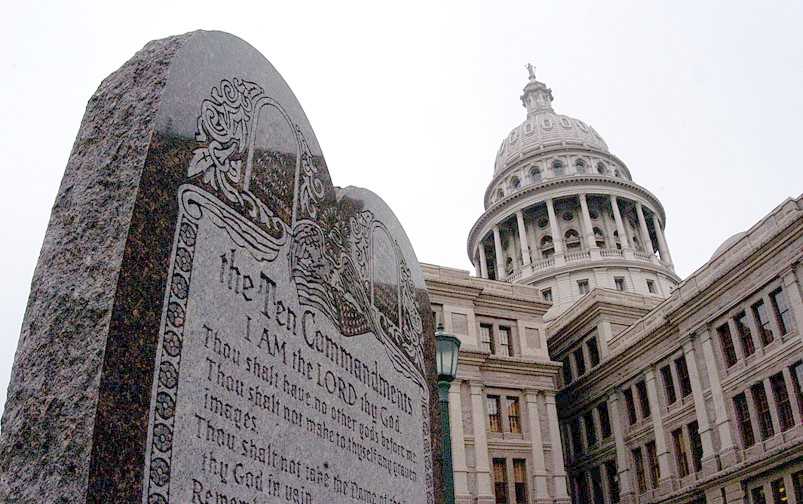
A Ten Commandments display outside the Texas state capitol building in Austin. Source: Public Domain Image from Texas Attorney General’s website news release, courtesy Wikimedia Commons.
General Christian
Politics and Religion
Previous Post

June 20, 2024
The Quest for Original Buddhism
Next Post

July 2, 2024 God and the Declaration of Independence
Recent Comments
"Thank you for this grounded, deeply necessary perspective. Shifting our framework from moralistic binaries to ..."
What You May Not Know About ..."
"Nonviolence is the weapon of the mighty and the strong. Violence is the weapon of ..."
Thomas Aquinas on the Morality of ..."
"Regarding Barbara O'Brien's article "Is Empathy a Weakness?" My answer in song is an emphatic ..."
""A government, which to bigotry gives no sanction." How far our government has fallen from ..."
George Washington’s Letter to Touro Synagogue
Browse Our Archives
Select a Category Buddhism Christianity Daoism Hinduism Indigenous religions Islam Judaism Mysticism New Age Origins of religion Paganism Popes Popular Religious Movements Protestantism Psychology and religion Religion and current events Religion and folklore Religion and News Media Religion and politics Religious Art and Music Religious Freedom Religious mistakes Religious philosophy Religious scriptures Religious Violence science and religion Spiritualism Technology and religion The Catholic Church The Dalai Lama The Reformation Uncategorized
Select a Month September 2026 August 2026 July 2026 June 2026 April 2026 March 2026 February 2026 January 2026 December 2025 November 2025 October 2025 September 2025 August 2025 July 2025 June 2025 May 2025 April 2025 March 2025 February 2025 January 2025 December 2024 November 2024 October 2024 September 2024 August 2024 July 2024 June 2024 May 2024 April 2024 March 2024 February 2024 January 2024 December 2023 November 2023 October 2023 September 2023 August 2023 July 2023 June 2023 May 2023 April 2023 March 2023 February 2023 January 2023 December 2022 November 2022 October 2022 September 2022 August 2022
Follow Us!
TAKE THE
Religious Wisdom Quiz
Like a sheep led to slaughter, silent before shearers, this servant was pierced for our transgressions. What chapter foretells this suffering?
Select your answer to see how you score.
Isaiah 7 Isaiah 9 Isaiah 61 Isaiah 53
Related posts from The Religious History Nerd

I Watched the Towers Fall. Here's What You...

Barring Mamdani From 9/11 Lets the Enemy Win

Is 'Separation of Church and State' Really a...

The President and the Pope: An Unprecedented Rift
TRENDING AT PATHEOS History and Religion

In one sense walking into Westminster Abbey is like walking down the...

'Super Scam Me' Exposes AI Jon Bon Jovi...
Leslie Pickett believed she was in a relationship with Jon Bon Jovi....

The Brazilian Remake of Kendricks' 'Flywheel' Opens in...
“Flywheel,” the story that launched the Kendrick Brothers’ filmmaking career is getting...

The Dangers of Gradual Accommodation (Winking at Sin)
Recently, the “law of gradualness” resurfaced during the opening of a weeklong,...

The Iron Gates and the Lion of the...
Yesterday, I didn't finish my report about, well, yesterday. So I'll...

The Image: On the Horror of Capitalism and...
The Image Then went the Pharisees, and took counsel how they might...
view all History and Religion blogs
What Are Your Thoughts?leave a comment
Ad-Free & Subscriber Log-In Subscription Support
- About Us
- 2026 Calendar
- Videos
- Podcasts
- Library of World Religions
- Faith In Media Tracker
- Advertise With Us
- Write for Us
- Privacy Policy
- Terms of Service
- Do Not Sell My Data
- Contact Us
- Radiant Digital
- Manage Newsletter Subscriptions
- Unsubscribe From Notifications
- Sitemap
Copyright 2008-2026, Patheos. All rights reserved.
Subscription Support Ad-Free & Subscriber Log-In
Follow Patheos