
BuddhistCatholicContemplativeEvangelicalGeneral ChristianHinduJewishLatter-day SaintMuslimNew VisionsProgressive Christian
Beliefs
- Buddhist
- Catholic
- Contemplative
- Evangelical
- General Christian
- Hindu
- Jewish
- Latter-day Saint
- More Voices
- Muslim
- New Visions
- Pagan
- Progressive Christian
Topics
- Religion News
- Food and Religion
- Sports and Religion
- Religious Art
- Religious Music and Entertainment
- Religious Events
- History and Religion
- Style and Religion
- Politics and Religion
- Women in Religion
- Recreation Outdoors and Religion
- Business Finance and Religion
- Careers Workplace and Religion
- Education and Religion
- Family Parenting and Religion
- Health Fitness and Religion
- Home and Religion
- Relationships and Religion
- Technology and Religion
- Travel and Religion
Columnists
- Buddhist Columnists
- Business Finance and Religion Columnists
- Careers Workplace and Religion Columnists
- Catholic Columnists
- Contemplative Columnists
- Education and Religion Columnists
- Evangelists Columnists
- Family Parenting and Religion Columnists
- General Christian Columnists
- Health Fitness and Religion Columnists
- Hindu Columnists
- History and Religion Columnists
- Home and Religion Columnists
- Jewish Columnists
- More Voices Columnists
- Latter Day Columnists
- Muslim Columnists
- New Visions Columnists
- Nonreligious Columnists
- Pagan Columnists
- Politics and Religion Columnists
- Progressive Columnists
- Recreation Outdoors and Religion Columnists
- Relationships and Religion Columnists
- Religion News Columnists
- Religious Art Columnists
- Religious Events Columnists
- Religious Music and Entertainment Columnists
- Sports and Religion Columnists
- Style and Religion Columnists
- Technology and Religion Columnists
- Travel and Religion Columnists
- Women in Religion Columnists
Resource Library
- 2026 Calendar
- Library of World Religions
- The 100 Most Holy Places on Earth
- Patheos Answers
- Podcasts
- Videos
- Faith Leaders Database
- Anglican Episcopalian
- Bahai
- Baptist
- Buddhism
- Christianity
- Confucianism
- Eastern Orthodoxy
- Hinduism
- Holiness and Pentecostal
- ISKCON
- Islam
- Judaism
- Lutheran
- Methodist
- The Church of Jesus Christ of Latter-day Saints
- New Age
- Paganism
- Presbytarian and Reformed
- Protestantism
- Religion Behind the Scenes
- Roman Catholic
- Scientology
- Shia Islam
- Sikhism
- Sufism
- Sunni Islam
- Taoism
- Zen
- See all religions
Research Tools
 Ad-Free & Subscriber Log-In Subscription Support
Follow Patheos 

- Trending:
- Advent
- |
- Forgiveness
- |
- Thanksgiving
- |
- Election
- |
- Seasonal Holidays
- |
- Marriage

- Home
- General Christian
- History and Religion
- The Appeal to Heaven Flag and Why It’s Controversial
The Appeal to Heaven Flag and Why It’s Controversial
Last updated on: May 23, 2024 at 4:01 pm by Barbara O'Brien
The Appeal to Heaven Flag and Why It’s Controversial 2024-05-23T16:01:51-05:00 Barbara O'Brien
Patheos Explore the world's faith through different perspectives on religion and spirituality! Patheos has the views of the prevalent religions and spiritualities of the world.
The Appeal to Heaven Flag, also called the Pine Tree Flag, is a bit of genuine Americana flown during the American Revolution. It’s in the news now because a U.S. Supreme Court justice, Samuel Alito, displayed it beside his New Jersey beach home. And this has become a scandal. But why?
Over the past couple of decades the Appeal to Heaven Flag has become a symbol of Christian nationalism. Writing in Christianity Today (February 2021), Paul Miller wrote that “Christian nationalism is the belief that the American nation is defined by Christianity, and that the government should take active steps to keep it that way.” This ideology is built on the myth of the Christian nation, the utterly ahistorical belief that the United States was dedicated to Christianity at its founding and given a government built upon Christian principles. It was not. The founders deliberately created a secular nation that would not favor any one religion over others.
In recent years Christian nationalism has been an organized, and powerful, movement. One of its biggest backers is Leonard Leo, a wealthy lawyer long associated with the right-wing Federalist Society. Leo has channeled an enormous amount of money and influence into making conservative Christianity the established religion of the United States, in spite of the clear language of the First Amendment of the Constitution that bans establishment of religion. Just one of many examples of Leo’s work is the ongoing attempt to establish a public Christian charter school in Oklahoma, a project that is connected to both Leonard Leo and Samuel Alito. Further, it’s reported that Leo flies an Appeal to Heaven flag next to his summer home in Maine.
The Appeal to Heaven Flag: Historical Background
The original Appeal to Heaven Flag was designed by Gen. George Washington’s secretary, Col. Joseph Reed, in 1775, for use by the naval ships Washington commissioned. The pine tree on the flag is a symbol of peace taken from Native Americans of the Iroquois Confederacy, which included the Seneca, Cayuga, Onondaga, Oneida, and Mohawk people. The native North American white pine was also especially favored in shipbuilding.
The words “appeal to heaven” came from John Locke’s Second Treatise on Government, published in 1690. John Locke (1632-1704) was a British philosopher whose ideas greatly influenced the founders of the United States. The Second Treatise covers a great many topics — you can read about them here — but for our purposes we want to just look at his “appeal to heaven.” Very simply, Locke wrote that where there is legitimate government one may appeal to the law when one is wronged. But if the government is oppressive and is violating the natural rights of life, liberty, and property that belong to all people, it is time to “appeal to heaven.”
Locke wrote, “And where the body of the people, or any single man, is deprived of their right, or is under the exercise of a power without right, and have no appeal on earth, then they have a liberty to appeal to heaven, whenever they judge the cause of sufficient moment.” This is a call to throw off the government and establish one that respects and protects the peoples’ rights. Although Thomas Jefferson didn’t use the phrase “appeal to heaven” in the Declaration of Indepence, he clearly was drawing on John Locke’s Second Treatise in the opening paragraphs of the Declaration, written in 1776.
The Consent of the Governed
In a recent post on Why It’s Hard to Separate Church and State I wrote that human civilizations from their very beginnings assumed the authority of government came from religion. In Europe, the power of monarchs was said to come from God, and thus monarchs ultimately did not answer to an earthly authority. This was the “divine right of kings.” But Jefferson wrote of human rights in the Delcaration, “That to secure these rights, governments are instituted among men, deriving their just powers from the consent of the governed.” The authority of government does not come from God, in other words. This was revolutionary in 1776, and it also was an idea that came from Locke’s Second Treatise.
So it’s a bit ironic that an organized movement to re-connect government and God is using Locke’s “appeal to heaven” rhetoric in its symbolism. I don’t think Locke would join their club, if he were here. Christian nationalism is an extremist movement determined to establish Christian supremacy in the U.S., by force if necessary.
See, for example, “The Christian Nationalist Danger Behind the ‘Appeal to Heaven’ Flag” by Sarah Jones at New York magazine. Jones interviews scholar Matthew D. Taylor, author of the forthcoming book The Violent Take It by Force: The Christian Movement That Is Threatening Our Democracy. Taylor says that these days the Appeal to Heaven flag “is a symbol of an aggressive vision of Christian nationalism driven by spiritual warfare and prophecy and the intent to remake America in the image of a very conservative Christianity.” And, apparently, Supreme Court Justice Samuel Alito — author of the Dobbs decision that overturned Roe v. Wade — is fine with that.
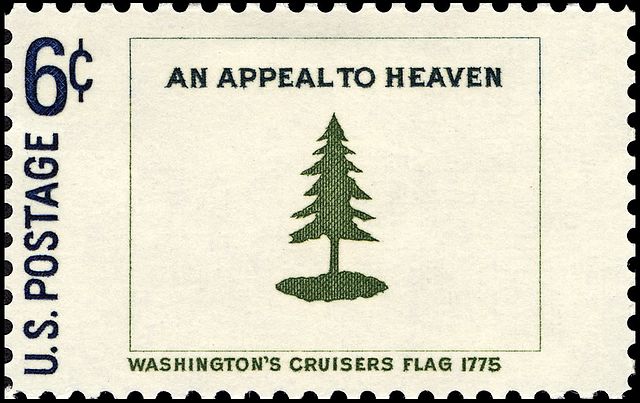
The Appeal to Heaven flag on a U.S. postage stamp issued in 1968. This version of the flag was flown by a squadron of frigates of the Continental Navy during the American Revolution. Source: Wikimedia Commons, public domain
General Christian
Politics and Religion
Previous Post

May 19, 2024
Louisiana Passes a Ten Commandments in Public Schools Bill
Next Post

May 30, 2024 Florida Embeds Christian Nationalism in School
Recent Comments
"Evil is indeed hard to pin down to any source other then what is reflected ..."
"Thank you for this grounded, deeply necessary perspective. Shifting our framework from moralistic binaries to ..."
What You May Not Know About ..."
"Nonviolence is the weapon of the mighty and the strong. Violence is the weapon of ..."
Thomas Aquinas on the Morality of ..."
"Regarding Barbara O'Brien's article "Is Empathy a Weakness?" My answer in song is an emphatic ..."
Browse Our Archives
Select a Category Buddhism Christianity Daoism Hinduism Indigenous religions Islam Jaina Judaism Mysticism New Age Origins of religion Paganism Popes Popular Religious Movements Protestantism Psychology and religion Religion and current events Religion and folklore Religion and News Media Religion and politics Religious Art and Music Religious Freedom Religious mistakes Religious philosophy Religious scriptures Religious Violence science and religion Spiritualism Technology and religion The Catholic Church The Dalai Lama The Reformation Uncategorized
Select a Month November 2026 October 2026 September 2026 August 2026 July 2026 June 2026 April 2026 March 2026 February 2026 January 2026 December 2025 November 2025 October 2025 September 2025 August 2025 July 2025 June 2025 May 2025 April 2025 March 2025 February 2025 January 2025 December 2024 November 2024 October 2024 September 2024 August 2024 July 2024 June 2024 May 2024 April 2024 March 2024 February 2024 January 2024 December 2023 November 2023 October 2023 September 2023 August 2023 July 2023 June 2023 May 2023 April 2023 March 2023 February 2023 January 2023 December 2022 November 2022 October 2022 September 2022 August 2022
Follow Us!
TAKE THE
Religious Wisdom Quiz
I sent an army of singers before my army, and God set ambushes against our enemies. Who am I?
Select your answer to see how you score.
Asa David Hezekiah Jehoshaphat
Related posts from The Religious History Nerd

First Jains Elected to the U.S. Congress!

I Watched the Towers Fall. Here's What You...

Barring Mamdani From 9/11 Lets the Enemy Win

Is 'Separation of Church and State' Really a...
TRENDING AT PATHEOS History and Religion

Smart people saying smart things (11.24.26)
Please take time to listen to Perry Bacon, Sarah Posner, Adam Serwer,...

The Contingency of Our Technology
Last week we were hit with a raft of massive technology outages....

In 1939, President Franklin D. Roosevelt moved Thanksgiving from November 30 to...

Reasons for Restraint: Ricardo Gonzalez, Florida and Dec...
The Morning of January 3 I begin with the dead. On the...

I published this column for Thanksgiving 2012 in the Deseret News....

For many years, Catholicism has been caught up in division over the...
view all History and Religion blogs
What Are Your Thoughts?leave a comment
Ad-Free & Subscriber Log-In Subscription Support
- About Us
- 2026 Calendar
- Videos
- Podcasts
- Library of World Religions
- Faith In Media Tracker
- Advertise With Us
- Write for Us
- Privacy Policy
- Terms of Service
- Do Not Sell My Data
- Contact Us
- Radiant Digital
- Manage Newsletter Subscriptions
- Unsubscribe From Notifications
- Sitemap
Copyright 2008-2026, Patheos, part of the Radiant Digital network of media brands. All rights reserved.
Subscription Support Ad-Free & Subscriber Log-In
Follow Patheos