
BuddhistCatholicContemplativeEvangelicalGeneral ChristianHinduJewishLatter-day SaintMuslimNew VisionsProgressive Christian
Beliefs
- Buddhist
- Catholic
- Contemplative
- Evangelical
- General Christian
- Hindu
- Jewish
- Latter-day Saint
- More Voices
- Muslim
- New Visions
- Pagan
- Progressive Christian
Topics
- Religion News
- Food and Religion
- Sports and Religion
- Religious Art
- Religious Music and Entertainment
- Religious Events
- History and Religion
- Style and Religion
- Politics and Religion
- Women in Religion
- Recreation Outdoors and Religion
- Business Finance and Religion
- Careers Workplace and Religion
- Education and Religion
- Family Parenting and Religion
- Health Fitness and Religion
- Home and Religion
- Relationships and Religion
- Technology and Religion
- Travel and Religion
Columnists
- Buddhist Columnists
- Business Finance and Religion Columnists
- Careers Workplace and Religion Columnists
- Catholic Columnists
- Contemplative Columnists
- Education and Religion Columnists
- Evangelists Columnists
- Family Parenting and Religion Columnists
- General Christian Columnists
- Health Fitness and Religion Columnists
- Hindu Columnists
- History and Religion Columnists
- Home and Religion Columnists
- Jewish Columnists
- More Voices Columnists
- Latter Day Columnists
- Muslim Columnists
- New Visions Columnists
- Nonreligious Columnists
- Pagan Columnists
- Politics and Religion Columnists
- Progressive Columnists
- Recreation Outdoors and Religion Columnists
- Relationships and Religion Columnists
- Religion News Columnists
- Religious Art Columnists
- Religious Events Columnists
- Religious Music and Entertainment Columnists
- Sports and Religion Columnists
- Style and Religion Columnists
- Technology and Religion Columnists
- Travel and Religion Columnists
- Women in Religion Columnists
Resource Library
- 2026 Calendar
- Library of World Religions
- The 100 Most Holy Places on Earth
- Patheos Answers
- Podcasts
- Videos
- Faith Leaders Database
- Anglican Episcopalian
- Bahai
- Baptist
- Buddhism
- Christianity
- Confucianism
- Eastern Orthodoxy
- Hinduism
- Holiness and Pentecostal
- ISKCON
- Islam
- Judaism
- Lutheran
- Methodist
- The Church of Jesus Christ of Latter-day Saints
- New Age
- Paganism
- Presbytarian and Reformed
- Protestantism
- Religion Behind the Scenes
- Roman Catholic
- Scientology
- Shia Islam
- Sikhism
- Sufism
- Sunni Islam
- Taoism
- Zen
- See all religions
Research Tools
 Ad-Free & Subscriber Log-In Subscription Support
Ad-Free & Subscriber Log-In Subscription Support
Follow Patheos 

- Trending:
- Forgiveness
- |
- Marriage
- |
- Consciousness
- |
- Death Penalty
- |
- Election
- |
- Halloween

- Home
- General Christian
- History and Religion
- Louisiana Passes a Ten Commandments in Public Schools Bill
Louisiana Passes a Ten Commandments in Public Schools Bill
Last updated on: May 19, 2024 at 3:58 pm by Barbara O'Brien
Louisiana Passes a Ten Commandments in Public Schools Bill 2024-05-19T15:58:09-05:00 Barbara O'Brien
Patheos Explore the world's faith through different perspectives on religion and spirituality! Patheos has the views of the prevalent religions and spiritualities of the world.
The Louisiana legislature just passed a bill mandating the display of the Ten Commandments in all public school classrooms. And this one is very close to becoming law. Texas attempted such a thing last year, but the bill passed by the Texas Senate died in the Texas House. Similar bills were introduced in South Carolina and Utah but have not yet become laws. At the moment, however, it appears the Louisiana bill will go all the way to being signed by the governor.
Note that none of these bills differs significantly from one passed in Kentucky in 1978 and declared unconstitutional by the U.S. Supreme Court in 1980. The current Supreme Court, however, seems to think a little establishment of religion never hurt anybody. James Madison, the chief author of the Bill of Rights, would no doubt disagree. The current conservative justices like to call themselves “originalists,” meaning they claim to interpret the Constitution to mean what the authors intended it to mean. But the justices can be remarkably creative in deciding what the authors meant.
The Louisiana bill mandates the text of the Ten Commandments to be used, which appears to be an abridged version of Exodus 20:1-17 from the King James Bible, with all the “thees” and “thous” intact. Just so we’re all clear, the classroom display must begin with the words “I AM the LORD thy God.” The Commandments must be printed on a poster or framed print no smaller than eleven by fourteen inches in a large, easily readable font. And it must be prominenetly displayed in every classroom and every building in every school in Louisiana that receives public funding, including universities.
Why This Is Happening
The last post discussed why it’s hard to separate church and state. There’s no question that Christianity has been the overhwhelmingly dominant religion in the U.S. since the beginning of the U.S. Even so, recorded history tells us that the founders of the nation deliberately created a secular government that could not be used by any religious faction to enforce its own beliefs and practices. But from the beginning many Americans simply refused to accept a secular government. Soon a myth of a “Christian nation” arose. According to this myth, the founders must have intended to give Christianity a privileged place in American government. Maybe they just forgot to say so.
Parallel to the “Christian nation” myth is the myth that the Ten Commandments are the basis of all laws, including American law, and this is why we must display the Ten Commandments in schools and courthouses and all over the place generally. But as history, this claim is pure bunk; see “The Ten Commandments and the Origins of Law.” There is no question the Ten Commandments are signifiant to the Abrahamic religions. But they were probably at least partily cribbed from the Code of Hammurabi. The laws of the United States had origins in English Common Law, and if you keep digging you can find roots in Viking law and the laws of the Roman Empire and lots of other early law codes. The Ten Commandments seriously had no special place in the origins of U.S. law.
We’re still fighting this fight over separation of church and state because some of America’s Christians cannot accept not being the dominant tribe. In recent decades the percentage of Americans who self-identify as Christian has been in significant decline. The Pew Research Center is predicting that the percentage of Christians in the U.S. could fall below 50 percent within a few decades. Some U.S. Christians find this unacceptable, even terrifying, and they are fighting back. So monuments to the Ten Commandments must be erected everywhere as Christian tribal totems, and public schools must be used to indoctrinate children into Christianity as much as possible. Several states are even considering bills that would replace school guidance counselors with Christian chaplains.
What the Founders Intended
The men who founded the United States and authored the Constitution didn’t see eye to eye on everything, certainly. But they did give us a Constitution that made no mention of God and forbade any sort of religious test for public office. This was not an oversight; it was intentional. Europe had suffered a couple of centuries of brutal warfare as religious factions fought over the power and privileges to be gained if their prince could be placed on the throne. By denying government the power to establish state religions or favor one religion over another, the founders hoped to avoid something similar happening in the U.S.
James Madison wrote, “Because if Religion be exempt from the authority of the Society at large, still less can it be subject to that of the Legislative Body.” In other words, the government must be constrained from encroaching on matters of personal conscience, like religion. “The Rulers who are guilty of such an encroachment exceed the commission from which they derive their authority, and are Tyrants. The People who submit to it are governed by laws made neither by themselves nor by an authority derived from them, and are slaves.”
Further, Madison said, “Who does not see that the same authority which can establish Christianity, in exclusion of all other Religions, may establish with the same ease any particular sect of Christians, in exclusion of all other Sects?” For that matter, the sect that excludes all other sects some day may not be Christian. Beware of unintended but possible consequences.
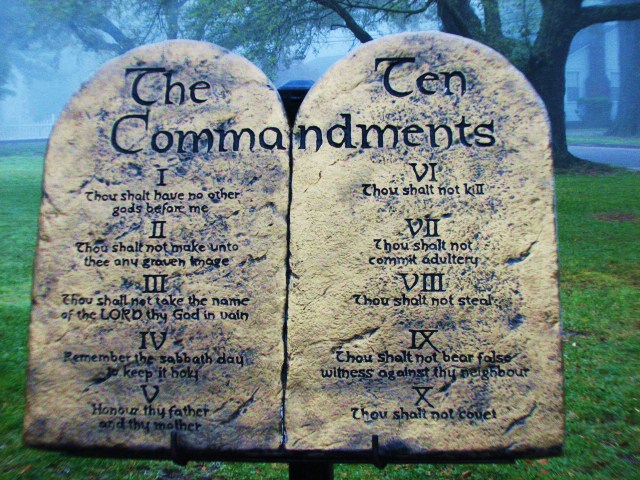
Display of the Ten Commandments outside of the Clarke County Baptist Association office building in Quitman, Mississippi, 2008. Photo by George Bannister. Source: Wikimedia Commons, Creative Commons Attribution 2.0 Generic license.
General Christian
Previous Post

May 17, 2024
Why It's Hard to Separate Church and State
Next Post

May 23, 2024 The Appeal to Heaven Flag and Why It's Controversial
Recent Comments
"Thank you for this grounded, deeply necessary perspective. Shifting our framework from moralistic binaries to ..."
What You May Not Know About ..."
"Nonviolence is the weapon of the mighty and the strong. Violence is the weapon of ..."
Thomas Aquinas on the Morality of ..."
"Regarding Barbara O'Brien's article "Is Empathy a Weakness?" My answer in song is an emphatic ..."
""A government, which to bigotry gives no sanction." How far our government has fallen from ..."
George Washington’s Letter to Touro Synagogue
Browse Our Archives
Select a Category Buddhism Christianity Daoism Hinduism Indigenous religions Islam Judaism Mysticism New Age Origins of religion Paganism Popes Popular Religious Movements Protestantism Psychology and religion Religion and current events Religion and folklore Religion and News Media Religion and politics Religious Art and Music Religious Freedom Religious mistakes Religious philosophy Religious scriptures Religious Violence science and religion Spiritualism Technology and religion The Catholic Church The Dalai Lama The Reformation Uncategorized
Select a Month September 2026 August 2026 July 2026 June 2026 April 2026 March 2026 February 2026 January 2026 December 2025 November 2025 October 2025 September 2025 August 2025 July 2025 June 2025 May 2025 April 2025 March 2025 February 2025 January 2025 December 2024 November 2024 October 2024 September 2024 August 2024 July 2024 June 2024 May 2024 April 2024 March 2024 February 2024 January 2024 December 2023 November 2023 October 2023 September 2023 August 2023 July 2023 June 2023 May 2023 April 2023 March 2023 February 2023 January 2023 December 2022 November 2022 October 2022 September 2022 August 2022
Follow Us!
TAKE THE
Religious Wisdom Quiz
True or False: Job's three friends were named Eliphaz, Bildad, and Zophar.
Select your answer to see how you score.
TRUE FALSE
Related posts from The Religious History Nerd

I Watched the Towers Fall. Here's What You...

Barring Mamdani From 9/11 Lets the Enemy Win

Is 'Separation of Church and State' Really a...

The President and the Pope: An Unprecedented Rift
TRENDING AT PATHEOS History and Religion

Looking at the Largest Orthodox Cathedral on Earth
There is often a considerable amount of anger and, shall we...

The Problem with False Prophets
Miller’s Station UMC| 10/18/26| Anchor Verse: Jeremiah 23: 1, 9-23 I...

Emotion in Early Christianity by Andrew Crislip
Andrew Crislip’s Emotion in Early Christianity examines an often overlooked dimension of...

16 Spiritual Touchstones for a More Grounded Life
After decades of spiritual study, here are 16 principles I try...

Catholic Evangelization: Sharing Your Faith Every Day
Welcome back to the Graceful Awakening mini-series called, “From Faith to Mission.” ...

The Pillar of the Boatmen: the Ancient Monument...
The Pillar of the Boatmen is a Romano-Gaulish sculpture that dates from...
view all History and Religion blogs
What Are Your Thoughts?leave a comment
Ad-Free & Subscriber Log-In Subscription Support
- About Us
- 2026 Calendar
- Videos
- Podcasts
- Library of World Religions
- Faith In Media Tracker
- Advertise With Us
- Write for Us
- Privacy Policy
- Terms of Service
- Do Not Sell My Data
- Contact Us
- Radiant Digital
- Manage Newsletter Subscriptions
- Unsubscribe From Notifications
- Sitemap
Copyright 2008-2026, Patheos. All rights reserved.
Subscription Support Ad-Free & Subscriber Log-In
Follow Patheos