
BuddhistCatholicContemplativeEvangelicalGeneral ChristianHinduJewishLatter-day SaintMuslimNew VisionsProgressive Christian
Beliefs
- Buddhist
- Catholic
- Contemplative
- Evangelical
- General Christian
- Hindu
- Jewish
- Latter-day Saint
- More Voices
- Muslim
- New Visions
- Pagan
- Progressive Christian
Topics
- Religion News
- Food and Religion
- Sports and Religion
- Religious Art
- Religious Music and Entertainment
- Religious Events
- History and Religion
- Style and Religion
- Politics and Religion
- Women in Religion
- Recreation Outdoors and Religion
- Business Finance and Religion
- Careers Workplace and Religion
- Education and Religion
- Family Parenting and Religion
- Health Fitness and Religion
- Home and Religion
- Relationships and Religion
- Technology and Religion
- Travel and Religion
Columnists
- Buddhist Columnists
- Business Finance and Religion Columnists
- Careers Workplace and Religion Columnists
- Catholic Columnists
- Contemplative Columnists
- Education and Religion Columnists
- Evangelists Columnists
- Family Parenting and Religion Columnists
- General Christian Columnists
- Health Fitness and Religion Columnists
- Hindu Columnists
- History and Religion Columnists
- Home and Religion Columnists
- Jewish Columnists
- More Voices Columnists
- Latter Day Columnists
- Muslim Columnists
- New Visions Columnists
- Nonreligious Columnists
- Pagan Columnists
- Politics and Religion Columnists
- Progressive Columnists
- Recreation Outdoors and Religion Columnists
- Relationships and Religion Columnists
- Religion News Columnists
- Religious Art Columnists
- Religious Events Columnists
- Religious Music and Entertainment Columnists
- Sports and Religion Columnists
- Style and Religion Columnists
- Technology and Religion Columnists
- Travel and Religion Columnists
- Women in Religion Columnists
Resource Library
- 2026 Calendar
- Library of World Religions
- The 100 Most Holy Places on Earth
- Patheos Answers
- Podcasts
- Videos
- Faith Leaders Database
- Anglican Episcopalian
- Bahai
- Baptist
- Buddhism
- Christianity
- Confucianism
- Eastern Orthodoxy
- Hinduism
- Holiness and Pentecostal
- ISKCON
- Islam
- Judaism
- Lutheran
- Methodist
- The Church of Jesus Christ of Latter-day Saints
- New Age
- Paganism
- Presbytarian and Reformed
- Protestantism
- Religion Behind the Scenes
- Roman Catholic
- Scientology
- Shia Islam
- Sikhism
- Sufism
- Sunni Islam
- Taoism
- Zen
- See all religions
Research Tools
 Ad-Free & Subscriber Log-In Subscription Support
Ad-Free & Subscriber Log-In Subscription Support
Follow Patheos 

- Trending:
- Forgiveness
- |
- Marriage
- |
- Consciousness
- |
- Death Penalty
- |
- Election
- |
- Halloween

- Home
- General Christian
- History and Religion
- The Great Disappointment of William Miller
The Great Disappointment of William Miller
Last updated on: April 18, 2024 at 2:39 pm by Barbara O'Brien
The Great Disappointment of William Miller 2024-04-18T14:39:03-05:00 Barbara O'Brien
Patheos Explore the world's faith through different perspectives on religion and spirituality! Patheos has the views of the prevalent religions and spiritualities of the world.
The Great Disappointment is the name given to a time when the world as we know it didn’t end. Tens of thousands of people fervently believed the date the world would change was October 22, 1844. They sincerely thought on that day Jesus would come in glory to gather the faithful to heaven before cleansing the world of sin. Many of them even gave away all their wordly possessions, donned white robes, and waited on hilltops — or in trees — for the great event. And it didn’t happen. Hence, there was great disappointment.
End-of-the-world predictions are fairly common, and occasionally some catch on with enough people that the eventual non-event becomes an event in itself. This particular non-event was one of the most famous in modern times. It’s been studied by historians, theologians, and social psychologists for clues to why this particular prediction was so compelling. Answers vary. How the non-event came to be rationalized by the disappointed has also been a focus of study.
It’s also the case that 19th century America, and to some extent Europe, was something like the Golden Age of Religious Free Spirits and Eccentrics. See, for example, “Talking With The Dead In 19th Century America” and “The Oneida Community: An Experiment In Perfectionism.” It was a time when the grip of many old orthodoxies was broken. And many otherwise psychologically normal people seemed willing to believe just about anything where spirituality was concerned. So maybe if you wanted to understand it, you had to be there.
The Great Disappointment: Origins
William Miller (1784-1849) thought a lot about religion. As a young man he rejected his Baptist upbringing and embraced Deism instead. Service in the War of 1812 left him with questions about death and an afterlife. His questions eventually took him back to the Baptists. When his Deist friends challenged his changed beliefs, he began a close reading of the Bible to look for support. And that close reading persuaded him the world was about to end.
Miller began his calculations with Daniel 8:14: “And he said unto me, Unto two thousand and three hundred days; then shall the sanctuary be cleansed.” (King James Version) Miller believed this cleansing referred to the Second Coming of Christ and the cleansing of sin from the earth. And apparently there was a rule of thumb from someplace that a prophetic day equals a year. He began his calculations with the command to rebuild the Jewish Temple after the Babylonian captivity. Miller dated this event to 457 BCE. Add 2,300 years, and you arrive at 1843. Just a few years away. Miller went on to create an elaborate calendar of events to help narrow down the date more precisely.
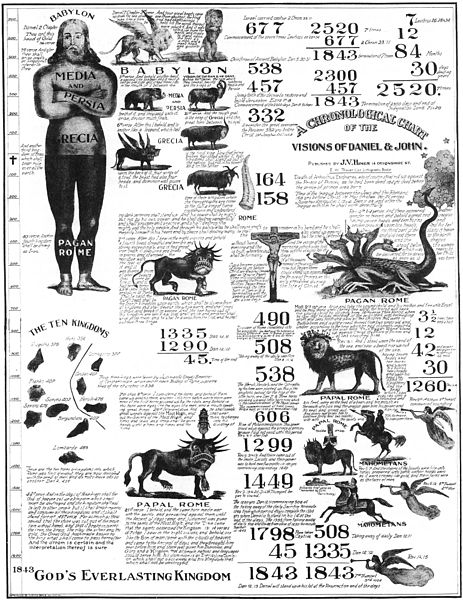
A chart distributed by the Millerites to explain the calculations behind the prophecy. Source: Wikimedia Commons, public domain.
Miller decided that the Millennium, the thousand-year rule of Christ on the earth, would begin right after the cleansing. Miller was among the first American premillennialists, a view that is mainstream in many Evangelical and Protestant denominations today, but it was new at the time. And this was about the same time that another premillennialist, John Nelson Darby, proposed the Rapture eschatology that’s become part of popular culture. Miller did not agree there would be a Rapture, or a secret snatching away of the faithful to leave sinners to suffer the Tribulation. In Miller’s view, Jesus’ return would be a much splashier event that everyone would notice.
The Great Disappointment: Spreading the Word
At first, Miller was reluctant to tell others that the Second Ccoming was imminent. He told only family and close friends, hoping that someone else would take up the task of informing the world. Eventually, however, he decided the job had fallen to him. In about 1831 he began to explain his calculations to his Baptist church members. And word spread. Other churches asked him to come and preach his eschatology to them. With practice he became a more effective public speaker.
In 1839 Miller’s movement drew the attention of Joshua Vaughan Himes. Himes was a publisher of religious works, and he had the resources, contacts, and organizational skills to spread Miller’s theories far and wide. Himes had an enormous tent made and then sent Miller and the tent on well-publicized speaking tour. He also published Miller’s theories in books and handbills. Many of Miller’s followers — who were called “Millerites” — also began to travel and preach about the great event that was about to occur. And all this preaching was covered in the local newspapers, often with great skepticism and ridicule. But it was covered.
Miller had originally proposed that the Second Coming would happen some time in 1843. Then he revised this somewhat — “My principles in brief, are, that Jesus Christ will come again to this earth, cleanse, purify, and take possession of the same, with all the saints, sometime between March 21, 1843, and March 21, 1844.” When March 21, 1844 passed without unusual incident, Miller adopted a new date, April 18, 1844. When that date came and went the Millerite movement still remained mostly intact. But when would Jesus come?
The Great Disappointment: October 22, 1844
The final date was proposed not by Miller but by Samuel Snow, one of Miller’s more enthusiastic followers. Snow’s revised calculations determined that Jesus would return on the tenth day of the seventh month of the present year. But this was using a calendar developed by Karaite Jews in the Middle Ages; I’m not sure why. And the tenth day of the seventh month of 1844 on the Karaite calendar corresponded to October 22, 1844, on the Gregorian calendar, apparently. Slowly other Millerites began to accept the new date.
By now Millerism was widespread throughout the northeastern states and into Canada. There were also Millerite groups in England. There is documentation of at least a few converts to Millerism in Australia, Chile, and Norway. As the auspicious date approached, with all the publicity, it’s possible even many skeptics were at least a little nervous. And then the day came, with the white robes and the hill and tree climbing. And it was followed by October 23.
In the days that followed the Great Disappointment, it seemed there were as many explanations for what didn’t happen as there were Millerites. Understandably, some simply walked away from the movement and went back to their original churches. But a remarkable number stayed to work out what they had misunderstood. By 1845 Millerites were beginning to coalesce around several post-disappointment Adventist sects, some of which are still with us. The largest of these is the Seventh-Day Adventist denomination, which claims about 20 million members worldwide.
I plan to write more about what we might call the Great Explanations — or rationalizations — in a future post.
General Christian
Previous Post

April 11, 2024
The Rapture: A Brief History
Next Post

May 10, 2024 The Problem With "Spiritual But Not Religious"
Recent Comments
"Thank you for this grounded, deeply necessary perspective. Shifting our framework from moralistic binaries to ..."
What You May Not Know About ..."
"Nonviolence is the weapon of the mighty and the strong. Violence is the weapon of ..."
Thomas Aquinas on the Morality of ..."
"Regarding Barbara O'Brien's article "Is Empathy a Weakness?" My answer in song is an emphatic ..."
""A government, which to bigotry gives no sanction." How far our government has fallen from ..."
George Washington’s Letter to Touro Synagogue
Browse Our Archives
Select a Category Buddhism Christianity Daoism Hinduism Indigenous religions Islam Judaism Mysticism New Age Origins of religion Paganism Popes Popular Religious Movements Protestantism Psychology and religion Religion and current events Religion and folklore Religion and News Media Religion and politics Religious Art and Music Religious Freedom Religious mistakes Religious philosophy Religious scriptures Religious Violence science and religion Spiritualism Technology and religion The Catholic Church The Dalai Lama The Reformation Uncategorized
Select a Month September 2026 August 2026 July 2026 June 2026 April 2026 March 2026 February 2026 January 2026 December 2025 November 2025 October 2025 September 2025 August 2025 July 2025 June 2025 May 2025 April 2025 March 2025 February 2025 January 2025 December 2024 November 2024 October 2024 September 2024 August 2024 July 2024 June 2024 May 2024 April 2024 March 2024 February 2024 January 2024 December 2023 November 2023 October 2023 September 2023 August 2023 July 2023 June 2023 May 2023 April 2023 March 2023 February 2023 January 2023 December 2022 November 2022 October 2022 September 2022 August 2022
Follow Us!
TAKE THE
Religious Wisdom Quiz
Which city was destroyed by fire and brimstone along with Gomorrah?
Select your answer to see how you score.
Babylon Nineveh Jericho Sodom
Related posts from The Religious History Nerd

I Watched the Towers Fall. Here's What You...

Barring Mamdani From 9/11 Lets the Enemy Win

Is 'Separation of Church and State' Really a...

The President and the Pope: An Unprecedented Rift
TRENDING AT PATHEOS History and Religion

The Iron Gates and the Lion of the...
Yesterday, I didn't finish my report about, well, yesterday. So I'll...

Dolly Parton’s Last Song Wins Dove Award with...
Bluegrass band The Grascals, speaking on the red carpet at the 57th...

The Image: On the Horror of Capitalism and...
The Image Then went the Pharisees, and took counsel how they might...

We are approaching the date of our new American national holiday: October...

Letters on Living the Faith by C.S. Lewis
Most of us met C.S. Lewis as a public intellectual. Mere Christianity....

When Halloween Unmasks Married Hearts
Written by Dr. David K. Ewen from Eternal Truth Bible College Behind...
view all History and Religion blogs
What Are Your Thoughts?leave a comment
Ad-Free & Subscriber Log-In Subscription Support
- About Us
- 2026 Calendar
- Videos
- Podcasts
- Library of World Religions
- Faith In Media Tracker
- Advertise With Us
- Write for Us
- Privacy Policy
- Terms of Service
- Do Not Sell My Data
- Contact Us
- Radiant Digital
- Manage Newsletter Subscriptions
- Unsubscribe From Notifications
- Sitemap
Copyright 2008-2026, Patheos. All rights reserved.
Subscription Support Ad-Free & Subscriber Log-In
Follow Patheos