
BuddhistCatholicContemplativeEvangelicalGeneral ChristianHinduJewishLatter-day SaintMuslimNew VisionsProgressive Christian
Beliefs
- Buddhist
- Catholic
- Contemplative
- Evangelical
- General Christian
- Hindu
- Jewish
- Latter-day Saint
- More Voices
- Muslim
- New Visions
- Pagan
- Progressive Christian
Topics
- Religion News
- Food and Religion
- Sports and Religion
- Religious Art
- Religious Music and Entertainment
- Religious Events
- History and Religion
- Style and Religion
- Politics and Religion
- Women in Religion
- Recreation Outdoors and Religion
- Business Finance and Religion
- Careers Workplace and Religion
- Education and Religion
- Family Parenting and Religion
- Health Fitness and Religion
- Home and Religion
- Relationships and Religion
- Technology and Religion
- Travel and Religion
Columnists
- Buddhist Columnists
- Business Finance and Religion Columnists
- Careers Workplace and Religion Columnists
- Catholic Columnists
- Contemplative Columnists
- Education and Religion Columnists
- Evangelists Columnists
- Family Parenting and Religion Columnists
- General Christian Columnists
- Health Fitness and Religion Columnists
- Hindu Columnists
- History and Religion Columnists
- Home and Religion Columnists
- Jewish Columnists
- More Voices Columnists
- Latter Day Columnists
- Muslim Columnists
- New Visions Columnists
- Nonreligious Columnists
- Pagan Columnists
- Politics and Religion Columnists
- Progressive Columnists
- Recreation Outdoors and Religion Columnists
- Relationships and Religion Columnists
- Religion News Columnists
- Religious Art Columnists
- Religious Events Columnists
- Religious Music and Entertainment Columnists
- Sports and Religion Columnists
- Style and Religion Columnists
- Technology and Religion Columnists
- Travel and Religion Columnists
- Women in Religion Columnists
Resource Library
- 2026 Calendar
- Library of World Religions
- The 100 Most Holy Places on Earth
- Patheos Answers
- Podcasts
- Videos
- Faith Leaders Database
- Anglican Episcopalian
- Bahai
- Baptist
- Buddhism
- Christianity
- Confucianism
- Eastern Orthodoxy
- Hinduism
- Holiness and Pentecostal
- ISKCON
- Islam
- Judaism
- Lutheran
- Methodist
- The Church of Jesus Christ of Latter-day Saints
- New Age
- Paganism
- Presbytarian and Reformed
- Protestantism
- Religion Behind the Scenes
- Roman Catholic
- Scientology
- Shia Islam
- Sikhism
- Sufism
- Sunni Islam
- Taoism
- Zen
- See all religions
Research Tools
 Ad-Free & Subscriber Log-In Subscription Support
Ad-Free & Subscriber Log-In Subscription Support
Follow Patheos 

- Trending:
- Forgiveness
- |
- Marriage
- |
- Consciousness
- |
- Death Penalty
- |
- Election
- |
- Halloween

- Home
- Catholic
- History and Religion
- Shogun the Miniseries and Real Japanese History
Shogun the Miniseries and Real Japanese History
Last updated on: March 10, 2024 at 4:35 pm by Barbara O'Brien
Shogun the Miniseries and Real Japanese History 2024-03-10T16:35:58-05:00 Barbara O'Brien
Patheos Explore the world's faith through different perspectives on religion and spirituality! Patheos has the views of the prevalent religions and spiritualities of the world.
How close is the new Shogun miniseries (not to be confused with the old one from 1980) to the real history of 17th-century Japan? This historical drama, streaming on Hulu, is set in a pivotal moment of Japanese history that I’ve written about recently, a tragic chapter in the history of Christianity in Asia.
Episode one begins by announcing that the year is 1600. What was significant about 1600? This was fifty-one years after the first Christian missionary, the Jesuit priest Francis Xavier, arrived in Japan. At first the Jesuits had great success converting Japanese to Christianity. But then things took a turn. In 1597 — just three years before the fictional Shogun narrative begins — 26 Catholic priests and converts were crucified in Nagasaki. And in 1614, Christianity was entirely banned in Japan, and it remained banned until 1868.
In the miniseries — of which I’ve seen only the first two episodes — many of the Japanese characters are openly Christian, and there is no hint (so far) of any backlash or oppression against them. So that much strikes me as a bit off. However, the warlord who ordered the crucifixion of the martyrs of Nagasaki, Toyotomi Hideyoshi, died in 1598. It’s possible that in 1600 the Christians of Japan were in a brief period of grace, as far as the warlords in charge were concerned.
The story also reflects history that was happening in Europe. The Reformation was still going strong in 1600, and this impacts the interactions of the European characters in the drama. In 1579 an armed resistance against Philip II of Spain and his Catholic rule of the Netherlands brought about the foundation of the Dutch Republic (see “William I of Orange and Religious Freedom“). In 1600 Queen Elizabeth I (1533-1603) was still on the throne of England. The Queen had been an ally of the Dutch rebels. This had inspired Philip II in 1588 to send the Spanish Armada to overthrow her and reinstate Catholicism as the state religion of England. You may recall that effort failed, in what is remembered as Elizabeth’s finest hour. But this was just one part of an Anglo-Spanish War that raged from 1585 to 1604. Hold that thought.
James Clavell’s Shogun
The ten-part series is a new adaptation of the James Clavell novel Shogun, first published in 1975. James Clavell based some of his fictional characters on actual historical figures. The English navigator John Blackthorne (played in the new series by Cosmo Jarvis) is based on William Adams, the first Englishman to reach Japan, in 1600. Adams was the navigator of a Dutch ship called the Liefde, owned by a consortium of Rotterdam merchants that would later become the Dutch East India Company. Significantly, the ship landed in Kyushu, the southern island of Japan that had the largest population of Christians at the time. Adams remained in Japan the rest of his life, eventually becoming a samurai in service to Tokugawa Ieyasu, who became Shogun — military dictator — of Japan in 1604. In the series, the character of Yoshii Toranaga, played by Hiroyuki Sanada, is based on Tokugawa Ieyasu. So — spoiler alert! — we can assume that Toranaga is going to become the Shogen at the end. But maybe we’ll be surprised.

William Adams before Shogun Tokugawa Ieyasu. Illustration dated 1868. Source: Wikimedia Commons, public domain.
The new series differs from the first Shogun miniseries, starring Richard Chamberlain and Toshirô Mifune, which was a television phenomenon in 1980. The major difference, so far, is that the old series was told entirely from John Blackthorne’s perspective. In the new one, we hear much more from the perspectives of the Japanese characters. Much of the dialogue is in Japanese, but (unlike in the first series) it’s subtitled. This promises to give us a richer and more layered story.
I read the novel shortly after the 1980 miniseries was broadcast. As I remember, the novel is very long and stops abuptly without a proper resolution. I imagined an editor yanking the manuscript out of Clavell’s hands and saying enough, already. Over the years the novel has been both praised and panned. It does tell a good story, but it is riddled with errors in Japanese geography. It exoticizes the Japanese, especially the women. One recent critic called the nnovel “laden with lazy stereotypes and Orientalism.” And I understand that in 1600 the Japanese really didn’t commit ritual suicide as lightly and frequently as the novel suggests. (Although it happened; see “The Warlord and the Tea Master.”) In World War II Clavell was a prisoner of war of the Japanese, although he wasn’t imprisoned in Japan. The casual cruelty of Japanese characters possibly reflects Clavell’s POW experience. I am hoping the miniseries will prove to be more balanced.
More About the History
The first episode begins when a tattered, drifting sailing ship with a starving crew lands near a fishing village somewhere in Japan We learn that this is a Dutch merchant ship, the Erasmus. Samurai of the local daimyo, something like a feudal lord, take the cargo and crew ashore. John Blackthorne, the navigator, is hauled before the daimyo. He realizes he is in trouble when a Catholic priest arrives to translate and accuses Blackthorne of being a pirate. The only Europeans in Japan were Portuguese and Spanish Catholics, missionaries and merchants, and until then the Japanese probably knew nothing of the wars roiling Europe. They would begin to learn from Blackthorne.
Meanwhile, we meet the powerful warlord Yoshii Toranaga, the character based on the historical Tokugawa Ieyasu. We learn that an unnamed regent, or Taiko, had died and left a small child, a son, as his heir. Before he died, the Taiko formed a five-person Council of Regents to govern Japan until the boy came of age. Toranaga was one of the five. The other four regents have united against him and made false accusations about keeping the heir’s mother hostage. This in effect caused Toranaga to become a hostage himself, in Osaka Castle, on the largest Japanese island of Honshu. The series hints that a great civil war is coming.
This is partly based on real history. The historical regent was the afore-mentioned Toyotomi Hideyoshi, who died when his heir was five years old. (Yes, there was an Emperor, but the Emperor had been just a figurehead since the 12th century.) Hideyoshi appointed a Council of Elders, five powerful warlords, although their role was limited to foreign relations and some domestic concerns, notably religious affairs and maintaining the loyalty of the many daimyo to the heir. They were also to keep an eye on another council, one of five commissioners or administrators who were charged with managing the government.
The Tokugawa Shogunate Begins
Staying with real history: One of the commissioners, Ishida Mitsunari, made an enemy of Tokugawa Ieyasu, the head of the Council of Elders. For some reason, Ishida actively worked at turning the daimyo against Tokugawa. This came to a head in October 1600 in a massive battle at Sekigahara, northwest of Kyoto. Tokugawa prevailed, and there was little questioning of his power after that. Shortly after Sekigahara, Tokugawa Ieyasu began the process of claiming the title of Shogun, the supreme leader of Japan. The Tokugawa shogunate ruled Japan from 1603 to 1868.
Oh, and to be sure there were no challenges to his power from the Toyotomi family, beginning in 1614 Tokugawa Ieyasu began a military offensive against Osaka castle, which for a time settled into a seige. The castle was taken in June 1615. The heir, 21-year-old Toyotomi Hideyori, commited ritual suicide. But this takes place long after the narrative in the book.
Tokugawa Ieyasu would eventually ban Christianity, in 1614, because he saw foreign missionaries as a threat to his power. By the 17th century, portions of Asia were already colonized by European powers. The pattern was that first came merchants, then came missionaries, then came troops. Merchants, missionaries, and their European rulers saw themselves in a kind of partnership. This explains why (in the series) a Spanish Catholic priest was alarmed that Dutch (and English) merchants had arrived in Japan. Would Protestants be far behind?
Rivalries
In real Japan, what kept coming were not Protestant missionaries but more orders of Catholic clergy. The Jesuits were first, and in the 16th century they enjoyed great success. This was in part because a particularly powerful, and ruthless, warlord named Oda Nobunaga (1534-1582) encouraged them. Nobunaga was less interested in Jesus than he was in using the Jesuits to reduce the power of some of the large Buddhist sects.
The Jesuits had a policy of blending in to local culture as much as possible so as to not cause offense or friction. By the late 16th century they also had a good understanding of how power worked in Japan, including when to keep their heads down. Then Franciscans began arriving in 1593. The Franciscans did not try to blend in or keep their heads down, and apparently they wouldn’t listen to the Jesuits. Public missionary work, including preaching, had been forbidden by the regent of Japan, Toyotomi Hideoshi. The Franciscans preached in public anyway. This possibly was a contributing factor to Toyotomi Hideyoshi’s decision to crucify 26 Catholics — 23 Franciscans and 3 Jesuits — in 1597. And it certainly didn’t help that, in our pivotal year 1600, Pope Clement VIII authorized more orders to do missionary work in Japan. Dominicans and Augustinians began arriving in Japan two years later.
Skipping quite a bit — eventually a third Tokugawa shogun, Iemitsu (1604–1651), evicted all Portuguese traders from Japan. And then most other foreigners were evicted from Japan, as well as mixed-race children of Japanese and foreigners. After 1639, Japan was closed to foreigners, and Japanese were not allowed to leave. The only contact allowed with the outside world was through trade, and the only European trade allowed was with the Dutch East India Company. And the Dutch were allowed to land only on an island in Nagasaki Bay. This isolation was maintained until 1853, when U.S. Commodore Matthew Perry arrived in Tokyo Bay with four well-armed warships.
The Rest of the Series
Shogun the miniseries is fiction. Many scenes depict events that never happened. Most of the side characters are invented. But if it’s going to maintain any connection to Japan in 1600, I’d expect to see foreshadowing, at least, of the coming repression of Christianity. We might also see some rivalry among the various Catholic orders in Japan.
The main female character, Toda Mariko (played by Anna Sawai) is modeled on the life of a Japanese noblewoman named Akechi Tama, better known as Hosokawa Gracia. Tama was born in 1563, which would make her a tad older than the Mariko character, and the real Tama was not known to have had anything to do with William Adams. Tama’s conversion to Christianity in the 1580s caused a rift with her husband, and apparently the quarrels between the two became the stuff of legend. I have read some criticism of Clavell’s character of Toda Mariko, because she seems to have more independence than a Japanese woman of her time would have had. This may be so, but it’s also my understanding that women of the samurai class had a bit more room to maneuver, so to speak.
Here’s something that probably won’t be in the series: The one real-world legacy of the Catholic missionaries in Japan was a Portuguese dish of breaded and fried vegetables called Peixinhos da horta, or “little fishes from the garden,” The Japanese ran with the idea, and the result was tempura.
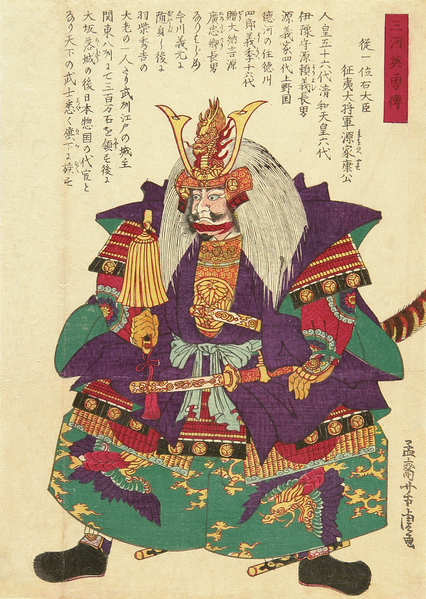
Tokugawa Ieyasu, the First Shogun of the Tokugawa Shogunate. From a woodblock print first published in 1873. Source: Wikimedia Commons, public domain.
Catholic
Religious Music and Entertainment
Previous Post
February 29, 2024
Thích Quảng Duc: The Burning Monk
Next Post
March 12, 2024 Wu Zetian, Ruthless Empress and Patroness of Buddhism
Recent Comments
"Thank you for this grounded, deeply necessary perspective. Shifting our framework from moralistic binaries to ..."
What You May Not Know About ..."
"Nonviolence is the weapon of the mighty and the strong. Violence is the weapon of ..."
Thomas Aquinas on the Morality of ..."
"Regarding Barbara O'Brien's article "Is Empathy a Weakness?" My answer in song is an emphatic ..."
""A government, which to bigotry gives no sanction." How far our government has fallen from ..."
George Washington’s Letter to Touro Synagogue
Browse Our Archives
Select a Category Buddhism Christianity Daoism Hinduism Indigenous religions Islam Judaism Mysticism New Age Origins of religion Paganism Popes Popular Religious Movements Protestantism Psychology and religion Religion and current events Religion and folklore Religion and News Media Religion and politics Religious Art and Music Religious Freedom Religious mistakes Religious philosophy Religious scriptures Religious Violence science and religion Spiritualism Technology and religion The Catholic Church The Dalai Lama The Reformation Uncategorized
Select a Month September 2026 August 2026 July 2026 June 2026 April 2026 March 2026 February 2026 January 2026 December 2025 November 2025 October 2025 September 2025 August 2025 July 2025 June 2025 May 2025 April 2025 March 2025 February 2025 January 2025 December 2024 November 2024 October 2024 September 2024 August 2024 July 2024 June 2024 May 2024 April 2024 March 2024 February 2024 January 2024 December 2023 November 2023 October 2023 September 2023 August 2023 July 2023 June 2023 May 2023 April 2023 March 2023 February 2023 January 2023 December 2022 November 2022 October 2022 September 2022 August 2022
Follow Us!
TAKE THE
Religious Wisdom Quiz
Who was Jesus' earthly father?
Select your answer to see how you score.
Joseph Joachim Simeon Zechariah
Related posts from The Religious History Nerd

The President and the Pope: An Unprecedented Rift
What Was the Avignon Papacy and Why Is...
Thomas Aquinas on the Morality of War

TRENDING AT PATHEOS History and Religion

When Halloween Unmasks Married Hearts
Written by Dr. David K. Ewen from Eternal Truth Bible College Behind...

Aristotle. He’s been called the father of logic, the father of the...

Methodist Central Hall and Westminster Abbey
Situated on the same square is Methodist Central Hall and Westminster Abbey. ...

57th Dove Awards Honor Dolly Parton, Crown New...
On gospel music’s biggest night, the 57th annual GMA Dove Awards honored...

The First Eucharistic Controversy: Christ’s Real Presence
For Catholics, the Eucharist is the source and summit of the Christian...

What a Stop Sign Can Teach Us About...
How to Make a Decision When You Can't Hear God Main point:...
view all History and Religion blogs
What Are Your Thoughts?leave a comment
Ad-Free & Subscriber Log-In Subscription Support
- About Us
- 2026 Calendar
- Videos
- Podcasts
- Library of World Religions
- Faith In Media Tracker
- Advertise With Us
- Write for Us
- Privacy Policy
- Terms of Service
- Do Not Sell My Data
- Contact Us
- Radiant Digital
- Manage Newsletter Subscriptions
- Unsubscribe From Notifications
- Sitemap
Copyright 2008-2026, Patheos. All rights reserved.
Subscription Support Ad-Free & Subscriber Log-In
Follow Patheos