
BuddhistCatholicContemplativeEvangelicalGeneral ChristianHinduJewishLatter-day SaintMuslimNew VisionsProgressive Christian
Beliefs
- Buddhist
- Catholic
- Contemplative
- Evangelical
- General Christian
- Hindu
- Jewish
- Latter-day Saint
- More Voices
- Muslim
- New Visions
- Pagan
- Progressive Christian
Topics
- Religion News
- Food and Religion
- Sports and Religion
- Religious Art
- Religious Music and Entertainment
- Religious Events
- History and Religion
- Style and Religion
- Politics and Religion
- Women in Religion
- Recreation Outdoors and Religion
- Business Finance and Religion
- Careers Workplace and Religion
- Education and Religion
- Family Parenting and Religion
- Health Fitness and Religion
- Home and Religion
- Relationships and Religion
- Technology and Religion
- Travel and Religion
Columnists
- Buddhist Columnists
- Business Finance and Religion Columnists
- Careers Workplace and Religion Columnists
- Catholic Columnists
- Contemplative Columnists
- Education and Religion Columnists
- Evangelists Columnists
- Family Parenting and Religion Columnists
- General Christian Columnists
- Health Fitness and Religion Columnists
- Hindu Columnists
- History and Religion Columnists
- Home and Religion Columnists
- Jewish Columnists
- More Voices Columnists
- Latter Day Columnists
- Muslim Columnists
- New Visions Columnists
- Nonreligious Columnists
- Pagan Columnists
- Politics and Religion Columnists
- Progressive Columnists
- Recreation Outdoors and Religion Columnists
- Relationships and Religion Columnists
- Religion News Columnists
- Religious Art Columnists
- Religious Events Columnists
- Religious Music and Entertainment Columnists
- Sports and Religion Columnists
- Style and Religion Columnists
- Technology and Religion Columnists
- Travel and Religion Columnists
- Women in Religion Columnists
Resource Library
- 2026 Calendar
- Library of World Religions
- The 100 Most Holy Places on Earth
- Patheos Answers
- Podcasts
- Videos
- Faith Leaders Database
- Anglican Episcopalian
- Bahai
- Baptist
- Buddhism
- Christianity
- Confucianism
- Eastern Orthodoxy
- Hinduism
- Holiness and Pentecostal
- ISKCON
- Islam
- Judaism
- Lutheran
- Methodist
- The Church of Jesus Christ of Latter-day Saints
- New Age
- Paganism
- Presbytarian and Reformed
- Protestantism
- Religion Behind the Scenes
- Roman Catholic
- Scientology
- Shia Islam
- Sikhism
- Sufism
- Sunni Islam
- Taoism
- Zen
- See all religions
Research Tools
 Ad-Free & Subscriber Log-In Subscription Support
Ad-Free & Subscriber Log-In Subscription Support
Follow Patheos 

- Trending:
- Forgiveness
- |
- Marriage
- |
- Consciousness
- |
- Death Penalty
- |
- Election
- |
- Halloween

- Home
- General Christian
- History and Religion
- When Christianity Was Banned in Japan
When Christianity Was Banned in Japan
Last updated on: March 7, 2024 at 2:37 pm by Barbara O'Brien
When Christianity Was Banned in Japan 2024-03-07T14:37:41-06:00 Barbara O'Brien
Patheos Explore the world's faith through different perspectives on religion and spirituality! Patheos has the views of the prevalent religions and spiritualities of the world.
Christianity was banned in Japan in 1614. This was about 65 years after it had been introduced to Japan. The last post told the story of the 26 Martyrs of Nagasaki, a group of Franciscan priests and Japanese Catholics who were crucified in Nagasaki in 1597. But that was just a preview. More executions followed, and after the ban Japanese officials went to extraordinary lengths to identify — and eliminate — all traces of Christianity in Japan. This purge of Christianity eventually extended to western hegemony in general, when nearly all foreigners were barred from entering Japan, and Japanese were barred from leaving it.
I mostly want to look at why this happened. I sometimes hear it said that Christianity was suppressed to protect Buddhism. But, frankly, most of the warlords originally behind the suppression of Christianity were not known to give a hoo-haw about Buddhism. At times they were as merciless toward Buddhist sects as they were to the Jesuits and Franciscans. And as told in the last post, one powerful warlord, Oda Nobunaga, encouraged the Catholic missionaries because he hoped they would take the more powerful Buddhist institutions down a few pegs. In truth, most of the leaders of 16th century Japan were less concerned with religious doctrines than they were about their own grip on power.
But now we move into the 17th century. The warlord who ordered the crufixions at Nagasaki, Toyotomi Hideyoshi, died in 1598, apparently of some disease. By 1600 control of Japan had passed to Tokugawa Ieyasu (1543-1616). Tokugawa Ieyasu was named Shogun in 1603. (As explained in the last post, Japan did have emperors, but beginning in the late 12th century the real ruler of Japan was the Shogun, a military dictator.) Tokugawa Ieyasu and his successors — the Tokugawa shogunate — would govern Japan until 1868.
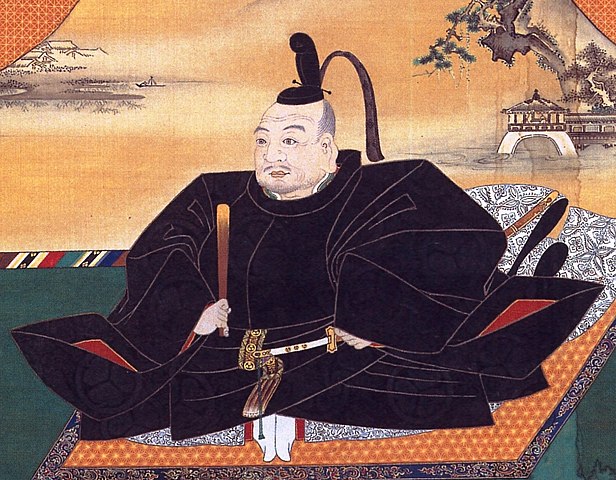
Portrait of Tokugawa Ieyasu at Osaka Castle, Osaka, Japan. Source: Wikimedia Commons, public domain.
Why Christianity Was Banned in Japan
Unlike many of the other military strongmen of Japan, Tokugawa Ieyasu was said to have been genuinely devoted to the Jodo Shinshu school of Buddhism. Whether this factored into his policies toward Christianity I cannot say. What might have worried Ieyasu, however, was Christianity’s claim of exclusivity. Japan had already adopted two foreign religions, Buddhism and Confucianism. Elements of popular Daoism imported from China had also been absorbed into Japanese folk beliefs. These foreign religions had co-existed reasonably well with the indigenous Japanese animistic religion that today is called Shinto. Indeed, Shinto and Buddhism commonly shared shrines in those days. In Japan, it wasn’t unusual, especially for laypeople, to mix together practices of more than one religion. But Christianity was insisting that it had to be followed exclusively. This may have triggered the Shogun’s fears that Catholic converts would be more loyal to the Pope than to him.
(This is not to say that religion in Japan was always harmonious. Centuries earlier some of the larger Buddhist monasteries began to hire mercenaries for defense. These mercenaries usually lived in the monasteries as monks, but it wasn’t clear they were ordained. And from time to time they were sent forth to attack rival temples. These disputes were usually more about politics and patronage that doctrinal disagreements. The practice of monasteries hosting their own private armies was ended in the 16th century by the aforementioned Oda Nobunaga, in a process that involved destroying many venerable temples and slaughtering thousands of monks.)
The new Shogun also suspected that the missionaries were the tip of the spear of European colonization. In the 16th century Spain had already seized the Philippines and parts of Malaysia. Portugal occupied a large part of Ceylon, today’s Sri Lanka. The established pattern was that first came merchants and missionaries, and then came warships. Was this the plan for Japan? It probably didn’t help that, in 1600, Pope Clement VIII authorized more orders to do missionary work in Japan. Dominicans and Augustinians began arriving in Japan two years later.
More Suppression
In time the concerns won out, and the Shogun banned Christianity in Japan in 1614. Waves of executions of Christians followed. Over the next few decades a few hundred missionaries and Japanese Christians are known to have been executed for being Christian. In 1629 Japanese officials began a practice called fumi-e, in which suspected Christians were required to step on an image of Jesus or Mary to prove they weren’t Christian. Those who refused were executed. Christianity was driven underground.
Remarkably, or perhaps irrationally, a few Catholic missionaries continued to arrive in Japan during this period. Two Augustinians who entered Nagasaki in 1632 were betrayed to authorities by the Chinese merchants who had given them passage on their ship. The Augustinians fled into the hills for a time but were recognized, and executed, when they reappeared in Nagasaki later that year.
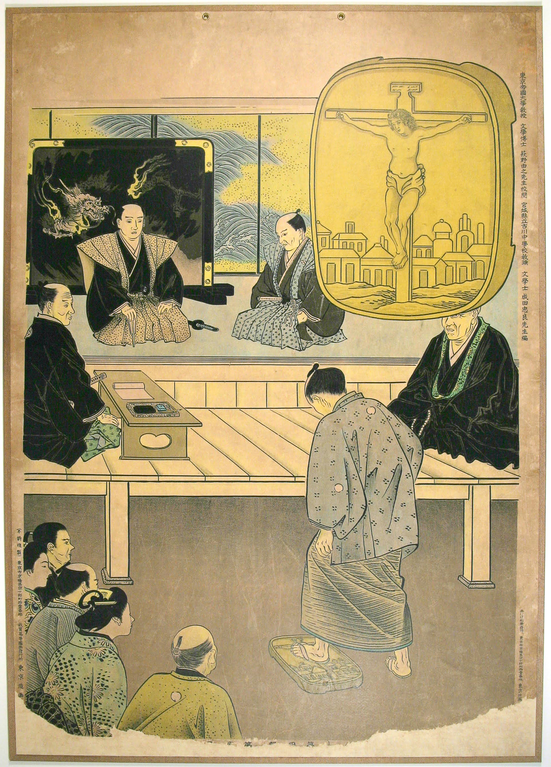
A 19th century Japanese illustration of fumi-e. Source: Wikimedia Commons, public domain.
The Tokugawa shogunate made use of the danka system to monitor Japan’s population. Danka originally was a long-standing custom in which households financially supported a Buddhist temple, which in turn would take care of the spiritual needs of household members. This system was voluntary, but the Tokugawas made it mandatory. All Japanese were required every year to register with the nearesst Buddhist temple to obtain a document called terauke that certified they were not Christian. One needed a terauke to function in society; to marry, to get work, to travel. The temples also kept track of births and deaths, who married or who moved away. All of this information was gathered and passed up the national organization chart, so it became a kind of running census for the shogunate as well as a means to identify hidden Christians. The system was also a major source of income for temples, which charged fees for issuing the terauke. Temples were also required to provide funerals and memorial services for all their registrants.
Sakoku: “Closed Country”
In 1637 a coalition of ronin and mostly Catholic peasants began a rebellion on Kyushu. (Kyushu is the southernmost of Japan’s main islands, and it had the largest number of Catholic converts.) The rebellion was against ruinous taxes imposed by their daimyo — a daimyo was something like a feudal lord — and also against his ruthless suppression of Christianity. The rebellion was quelled by the shogunate in 1638. The third Tokugawa shogun, Iemitsu (1604–1651), believed that European Catholics were behind the rebellion, and all Portuguese traders were evicted from Japan. And then most other foreigners were evicted from Japan, as well as mixed-race children of Japanese and foreigners.
The period called Sakoku — “closed country” — began in 1639. Japanese were no longer allowed to leave Japan. Non-Japanese were not allowed to enter, with a few carefully watched exceptions. Foreign trade was mostly limited to the Dutch East India Company and China, and these foreign merchants were allowed to set foot only on an island in Nagasaki Bay. Japan was not completely cut off from the rest of the world, but very nearly so. This isolation was finally broken in 1853, when Commodore Matthew C. Perry entered Tokyo Bay with four steam-powered and heavily armed U.S. warships and asked to speak to whoever was in charge.
In the meantime, Christianity went deep underground. A few European missionaries remained, in secret, but when they died people had no priests to lead them. Yet thousands of people, especially on Kyushu or the smaller islands near Kyushu, continued to practice Christianity in secret. They worshipped in hidden rooms in their homes. They memorized liturgies and teachings and passed them on to their children orally. And this continued until the end of the Tokugawa shogunate in 1868, which also ended the ban on Christianity.
When Christianity Was Banned in Japan: Postscript
Today, according to the government of Japan, about 1.5 percent of Japanese, about 1.9 million people, are Christian. This percentage appears to have not changed for several years.
Although danka seemed like a great deal for Buddhist temples, over time it had a corrupting effect. By the end of the shogunate smaller temples in particular were nothing but funeral businesses. There also was considerable pent-up resentment against Buddhism about the danka requirement to give money to Buddhist temples whether one wanted to or not. In recent decades thousands of small temples have closed, and many of the larger, historic temples rely on tourism for income.
General Christian
Catholic
Previous Post
February 3, 2024
The 26 Martyrs of Nagasaki
Next Post
February 8, 2024 The Warlord and the Tea Master
Recent Comments
"Thank you for this grounded, deeply necessary perspective. Shifting our framework from moralistic binaries to ..."
What You May Not Know About ..."
"Nonviolence is the weapon of the mighty and the strong. Violence is the weapon of ..."
Thomas Aquinas on the Morality of ..."
"Regarding Barbara O'Brien's article "Is Empathy a Weakness?" My answer in song is an emphatic ..."
""A government, which to bigotry gives no sanction." How far our government has fallen from ..."
George Washington’s Letter to Touro Synagogue
Browse Our Archives
Select a Category Buddhism Christianity Daoism Hinduism Indigenous religions Islam Judaism Mysticism New Age Origins of religion Paganism Popes Popular Religious Movements Protestantism Psychology and religion Religion and current events Religion and folklore Religion and News Media Religion and politics Religious Art and Music Religious Freedom Religious mistakes Religious philosophy Religious scriptures Religious Violence science and religion Spiritualism Technology and religion The Catholic Church The Dalai Lama The Reformation Uncategorized
Select a Month September 2026 August 2026 July 2026 June 2026 April 2026 March 2026 February 2026 January 2026 December 2025 November 2025 October 2025 September 2025 August 2025 July 2025 June 2025 May 2025 April 2025 March 2025 February 2025 January 2025 December 2024 November 2024 October 2024 September 2024 August 2024 July 2024 June 2024 May 2024 April 2024 March 2024 February 2024 January 2024 December 2023 November 2023 October 2023 September 2023 August 2023 July 2023 June 2023 May 2023 April 2023 March 2023 February 2023 January 2023 December 2022 November 2022 October 2022 September 2022 August 2022
Follow Us!
TAKE THE
Religious Wisdom Quiz
What does "Levi" (as in the tribe and the priesthood) mean?
Select your answer to see how you score.
Strong Firstborn Attached/Joined Blessed
Related posts from The Religious History Nerd

The President and the Pope: An Unprecedented Rift
What Was the Avignon Papacy and Why Is...
Thomas Aquinas on the Morality of War

TRENDING AT PATHEOS History and Religion

'Super Scam Me' Exposes AI Jon Bon Jovi...
Leslie Pickett believed she was in a relationship with Jon Bon Jovi....

The Brazilian Remake of Kendricks' 'Flywheel' Opens in...
“Flywheel,” the story that launched the Kendrick Brothers’ filmmaking career is getting...

The Dangers of Gradual Accommodation (Winking at Sin)
Recently, the “law of gradualness” resurfaced during the opening of a weeklong,...

The Iron Gates and the Lion of the...
Yesterday, I didn't finish my report about, well, yesterday. So I'll...

The Image: On the Horror of Capitalism and...
The Image Then went the Pharisees, and took counsel how they might...

We are approaching the date of our new American national holiday: October...
view all History and Religion blogs
What Are Your Thoughts?leave a comment
Ad-Free & Subscriber Log-In Subscription Support
- About Us
- 2026 Calendar
- Videos
- Podcasts
- Library of World Religions
- Faith In Media Tracker
- Advertise With Us
- Write for Us
- Privacy Policy
- Terms of Service
- Do Not Sell My Data
- Contact Us
- Radiant Digital
- Manage Newsletter Subscriptions
- Unsubscribe From Notifications
- Sitemap
Copyright 2008-2026, Patheos. All rights reserved.
Subscription Support Ad-Free & Subscriber Log-In
Follow Patheos