
BuddhistCatholicContemplativeEvangelicalGeneral ChristianHinduJewishLatter-day SaintMuslimNew VisionsProgressive Christian
Beliefs
- Buddhist
- Catholic
- Contemplative
- Evangelical
- General Christian
- Hindu
- Jewish
- Latter-day Saint
- More Voices
- Muslim
- New Visions
- Pagan
- Progressive Christian
Topics
- Religion News
- Food and Religion
- Sports and Religion
- Religious Art
- Religious Music and Entertainment
- Religious Events
- History and Religion
- Style and Religion
- Politics and Religion
- Women in Religion
- Recreation Outdoors and Religion
- Business Finance and Religion
- Careers Workplace and Religion
- Education and Religion
- Family Parenting and Religion
- Health Fitness and Religion
- Home and Religion
- Relationships and Religion
- Technology and Religion
- Travel and Religion
Columnists
- Buddhist Columnists
- Business Finance and Religion Columnists
- Careers Workplace and Religion Columnists
- Catholic Columnists
- Contemplative Columnists
- Education and Religion Columnists
- Evangelists Columnists
- Family Parenting and Religion Columnists
- General Christian Columnists
- Health Fitness and Religion Columnists
- Hindu Columnists
- History and Religion Columnists
- Home and Religion Columnists
- Jewish Columnists
- More Voices Columnists
- Latter Day Columnists
- Muslim Columnists
- New Visions Columnists
- Nonreligious Columnists
- Pagan Columnists
- Politics and Religion Columnists
- Progressive Columnists
- Recreation Outdoors and Religion Columnists
- Relationships and Religion Columnists
- Religion News Columnists
- Religious Art Columnists
- Religious Events Columnists
- Religious Music and Entertainment Columnists
- Sports and Religion Columnists
- Style and Religion Columnists
- Technology and Religion Columnists
- Travel and Religion Columnists
- Women in Religion Columnists
Resource Library
- 2026 Calendar
- Library of World Religions
- The 100 Most Holy Places on Earth
- Patheos Answers
- Podcasts
- Videos
- Faith Leaders Database
- Anglican Episcopalian
- Bahai
- Baptist
- Buddhism
- Christianity
- Confucianism
- Eastern Orthodoxy
- Hinduism
- Holiness and Pentecostal
- ISKCON
- Islam
- Judaism
- Lutheran
- Methodist
- The Church of Jesus Christ of Latter-day Saints
- New Age
- Paganism
- Presbytarian and Reformed
- Protestantism
- Religion Behind the Scenes
- Roman Catholic
- Scientology
- Shia Islam
- Sikhism
- Sufism
- Sunni Islam
- Taoism
- Zen
- See all religions
Research Tools
 Ad-Free & Subscriber Log-In Subscription Support
Ad-Free & Subscriber Log-In Subscription Support
Follow Patheos 

- Trending:
- Forgiveness
- |
- Marriage
- |
- Consciousness
- |
- Death Penalty
- |
- Election
- |
- Halloween

- Home
- General Christian
- History and Religion
- The 26 Martyrs of Nagasaki
The 26 Martyrs of Nagasaki
Last updated on: February 5, 2024 at 8:27 am by Barbara O'Brien
The 26 Martyrs of Nagasaki 2024-02-05T08:27:17-06:00 Barbara O'Brien
Patheos Explore the world's faith through different perspectives on religion and spirituality! Patheos has the views of the prevalent religions and spiritualities of the world.
The 26 martyrs of Nagasaki were Christian missionaries who were crucified in Nagasaki, Japan, on February 5, 1597. Among these were six Franciscan priests, most of them Spanish. The remainder were Japanese Catholic converts, at least one of whom had been ordained by the Jesuits. Three were young boys who had served as altar attendants. The martyrs of Nagasaki were executed on the order of Toyotomi Hideyoshi (1537-1598), a powerful samurai warlord who is credited with unifying Japan after a period of chaos and anarchy. He is also remembered for his ruthlessness and cruelty.
Toyotomi Hideyoshi’s persecution of Christians was just a beginning. Christianity would be officially banned in Japan in 1614, and officials went to extraordinary lengths to identify — and eliminate — all traces of Christianity in Japan. This post is about how the oppression of Christianity in Japan began, and why. As we’ll see, the why had very little to do with religion and more to do with politics and xenophobia.
Martyrs of Nagasaki: Sengoku Japan
First, here is some background on the political state of 16th century Japan. Although Japan still had emperors, since the late 12th century the real ruler of Japan had been the shogun, who was a military dictator. But a brutal civil war called the Ōnin War (1467-1477) destroyed the authority of the shogun. The Ōnin War marked the beginning of Sengoku, the “warring states period,” in which clans of samurai fought each other for territory and power. Civil order in Japan was nearly extinguished.
During Sengoku what civil order existed was being enforced by the samurai clans. Samurai were not just warriors but were an elite military caste that dominated Japan. The heads of the samurai families or clans were called daimyo, and a daimyo was something like the fuedal lord of his territory.
Eventually some warlords came forward to unify Japan, preferably under their control. Most notable of these was Oda Nobunaga (1534-1582). who turns up in an earlier post, “Ikkō-Ikki: Buddhism and The Japanese Peasant Revolts.” Nobunaga had not yet achieved his goal of unifying Japan when he was assasinated in 1582. Toyotomi Hideyoshi had been one of Nobunaga’s retainers and then became his successor. He continued Nobunaga’s work of unifying Japan and was successful enough that he became the de facto ruler of Japan. He did not call himself shogun, however, because he had been born into a peasant family. Instead he called himself the emperor’s regent.
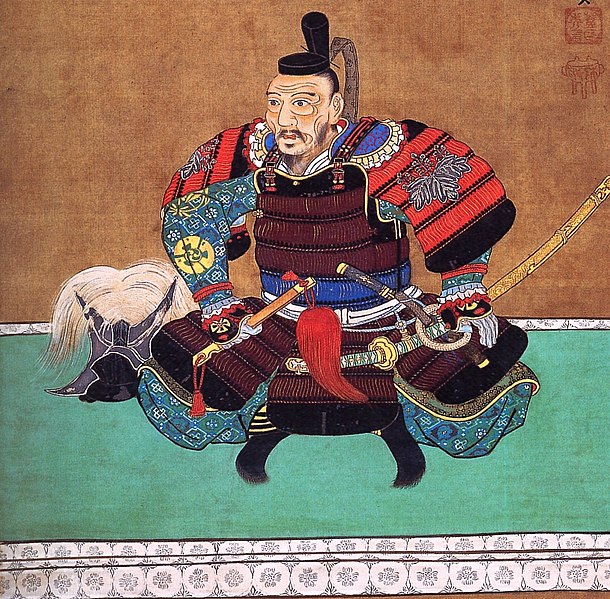
Toyotomi Hideyoshi. From the Hideyoshi Kiyomasa Memorial Hall, Nagoya. Source: Wikimedia Commons, public domain.
Martyrs of Nagasaki: Christian Missionaries Arrive in Japan
The first Christian missionaries known to reach Japan arrived during Sengoku. Francis Xavier (1506-1552), a Jesuit priest, reached Japan in 1549. This was just six years after the arrival of the first European merchant ships. He was accompanied by a Japanese man named Anjiro, whom Xavier had met in Malaysia, and two other Jesuits. Francis Xavier tried and failed to meet the Emperor Tomohito, but he and his mission work were welcomed by Oda Nobunaga. After making a promising beginning at converting the Japanese, Father Xavier left Japan in 1551. His Jesuit brothers remained and continued the work, and eventually more than 90 other Jesuits joined them.
Nobunaga was keenly interested in reducing the power and influence of some of the Buddhist sects. In the years to come Nobundaga would ruthlessly put down a peasant revolt led by Jodo Shinshu priests and destroy Enryakuji, the most prestigious Buddhist temple/monastery complex in Japan and home to thousands of monks, who were slaughtered. Nobunaga considered the Enryakuji monks to be a threat to his power. Nobunaga probably thought that anything that challenged the authority of Buddhist clergy was a benefit to him.
With Nobunaga’s approval, the Jesuits had remarkable success converting Japanese to Christianity. These missionaries were sometimes able to convert daimyo, the elites who headed samurai clans, and all their subjects with them. It’s believed some of these conversions had more to do with the idea of gaining connections and influence with the foreigners than with religious devotion, but the missionaries considered them a win in their column nonetheless.
The Christians of Kyushu
The mission was especially successful on Kyushu, the southernmost of Japan’s main islands. One of the first daimyo to convert, in 1563, was Omura Sumitada (1533-1587), whose territory was in northwestern Kyushu. Sumitada required the people living in his territory to convert also. And in his zeal Omura Sumitada destroyed the Buddhist and Shinto temples and shrines in his territory, an act that would have many repercussions.
Someone who objected to the destruction of the temples and shrines destroyed the main seaport in northwestern Kyushu that served Sumitada’s territory. So, in 1570 Sumitada opened the port of Nagasaki to the Jesuits so they could come and go from Japan freely. Nagasaki was a small fishing village, but from that time on it grew into a center of foreign activity.
By 1584, the Jesuits had recorded more than 300,000 Japanese converts. A third of these were on Kyushu.
Oda Nobunaga was assasinated in 1582. By 1585, Toyotomi Hideyoshi had fought and maneuvered his way into Nobunaga’s place as the most powerful warlord in Japan. For a time he seemed to continue Oda Nobunaga’s benign acceptance of the Christian missionaries. But that changed.
Hideyoshi’s Persecution of Christians Begins
In 1587, after he had seized control of Kyushu, Hideyoshi issued an edict that banned missionary activities. Hideyoshi’s edict also called for expelling foreign missionaries, but this was not enforced. In Kyushu he had seen that Buddhist and Shinto shrines and temples had been destroyed, and that common people had been forced to convert to Christianity by their daimyo. He also imagined, with no evidence, that the Jesuits had sold Japanese into slavery. And he became concerned that Christian daimyo would have mixed loyalties.
After this, the Jesuits were careful to keep their heads down. The Jesuits had already adopted a policy of respect to local etiquette and culture. In short, they tried to blend in and appear less “foreign” to their hosts so that the Japanese would be more comfortable with them. They thought if they remained unobtrusive they could continue to do their work as priests.
By 1592 Hideyoshi had effectively unified Japan under his control. Then Franciscans arrived in 1593 to begin their own mission work in Japan. Believing they had Hideyoshi’s permission — they did not — they built a church and began holding traditional Latin masses, with sermons, singing, bells, and the works. They also preached in public, which Hideoyoshi had forbidden. The Jesuits — who knew Hideoyshi to be volatile — warned the Franciscans to tone it down. It didn’t help that there was rivalry between the two orders.
The Crucifixions of the Martyrs of Nagasaki
In 1596 a Spanish galleon was shipwrecked at Urado Bay, a bay of the main island of Shikoku, which is north of Kyushu. The local daimyo ordered his samurai to confiscate the cargo. According to some accounts, weapons were found on the ship. The ship’s navigator, possibly under torture, “admitted” that Spain was planning to invade Japan, as soon as the missionaries had done their work of “softening” the population with religion. When this was reported to Toyotomi Hideyoshi, he ordered the executions of the twenty-six Christians in Nagasaki.
Why these particular twenty-six people were chosen for execution, I do not know. By all accounts their executions were brutal. For several days they were torturned, mutilated, and paraded through villages throughout Japan. Then on February 5, 1597, they were crucified, tied to crosses and impaled with spears, on a hill overlooking Nagasaki.
Postscript
The 26 martyrs were canonized on June 8, 1862, by Pope Pius IX. They are commemorated on February 6, since February 5 already was the feast day of Saint Agatha. Francis Xavier also has been formally venerated as a saint by the Catholic church since 1622. The Basilica of the Twenty-Six Holy Martyrs of Japan, built in the late 19th century, sustained damage from the atomic bomb dropped on Nagasaki on August 9, 1945, but it has been restored.
A great deal more happened with Japan’s Christians in the years after the crucifixions at Nagasaki, and that will be covered in the next post.
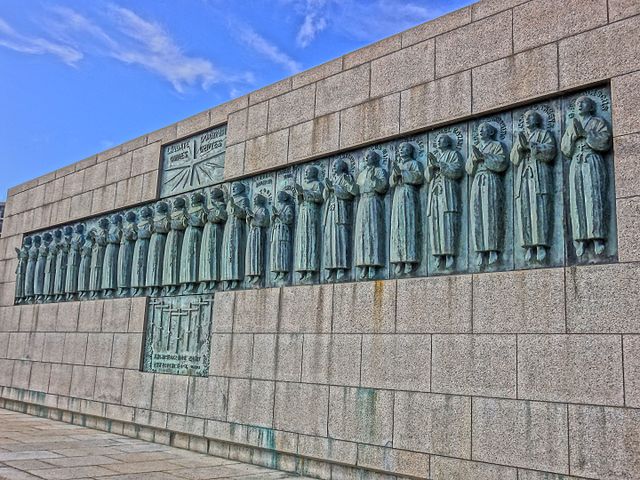
Memorial on the site of the crucifixion of the 26 martyrs. Photo by Masoud Akbari. Soure: Wikimedia Commons, Creative Commons Attribution-Share Alike 3.0 Unported license.
General Christian
Catholic
Previous Post

January 26, 2024
Why Are There More Nones?
Next Post
February 4, 2024 When Christianity Was Banned in Japan
Recent Comments
"Thank you for this grounded, deeply necessary perspective. Shifting our framework from moralistic binaries to ..."
What You May Not Know About ..."
"Nonviolence is the weapon of the mighty and the strong. Violence is the weapon of ..."
Thomas Aquinas on the Morality of ..."
"Regarding Barbara O'Brien's article "Is Empathy a Weakness?" My answer in song is an emphatic ..."
""A government, which to bigotry gives no sanction." How far our government has fallen from ..."
George Washington’s Letter to Touro Synagogue
Browse Our Archives
Select a Category Buddhism Christianity Daoism Hinduism Indigenous religions Islam Judaism Mysticism New Age Origins of religion Paganism Popes Popular Religious Movements Protestantism Psychology and religion Religion and current events Religion and folklore Religion and News Media Religion and politics Religious Art and Music Religious Freedom Religious mistakes Religious philosophy Religious scriptures Religious Violence science and religion Spiritualism Technology and religion The Catholic Church The Dalai Lama The Reformation Uncategorized
Select a Month September 2026 August 2026 July 2026 June 2026 April 2026 March 2026 February 2026 January 2026 December 2025 November 2025 October 2025 September 2025 August 2025 July 2025 June 2025 May 2025 April 2025 March 2025 February 2025 January 2025 December 2024 November 2024 October 2024 September 2024 August 2024 July 2024 June 2024 May 2024 April 2024 March 2024 February 2024 January 2024 December 2023 November 2023 October 2023 September 2023 August 2023 July 2023 June 2023 May 2023 April 2023 March 2023 February 2023 January 2023 December 2022 November 2022 October 2022 September 2022 August 2022
Follow Us!
TAKE THE
Religious Wisdom Quiz
Who said: "Little children, keep yourselves from idols"?
Select your answer to see how you score.
James John Peter Paul
Related posts from The Religious History Nerd

The President and the Pope: An Unprecedented Rift
What Was the Avignon Papacy and Why Is...
Thomas Aquinas on the Morality of War

TRENDING AT PATHEOS History and Religion

Looking at the Largest Orthodox Cathedral on Earth
There is often a considerable amount of anger and, shall we...

The Problem with False Prophets
Miller’s Station UMC| 10/18/26| Anchor Verse: Jeremiah 23: 1, 9-23 I...

Emotion in Early Christianity by Andrew Crislip
Andrew Crislip’s Emotion in Early Christianity examines an often overlooked dimension of...

16 Spiritual Touchstones for a More Grounded Life
After decades of spiritual study, here are 16 principles I try...

Catholic Evangelization: Sharing Your Faith Every Day
Welcome back to the Graceful Awakening mini-series called, “From Faith to Mission.” ...

The Pillar of the Boatmen: the Ancient Monument...
The Pillar of the Boatmen is a Romano-Gaulish sculpture that dates from...
view all History and Religion blogs
What Are Your Thoughts?leave a comment
Ad-Free & Subscriber Log-In Subscription Support
- About Us
- 2026 Calendar
- Videos
- Podcasts
- Library of World Religions
- Faith In Media Tracker
- Advertise With Us
- Write for Us
- Privacy Policy
- Terms of Service
- Do Not Sell My Data
- Contact Us
- Radiant Digital
- Manage Newsletter Subscriptions
- Unsubscribe From Notifications
- Sitemap
Copyright 2008-2026, Patheos. All rights reserved.
Subscription Support Ad-Free & Subscriber Log-In
Follow Patheos