
BuddhistCatholicContemplativeEvangelicalGeneral ChristianHinduJewishLatter-day SaintMuslimNew VisionsProgressive Christian
Beliefs
- Buddhist
- Catholic
- Contemplative
- Evangelical
- General Christian
- Hindu
- Jewish
- Latter-day Saint
- More Voices
- Muslim
- New Visions
- Pagan
- Progressive Christian
Topics
- Religion News
- Food and Religion
- Sports and Religion
- Religious Art
- Religious Music and Entertainment
- Religious Events
- History and Religion
- Style and Religion
- Politics and Religion
- Women in Religion
- Recreation Outdoors and Religion
- Business Finance and Religion
- Careers Workplace and Religion
- Education and Religion
- Family Parenting and Religion
- Health Fitness and Religion
- Home and Religion
- Relationships and Religion
- Technology and Religion
- Travel and Religion
Columnists
- Buddhist Columnists
- Business Finance and Religion Columnists
- Careers Workplace and Religion Columnists
- Catholic Columnists
- Contemplative Columnists
- Education and Religion Columnists
- Evangelists Columnists
- Family Parenting and Religion Columnists
- General Christian Columnists
- Health Fitness and Religion Columnists
- Hindu Columnists
- History and Religion Columnists
- Home and Religion Columnists
- Jewish Columnists
- More Voices Columnists
- Latter Day Columnists
- Muslim Columnists
- New Visions Columnists
- Nonreligious Columnists
- Pagan Columnists
- Politics and Religion Columnists
- Progressive Columnists
- Recreation Outdoors and Religion Columnists
- Relationships and Religion Columnists
- Religion News Columnists
- Religious Art Columnists
- Religious Events Columnists
- Religious Music and Entertainment Columnists
- Sports and Religion Columnists
- Style and Religion Columnists
- Technology and Religion Columnists
- Travel and Religion Columnists
- Women in Religion Columnists
Resource Library
- 2026 Calendar
- Library of World Religions
- The 100 Most Holy Places on Earth
- Patheos Answers
- Podcasts
- Videos
- Faith Leaders Database
- Anglican Episcopalian
- Bahai
- Baptist
- Buddhism
- Christianity
- Confucianism
- Eastern Orthodoxy
- Hinduism
- Holiness and Pentecostal
- ISKCON
- Islam
- Judaism
- Lutheran
- Methodist
- The Church of Jesus Christ of Latter-day Saints
- New Age
- Paganism
- Presbytarian and Reformed
- Protestantism
- Religion Behind the Scenes
- Roman Catholic
- Scientology
- Shia Islam
- Sikhism
- Sufism
- Sunni Islam
- Taoism
- Zen
- See all religions
Research Tools
 Ad-Free & Subscriber Log-In Subscription Support
Ad-Free & Subscriber Log-In Subscription Support
Follow Patheos 

- Trending:
- Forgiveness
- |
- Marriage
- |
- Consciousness
- |
- Death Penalty
- |
- Election
- |
- Halloween

- Home
- Buddhism
- History and Religion
- Wonhyo, Buddhist Folk Hero of Korea
Wonhyo, Buddhist Folk Hero of Korea
Last updated on: December 10, 2023 at 11:03 pm by Barbara O'Brien
Wonhyo, Buddhist Folk Hero of Korea 2023-12-10T23:03:31-06:00 Barbara O'Brien
Patheos Explore the world's faith through different perspectives on religion and spirituality! Patheos has the views of the prevalent religions and spiritualities of the world.
The story of Wonhyo (617-686 CE), who was among the most important philosophers of east Asian Buddhism, begins with a folk tale. When Wonhyo was a young monk, he and his friend Uisang decided to go to China to study Buddhism. They lived on the Korean Peninsula in the kingdom of Silla, and to reach China they walked through forests and villages toward a port on the Yellow Sea. One night they were caught in a pounding rainstorm. They stumbled through the mud and dark looking for shelter. To their relief they found a small stone building, possibly a toolshed. It was utterly dark inside, and the monks had no wood to build a fire, but at least they were out of the pelting rain. The thirsty Wonhyo felt around and found a gourd filled with rainwater. He drank his fill.
In the morning light, however, Wonhyo saw that the shelter was a tomb and the gourd was part of a skull. Wonhyo then had a powerful realization of how his mind created his perception of reality. He said, “The three worlds are only mind, and all phenomena arise from the mind, consciousness. If the truth is present in the mind, how could it be found outside of the mind!” He decided he had no need to go to China. Uisang (625–702), who also made significant contributions to Korean Buddhism, went on alone to China, and Wonhyo returned to Silla.
When Wonhyo returned to Silla he devoted himself to living among laypeople to teach Buddhism. He traveled from village to village carrying a gayageum, a traditional Korean musical instrument similar to a zither. He played the gayageum and led people in song and dance as an expression of harmony in everyday life. He reverted to being a layman, According to a story with many variations, this was because of an affair with a princess of Silla who became enamored of Wonhyo when she heard him speak. Later in his life Wonhyo married and had a son, Seol Chong, who became one of Korea’s eminent scholars. Wonhyo’s unconventional life made him a folk hero of Korea as well as a historical figure.
Wonhyo’s Interpenetrated Buddhism
Buddhism had reached what is now Korea in 372 CE, when a Chinese monk arrived bearing sutras and images of the Buddha. By the 7th century, when Wonhyo and Uisang began their journey to China, it was common for monks of the Korean Peninsula to spend some time in China studying with the Chinese masters. And by that time several distinctive schools of Buddhism were emerging in China, each with its own doctrines and practices. For example, in China Uisang studied with Zhiyan, a patriarch of the Huayan school of Buddhism. Other schools of the time included Pure Land, Tiantai, and early Chan, better known in the West by its Japanese name, Zen. Although these shared a basic doctrinal foundation, there were significant differences among them. Monks were coming back to the Korean Peninsula with very different versions of Buddhism. This was causing considerable dissension among the monks.
Wonhyo surveyed the schools of Buddhism that had been transmitted to Korea. He systematically presented these diverse schools in a larger framework of Buddhist teaching to resolve their differences. The result is called Tongbulgyo or T’ong pulgyo, which means “interpenetrated Buddhism.” In Wonhyo’s view, the differing positions of various schools can be understood as partial views of the whole reality, seen from their respective perspectives. Therefore, even though doctrines may differ they are all self-consistent parts of the one integrated whole. Korean Buddhism on the whole adopted Wonhyo’s perspective to reduce sectarian conflict.
Wonhyo’s One Mind
One Mind is at the center of much of Wonhyo’s work. To explain as simply as I can, the One Mind consists of the minds of all sentient beings and also the ground from which they manfest. One Mind is a complex teaching that had been proposed in earlier Buddhist commentaries in China, but Wonhyo took the teaching further and explained it in a way that, once again, reconciled different Buddhist philosophical schools. Wonhyo’s commentaries on One Mind influenced Buddhism in China and, eventually, all of East Asia. Wonhyo said that if people understood the One Mind, they would realize that religious differences are just misguided labels that cause strife and misunderstanding.
Wonhyo remains less well known in the West than many Chinese and Japanese masters. This is a shame, because I suspect he has much to teach us still. For more about Wonhyo and the One Mind teachings in China and elsewhere, see my book The Circle of the Way: A Concise History of Zen from the Buddha to the Modern World.
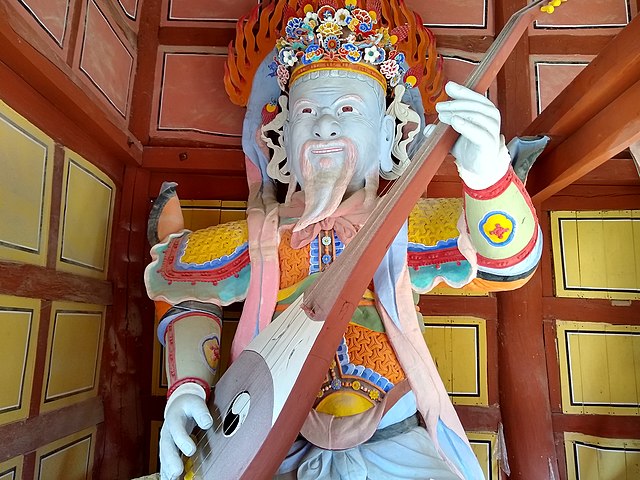
A temple guardian of Sonunsa Temple, Gochang County, South Korea. Photo by Lance Vanlewen. Source: Wikimedia Commons, Creative Commons Attribution-Share Alike 4.0 International license..
Buddhism
Previous Post
November 27, 2023
Muslims in Colonial America
Next Post

December 14, 2023 When Christmas Was Banned in Boston
Recent Comments
"Thank you for this grounded, deeply necessary perspective. Shifting our framework from moralistic binaries to ..."
What You May Not Know About ..."
"Nonviolence is the weapon of the mighty and the strong. Violence is the weapon of ..."
Thomas Aquinas on the Morality of ..."
"Regarding Barbara O'Brien's article "Is Empathy a Weakness?" My answer in song is an emphatic ..."
""A government, which to bigotry gives no sanction." How far our government has fallen from ..."
George Washington’s Letter to Touro Synagogue
Browse Our Archives
Select a Category Buddhism Christianity Daoism Hinduism Indigenous religions Islam Judaism Mysticism New Age Origins of religion Paganism Popes Popular Religious Movements Protestantism Psychology and religion Religion and current events Religion and folklore Religion and News Media Religion and politics Religious Art and Music Religious Freedom Religious mistakes Religious philosophy Religious scriptures Religious Violence science and religion Spiritualism Technology and religion The Catholic Church The Dalai Lama The Reformation Uncategorized
Select a Month September 2026 August 2026 July 2026 June 2026 April 2026 March 2026 February 2026 January 2026 December 2025 November 2025 October 2025 September 2025 August 2025 July 2025 June 2025 May 2025 April 2025 March 2025 February 2025 January 2025 December 2024 November 2024 October 2024 September 2024 August 2024 July 2024 June 2024 May 2024 April 2024 March 2024 February 2024 January 2024 December 2023 November 2023 October 2023 September 2023 August 2023 July 2023 June 2023 May 2023 April 2023 March 2023 February 2023 January 2023 December 2022 November 2022 October 2022 September 2022 August 2022
Follow Us!
TAKE THE
Religious Wisdom Quiz
True or False: Eve was created from Adam's rib.
Select your answer to see how you score.
FALSE TRUE
Related posts from The Religious History Nerd

Sarvastivada: An Extinct Buddhist Sect That's Still With...
A Goddess Who Swapped Bodies to Prove Gender...

The Beat Zen Movement: When Zen Became Cool
TRENDING AT PATHEOS History and Religion

Emotion in Early Christianity by Andrew Crislip
Andrew Crislip’s Emotion in Early Christianity examines an often overlooked dimension of...

16 Spiritual Touchstones for a More Grounded Life
After decades of spiritual study, here are 16 principles I try...

Catholic Evangelization: Sharing Your Faith Every Day
Welcome back to the Graceful Awakening mini-series called, “From Faith to Mission.” ...

The Pillar of the Boatmen: the Ancient Monument...
The Pillar of the Boatmen is a Romano-Gaulish sculpture that dates from...

In one sense walking into Westminster Abbey is like walking down the...

'Super Scam Me' Exposes AI Jon Bon Jovi...
Leslie Pickett believed she was in a relationship with Jon Bon Jovi....
view all History and Religion blogs
What Are Your Thoughts?leave a comment
Ad-Free & Subscriber Log-In Subscription Support
- About Us
- 2026 Calendar
- Videos
- Podcasts
- Library of World Religions
- Faith In Media Tracker
- Advertise With Us
- Write for Us
- Privacy Policy
- Terms of Service
- Do Not Sell My Data
- Contact Us
- Radiant Digital
- Manage Newsletter Subscriptions
- Unsubscribe From Notifications
- Sitemap
Copyright 2008-2026, Patheos. All rights reserved.
Subscription Support Ad-Free & Subscriber Log-In
Follow Patheos