
BuddhistCatholicContemplativeEvangelicalGeneral ChristianHinduJewishLatter-day SaintMuslimNew VisionsProgressive Christian
Beliefs
- Buddhist
- Catholic
- Contemplative
- Evangelical
- General Christian
- Hindu
- Jewish
- Latter-day Saint
- More Voices
- Muslim
- New Visions
- Pagan
- Progressive Christian
Topics
- Religion News
- Food and Religion
- Sports and Religion
- Religious Art
- Religious Music and Entertainment
- Religious Events
- History and Religion
- Style and Religion
- Politics and Religion
- Women in Religion
- Recreation Outdoors and Religion
- Business Finance and Religion
- Careers Workplace and Religion
- Education and Religion
- Family Parenting and Religion
- Health Fitness and Religion
- Home and Religion
- Relationships and Religion
- Technology and Religion
- Travel and Religion
Columnists
- Buddhist Columnists
- Business Finance and Religion Columnists
- Careers Workplace and Religion Columnists
- Catholic Columnists
- Contemplative Columnists
- Education and Religion Columnists
- Evangelists Columnists
- Family Parenting and Religion Columnists
- General Christian Columnists
- Health Fitness and Religion Columnists
- Hindu Columnists
- History and Religion Columnists
- Home and Religion Columnists
- Jewish Columnists
- More Voices Columnists
- Latter Day Columnists
- Muslim Columnists
- New Visions Columnists
- Nonreligious Columnists
- Pagan Columnists
- Politics and Religion Columnists
- Progressive Columnists
- Recreation Outdoors and Religion Columnists
- Relationships and Religion Columnists
- Religion News Columnists
- Religious Art Columnists
- Religious Events Columnists
- Religious Music and Entertainment Columnists
- Sports and Religion Columnists
- Style and Religion Columnists
- Technology and Religion Columnists
- Travel and Religion Columnists
- Women in Religion Columnists
Resource Library
- 2026 Calendar
- Library of World Religions
- The 100 Most Holy Places on Earth
- Patheos Answers
- Podcasts
- Videos
- Faith Leaders Database
- Anglican Episcopalian
- Bahai
- Baptist
- Buddhism
- Christianity
- Confucianism
- Eastern Orthodoxy
- Hinduism
- Holiness and Pentecostal
- ISKCON
- Islam
- Judaism
- Lutheran
- Methodist
- The Church of Jesus Christ of Latter-day Saints
- New Age
- Paganism
- Presbytarian and Reformed
- Protestantism
- Religion Behind the Scenes
- Roman Catholic
- Scientology
- Shia Islam
- Sikhism
- Sufism
- Sunni Islam
- Taoism
- Zen
- See all religions
Research Tools
 Ad-Free & Subscriber Log-In Subscription Support
Ad-Free & Subscriber Log-In Subscription Support
Follow Patheos 

- Trending:
- Forgiveness
- |
- Marriage
- |
- Consciousness
- |
- Death Penalty
- |
- Election
- |
- Halloween

- Home
- General Christian
- History and Religion
- When Christmas Was Banned in Boston
When Christmas Was Banned in Boston
Last updated on: December 18, 2023 at 7:12 pm by Barbara O'Brien
When Christmas Was Banned in Boston 2023-12-18T19:12:28-06:00 Barbara O'Brien
Patheos Explore the world's faith through different perspectives on religion and spirituality! Patheos has the views of the prevalent religions and spiritualities of the world.
Christmas was banned in Boston, and the rest of Massachusetts, by the legislature of the Massachusetts Bay Colony in 1659. It was a criminal offense to publicly celebrate Christmas. The law declared, “whosoever shall be found observing any such day as Christmas or the like, either by forbearing of labor, feasting, or any other way” would be subject to a 5-shilling fine. Shops and schools were to remain open on Christmas day. Churches were closed.
This was the work of the Puritans, members of a Christian sect who sailed from England in 1620 to found the Massachusetts Bay Colony. In brief, the Puritans were English Protestants who didn’t think the English Reformation of the 16th century — when the Church of England broke away from the Catholic Church — had gone far enough. The Church of England was still too “Catholic” in the Puritans’ view. Some decided to go to the New World so they could worship as they pleased. Those remaining in England would become embroiled in growing opposition to King Charles I, whose Queen Consort openly practiced Catholicism. After Charles I was deposed and beheaded in 1649, the Puritans had enough political clout in Parliament to have public celebrations of Christmas banned in England. And then the Massachusetts Puritans followed suit in 1659.
The English ban on Christmas ended in 1660 when the monarchy was restored. The ban in Massachusetts stayed on the books until 1681. It was repealed under pressure from the government of King Charles II. Even after the repeal, however, public celebrations of Christmas were frowned upon in Massachusetts for many more years.
Why the Puritans Banned Christmas
The Puritans’ primary objection to Christmas was that it wasn’t biblical. There was no mention of celebrating Christ’s birthday in the Bible; therefore, it should not be celebrated. (Note that today’s Seventh-Day Adventists and Jehovah’s Witnesses share the same belief. Quakers consider all days to be holy, so none should be singled out as more holy.)
Further, there was no date given for Christ’s birth. It seemed obvious to the Puritans that the date was chosen by the Catholic Church to co-opt long-celebrated pagan festivals of the winter solstice. According to Stephen Nissenbaum, the author of The Battle for Christmas: A Cultural History of America’s Most Cherished Holiday (Vintage, 1997), “Puritans believed Christmas was basically just a pagan custom that the Catholics took over without any biblical basis for it. The holiday had everything to do with the time of year, the solstice and Saturnalia and nothing to do with Christianity.”
Further, the Puritans believed English Christmases had gotten out of hand. By the reign of Queen Elizabeth I (1558–1603) the twelve days of Christmas — December 25 to January 6 — had become a rowdy public festival of drinking, dancing, games, sports, feasting, gambling, and licentious behavior. The old custom of wassailing had been taken over by gangs of young men, sometimes dressed as women, who entered the homes of the well-to-do and demanded free food and drink. If the homeowners refused, the home might be vandalized. This was all decidedly un-Puritan.
Those who did wish to observe Christmas Day could do so quietly in their own homes without risk of punishment, but none dare celebrate publicly in Boston. However, it’s recorded that some of the fishing villages a safe distance from Boston were infamous for public Christmas revelry.
After the Ban on Christmas Was Repealed
The Puritans had done such a good job of making a scandal of Christmas that it remained uncelebrated in parts of Massachusetts for a long time. In many Massachusetts communities schools and businesses remained open on Christmas, and churches closed, until well into the 19th century. Finally in 1856 the state made Christmas a public holiday.
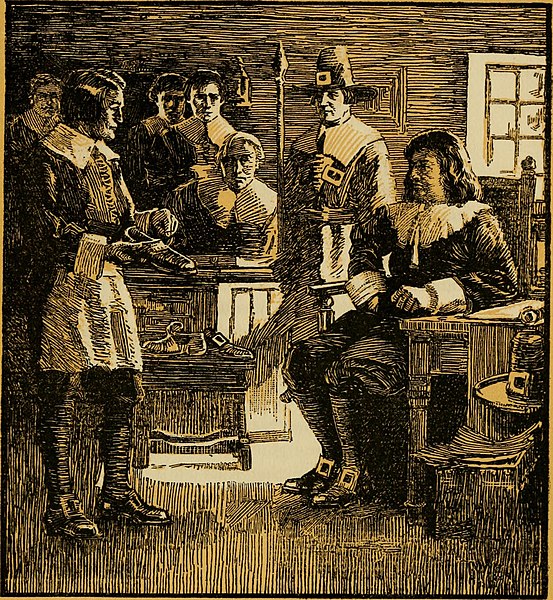
New England Pilgrims. Illustration from New England Old and New (1920). Source: Wikimedia Commons, public domain
General Christian

About Barbara OBrien
Barbara is the author of The Circle of the Way: A Concise History of Zen from the Buddha to the Modern World (Shambhala, 2019) You can read more about the author here.
Previous Post
December 2, 2023
Wonhyo, Buddhist Folk Hero of Korea
Next Post
December 18, 2023 The Commercialization of Christmas: A Short History
Recent Comments
"Thank you for this grounded, deeply necessary perspective. Shifting our framework from moralistic binaries to ..."
What You May Not Know About ..."
"Nonviolence is the weapon of the mighty and the strong. Violence is the weapon of ..."
Thomas Aquinas on the Morality of ..."
"Regarding Barbara O'Brien's article "Is Empathy a Weakness?" My answer in song is an emphatic ..."
""A government, which to bigotry gives no sanction." How far our government has fallen from ..."
George Washington’s Letter to Touro Synagogue
Browse Our Archives
Select a Category Buddhism Christianity Daoism Hinduism Indigenous religions Islam Judaism Mysticism New Age Origins of religion Paganism Popes Popular Religious Movements Protestantism Psychology and religion Religion and current events Religion and folklore Religion and News Media Religion and politics Religious Art and Music Religious Freedom Religious mistakes Religious philosophy Religious scriptures Religious Violence science and religion Spiritualism Technology and religion The Catholic Church The Dalai Lama The Reformation Uncategorized
Select a Month September 2026 August 2026 July 2026 June 2026 April 2026 March 2026 February 2026 January 2026 December 2025 November 2025 October 2025 September 2025 August 2025 July 2025 June 2025 May 2025 April 2025 March 2025 February 2025 January 2025 December 2024 November 2024 October 2024 September 2024 August 2024 July 2024 June 2024 May 2024 April 2024 March 2024 February 2024 January 2024 December 2023 November 2023 October 2023 September 2023 August 2023 July 2023 June 2023 May 2023 April 2023 March 2023 February 2023 January 2023 December 2022 November 2022 October 2022 September 2022 August 2022
Follow Us!
TAKE THE
Religious Wisdom Quiz
I sent an army of singers before my army, and God set ambushes against our enemies. Who am I?
Select your answer to see how you score.
Hezekiah Asa Jehoshaphat David
Related posts from The Religious History Nerd

I Watched the Towers Fall. Here's What You...

Barring Mamdani From 9/11 Lets the Enemy Win

Is 'Separation of Church and State' Really a...

The President and the Pope: An Unprecedented Rift
TRENDING AT PATHEOS History and Religion

The Dangers of Gradual Accommodation (Winking at Sin)
Recently, the “law of gradualness” resurfaced during the opening of a weeklong,...

The Iron Gates and the Lion of the...
Yesterday, I didn't finish my report about, well, yesterday. So I'll...

Dolly Parton’s Last Song Wins Dove Award with...
Bluegrass band The Grascals, speaking on the red carpet at the 57th...

The Image: On the Horror of Capitalism and...
The Image Then went the Pharisees, and took counsel how they might...

We are approaching the date of our new American national holiday: October...

Letters on Living the Faith by C.S. Lewis
Most of us met C.S. Lewis as a public intellectual. Mere Christianity....
view all History and Religion blogs
What Are Your Thoughts?leave a comment
Ad-Free & Subscriber Log-In Subscription Support
- About Us
- 2026 Calendar
- Videos
- Podcasts
- Library of World Religions
- Faith In Media Tracker
- Advertise With Us
- Write for Us
- Privacy Policy
- Terms of Service
- Do Not Sell My Data
- Contact Us
- Radiant Digital
- Manage Newsletter Subscriptions
- Unsubscribe From Notifications
- Sitemap
Copyright 2008-2026, Patheos. All rights reserved.
Subscription Support Ad-Free & Subscriber Log-In
Follow Patheos