
BuddhistCatholicContemplativeEvangelicalGeneral ChristianHinduJewishLatter-day SaintMuslimNew VisionsProgressive Christian
Beliefs
- Buddhist
- Catholic
- Contemplative
- Evangelical
- General Christian
- Hindu
- Jewish
- Latter-day Saint
- More Voices
- Muslim
- New Visions
- Pagan
- Progressive Christian
Topics
- Religion News
- Food and Religion
- Sports and Religion
- Religious Art
- Religious Music and Entertainment
- Religious Events
- History and Religion
- Style and Religion
- Politics and Religion
- Women in Religion
- Recreation Outdoors and Religion
- Business Finance and Religion
- Careers Workplace and Religion
- Education and Religion
- Family Parenting and Religion
- Health Fitness and Religion
- Home and Religion
- Relationships and Religion
- Technology and Religion
- Travel and Religion
Columnists
- Buddhist Columnists
- Business Finance and Religion Columnists
- Careers Workplace and Religion Columnists
- Catholic Columnists
- Contemplative Columnists
- Education and Religion Columnists
- Evangelists Columnists
- Family Parenting and Religion Columnists
- General Christian Columnists
- Health Fitness and Religion Columnists
- Hindu Columnists
- History and Religion Columnists
- Home and Religion Columnists
- Jewish Columnists
- More Voices Columnists
- Latter Day Columnists
- Muslim Columnists
- New Visions Columnists
- Nonreligious Columnists
- Pagan Columnists
- Politics and Religion Columnists
- Progressive Columnists
- Recreation Outdoors and Religion Columnists
- Relationships and Religion Columnists
- Religion News Columnists
- Religious Art Columnists
- Religious Events Columnists
- Religious Music and Entertainment Columnists
- Sports and Religion Columnists
- Style and Religion Columnists
- Technology and Religion Columnists
- Travel and Religion Columnists
- Women in Religion Columnists
Resource Library
- 2026 Calendar
- Library of World Religions
- The 100 Most Holy Places on Earth
- Patheos Answers
- Podcasts
- Videos
- Faith Leaders Database
- Anglican Episcopalian
- Bahai
- Baptist
- Buddhism
- Christianity
- Confucianism
- Eastern Orthodoxy
- Hinduism
- Holiness and Pentecostal
- ISKCON
- Islam
- Judaism
- Lutheran
- Methodist
- The Church of Jesus Christ of Latter-day Saints
- New Age
- Paganism
- Presbytarian and Reformed
- Protestantism
- Religion Behind the Scenes
- Roman Catholic
- Scientology
- Shia Islam
- Sikhism
- Sufism
- Sunni Islam
- Taoism
- Zen
- See all religions
Research Tools
 Ad-Free & Subscriber Log-In Subscription Support
Ad-Free & Subscriber Log-In Subscription Support
Follow Patheos 

- Trending:
- Forgiveness
- |
- Marriage
- |
- Consciousness
- |
- Death Penalty
- |
- Election
- |
- Halloween

- Home
- General Christian
- History and Religion
- The Wall of Separation Has Two Sides
The Wall of Separation Has Two Sides
Last updated on: November 19, 2023 at 5:28 pm by Barbara O'Brien
The Wall of Separation Has Two Sides 2023-11-19T17:28:34-06:00 Barbara O'Brien
Patheos Explore the world's faith through different perspectives on religion and spirituality! Patheos has the views of the prevalent religions and spiritualities of the world.
The wall of separation between church and state is in the news again. Recently Rep. Mike Johnson, the new U.S. Speaker of the House, told an interviewer that “separation of church and state” is a “misnomer.” “People misunderstand it,” Johnson said. “Of course, it comes from a phrase that was in a letter that Jefferson wrote. It’s not in the Constitution. And what he was explaining is they did not want the government to encroach upon the church — not that they didn’t want principles of faith to have influence on our public life. It’s exactly the opposite.” Johnson went on to say that the founders believed religion and morality were central to maintaining government. “And that’s why I think we need more of that — not an establishment of any national religion — but we need everybody’s vibrant expression of faith because it’s such an important part of who we are as a nation.”
Neither Jefferson nor any other founder intended religion to be banished from public life. That isn’t what the “wall of separation between church and state” refers to. People are free to bring their religious convictions to the public sphere as much as they like. But Johnson imagines that somehow there can be a one-sided wall that stops government from encroaching on religion but allows religious institutions to encroach on government. The power of government can then be used to encroach on their fellow citizens who may not share their religious views. And while the words “wall of separation between church and state” are not in the Constitution, Jefferson used the phrase as a metaphor to explain the opening phrase of the First Amendment, which very much is in the Constitution. For more background on how Jefferson used the phrase, see “Jefferson’s Wall of Separation Between Church and State.”
Jefferson and the other founders of the nation were primarily concerned about religious factionalism. What might happen if a particular religious faction gained control of Congress and the White House and began to write laws that favored their religion? Or that compelled all Americans to obey laws based on that religion’s beliefs? They knew the history of the wars of religion in Europe, in which armies fought to determine if their government would be Protestant or Catholic. Something like that might happen in the United States. For that reason, the first clause of the Bill of Rights begins, “Congress shall make no law respecting an establishment of religion, or prohibiting the free exercise thereof.” “Establishment of religion” refers to designating an official state religion. The authors of the Constitution reasoned that if the federal government didn’t have the power to give one religion special privileges over others, then religious wars wouldn’t break out over which church controlled the government.
Why the Wall of Separation Has Two Sides
In human history, most of the time where there is oppression of religion it is at the hands of another religion. This is why the wall of separation has two sides. It prevents government from encroaching on religion, but it also prevents religious factions from taking over government and using it to enforce their particular religious beliefs (which would end up encroaching on those other religions). A one-sided wall, even a metaphorical one, doesn’t work.
The Constitution itself was deliberately written without mention of God. This was not an oversight but was debated by the Constitutional Convention. Some of the members wanted to say something about God, but they were outvoted. (For more background, see “The Myth of the Christian Nation.”) The provision in Article VI of the Constitution forbidding a religious test as a requirement for office was widely denounced by those opposed to ratification of the Constitution. A New Hampshire critic complained that “according to this [provision] we may have a Papist, a Mohomatan, a Deist, yeah an Atheist at the helm of Government.” Well, yes. We most certainly may. This is what religious freedom looks like.
James Madision, the chief author of the Bill of Rights, had opposed religious laws while he was a member of the Virginia legislature. In a text called “Memorial and Remonstrance against Religious Assessments” (1785) he wrote that religion must be a matter of individual, personal conscience. It must not be dictated and controlled by the majority opinion of society. The Establishment Clause prevents government from encroaching upon the church, as Speaker Johnson says. But it also prevents government from being used to force the religious beliefs of a majority faction on the minority. Certainly individuals may consider their religious beliefs when forming opinions on public policy. But attempts to use law to encode religion-based policy is overreach. For example, a law that criminalizes homosexuality (which Mike Johnson has said he supports) because God supposedly doesn’t like it would be a breach of the wall of separation. (See “James Madison and Religious Freedom” for more background.)
Religion in the Public Sphere
The United States has a rich history of religious activism. The abolitionist movement to end slavery was very much a Christian movement. A clergyman was behind the movement to end child labor. When the Rev. Dr. Martin Luther King. Jr., worked for racial equality, he was drawing on evangelical tradition. Likewise, when the Rev. William Barber organized the Moral Monday movement, he was drawing on evangelical tradition. These are all examples of religion in the public sphere that have nothing to do with the wall of separation. There are a handful of ordained clergy currently serving in the U.S. Congress, and that doesn’t violate the wall of separation, either. Religious people and institutions have the same rights of free speech as other people and institutions. The Establishment Clause and the wall of separation are limits on what government can do. But that limit protects us from oppression by religious theocrats.
Large religious factions may sincerely believe that some behaviors are sinful and shouldn’t be done, and they are free to say so publicly. But unless there is a secular reason for banning such behavior, government is supposed to leave it alone. “The legitimate powers of government extend to such acts only as are injurious to others,” Thomas Jefferson wrote. “But it does me no injury for my neighbour to say there are twenty gods, or no god. It neither picks my pocket nor breaks my leg.”
The Wall Protects All of Us
Since the founding of the nation there have been those who really want the U.S. to be a Christian theocracy rather than a republic of the people, by the people, and for the people. Speaker Mike Johnson appears to be a Christian theocrat. “Johnson is in fact a believer in scriptural originalism, the view that the Bible is the truth and the sole legitimate source for public policy,” Marci A Hamilton wrote in The Guardian. Johnson believes the founders of the United States intended it to be a “biblical” republic, Hamilton continues. But in fact, the founders were sons of the 18th-century Enlightenment. They celebrated reason and free thinking. Many of them were more Deist than Christian. I cannot say if Mike Johnson knows he is lying about the founders and the Constitution, but he is.
See also “I Read Mike Johnson’s Legal Filings. They Reveal a Distinctive Pattern” by Kimberly Wehle at Politico. As a lawyer, Johnson handled many free speech and religion cases before he was elected to Congress in 2016. Wehle writes that Johnson has been a fervent defender of First Amendment protections, but only for Christians. “When nonreligious secularists brought a religion-based challenge, he took the other side,” Wehle writes. “Johnson’s theory, summed up, appears to be what might be dubbed, ‘the First Amendment for me but not for thee.'”
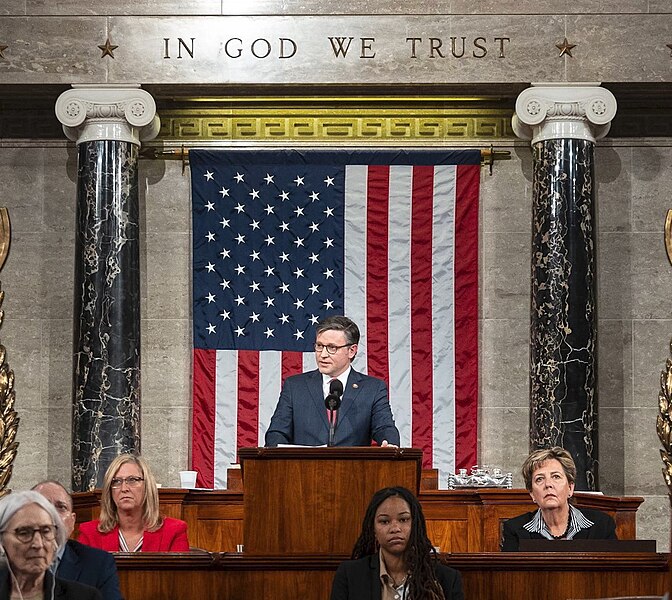
Speaker of the United States House of Representatives Mike Johnson delivers remarks following his election to the position, October 25, 2023. Source: Wikimedia Commons, public domain.
General Christian
Politics and Religion
Previous Post
November 16, 2023
Anagarika Dharmapala, a Missionary for Buddhism
Next Post

November 27, 2023 Muslims in Colonial America
Recent Comments
"Thank you for this grounded, deeply necessary perspective. Shifting our framework from moralistic binaries to ..."
What You May Not Know About ..."
"Nonviolence is the weapon of the mighty and the strong. Violence is the weapon of ..."
Thomas Aquinas on the Morality of ..."
"Regarding Barbara O'Brien's article "Is Empathy a Weakness?" My answer in song is an emphatic ..."
""A government, which to bigotry gives no sanction." How far our government has fallen from ..."
George Washington’s Letter to Touro Synagogue
Browse Our Archives
Select a Category Buddhism Christianity Daoism Hinduism Indigenous religions Islam Judaism Mysticism New Age Origins of religion Paganism Popes Popular Religious Movements Protestantism Psychology and religion Religion and current events Religion and folklore Religion and News Media Religion and politics Religious Art and Music Religious Freedom Religious mistakes Religious philosophy Religious scriptures Religious Violence science and religion Spiritualism Technology and religion The Catholic Church The Dalai Lama The Reformation Uncategorized
Select a Month September 2026 August 2026 July 2026 June 2026 April 2026 March 2026 February 2026 January 2026 December 2025 November 2025 October 2025 September 2025 August 2025 July 2025 June 2025 May 2025 April 2025 March 2025 February 2025 January 2025 December 2024 November 2024 October 2024 September 2024 August 2024 July 2024 June 2024 May 2024 April 2024 March 2024 February 2024 January 2024 December 2023 November 2023 October 2023 September 2023 August 2023 July 2023 June 2023 May 2023 April 2023 March 2023 February 2023 January 2023 December 2022 November 2022 October 2022 September 2022 August 2022
Follow Us!
TAKE THE
Religious Wisdom Quiz
Who was Timothy's mother?
Select your answer to see how you score.
Lois Mary Priscilla Eunice
Related posts from The Religious History Nerd

I Watched the Towers Fall. Here's What You...

Barring Mamdani From 9/11 Lets the Enemy Win

Is 'Separation of Church and State' Really a...

The President and the Pope: An Unprecedented Rift
TRENDING AT PATHEOS History and Religion

Letters on Living the Faith by C.S. Lewis
Most of us met C.S. Lewis as a public intellectual. Mere Christianity....

When Halloween Unmasks Married Hearts
Written by Dr. David K. Ewen from Eternal Truth Bible College Behind...

Aristotle. He’s been called the father of logic, the father of the...

Methodist Central Hall and Westminster Abbey
Situated on the same square is Methodist Central Hall and Westminster Abbey. ...

57th Dove Awards Honor Dolly Parton, Crown New...
On gospel music’s biggest night, the 57th annual GMA Dove Awards honored...

The First Eucharistic Controversy: Christ’s Real Presence
For Catholics, the Eucharist is the source and summit of the Christian...
view all History and Religion blogs
What Are Your Thoughts?leave a comment
Ad-Free & Subscriber Log-In Subscription Support
- About Us
- 2026 Calendar
- Videos
- Podcasts
- Library of World Religions
- Faith In Media Tracker
- Advertise With Us
- Write for Us
- Privacy Policy
- Terms of Service
- Do Not Sell My Data
- Contact Us
- Radiant Digital
- Manage Newsletter Subscriptions
- Unsubscribe From Notifications
- Sitemap
Copyright 2008-2026, Patheos. All rights reserved.
Subscription Support Ad-Free & Subscriber Log-In
Follow Patheos