
BuddhistCatholicContemplativeEvangelicalGeneral ChristianHinduJewishLatter-day SaintMuslimNew VisionsProgressive Christian
Beliefs
- Buddhist
- Catholic
- Contemplative
- Evangelical
- General Christian
- Hindu
- Jewish
- Latter-day Saint
- More Voices
- Muslim
- New Visions
- Pagan
- Progressive Christian
Topics
- Religion News
- Food and Religion
- Sports and Religion
- Religious Art
- Religious Music and Entertainment
- Religious Events
- History and Religion
- Style and Religion
- Politics and Religion
- Women in Religion
- Recreation Outdoors and Religion
- Business Finance and Religion
- Careers Workplace and Religion
- Education and Religion
- Family Parenting and Religion
- Health Fitness and Religion
- Home and Religion
- Relationships and Religion
- Technology and Religion
- Travel and Religion
Columnists
- Buddhist Columnists
- Business Finance and Religion Columnists
- Careers Workplace and Religion Columnists
- Catholic Columnists
- Contemplative Columnists
- Education and Religion Columnists
- Evangelists Columnists
- Family Parenting and Religion Columnists
- General Christian Columnists
- Health Fitness and Religion Columnists
- Hindu Columnists
- History and Religion Columnists
- Home and Religion Columnists
- Jewish Columnists
- More Voices Columnists
- Latter Day Columnists
- Muslim Columnists
- New Visions Columnists
- Nonreligious Columnists
- Pagan Columnists
- Politics and Religion Columnists
- Progressive Columnists
- Recreation Outdoors and Religion Columnists
- Relationships and Religion Columnists
- Religion News Columnists
- Religious Art Columnists
- Religious Events Columnists
- Religious Music and Entertainment Columnists
- Sports and Religion Columnists
- Style and Religion Columnists
- Technology and Religion Columnists
- Travel and Religion Columnists
- Women in Religion Columnists
Resource Library
- 2026 Calendar
- Library of World Religions
- The 100 Most Holy Places on Earth
- Patheos Answers
- Podcasts
- Videos
- Faith Leaders Database
- Anglican Episcopalian
- Bahai
- Baptist
- Buddhism
- Christianity
- Confucianism
- Eastern Orthodoxy
- Hinduism
- Holiness and Pentecostal
- ISKCON
- Islam
- Judaism
- Lutheran
- Methodist
- The Church of Jesus Christ of Latter-day Saints
- New Age
- Paganism
- Presbytarian and Reformed
- Protestantism
- Religion Behind the Scenes
- Roman Catholic
- Scientology
- Shia Islam
- Sikhism
- Sufism
- Sunni Islam
- Taoism
- Zen
- See all religions
Research Tools
 Ad-Free & Subscriber Log-In Subscription Support
Ad-Free & Subscriber Log-In Subscription Support
Follow Patheos 

- Trending:
- Forgiveness
- |
- Marriage
- |
- Consciousness
- |
- Death Penalty
- |
- Election
- |
- Halloween

- Home
- General Christian
- History and Religion
- Is “In God We Trust” Religious or Patriotic?
Is “In God We Trust” Religious or Patriotic?
Last updated on: November 6, 2023 at 1:24 pm by Barbara O'Brien
Is “In God We Trust” Religious or Patriotic? 2023-11-06T13:24:59-06:00 Barbara O'Brien
Patheos Explore the world's faith through different perspectives on religion and spirituality! Patheos has the views of the prevalent religions and spiritualities of the world.
A new law in Louisiana requires posting “In God We Trust” in every classroom in every school, from elementary to college, in the state. The law went into effect August 1, 2023. It replaces a previous law that mandated posting “In God We Trust” somewhere in every school building. The law provides that the motto “shall be displayed on a poster or framed document that is at least 11 inches by 14 inches. The motto shall be the central focus … and shall be printed in a large, easily readable font.” Further, teachers must instruct students about the phrase as a way of teaching “patriotic customs.”
Are we looking at another challenge to the Establishment Clause here? This Louisiana law is similar in some way to the Texas “Ten Commandments” bill I wrote about earlier this year; see “Do the Ten Commandments Belong in Public School Classrooms?” The Texas bill was very similar to a Kentucky law that the U.S. Supreme Court declared unconstitutional in 1980. The Texas bill failed to pass, but that was mostly because of a missed deadline. I expect Texas to try again.
The current Supreme Court has already done considerable damage to the wall of separation between church and state. (For more discussion of this see “Oklahoma Approves a Religious Charter School.”) People who want to use the public schools to indoctrinate children into conservative Christianity have been emboldened. And the Louisiana law has an extra complication for wall of separation supporters. “In God We Trust” really is an official national motto of the United States that appears on currency and other official government properties.
How “In God We Trust” Became a National Motto
The history of “In God We Trust” goes back to 1864, during the Civil War. The words first appeared on a two-cent coin in 1864. This was done at the urging of M.R. Watkinson, a Pennsylvania clergyman. Watkinson thought the placement would “place us openly under the divine protection” and help the Union win the war. The motto soon appeared on other coins, although late in the 19th century it was dropped off of most coins in favor of the older, unofficial national motto, “E pluribus unum” — out of many, one.
But “In God We Trust” was not forgotten. In the 1950s it was taken out of mothballs, so to speak. In the early 1950s “In God We Trust” began appearing on postage stamps. In 1955, President Dwight Eisenhower signed a bill that placed “In God We Trust” on all U.S. currency. In 1956 Congress passed a resolution making “In God We Trust” the official national motto. Note that the mid-1950s was the peak of anti-Communist hysteria in the U.S. I was a small child then, but I remember the late 1950s well enough. People were conflating Communism with atheism with Satan. Even my usually cheerful Lutheran Sunday School was showing us frightening pictures of Lucifer brandishing a hammer and cycle. There was much rallying around God in popular culture at the time. It was also in 1954 that the words “under God” were added to the Pledge of Allegiance. In Gallup surveys in the 1950s, over 90% of the adult population of the U.S. identified as Christian, Gallup says that’s down to 69 percent today.
A court challenge of “In God We Trust” on currency followed. In Aronow v. U.S. (1970) the Ninth Circuit Court of Appeals agreed with lower courts that the plaintiff, Stefan Ray Aronow, did not have standing to sue the goveerment about what was written on currency. But it set aside the standing issue to address the merits of the case. Use of “In God We Trust,” the opinion said, “is of patriotic or ceremonial character and bears no true resemblance to a governmental sponsorship of a religious exercise.” The Supreme Court declined to hear an appeal.
But What About School?
If it’s okay on coins, is it okay on the walls of a classroom? Going back to the appeals court ruling in Aronow, the opinion continued —
It is not easy to discern any religious significance attendant the payment of a bill with coin or currency on which has been imprinted ‘In God We Trust’ or the study of a government publication or document bearing that slogan. In fact, such secular uses of the motto was viewed as sacrilegious and irreverent by President Theodore Roosevelt. Yet Congress has directed such uses. While ‘ceremonial’ and ‘patriotic’ may not be particularly apt words to describe the category of the national motto, it is excluded from First Amendment significance because the motto has no theological or ritualistic impact. As stated by the Congressional report, it has ‘spiritual and psychological value’ and ‘inspirational quality.’
Most of us, God believers and not, use currency in our daily lives without feeling religiously compomised, I suspect. Although as a Buddhist I’d prefer “E pluribus unum” if anyone asks. But putting big signs saying “In God We Trust” in classrooms, and stipulating that teachers must instruct children about the phrase, seems to me to cross a line. This is not ceremonial or patriotic or mere inspiration. It is religion. A state government cannot require people to believe in God, but this is coming awfully close to doing that.
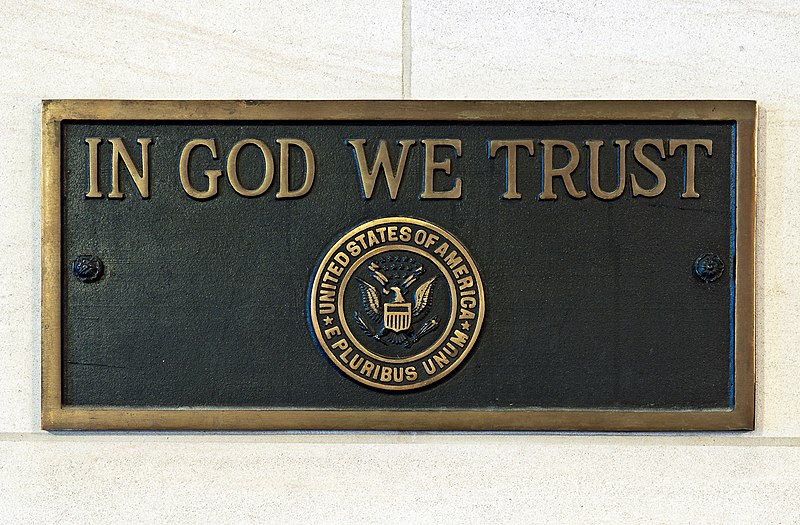
The U.S. Capitol’s ‘In God We Trust’ plaque. Photograph provided by the Architect of the Capitol. Source: Wikimedia Commons, public domain.
General Christian
Previous Post

November 4, 2023
Henry Steel Olcott, the "White Buddhist"
Next Post

November 9, 2023 Dorothy Buxton and the Children of War
Recent Comments
"Thank you for this grounded, deeply necessary perspective. Shifting our framework from moralistic binaries to ..."
What You May Not Know About ..."
"Nonviolence is the weapon of the mighty and the strong. Violence is the weapon of ..."
Thomas Aquinas on the Morality of ..."
"Regarding Barbara O'Brien's article "Is Empathy a Weakness?" My answer in song is an emphatic ..."
""A government, which to bigotry gives no sanction." How far our government has fallen from ..."
George Washington’s Letter to Touro Synagogue
Browse Our Archives
Select a Category Buddhism Christianity Daoism Hinduism Indigenous religions Islam Judaism Mysticism New Age Origins of religion Paganism Popes Popular Religious Movements Protestantism Psychology and religion Religion and current events Religion and folklore Religion and News Media Religion and politics Religious Art and Music Religious Freedom Religious mistakes Religious philosophy Religious scriptures Religious Violence science and religion Spiritualism Technology and religion The Catholic Church The Dalai Lama The Reformation Uncategorized
Select a Month September 2026 August 2026 July 2026 June 2026 April 2026 March 2026 February 2026 January 2026 December 2025 November 2025 October 2025 September 2025 August 2025 July 2025 June 2025 May 2025 April 2025 March 2025 February 2025 January 2025 December 2024 November 2024 October 2024 September 2024 August 2024 July 2024 June 2024 May 2024 April 2024 March 2024 February 2024 January 2024 December 2023 November 2023 October 2023 September 2023 August 2023 July 2023 June 2023 May 2023 April 2023 March 2023 February 2023 January 2023 December 2022 November 2022 October 2022 September 2022 August 2022
Follow Us!
TAKE THE
Religious Wisdom Quiz
What does 2 Peter say scoffers will say in the last days?
Select your answer to see how you score.
Where is this 'coming' he promised? Jesus will never return The world will never end There is no God
Related posts from The Religious History Nerd

I Watched the Towers Fall. Here's What You...

Barring Mamdani From 9/11 Lets the Enemy Win

Is 'Separation of Church and State' Really a...

The President and the Pope: An Unprecedented Rift
TRENDING AT PATHEOS History and Religion

Emotion in Early Christianity by Andrew Crislip
Andrew Crislip’s Emotion in Early Christianity examines an often overlooked dimension of...

16 Spiritual Touchstones for a More Grounded Life
After decades of spiritual study, here are 16 principles I try...

Catholic Evangelization: Sharing Your Faith Every Day
Welcome back to the Graceful Awakening mini-series called, “From Faith to Mission.” ...

The Pillar of the Boatmen: the Ancient Monument...
The Pillar of the Boatmen is a Romano-Gaulish sculpture that dates from...

In one sense walking into Westminster Abbey is like walking down the...

'Super Scam Me' Exposes AI Jon Bon Jovi...
Leslie Pickett believed she was in a relationship with Jon Bon Jovi....
view all History and Religion blogs
What Are Your Thoughts?leave a comment
Ad-Free & Subscriber Log-In Subscription Support
- About Us
- 2026 Calendar
- Videos
- Podcasts
- Library of World Religions
- Faith In Media Tracker
- Advertise With Us
- Write for Us
- Privacy Policy
- Terms of Service
- Do Not Sell My Data
- Contact Us
- Radiant Digital
- Manage Newsletter Subscriptions
- Unsubscribe From Notifications
- Sitemap
Copyright 2008-2026, Patheos. All rights reserved.
Subscription Support Ad-Free & Subscriber Log-In
Follow Patheos