
BuddhistCatholicContemplativeEvangelicalGeneral ChristianHinduJewishLatter-day SaintMuslimNew VisionsProgressive Christian
Beliefs
- Buddhist
- Catholic
- Contemplative
- Evangelical
- General Christian
- Hindu
- Jewish
- Latter-day Saint
- More Voices
- Muslim
- New Visions
- Pagan
- Progressive Christian
Topics
- Religion News
- Food and Religion
- Sports and Religion
- Religious Art
- Religious Music and Entertainment
- Religious Events
- History and Religion
- Style and Religion
- Politics and Religion
- Women in Religion
- Recreation Outdoors and Religion
- Business Finance and Religion
- Careers Workplace and Religion
- Education and Religion
- Family Parenting and Religion
- Health Fitness and Religion
- Home and Religion
- Relationships and Religion
- Technology and Religion
- Travel and Religion
Columnists
- Buddhist Columnists
- Business Finance and Religion Columnists
- Careers Workplace and Religion Columnists
- Catholic Columnists
- Contemplative Columnists
- Education and Religion Columnists
- Evangelists Columnists
- Family Parenting and Religion Columnists
- General Christian Columnists
- Health Fitness and Religion Columnists
- Hindu Columnists
- History and Religion Columnists
- Home and Religion Columnists
- Jewish Columnists
- More Voices Columnists
- Latter Day Columnists
- Muslim Columnists
- New Visions Columnists
- Nonreligious Columnists
- Pagan Columnists
- Politics and Religion Columnists
- Progressive Columnists
- Recreation Outdoors and Religion Columnists
- Relationships and Religion Columnists
- Religion News Columnists
- Religious Art Columnists
- Religious Events Columnists
- Religious Music and Entertainment Columnists
- Sports and Religion Columnists
- Style and Religion Columnists
- Technology and Religion Columnists
- Travel and Religion Columnists
- Women in Religion Columnists
Resource Library
- 2026 Calendar
- Library of World Religions
- The 100 Most Holy Places on Earth
- Patheos Answers
- Podcasts
- Videos
- Faith Leaders Database
- Anglican Episcopalian
- Bahai
- Baptist
- Buddhism
- Christianity
- Confucianism
- Eastern Orthodoxy
- Hinduism
- Holiness and Pentecostal
- ISKCON
- Islam
- Judaism
- Lutheran
- Methodist
- The Church of Jesus Christ of Latter-day Saints
- New Age
- Paganism
- Presbytarian and Reformed
- Protestantism
- Religion Behind the Scenes
- Roman Catholic
- Scientology
- Shia Islam
- Sikhism
- Sufism
- Sunni Islam
- Taoism
- Zen
- See all religions
Research Tools
 Ad-Free & Subscriber Log-In Subscription Support
Ad-Free & Subscriber Log-In Subscription Support
Follow Patheos 

- Trending:
- Forgiveness
- |
- Marriage
- |
- Consciousness
- |
- Death Penalty
- |
- Election
- |
- Halloween

- Home
- Buddhism
- History and Religion
- The Boy Who Is the Bogd
The Boy Who Is the Bogd
Last updated on: October 11, 2023 at 11:34 pm by Barbara O'Brien
The Boy Who Is the Bogd 2023-10-11T23:34:41-05:00 Barbara O'Brien
Patheos Explore the world's faith through different perspectives on religion and spirituality! Patheos has the views of the prevalent religions and spiritualities of the world.
Very old history has a way of keeping its grip on current events. Now some very old history has thrust an eight-year-old boy into an international conflict of global concern. The boy is known as A. Altannar, and he has been identified as the tenth tulku, or rebirth, of the Bogd, the spiritual leader of Mongolia. This puts the child at the center of long contention among China, Mongolia, Tibet, and leaders of Tibetan Buddhism. It could have implications regarding China’s claims on Taiwan. And it might also have put the boy himself in great danger.
A Altannar is one of a pair of identical twins named Achildai Altannar and Agudai Altannar, who are rarely seen in public without each other. Because of security concerns, the precise identity of the tulku remains secret. Only a few know which twin, Achildai or Agudai, is the Tenth Jetsun Dampa, or more formally the Tenth Jebtsundamba Khutuktu, the highest ranking Buddhist lama of Mongolia. He is also called the Bogd, a Mongolian word that means “saint” or “holy.” The Bogd is a lama of the Geluk school of Tibetan Buddhism, which is the same school as the Dalai Lama. This past March the new Bogd was publicly introduced for the first time in a ceremony in India conducted by His Holiness the Fourteenth Dalai Lama.
And this puts the twins, and the government of Mongolia, at odds with China. China has awarded itself the authority to name all high lamas of Tibetan Buddhism and had not given approval for the naming of a new Bogd. Beijing can be ruthless in enforcing this authority. In 1995, six-year-old Gedhun Choekyi Nyima, the newly identified Eleventh Panchen Lama, and all of his family were taken into custody by Chinese authorities. They have not been seen since. Officially they are still “detained,” but one does suspect they were all killed. Later in 1995 Beijing declared that another child, the son of a loyal Chinese Communist Party member, was the real Eleventh Panchen Lama. That child, now 33 years old, serves as the face of Tibetan Buddhism in Chinese media.
As with all things involving Tibetan Buddhism and the government of China, the current situation with the Bogd is endlessly convoluted. I will try to explain it as simply as I can. Also note that no two sources spell Tibetan and Mongolian names and titles the same way. “Jetsun Dampa” is a simplified spelling I found in a history of Tibet, and I’m sticking to it.
About the Bogd and Mongolian Buddhism
Buddhism in Mongolia has been associated with the Geluk school, and the succession of Dalai Lamas, since the time of the Third Dalai Lama, Sonam Gyatso (1543-1588). The Third Dalai Lama was invited to Mongolia by Altan Khan, a descendant of Kublai Khan. This began a relationship between the people of Mongolia and the Dalai Lamas that continues to this day; see “The First Dalai Lama” for more background. (The Third Dalai Lama was, in fact, the first living person called “Dalai Lama.”)
The first Jetsun Dampa, Zanabazar (1635–1723), was identified as the rebirth of a renowned Tibetan Buddhist scholar named Taranatha, who had died in 1634. Zanabazar came from Mongolian nobility and was a descendant of Genghis Khan, as was the next Jetsun Dampa. In the 18th century a Manchu campaign against a large Mongol-ruled area called the Zunghar Khanate was followed by a Mongol rebellion against the incursion of Chinese authority, which mostly failed, although the effort is fondly remembered by Mongolians. One of the results of this episode was that the Qing Emperor of China declared that all future Jetsun Dampas must be born in Tibet. (Yes, I am leaving a lot out. As I already said, this history is endlessly convoluted.)
Outer Mongolia declared independence from the then-crumbling Qing Dynasty in 1911. The Eighth Jetsun Dampa (1869–1924) became the new head of state for Outer Mongolia with the title Bogd Khan. His government was called the Bogd Khanate. (Note that the Eighth Jetsun Dampa has appeared in this space before. In 1904 the Thirteenth Dalai Lama, in advance of an invasion of British troops, fled Lhasa to spend two years in Mongolia with the Jetsun Dampa. See “Tibet’s Declaration of Independence and the Thirteenth Dalai Lama” for more background.)
Change in the Twentieth Century
After the Bogd Khan died in 1924 his theocracy was replaced by a Communist government that declared there would be no more reincarnations of the Jetsun Dampa. But obviously this was not the end of the lineage of Jetsun Dampas. A Tibetan boy named Jampal Namdol, born in 1932, was identified as the Ninth Jetsun Dampa. His identity was kept secret to all but the highest echelons of the Geluk school to avoid causing trouble with Mongolia. Jampal Namdol fled Chinese-occupied Tibet for India in 1959, as did the Fourteenth Dalai Lama. In 1990, after the government of Mongolia had begun democratic reforms, Jampal Namdol’s identity as the Jetsun Dampa finally was revealed. He died in March 2012.
And this takes us to the search for the Tenth Jetsun Dampa. Accounts I have found in news stories vary a tad, but it appears that about seven years ago some Mongolian toddlers identified by Geluk lamas as potential candidates were summoned to a monastery in the Mongolian capital of Ulaanbaatar. Among the toddlers were the Altannar twins. The children were taken to a table strewn with religious objects and candy. Most of the boys went for the candy. But one of the twins instead reached for prayer beads and a ceremonial bell, and then he climbed onto the lap of a nearby monk. The beads and bell had belonged to the Ninth Jetsun Dampa, and the monk had been the Jetsun Dampa’s assistant.
There was a complication. The Altannar parents are wealthy and prominent business owners and educated in the U.S. They went along with the test, but when informed one of their sons had been chosen, they rebelled and said no. Surely another boy could be found. The mother even wrote a letter to UNICEF complaining that reincarnation had robbed one of her sons of his rights. But the Dalai Lama said the choice was the choice. Eventually the parents decided they would allow their son to be tutored by monks to prepare for his future role, but he also had to continue his regular education. And they insisted that the boy be allowed to decide for himself, when he turns 18, whther to accept the role of Jetsun Dampa or not.
The Political Fallout
There has also been criticism of the choice in Mongolian news media. Choosing a boy from such an elite family did not sit well with many Mongolians. We’ll have to wait to see how that turns out. But now let’s go back to the situation with China.
In 2007 China’s State Administration of Religious Affairs released Order No. 5, which covers “the management measures for the reincarnation of living Buddhas in Tibetan Buddhism.” The order describes the procedures necessary for recognition as a tulku. Applicants for reincarnation must apply to various parts of the bureaucracy of the People’s Republic of China to be approved and recognized. The fact that a tulku is not residing in China doesn’t necessarily change the rules. James A. Millward, professor of history in the School of Foreign Service at Georgetown University, writes for Foreign Affairs (“China’s Reincarnation Monopoly Has a Mongolia Problem,” April 23, 2023) that the Chinese Communist Party considers all territory once controlled by the Qing Dynasty to be part of the People’s Republic of China. That would include Mongolia, and it also is the basis for China’s claim to Taiwan. And Beijing is very serious about this. Recognition of a Mongolian Jetsun Dampa without Beijing’s approval could be interpreted by Beijing as a provocation. James Millward continues,
“How Beijing reacts to the new Jebtsundamba—a high lama in a religion it claims to control—thus implicates Beijing’s theory of the case regarding Taiwan, as well. If Beijing says there can be no Mongolian high lama without its say-so, that reveals the ludicrous overreach of its policy toward Tibetan Buddhism. But if it says nothing while a Qing-era lineage of tulku-leaders continues autonomously in Mongolia, that reminds us that the PRC is not the full-blown reincarnation of the Qing that it says it is.” And the world is watching.
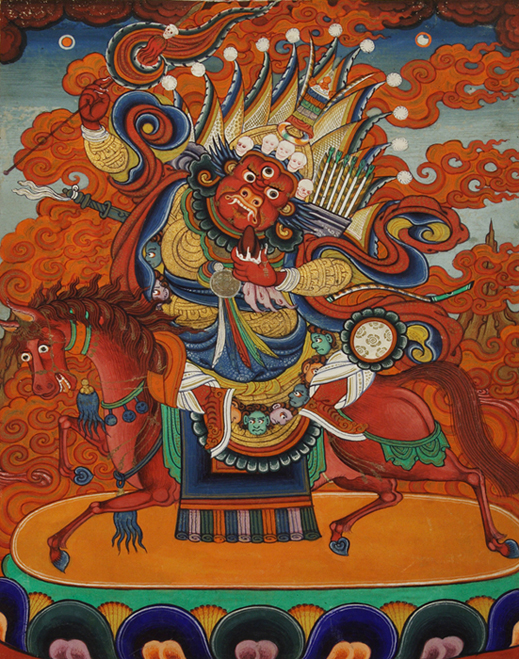
Begtse, an iconic dharmapala (dharma protector) of Mongolian Buddhism. Source: Wikimedia Commons, public domain.
Buddhism
Religion News
Previous Post
September 28, 2023
Beneath the Sands of Mes Aynak
Next Post

October 12, 2023 Reflections on War and Religion
Recent Comments
"Thank you for this grounded, deeply necessary perspective. Shifting our framework from moralistic binaries to ..."
What You May Not Know About ..."
"Nonviolence is the weapon of the mighty and the strong. Violence is the weapon of ..."
Thomas Aquinas on the Morality of ..."
"Regarding Barbara O'Brien's article "Is Empathy a Weakness?" My answer in song is an emphatic ..."
""A government, which to bigotry gives no sanction." How far our government has fallen from ..."
George Washington’s Letter to Touro Synagogue
Browse Our Archives
Select a Category Buddhism Christianity Daoism Hinduism Indigenous religions Islam Judaism Mysticism New Age Origins of religion Paganism Popes Popular Religious Movements Protestantism Psychology and religion Religion and current events Religion and folklore Religion and News Media Religion and politics Religious Art and Music Religious Freedom Religious mistakes Religious philosophy Religious scriptures Religious Violence science and religion Spiritualism Technology and religion The Catholic Church The Dalai Lama The Reformation Uncategorized
Select a Month September 2026 August 2026 July 2026 June 2026 April 2026 March 2026 February 2026 January 2026 December 2025 November 2025 October 2025 September 2025 August 2025 July 2025 June 2025 May 2025 April 2025 March 2025 February 2025 January 2025 December 2024 November 2024 October 2024 September 2024 August 2024 July 2024 June 2024 May 2024 April 2024 March 2024 February 2024 January 2024 December 2023 November 2023 October 2023 September 2023 August 2023 July 2023 June 2023 May 2023 April 2023 March 2023 February 2023 January 2023 December 2022 November 2022 October 2022 September 2022 August 2022
Follow Us!
TAKE THE
Religious Wisdom Quiz
Who said, “Follow me, and I will make you fishers of men”?
Select your answer to see how you score.
Jesus Peter Moses Paul
Related posts from The Religious History Nerd

I Watched the Towers Fall. Here's What You...

Barring Mamdani From 9/11 Lets the Enemy Win

Sarvastivada: An Extinct Buddhist Sect That's Still With...

Is 'Separation of Church and State' Really a...
TRENDING AT PATHEOS History and Religion

Catholic Evangelization: Sharing Your Faith Every Day
Welcome back to the Graceful Awakening mini-series called, “From Faith to Mission.” ...

The Pillar of the Boatmen: the Ancient Monument...
The Pillar of the Boatmen is a Romano-Gaulish sculpture that dates from...

In one sense walking into Westminster Abbey is like walking down the...

'Super Scam Me' Exposes AI Jon Bon Jovi...
Leslie Pickett believed she was in a relationship with Jon Bon Jovi....

The Brazilian Remake of Kendricks' 'Flywheel' Opens in...
“Flywheel,” the story that launched the Kendrick Brothers’ filmmaking career is getting...

The Dangers of Gradual Accommodation (Winking at Sin)
Recently, the “law of gradualness” resurfaced during the opening of a weeklong,...
view all History and Religion blogs
What Are Your Thoughts?leave a comment
Ad-Free & Subscriber Log-In Subscription Support
- About Us
- 2026 Calendar
- Videos
- Podcasts
- Library of World Religions
- Faith In Media Tracker
- Advertise With Us
- Write for Us
- Privacy Policy
- Terms of Service
- Do Not Sell My Data
- Contact Us
- Radiant Digital
- Manage Newsletter Subscriptions
- Unsubscribe From Notifications
- Sitemap
Copyright 2008-2026, Patheos. All rights reserved.
Subscription Support Ad-Free & Subscriber Log-In
Follow Patheos