
BuddhistCatholicContemplativeEvangelicalGeneral ChristianHinduJewishLatter-day SaintMuslimNew VisionsProgressive Christian
Beliefs
- Buddhist
- Catholic
- Contemplative
- Evangelical
- General Christian
- Hindu
- Jewish
- Latter-day Saint
- More Voices
- Muslim
- New Visions
- Pagan
- Progressive Christian
Topics
- Religion News
- Food and Religion
- Sports and Religion
- Religious Art
- Religious Music and Entertainment
- Religious Events
- History and Religion
- Style and Religion
- Politics and Religion
- Women in Religion
- Recreation Outdoors and Religion
- Business Finance and Religion
- Careers Workplace and Religion
- Education and Religion
- Family Parenting and Religion
- Health Fitness and Religion
- Home and Religion
- Relationships and Religion
- Technology and Religion
- Travel and Religion
Columnists
- Buddhist Columnists
- Business Finance and Religion Columnists
- Careers Workplace and Religion Columnists
- Catholic Columnists
- Contemplative Columnists
- Education and Religion Columnists
- Evangelists Columnists
- Family Parenting and Religion Columnists
- General Christian Columnists
- Health Fitness and Religion Columnists
- Hindu Columnists
- History and Religion Columnists
- Home and Religion Columnists
- Jewish Columnists
- More Voices Columnists
- Latter Day Columnists
- Muslim Columnists
- New Visions Columnists
- Nonreligious Columnists
- Pagan Columnists
- Politics and Religion Columnists
- Progressive Columnists
- Recreation Outdoors and Religion Columnists
- Relationships and Religion Columnists
- Religion News Columnists
- Religious Art Columnists
- Religious Events Columnists
- Religious Music and Entertainment Columnists
- Sports and Religion Columnists
- Style and Religion Columnists
- Technology and Religion Columnists
- Travel and Religion Columnists
- Women in Religion Columnists
Resource Library
- 2026 Calendar
- Library of World Religions
- The 100 Most Holy Places on Earth
- Patheos Answers
- Podcasts
- Videos
- Faith Leaders Database
- Anglican Episcopalian
- Bahai
- Baptist
- Buddhism
- Christianity
- Confucianism
- Eastern Orthodoxy
- Hinduism
- Holiness and Pentecostal
- ISKCON
- Islam
- Judaism
- Lutheran
- Methodist
- The Church of Jesus Christ of Latter-day Saints
- New Age
- Paganism
- Presbytarian and Reformed
- Protestantism
- Religion Behind the Scenes
- Roman Catholic
- Scientology
- Shia Islam
- Sikhism
- Sufism
- Sunni Islam
- Taoism
- Zen
- See all religions
Research Tools
 Ad-Free & Subscriber Log-In Subscription Support
Ad-Free & Subscriber Log-In Subscription Support
Follow Patheos 

- Trending:
- Forgiveness
- |
- Marriage
- |
- Consciousness
- |
- Death Penalty
- |
- Election
- |
- Halloween

- Home
- More Voices
- History and Religion
- Albert Einstein and Spinoza’s God
Albert Einstein and Spinoza’s God
Last updated on: October 24, 2023 at 5:00 pm by Barbara O'Brien
Albert Einstein and Spinoza’s God 2023-10-24T17:00:15-05:00 Barbara O'Brien
Patheos Explore the world's faith through different perspectives on religion and spirituality! Patheos has the views of the prevalent religions and spiritualities of the world.
Theoretical physicist Albert Einstein (1879 – 1955) often was asked if he believed in God. His usual answer was that he believed in Spinoza’s God. “I believe in Spinoza’s God who reveals himself in the orderly harmony of what exists, not in a God who concerns himself with fates and actions of human beings,” the physicist once wrote in a letter. In an article he wrote in 1930 titled “Religion and Science,” Einstein mentioned Spinoza three times as an example of someone with the highest “religious feeling.”
Einstein became the personification of genius in popular culture. Perhaps for that reason, many religious people fervently want to think he believed in God. But Einstein was a tad coy on the subject. He sometimes denied being an atheist, but he was hardly a believer in any conventional sense. “I have repeatedly said that in my opinion the idea of a personal god is a childlike one,” he wrote. “You may call me an agnostic, but I do not share the crusading spirit of the professional atheist whose fervor is mostly due to a painful act of liberation from the fetters of religious indoctrination received in youth. I prefer an attitude of humility corresponding to the weakness of our intellectual understanding of nature and of our own being.”
Albert Einstein is no longer among us to explain his thoughts. Perhaps the best way to understand his ideas about God is to look to Spinoza.
Baruch Spinoza and Spinoza’s God
Baruch Spinoza (1632 – 1677) is considered today to be one of the most important philosophers of the early modern period. But he was not always held in such high regard. He was a Sephardic Jew whose ideas drew condemnation from rabbis and whose books were banned by the Catholic Church. As recently as the 19th century, to be called a “Spinozist” was an insult in many intellectual circles.
Spinoza was born into a Portuguese-Jewish family in Amsterdam. He may have been a star pupil at the community’s Torah school, but while still a teenager he left school and went to work in his family’s importing business. At the age of 24 he was issued the harshest herem, or ban, ever pronounced by the Sephardic community of Amsterdam. We do not know precisely why. We can only assume he was already expressing some of the views Albert Einstein came to admire centuries later. But he was no longer part of the Jewish community, and he did not convert to Christianity. In 17th century Europe that made Spinoza a genuine outsider. Perhaps being an outsider gave him the fearless independence of thought for which he is admired today.
I cannot even begin to explain the breadth of his ideas in a few paragraphs. Here I will try just to simply explain Spinoza’s most basic ideas about God that caught the attention of Albert Einstein.
Attributes of Spinoza’s God
Spinoza is often called a pantheist, or someone who believes that the universe itself is God. However, it’s not quite that simple. He did not think of God and the phenomenal universe — let’s say “nature” — as exactly the same thing. Instead, he thought that God and nature are two aspects of a single reality. Put another way, everything that exists is an aspect of God. Instead of a vast supernatural being who governs the universe, Spinoza’s God is the infinite and self-caused substance of the universe. Whether that view is or isn’t pantheism depends on how one defines pantheism, and I’ll spare you that analysis.
Spinoza’s God does not perform “miracles” or cause supernatural things to happen to intervene in human events. Instead, “divine providence is identical with the course of nature,” Spinoza wrote. Nature has a fixed and eternal order that no power can change. Spinoza thought that belief in miracles was vulgar and ignorant, not proof of God’s power. God is revealed not through miracles but through nature. This part of Spinoza’s thought definitely turns up in the writing of Einstein the theoretical physicist.
Spinoza rejected anthropomorphism, or giving God human characteristics. Spinoza’s God does not have opinions. Nor does God grant requests sent through prayer. God does not reward or punish. God is entirely impersonal. Some might argue that this God is so far removed from how God is normally understood that it is no God at all. But Spinoza didn’t see it that way. He thought the ideal human life was one devoted to the love of God. The way to “blessedness,” Spinoza wrote, was to cultivate an expansive, intuitive understanding of God. And, I have to say, love of God who is an aspect of nature does appeal to me. Instead of relating to nature as something to exploit for its resources — a strategy that is killing our planet — what if we all treated nature, and each other, as an aspect of God?
Einstein and Spinoza
In The New Yorker (“Reading Into Albert Einstein’s God Letter,” December 25, 2018), Louis Menand wrote that Einstein “regarded organized religion as a superstition, but he believed that, by means of scientific inquiry, a person might gain an insight into the exquisite rationality of the world’s structure, and he called this experience ‘cosmic religion.’” This cosmic religion is not about sin and redemption. Instead, it is about what is. It is about the awesome and inexorable laws of the universe, of the infinite interaction of time and space. And it is about how there is something instead of nothing. Reflecting on this should fill us with awe and a profound religious feeling. Einstein wrote in 1930,
The religious geniuses of all ages have been distinguished by this kind of religious feeling, which knows no dogma and no God conceived in man’s image; so that there can be no church whose central teachings are based on it. Hence it is precisely among the heretics of every age that we find men who were filled with this highest kind of religious feeling and were in many cases regarded by their contemporaries as atheists, sometimes also as saints. Looked at in this light, men like Democritus, Francis of Assisi, and Spinoza are closely akin to one another.
How can cosmic religious feeling be communicated from one person to another, if it can give rise to no definite notion of a God and no theology? In my view, it is the most important function of art and science to awaken this feeling and keep it alive in those who are receptive to it.
Baruch Spinoza explained his ideas in far more depth and detail than I have just hinted at here, so I hope you don’t dismiss them outright. And I can’t say that he and Albert Einstein would have agreed in every detail. But the religious views of these two geniuses of separate centuries were certainly very close.
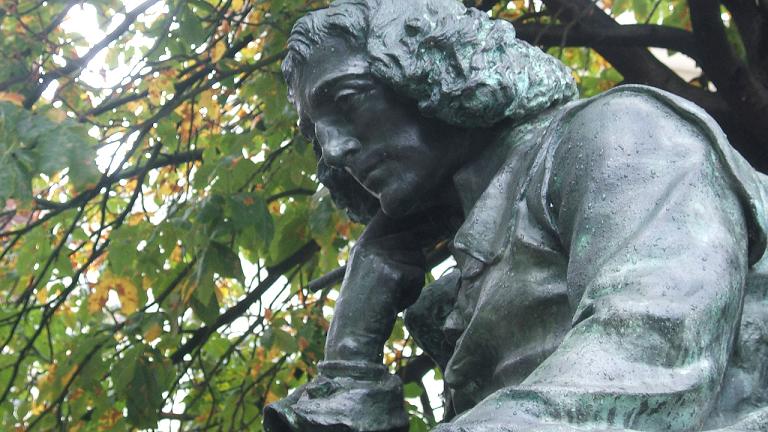
Statue of Baruch Spinoza at The Hague. Source: Wikimedia Commons, I, LeonK, CC BY-SA 3.0 license.
More Voices
Previous Post
October 19, 2023
Don't Fall for Jesus Mythicism
Next Post

October 25, 2023 Hallowe'en Is an Irish-American Holiday
Recent Comments
"Thank you for this grounded, deeply necessary perspective. Shifting our framework from moralistic binaries to ..."
What You May Not Know About ..."
"Nonviolence is the weapon of the mighty and the strong. Violence is the weapon of ..."
Thomas Aquinas on the Morality of ..."
"Regarding Barbara O'Brien's article "Is Empathy a Weakness?" My answer in song is an emphatic ..."
""A government, which to bigotry gives no sanction." How far our government has fallen from ..."
George Washington’s Letter to Touro Synagogue
Browse Our Archives
Select a Category Buddhism Christianity Daoism Hinduism Indigenous religions Islam Judaism Mysticism New Age Origins of religion Paganism Popes Popular Religious Movements Protestantism Psychology and religion Religion and current events Religion and folklore Religion and News Media Religion and politics Religious Art and Music Religious Freedom Religious mistakes Religious philosophy Religious scriptures Religious Violence science and religion Spiritualism Technology and religion The Catholic Church The Dalai Lama The Reformation Uncategorized
Select a Month September 2026 August 2026 July 2026 June 2026 April 2026 March 2026 February 2026 January 2026 December 2025 November 2025 October 2025 September 2025 August 2025 July 2025 June 2025 May 2025 April 2025 March 2025 February 2025 January 2025 December 2024 November 2024 October 2024 September 2024 August 2024 July 2024 June 2024 May 2024 April 2024 March 2024 February 2024 January 2024 December 2023 November 2023 October 2023 September 2023 August 2023 July 2023 June 2023 May 2023 April 2023 March 2023 February 2023 January 2023 December 2022 November 2022 October 2022 September 2022 August 2022
Follow Us!
TAKE THE
Religious Wisdom Quiz
Who prayed in a den of lions?
Select your answer to see how you score.
Daniel Noah Elijah David
Related posts from The Religious History Nerd

Is 'Separation of Church and State' Really a...

The President and the Pope: An Unprecedented Rift
What Was the Avignon Papacy and Why Is...
Thomas Aquinas on the Morality of War
TRENDING AT PATHEOS History and Religion

Methodist Central Hall and Westminster Abbey
Situated on the same square is Methodist Central Hall and Westminster Abbey. ...

57th Dove Awards Honor Dolly Parton, Crown New...
On gospel music’s biggest night, the 57th annual GMA Dove Awards honored...

The First Eucharistic Controversy: Christ’s Real Presence
For Catholics, the Eucharist is the source and summit of the Christian...

What a Stop Sign Can Teach Us About...
How to Make a Decision When You Can't Hear God Main point:...

Archdiocese Hosts Military Marriage Retreat in Germany
RASTATT, Germany — The transient military lifestyle, with its frequent deployments and...

Nearly every morning, I make the drive to Detroit with my high-school-age...
view all History and Religion blogs
What Are Your Thoughts?leave a comment
Ad-Free & Subscriber Log-In Subscription Support
- About Us
- 2026 Calendar
- Videos
- Podcasts
- Library of World Religions
- Faith In Media Tracker
- Advertise With Us
- Write for Us
- Privacy Policy
- Terms of Service
- Do Not Sell My Data
- Contact Us
- Radiant Digital
- Manage Newsletter Subscriptions
- Unsubscribe From Notifications
- Sitemap
Copyright 2008-2026, Patheos. All rights reserved.
Subscription Support Ad-Free & Subscriber Log-In
Follow Patheos