
BuddhistCatholicContemplativeEvangelicalGeneral ChristianHinduJewishLatter-day SaintMuslimNew VisionsProgressive Christian
Beliefs
- Buddhist
- Catholic
- Contemplative
- Evangelical
- General Christian
- Hindu
- Jewish
- Latter-day Saint
- More Voices
- Muslim
- New Visions
- Pagan
- Progressive Christian
Topics
- Religion News
- Food and Religion
- Sports and Religion
- Religious Art
- Religious Music and Entertainment
- Religious Events
- History and Religion
- Style and Religion
- Politics and Religion
- Women in Religion
- Recreation Outdoors and Religion
- Business Finance and Religion
- Careers Workplace and Religion
- Education and Religion
- Family Parenting and Religion
- Health Fitness and Religion
- Home and Religion
- Relationships and Religion
- Technology and Religion
- Travel and Religion
Columnists
- Buddhist Columnists
- Business Finance and Religion Columnists
- Careers Workplace and Religion Columnists
- Catholic Columnists
- Contemplative Columnists
- Education and Religion Columnists
- Evangelists Columnists
- Family Parenting and Religion Columnists
- General Christian Columnists
- Health Fitness and Religion Columnists
- Hindu Columnists
- History and Religion Columnists
- Home and Religion Columnists
- Jewish Columnists
- More Voices Columnists
- Latter Day Columnists
- Muslim Columnists
- New Visions Columnists
- Nonreligious Columnists
- Pagan Columnists
- Politics and Religion Columnists
- Progressive Columnists
- Recreation Outdoors and Religion Columnists
- Relationships and Religion Columnists
- Religion News Columnists
- Religious Art Columnists
- Religious Events Columnists
- Religious Music and Entertainment Columnists
- Sports and Religion Columnists
- Style and Religion Columnists
- Technology and Religion Columnists
- Travel and Religion Columnists
- Women in Religion Columnists
Resource Library
- 2026 Calendar
- Library of World Religions
- The 100 Most Holy Places on Earth
- Patheos Answers
- Podcasts
- Videos
- Faith Leaders Database
- Anglican Episcopalian
- Bahai
- Baptist
- Buddhism
- Christianity
- Confucianism
- Eastern Orthodoxy
- Hinduism
- Holiness and Pentecostal
- ISKCON
- Islam
- Judaism
- Lutheran
- Methodist
- The Church of Jesus Christ of Latter-day Saints
- New Age
- Paganism
- Presbytarian and Reformed
- Protestantism
- Religion Behind the Scenes
- Roman Catholic
- Scientology
- Shia Islam
- Sikhism
- Sufism
- Sunni Islam
- Taoism
- Zen
- See all religions
Research Tools
 Ad-Free & Subscriber Log-In Subscription Support
Ad-Free & Subscriber Log-In Subscription Support
Follow Patheos 

- Trending:
- Forgiveness
- |
- Marriage
- |
- Consciousness
- |
- Death Penalty
- |
- Election
- |
- Halloween

- Home
- General Christian
- History and Religion
- Oklahoma Approves a Religious Charter School
Oklahoma Approves a Religious Charter School
Last updated on: August 20, 2023 at 6:38 pm by Barbara O'Brien
Oklahoma Approves a Religious Charter School 2023-08-20T18:38:49-05:00 Barbara O'Brien
Patheos Explore the world's faith through different perspectives on religion and spirituality! Patheos has the views of the prevalent religions and spiritualities of the world.
Last month, the state of Oklahoma approved the first religious charter school in the nation. Oklahoma is now facing lawsuits as well as pushback from the charter school movement.
St. Isidore of Seville Catholic Virtual School, an online school proposed for rural students, will receive tax money and also provide Catholic instruction. Until very recently, this would have been considered a clear and obvious violation of the Estabishment Clause of the First Amendment to the Constitution. But recent U.S. Supreme Court rulings have emboldened lawmakers in several states who want Christianity taught and promoted in public schools.
Last week the American Civil Liberties Union, Americans United for Separation of Church and State, and the Education Law Center and Freedom From Religion Foundation filed a lawsuit to stop St. Isidore of Seville from going online, or at least from being sponsored by the taxpayers of Oklahoma. The suit was filed on behalf of several plaintiffs, including parents, educators, and clergy. They see the religious charter school as a breach of separation of church and state.
What Is a Charter School?
In the U.S., a charter school is a public primary or secondary school for children that is organized and operated independently from the standard public school system. These independent schools are chartered by state or local government and subsidized by taxes. They are accountable to the state for meeting academic goals, but they have some autonomy to make their own rules and curricula. Parents may choose to send their children there instead of to the standard public school.
As true public schools, charter schools in the U.S. are tuition free, accept all students who apply, and have no religious affiliation. Charter school proponents are not happy with Oklahoma. The New York Times reported that the National Alliance for Public Charter Schools, a leading advocate for charters, “sees the latest effort as antithetical to the spirit of public schools.” Among other things, they are concerned that religious charter schools will get mired in church-state controversies, such as discriminating against LBGTQ students or refusing to hire teachers of different or no religious affiliation.
The History of Religion in Public Schools
Public schools — taxpayer supported, tuition-free schools for all children — began in the New England colonies. By the mid-19th century most states had at least some public schools. These were for white children only in those days. Bible reading and prayer were part of the curricula. But in the 2oth century a number of lawsuits were filed seeking to remove religious observances from public schools.
One of the first of these cases was Everson v. Board of Education (1947). In this case, a taxpayer objected when the state of New Jersey paid for buses to take children to parochial schools. The Supreme Court sided with New Jersey. Justice Hugo Black wrote the majority opinion. “The First Amendment has erected a wall between church and state. That wall must be kept high and impregnable. We could not approve the slightest breach.” However, he continued, “New Jersey has not breached it here.” The majority argued that transportation to and from schools was a benefit to the students and their parents, not to a church.
The Lemon Test
In a later opinion, Lemon v. Kurtzman (1971), the Court proposed what came to be called the “Lemon test” to resolve issues involving tax money and religious schools. The Lemon test has three parts:
- Does the law have a clear secular purpose?
- Would the law have the effect of either advancing or inhibiting religion?
- Would the law create an excessive government entanglement with religion?
As with the New Jersey school buses, the Court has been okay with tax dollars going to religious schools when the money benefits students and couldn’t possibly be used for religious instruction. In the Lemon case, state tax dollars were helping to supplement teacher salaries and pay for textbooks and instructional materials in secular subjects for religious schools. The Supreme Court decided that this setup created excessive entanglement with religion, since the state would have to monitor the schools’ spending closely to be sure it wasn’t being used for religious instruction.
Why This Is Happening Now
The current Supreme Court has effectively killed the Lemon test in recent cases. The recent case of Kennedy v. Bremerton School District (2022), about a high school football coach accused of coercing players to take part in prayers, made the biggest splash. But Carson v. Makin (2022) is more pertinent to the Oklahoma religious charter school. The Carson case challenged a Maine law that barred tax dollars from going to schools that provide religious instruction.
This was an issue in rural Maine, where the population was too sparse to support public secondary schools. But the state was still obligated to provide free education through high school. So in some rural areas the state paid tuition for students to go to private schools, but only if the schools were nonsectarian.
In Carson, a majority of the Supreme Court said that if Maine was subsidizing tuition to private schools, it must not discriminate between religious and not-religious private schools. In other words, the Court has gone from worrying that tax dollars might create an “entanglement” and get used to pay for religious instruction, to saying that the state certainly should pay for religious instruction if it’s giving money to private schools at all.
This Will Not End Well
The six conservative justices on the Supreme Court have made it clear in this and other rulings that they want to weaken, if not smash, the wall of separation between church and state. They call themselves “originalists,” but they manage to not notice the founding fathers who didn’t agree with them. See especially Jefferson’s Wall of Separation Between Church and State and James Madison and Religious Freedom.
The justices appear to be in sympathy with Christian nationalists who want Christianity to be given a privileged status over other religions, something a majority of the framers of the Constitution opposed. But they seem not to have thought out what they will do when the school requesting subsidy is not Christian, but Muslim, or Buddhist. Will Christian nationalists rebel? Will justices come up with some excuse that not-Christian schools are held to a different standard?
For more more articles on religion in U.S. public schools, see When the U.S. Supreme Court Didn’t Ban School Prayer; and The Problem With Bible Readings in U.S. Public Schools.
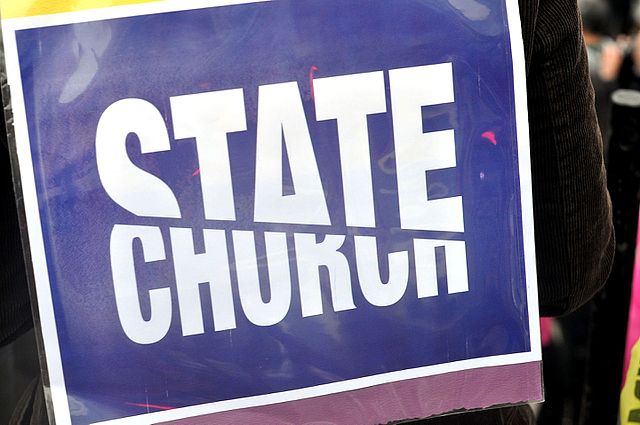
Sign at Women’s March in Washington D.C., 21 January 2017. Photograph by Edward Kimmel. Source: Wikimedia Commons, CC-BY-SA-2.0.
General Christian
Politics and Religion
Previous Post
August 7, 2023
A Tale of the Buddha's Tooth
Next Post

August 25, 2023 The Ancient Secret of the Dunhuang Cave
Recent Comments
"Thank you for this grounded, deeply necessary perspective. Shifting our framework from moralistic binaries to ..."
What You May Not Know About ..."
"Nonviolence is the weapon of the mighty and the strong. Violence is the weapon of ..."
Thomas Aquinas on the Morality of ..."
"Regarding Barbara O'Brien's article "Is Empathy a Weakness?" My answer in song is an emphatic ..."
""A government, which to bigotry gives no sanction." How far our government has fallen from ..."
George Washington’s Letter to Touro Synagogue
Browse Our Archives
Select a Category Buddhism Christianity Daoism Hinduism Indigenous religions Islam Judaism Mysticism New Age Origins of religion Paganism Popes Popular Religious Movements Protestantism Psychology and religion Religion and current events Religion and folklore Religion and News Media Religion and politics Religious Art and Music Religious Freedom Religious mistakes Religious philosophy Religious scriptures Religious Violence science and religion Spiritualism Technology and religion The Catholic Church The Dalai Lama The Reformation Uncategorized
Select a Month September 2026 August 2026 July 2026 June 2026 April 2026 March 2026 February 2026 January 2026 December 2025 November 2025 October 2025 September 2025 August 2025 July 2025 June 2025 May 2025 April 2025 March 2025 February 2025 January 2025 December 2024 November 2024 October 2024 September 2024 August 2024 July 2024 June 2024 May 2024 April 2024 March 2024 February 2024 January 2024 December 2023 November 2023 October 2023 September 2023 August 2023 July 2023 June 2023 May 2023 April 2023 March 2023 February 2023 January 2023 December 2022 November 2022 October 2022 September 2022 August 2022
Follow Us!
TAKE THE
Religious Wisdom Quiz
Which Gospel records the most parables?
Select your answer to see how you score.
John Mark Luke Matthew
Related posts from The Religious History Nerd

I Watched the Towers Fall. Here's What You...

Barring Mamdani From 9/11 Lets the Enemy Win

Is 'Separation of Church and State' Really a...

The President and the Pope: An Unprecedented Rift
TRENDING AT PATHEOS History and Religion

Emotion in Early Christianity by Andrew Crislip
Andrew Crislip’s Emotion in Early Christianity examines an often overlooked dimension of...

16 Spiritual Touchstones for a More Grounded Life
After decades of spiritual study, here are 16 principles I try...

Catholic Evangelization: Sharing Your Faith Every Day
Welcome back to the Graceful Awakening mini-series called, “From Faith to Mission.” ...

The Pillar of the Boatmen: the Ancient Monument...
The Pillar of the Boatmen is a Romano-Gaulish sculpture that dates from...

In one sense walking into Westminster Abbey is like walking down the...

'Super Scam Me' Exposes AI Jon Bon Jovi...
Leslie Pickett believed she was in a relationship with Jon Bon Jovi....
view all History and Religion blogs
What Are Your Thoughts?leave a comment
Ad-Free & Subscriber Log-In Subscription Support
- About Us
- 2026 Calendar
- Videos
- Podcasts
- Library of World Religions
- Faith In Media Tracker
- Advertise With Us
- Write for Us
- Privacy Policy
- Terms of Service
- Do Not Sell My Data
- Contact Us
- Radiant Digital
- Manage Newsletter Subscriptions
- Unsubscribe From Notifications
- Sitemap
Copyright 2008-2026, Patheos. All rights reserved.
Subscription Support Ad-Free & Subscriber Log-In
Follow Patheos