
BuddhistCatholicContemplativeEvangelicalGeneral ChristianHinduJewishLatter-day SaintMuslimNew VisionsProgressive Christian
Beliefs
- Buddhist
- Catholic
- Contemplative
- Evangelical
- General Christian
- Hindu
- Jewish
- Latter-day Saint
- More Voices
- Muslim
- New Visions
- Pagan
- Progressive Christian
Topics
- Religion News
- Food and Religion
- Sports and Religion
- Religious Art
- Religious Music and Entertainment
- Religious Events
- History and Religion
- Style and Religion
- Politics and Religion
- Women in Religion
- Recreation Outdoors and Religion
- Business Finance and Religion
- Careers Workplace and Religion
- Education and Religion
- Family Parenting and Religion
- Health Fitness and Religion
- Home and Religion
- Relationships and Religion
- Technology and Religion
- Travel and Religion
Columnists
- Buddhist Columnists
- Business Finance and Religion Columnists
- Careers Workplace and Religion Columnists
- Catholic Columnists
- Contemplative Columnists
- Education and Religion Columnists
- Evangelists Columnists
- Family Parenting and Religion Columnists
- General Christian Columnists
- Health Fitness and Religion Columnists
- Hindu Columnists
- History and Religion Columnists
- Home and Religion Columnists
- Jewish Columnists
- More Voices Columnists
- Latter Day Columnists
- Muslim Columnists
- New Visions Columnists
- Nonreligious Columnists
- Pagan Columnists
- Politics and Religion Columnists
- Progressive Columnists
- Recreation Outdoors and Religion Columnists
- Relationships and Religion Columnists
- Religion News Columnists
- Religious Art Columnists
- Religious Events Columnists
- Religious Music and Entertainment Columnists
- Sports and Religion Columnists
- Style and Religion Columnists
- Technology and Religion Columnists
- Travel and Religion Columnists
- Women in Religion Columnists
Resource Library
- 2026 Calendar
- Library of World Religions
- The 100 Most Holy Places on Earth
- Patheos Answers
- Podcasts
- Videos
- Faith Leaders Database
- Anglican Episcopalian
- Bahai
- Baptist
- Buddhism
- Christianity
- Confucianism
- Eastern Orthodoxy
- Hinduism
- Holiness and Pentecostal
- ISKCON
- Islam
- Judaism
- Lutheran
- Methodist
- The Church of Jesus Christ of Latter-day Saints
- New Age
- Paganism
- Presbytarian and Reformed
- Protestantism
- Religion Behind the Scenes
- Roman Catholic
- Scientology
- Shia Islam
- Sikhism
- Sufism
- Sunni Islam
- Taoism
- Zen
- See all religions
Research Tools
 Ad-Free & Subscriber Log-In Subscription Support
Ad-Free & Subscriber Log-In Subscription Support
Follow Patheos 

- Trending:
- Forgiveness
- |
- Marriage
- |
- Consciousness
- |
- Death Penalty
- |
- Election
- |
- Halloween

- Home
- More Voices
- History and Religion
- The Prophet’s 100th Birthday
The Prophet’s 100th Birthday
Last updated on: July 12, 2023 at 6:17 pm by Barbara O'Brien
The Prophet’s 100th Birthday 2023-07-12T18:17:01-05:00 Barbara O'Brien
Patheos Explore the world's faith through different perspectives on religion and spirituality! Patheos has the views of the prevalent religions and spiritualities of the world.
I recently moved, and this morning while unpacking a box of books I came across one I probably haven’t looked at for 50 years — The Prophet by Kahlil Gibran. When I was in college — 1969 to 1973 — this was one of the books everybody read, or claimed to have read, or at least carried around and cited occcasionally.
The Prophet was first published a century ago in 1923, and I doubt that it has ever been out of print since then. It’s a short book of prose poems that one might call brief sermons or meditations, spoken by a sage named Al Mustafa — “the chosen and the beloved, who was a dawn unto his own day.” The book has no clear sectarian orientation, although God is mentioned now and then.
And now that it’s in public domain, you can read it online. There is also an animated film version, released in 2014 or thereabouts.
Quotes from The Prophet
Here’s a sample:
When love beckons to you, follow him, / Though his ways are hard and steep. / And when his wings enfold you yield to him, / Though the sword hidden among his pinions may wound you. / And when he speaks to you believe in him, / Though his voice may shatter your dreams as the north wind lays waste the garden.
Not your standard inspirational spiritual quotes, in other words. If that speaks to you, The Prophet may be worth your time.
One quote from The Prophet I’ve carried with me through the years is “Your daily life is your temple and your religion.” Religion is a loaded word these days, and I want to address that in a future post. Most of the time people use the word to refer to a category of belief systems and the institutions that promote and support them. But in much earlier times religion was more about the way one lived and the obligations one carried out faithfully. To what do you give your time and attention? What do you do conscientiously and faithfully? In a sense that’s your true religion. And it may or may not have anything to do with beliefs or institutions.
About Kahlil Gibran
Khalil Gibran (1883-1931) was born in Lebanon into a family of Maronite Christians. He immigrated with his mother and siblings to Boston in 1895. His American teachers recognized that he was gifted at drawing and painting, and they encouraged him to study art. His artwork received enough recognition that he was able to study in Paris from 1908 to 1910. He was also writing by then. His first works were mostly short stories, in Arabic.
Gibran’s first book in English was The Madman, His Parables and Poems. It was published in the U.S. in 1918 by Alfred A. Knopf. You can read it here; it’s a book of little vignettes. This was followed by The Forerunner in 1920 and The Prophet in 1923. Several other books came after. But it was The Prophet that somehow caught on.
About The Prophet
After The Prophet was published, demand for the book doubled every year. At the time of Gibran’s death in 1931 the book had been translated into French and German and was selling briskly in Europe. It’s been translated into many other languages since. Someone bought the millionth copy of the book in 1957. And then The Prophet became something like the official catechism of the 1960s counterculture.
Professor Juan Cole, historian of the Middle East at the University of Michigan has translated several of Gibran’s works from Arabic. He spoke to the BBC about the appeal of The Prophet — “Many people turned away from the establishment of the Church to Gibran,” Professor Cole said. “He offered a dogma-free universal spiritualism as opposed to orthodox religion, and his vision of the spiritual was not moralistic. In fact, he urged people to be non-judgmental.”
But The Prophet, one of the best-selling books of all time, was never accepted into the English language academic literary canon. Gibran is considered a major figure of Arabic literature, but most western literary critics and academics have dismissed The Prophet as insipid and sentimental. The problem, some have argued, is that The Prophet is a Middle Eastern work even though it was written in English. It is more closely related to the didactic work of long-ago Persian poets like Rumi and Saadi than to anything in modern American literature.
The Next Hundred Years
Sometimes a book or a song or a work of art resonates with a particular time and place and with a particular generation. So it is hugely popular when it’s new, but it doesn’t catch on with generations that come after. Will The Prophet become a work for the ages, whether academia approves of it or not? It’s certainly got a good start.
Reading it again, I found some lines that still resonate with me and others that don’t. But this is probably an individual thing. For example, today I was very much taken with this bit:
“Your children are not your children. / They are the sons and daughters of Life’s longing for itself.”
But someone else may just find that odd.
End note: Back when I was in college everyone also was reading anything by Hermann Hesse (1877-1962) — especially Steppenwolf, Siddhartha, and The Journey to the East. I remember getting bogged down in The Glass Bead Game and not finishing it; maybe I should try it again. Also popular was something called Jonathan Livingston Seagull by Richard Bach, which I can’t say I remember clearly. There were birds. It’s been a while.

Kahlil Gibran, probably in the late 1890s. Source: Wikimedia Commons, public domain
More Voices
Previous Post

July 3, 2023
The Rev. Edgar Gardner Murphy and the Movement to End Child Labor
Next Post

July 17, 2023 Defining Religion, and Why That's So Hard
Recent Comments
"Thank you for this grounded, deeply necessary perspective. Shifting our framework from moralistic binaries to ..."
What You May Not Know About ..."
"Nonviolence is the weapon of the mighty and the strong. Violence is the weapon of ..."
Thomas Aquinas on the Morality of ..."
"Regarding Barbara O'Brien's article "Is Empathy a Weakness?" My answer in song is an emphatic ..."
""A government, which to bigotry gives no sanction." How far our government has fallen from ..."
George Washington’s Letter to Touro Synagogue
Browse Our Archives
Select a Category Buddhism Christianity Daoism Hinduism Indigenous religions Islam Judaism Mysticism New Age Origins of religion Paganism Popes Popular Religious Movements Protestantism Psychology and religion Religion and current events Religion and folklore Religion and News Media Religion and politics Religious Art and Music Religious Freedom Religious mistakes Religious philosophy Religious scriptures Religious Violence science and religion Spiritualism Technology and religion The Catholic Church The Dalai Lama The Reformation Uncategorized
Select a Month September 2026 August 2026 July 2026 June 2026 April 2026 March 2026 February 2026 January 2026 December 2025 November 2025 October 2025 September 2025 August 2025 July 2025 June 2025 May 2025 April 2025 March 2025 February 2025 January 2025 December 2024 November 2024 October 2024 September 2024 August 2024 July 2024 June 2024 May 2024 April 2024 March 2024 February 2024 January 2024 December 2023 November 2023 October 2023 September 2023 August 2023 July 2023 June 2023 May 2023 April 2023 March 2023 February 2023 January 2023 December 2022 November 2022 October 2022 September 2022 August 2022
Follow Us!
TAKE THE
Religious Wisdom Quiz
Who did God give the Ten Commandments to?
Select your answer to see how you score.
Abraham Noah Moses Joshua
Related posts from The Religious History Nerd

The Problem With "Spiritual But Not Religious"

13th Century Mystics and the Beguines
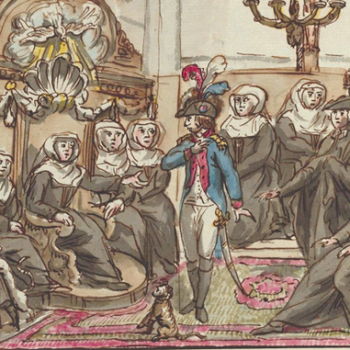
The Beguines: Independent Holy Women of the Middle...
TRENDING AT PATHEOS History and Religion

The Iron Gates and the Lion of the...
Yesterday, I didn't finish my report about, well, yesterday. So I'll...

Dolly Parton’s Last Song Wins Dove Award with...
Bluegrass band The Grascals, speaking on the red carpet at the 57th...

The Image: On the Horror of Capitalism and...
The Image Then went the Pharisees, and took counsel how they might...

We are approaching the date of our new American national holiday: October...

Letters on Living the Faith by C.S. Lewis
Most of us met C.S. Lewis as a public intellectual. Mere Christianity....

When Halloween Unmasks Married Hearts
Written by Dr. David K. Ewen from Eternal Truth Bible College Behind...
view all History and Religion blogs
What Are Your Thoughts?leave a comment
Ad-Free & Subscriber Log-In Subscription Support
- About Us
- 2026 Calendar
- Videos
- Podcasts
- Library of World Religions
- Faith In Media Tracker
- Advertise With Us
- Write for Us
- Privacy Policy
- Terms of Service
- Do Not Sell My Data
- Contact Us
- Radiant Digital
- Manage Newsletter Subscriptions
- Unsubscribe From Notifications
- Sitemap
Copyright 2008-2026, Patheos. All rights reserved.
Subscription Support Ad-Free & Subscriber Log-In
Follow Patheos