
BuddhistCatholicContemplativeEvangelicalGeneral ChristianHinduJewishLatter-day SaintMuslimNew VisionsProgressive Christian
Beliefs
- Buddhist
- Catholic
- Contemplative
- Evangelical
- General Christian
- Hindu
- Jewish
- Latter-day Saint
- More Voices
- Muslim
- New Visions
- Pagan
- Progressive Christian
Topics
- Religion News
- Food and Religion
- Sports and Religion
- Religious Art
- Religious Music and Entertainment
- Religious Events
- History and Religion
- Style and Religion
- Politics and Religion
- Women in Religion
- Recreation Outdoors and Religion
- Business Finance and Religion
- Careers Workplace and Religion
- Education and Religion
- Family Parenting and Religion
- Health Fitness and Religion
- Home and Religion
- Relationships and Religion
- Technology and Religion
- Travel and Religion
Columnists
- Buddhist Columnists
- Business Finance and Religion Columnists
- Careers Workplace and Religion Columnists
- Catholic Columnists
- Contemplative Columnists
- Education and Religion Columnists
- Evangelists Columnists
- Family Parenting and Religion Columnists
- General Christian Columnists
- Health Fitness and Religion Columnists
- Hindu Columnists
- History and Religion Columnists
- Home and Religion Columnists
- Jewish Columnists
- More Voices Columnists
- Latter Day Columnists
- Muslim Columnists
- New Visions Columnists
- Nonreligious Columnists
- Pagan Columnists
- Politics and Religion Columnists
- Progressive Columnists
- Recreation Outdoors and Religion Columnists
- Relationships and Religion Columnists
- Religion News Columnists
- Religious Art Columnists
- Religious Events Columnists
- Religious Music and Entertainment Columnists
- Sports and Religion Columnists
- Style and Religion Columnists
- Technology and Religion Columnists
- Travel and Religion Columnists
- Women in Religion Columnists
Resource Library
- 2026 Calendar
- Library of World Religions
- The 100 Most Holy Places on Earth
- Patheos Answers
- Podcasts
- Videos
- Faith Leaders Database
- Anglican Episcopalian
- Bahai
- Baptist
- Buddhism
- Christianity
- Confucianism
- Eastern Orthodoxy
- Hinduism
- Holiness and Pentecostal
- ISKCON
- Islam
- Judaism
- Lutheran
- Methodist
- The Church of Jesus Christ of Latter-day Saints
- New Age
- Paganism
- Presbytarian and Reformed
- Protestantism
- Religion Behind the Scenes
- Roman Catholic
- Scientology
- Shia Islam
- Sikhism
- Sufism
- Sunni Islam
- Taoism
- Zen
- See all religions
Research Tools
 Ad-Free & Subscriber Log-In Subscription Support
Ad-Free & Subscriber Log-In Subscription Support
Follow Patheos 

- Trending:
- Forgiveness
- |
- Marriage
- |
- Consciousness
- |
- Death Penalty
- |
- Election
- |
- Halloween

- Home
- Buddhism
- History and Religion
- The First Buddhist Same-Sex Wedding
The First Buddhist Same-Sex Wedding
Last updated on: June 10, 2023 at 6:38 am by Barbara O'Brien
The First Buddhist Same-Sex Wedding 2023-06-10T06:38:12-05:00 Barbara O'Brien
Patheos Explore the world's faith through different perspectives on religion and spirituality! Patheos has the views of the prevalent religions and spiritualities of the world.
The first Buddhist same-sex wedding (that we know of) took place in about 1970 in San Francisco. That much is widely agreed on, even if the exact date of the event is uncertain. It’s also widely agreed that the wedding raised no controversy or objections from clergy. And this may have something to tell us about how religion, culture, and social convention tend to blend together.
This first Buddhist same-sex wedding was conducted by the Rev. Koshin Ogui of the Buddhist Church of San Francisco. BCSF, established in 1898, was the first Jodo Shinshu temple on the mainland United States. Jodo Shinshu, often called “Shin” for short, is the largest school of Buddhism in Japan and in Japanese ethnic communities around the world. It’s the main stream of the main stream of Japanese Buddhism, in other words. Note that Shin Buddhism in the West is becoming multiethnic these days. BCSF is part of the larger Buddhist Churches of America organization, established in 1899, which is the North American branch of a denomination of Shin called Nishi Hongwanji-ha.
BCSF is located near San Francisco’s Castro district, home to one of the first gay neighborhoods in the U.S. The Buddhist Church of San Francisco “was attended by singles and couples, gay and straight” wrote Shin priest Jeff Wilson in the Buddhist journal Tricycle (“A Big Gay History of Same-sex Marriage in the Sangha,” June 27, 2015). Two men who were members of the church asked the Rev. Koshin Ogui to marry them. And he did. “Soon other BCA temples were also conducting same-sex marriages,” Wilson wrote.
No Controversy
If you aren’t old enough to remember the 1970s you might not appreciate how unusual a same-sex wedding was at the time. The LGBTQ movement was in its infancy. Indeed, I believe no one yet was using the initials “LBGTQ.” The Gallup organization didn’t begin to do polling on “gay issues” until 1977, and same sex-marriage wasn’t part of that poll. At the time, only 43 percent of participants believed same-sex relationships should be legal, never mind marriage. And of course it would be many years before same-sex marriages would be legally recognized in the U.S.
Most religions place great significance on marriage and sexual conduct. Buddhism, for the most part, considers marriage to be a secular or social contract and not a religious matter. It’s my understanding that for centuries Buddhist clergy usually didn’t perform wedding ceremonies, although now they do. The early rules for the sangha, or community of Buddhists, call for clergy to be celibate. This was not because sex is “sinful” but because it is a distraction from realizing enlightenment. The only teaching from the early scriptures regarding laypeople and sex is the Third Precept, a precaution to refrain from “sexual misconduct.” This has traditionally been interpreted to mean conforming to community norms, whatever those are. Marriage for laypeople was neither encouraged nor discouraged.
As Buddhism spread through Asia it did so without central institutional oversight. Clergy who established new temples often had considerable discretion to present Buddhism in their own way. And over the course of time, the Buddhist establishments that developed in various parts of Asia came to reflect local social conventions. They also developed separate canons of scripture. The only canonical prohibition of homosexual sex in Buddhism is in the Tibetan canon. This is in a text written by Tsongkhapa (1357–1419), and it forbids sex between men. But this text is only authoritative in Tibetan Buddhism. In east and south Asia, homosexuality appears not to have been an issue, one way or another, in Buddhism. It appears not to have been an issue in the cultures of south and east Asia until Europeans showed up.
The First Same-Sex Buddhist Wedding
So it was that when two men asked the Rev. Koshin Ogui to marry them, they were not asking for anything specifically prohibited in Japanese Buddhism. The wedding was conducted in the main hall of the Buddhist Church of San Francisco, as were other weddings. But no, it was not publicized at the time.
Writing in the Berkley Forum of the Berkley Center for Religion, Peace and World Affairs, Jeff Wilson points to three factors that contributed to Jodo Shinshu’s attitude toward same-sex marriage. (See “Buddha’s Big Shrug: The Non-Conflictual History of Same-Sex Marriage in the Buddhist Churches of America,” June 20, 2018.) First, he said, the Shin communities have experienced discrimination themselves. Shin priests in Hawaii and California were the first ethnic Japanese detained by authorities and sent to internment camps after the Pearl Harbor bombing in 1941. Second, as already explained, there’s nothing in Shin Buddhist teachings that condemns homosexuality specifically.
And third: Jodo Shinshu is part of the larger Pure Land tradition of Buddhism, introduced into Japan from China many centuries ago. The central practice of Pure Land is devotion to Amitabha, the Buddha of Boundless Light. Through Amitabha’s grace all beings may enter the Pure Land, the Western Paradise, where enlightenment may be realized by anyone. The Pure Land may be understood as a real place or as a mind purified by faith and devotion.
Amitabha does not discriminate. His mercy is open to all. As Jeff Wilson writes, “All beings are embraced and liberated by the Buddha, good and bad, old and young, male and female, the teachings proclaim—and straight and gay as well, state the ministers unanimously.” And so there was a wedding.
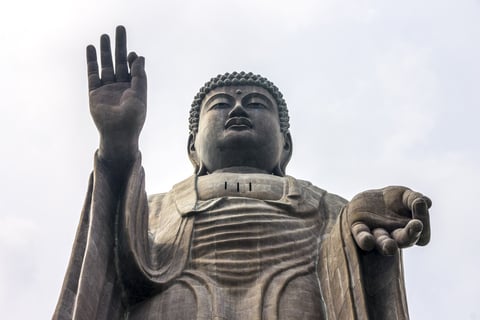
The Ushiku Daibutsu, a 120 metres (390 feet) tall statue of Amitabha Buddha in Ushiku, Japan. The hand gestures signify the spread of the Buddha’s teaching. Source: Photo 95946894 / Amida Buddha © Joaquin Ossorio Castillo | Dreamstime.com
Buddhism
Previous Post
June 8, 2023
Pat Robertson's Legacy
Next Post
June 16, 2023 The Afterlife of the Bamiyan Buddhas
Recent Comments
"Thank you for this grounded, deeply necessary perspective. Shifting our framework from moralistic binaries to ..."
What You May Not Know About ..."
"Nonviolence is the weapon of the mighty and the strong. Violence is the weapon of ..."
Thomas Aquinas on the Morality of ..."
"Regarding Barbara O'Brien's article "Is Empathy a Weakness?" My answer in song is an emphatic ..."
""A government, which to bigotry gives no sanction." How far our government has fallen from ..."
George Washington’s Letter to Touro Synagogue
Browse Our Archives
Select a Category Buddhism Christianity Daoism Hinduism Indigenous religions Islam Judaism Mysticism New Age Origins of religion Paganism Popes Popular Religious Movements Protestantism Psychology and religion Religion and current events Religion and folklore Religion and News Media Religion and politics Religious Art and Music Religious Freedom Religious mistakes Religious philosophy Religious scriptures Religious Violence science and religion Spiritualism Technology and religion The Catholic Church The Dalai Lama The Reformation Uncategorized
Select a Month September 2026 August 2026 July 2026 June 2026 April 2026 March 2026 February 2026 January 2026 December 2025 November 2025 October 2025 September 2025 August 2025 July 2025 June 2025 May 2025 April 2025 March 2025 February 2025 January 2025 December 2024 November 2024 October 2024 September 2024 August 2024 July 2024 June 2024 May 2024 April 2024 March 2024 February 2024 January 2024 December 2023 November 2023 October 2023 September 2023 August 2023 July 2023 June 2023 May 2023 April 2023 March 2023 February 2023 January 2023 December 2022 November 2022 October 2022 September 2022 August 2022
Follow Us!
TAKE THE
Religious Wisdom Quiz
According to 2 Timothy, all Scripture is given by inspiration of God and is profitable for what four things?
Select your answer to see how you score.
Prayer, worship, fellowship, and service Faith, hope, love, and peace Salvation, sanctification, justification, and glorification Teaching, rebuking, correcting, and training in righteousness
Related posts from The Religious History Nerd

I Watched the Towers Fall. Here's What You...

Barring Mamdani From 9/11 Lets the Enemy Win

Sarvastivada: An Extinct Buddhist Sect That's Still With...

Is 'Separation of Church and State' Really a...
TRENDING AT PATHEOS History and Religion

In one sense walking into Westminster Abbey is like walking down the...

'Super Scam Me' Exposes AI Jon Bon Jovi...
Leslie Pickett believed she was in a relationship with Jon Bon Jovi....

The Brazilian Remake of Kendricks' 'Flywheel' Opens in...
“Flywheel,” the story that launched the Kendrick Brothers’ filmmaking career is getting...

The Dangers of Gradual Accommodation (Winking at Sin)
Recently, the “law of gradualness” resurfaced during the opening of a weeklong,...

The Iron Gates and the Lion of the...
Yesterday, I didn't finish my report about, well, yesterday. So I'll...

The Image: On the Horror of Capitalism and...
The Image Then went the Pharisees, and took counsel how they might...
view all History and Religion blogs
What Are Your Thoughts?leave a comment
Ad-Free & Subscriber Log-In Subscription Support
- About Us
- 2026 Calendar
- Videos
- Podcasts
- Library of World Religions
- Faith In Media Tracker
- Advertise With Us
- Write for Us
- Privacy Policy
- Terms of Service
- Do Not Sell My Data
- Contact Us
- Radiant Digital
- Manage Newsletter Subscriptions
- Unsubscribe From Notifications
- Sitemap
Copyright 2008-2026, Patheos. All rights reserved.
Subscription Support Ad-Free & Subscriber Log-In
Follow Patheos