
BuddhistCatholicContemplativeEvangelicalGeneral ChristianHinduJewishLatter-day SaintMuslimNew VisionsProgressive Christian
Beliefs
- Buddhist
- Catholic
- Contemplative
- Evangelical
- General Christian
- Hindu
- Jewish
- Latter-day Saint
- More Voices
- Muslim
- New Visions
- Pagan
- Progressive Christian
Topics
- Religion News
- Food and Religion
- Sports and Religion
- Religious Art
- Religious Music and Entertainment
- Religious Events
- History and Religion
- Style and Religion
- Politics and Religion
- Women in Religion
- Recreation Outdoors and Religion
- Business Finance and Religion
- Careers Workplace and Religion
- Education and Religion
- Family Parenting and Religion
- Health Fitness and Religion
- Home and Religion
- Relationships and Religion
- Technology and Religion
- Travel and Religion
Columnists
- Buddhist Columnists
- Business Finance and Religion Columnists
- Careers Workplace and Religion Columnists
- Catholic Columnists
- Contemplative Columnists
- Education and Religion Columnists
- Evangelists Columnists
- Family Parenting and Religion Columnists
- General Christian Columnists
- Health Fitness and Religion Columnists
- Hindu Columnists
- History and Religion Columnists
- Home and Religion Columnists
- Jewish Columnists
- More Voices Columnists
- Latter Day Columnists
- Muslim Columnists
- New Visions Columnists
- Nonreligious Columnists
- Pagan Columnists
- Politics and Religion Columnists
- Progressive Columnists
- Recreation Outdoors and Religion Columnists
- Relationships and Religion Columnists
- Religion News Columnists
- Religious Art Columnists
- Religious Events Columnists
- Religious Music and Entertainment Columnists
- Sports and Religion Columnists
- Style and Religion Columnists
- Technology and Religion Columnists
- Travel and Religion Columnists
- Women in Religion Columnists
Resource Library
- 2026 Calendar
- Library of World Religions
- The 100 Most Holy Places on Earth
- Patheos Answers
- Podcasts
- Videos
- Faith Leaders Database
- Anglican Episcopalian
- Bahai
- Baptist
- Buddhism
- Christianity
- Confucianism
- Eastern Orthodoxy
- Hinduism
- Holiness and Pentecostal
- ISKCON
- Islam
- Judaism
- Lutheran
- Methodist
- The Church of Jesus Christ of Latter-day Saints
- New Age
- Paganism
- Presbytarian and Reformed
- Protestantism
- Religion Behind the Scenes
- Roman Catholic
- Scientology
- Shia Islam
- Sikhism
- Sufism
- Sunni Islam
- Taoism
- Zen
- See all religions
Research Tools
 Ad-Free & Subscriber Log-In Subscription Support
Ad-Free & Subscriber Log-In Subscription Support
Follow Patheos 

- Trending:
- Forgiveness
- |
- Marriage
- |
- Consciousness
- |
- Death Penalty
- |
- Election
- |
- Halloween

- Home
- Jewish
- History and Religion
- New Insight Into the Life of Maimonides
New Insight Into the Life of Maimonides
Last updated on: June 4, 2023 at 7:36 pm by Barbara O'Brien
New Insight Into the Life of Maimonides 2023-06-04T19:36:10-05:00 Barbara O'Brien
Patheos Explore the world's faith through different perspectives on religion and spirituality! Patheos has the views of the prevalent religions and spiritualities of the world.
A long overlooked document has shed a bit of new light on the life of Moses Ben Maimon, better known as Maimonides (c. 1138–1204), one of the most prominent rabbis of Jewish history. Maimonides was one of the great philosophers of the Medieval period. His work influenced many who came after, including Thomas Aquinas, Baruch Spinoza, and Isaac Newton. And his commentaries on Jewish Law are influential to this day.
Maimonides also was a renowned astronomer and physician. For a time he was the personal physician of Saladin, the Muslim Sultan of Egypt and Syria who defeated armies of Christian crusaders and captured Jerusalem in 1187.
Early Life of Maimonides
Maimonides was a Sephardic Jew born in Córdoba, Andalusia. or today’s southern Spain. His father was a prominent judge who taught his young son the Torah. Sephardic Jews, or Sepharadim, are believed to have lived in the Iberian Peninsula since the late 1st century, after the destruction of the Second Temple. Córdoba then come under the rule of the Moors, who were Muslim, in the 8th century. This rule is remembered as a time in which Muslims, Jews, and Christians lived together harmoniously. The Jews of Córdoba enjoyed a golden age under Muslim rule.
But that golden age faded. In 1148, when Moses Ben Maimon was still a boy, a new regime gained control of Córdoba and put an end to religious tolerance. This was the Almohad Caliphate, a Muslim empire that would, at its peak, control most of the Iberian Peninsula and north Africa. Jews and Christians in Córdoba had a stark choice — convert to Islam, leave Iberia, or die. Maimonides’s family became refugees. Eventually, in 1160, they settled in Morocco. After a few years Maimonides left Morocco for Palestine with his father and brother. By 1168 he was living in Egypt, where he spent most of the rest of his life.
Maimonides is believed to have written his first known work of philosophy, the Treatise on Logic, when he was only sixteen years old and still a refugee with his family. He wrote the Treatise in Arabic. A Hebrew translation by Rabbi Moses Ibn Tibbon (d. 1283) brought the work into wide circulation.
Maimonides’s Greatest Works
His first religious masterpiece, the Commentary on the Mishnah, was completed in 1168, when Maimonides was 30 years old. The Mishnah consists of teachings that had been transmitted orally over generations, and it was compiled around 200 CE. It explains the many laws governing Jewish life through multiple legal opinions and occasional stories. It is the foundation of the Jewish oral tradition. The Mishnah also is part of a larger collection called the Talmud. Writing in vernacular Arabic, Maimonides sought to provide clear and practical guidance to the Mishnah, a text that many found disorganized and hard to read. Scholars have noted that Maimonides drew upon Aristotle and Plato in this work. Included in the Commentary is the The Thirteen Principles of Jewish Faith.
The Mishneh Torah, completed in 1177, is a 14-volume comprehensive compendium of Jewish Law. In this work Maimonides presents every part of Jewish Law as serving a rational purpose. The work provides guidance on virtually every aspect of the Law and explains the philosophic foundations of Jewish belief.
The Guide of the Perplexed, completed in 1190, contains Maimonides’s most extensive philosophic discussions. It takes the form of a letter written to a student who cannot decide whether to follow philosophy or the teachings of his religion. It provides a commentary on biblical terms and defends negative theology among other things. The Guide has been considered controversial because of Maimonides’s rejection of literal interpretations of scripture.
The New Discovery …
The “new” discovery was found within the Cairo Genizah Collection at Cambridge University Library. This collection came from a storage room in the Ben Ezra Synagogue in Cairo, Egypt. The storage room contained hundreds of thousands of books and manuscripts that had been stored by Jewish communities for over a thousand years. The collection itself is not new but was received at Cambridge in 1897. It has been a treasure of information on centuries of Jewish life.
A scrap of paper that has been catalogued for several years recently came to the attention of a visiting scholar, José Martínez Delgado, who thought the handwriting looked familiar. “At last, I realised what I was looking at. I had seen this handwriting before,” he said. And he asked his friend Amir Ashur of Tel Aviv University to take a look at it.
“I didn’t say what I was thinking – I just asked him to look at the fragment, too. Then came confirmation of my suspicions. Amir had seen what I had seen. We were looking at Maimonides’ handwriting, in some sort of Romance dialect.”
The text is a glossary written in the Hebrew alphabet that translates more than 90 words into a pre-Spanish language known as Romance. Maimonides was known to write in Hebrew, in Arabic, and in Judaeo-Arabic, an Arabic dialect written in the Hebrew alphabet that employed Hebrew or Aramaic phrases. But until now it was not known he had any knowledge of Romance. Martínez Delgado said, “The glossary covers four semantic categories: colours, flavours and aromas, actions, and food. Why was Maimonides collecting these words? What does it tell us about him?” Perhaps he had a medical or educational reason to collect the words. Or perhaps he was testing his own vocabulary.
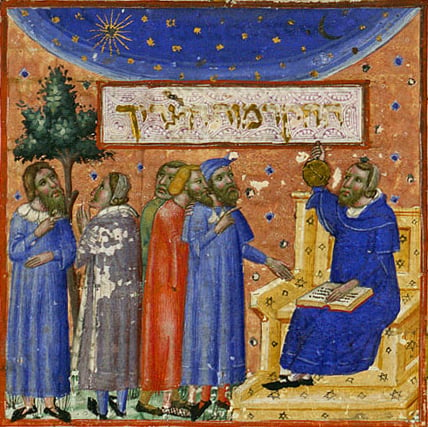
Maimonides teaching, from an illuminated manuscript, 1347. Source: Wikimedia Commons, public domain.
Jewish
Previous Post

May 25, 2023
Tina Turner's Buddhism
Next Post

June 8, 2023 Pat Robertson's Legacy
Recent Comments
"Thank you for this grounded, deeply necessary perspective. Shifting our framework from moralistic binaries to ..."
What You May Not Know About ..."
"Nonviolence is the weapon of the mighty and the strong. Violence is the weapon of ..."
Thomas Aquinas on the Morality of ..."
"Regarding Barbara O'Brien's article "Is Empathy a Weakness?" My answer in song is an emphatic ..."
""A government, which to bigotry gives no sanction." How far our government has fallen from ..."
George Washington’s Letter to Touro Synagogue
Browse Our Archives
Select a Category Buddhism Christianity Daoism Hinduism Indigenous religions Islam Judaism Mysticism New Age Origins of religion Paganism Popes Popular Religious Movements Protestantism Psychology and religion Religion and current events Religion and folklore Religion and News Media Religion and politics Religious Art and Music Religious Freedom Religious mistakes Religious philosophy Religious scriptures Religious Violence science and religion Spiritualism Technology and religion The Catholic Church The Dalai Lama The Reformation Uncategorized
Select a Month September 2026 August 2026 July 2026 June 2026 April 2026 March 2026 February 2026 January 2026 December 2025 November 2025 October 2025 September 2025 August 2025 July 2025 June 2025 May 2025 April 2025 March 2025 February 2025 January 2025 December 2024 November 2024 October 2024 September 2024 August 2024 July 2024 June 2024 May 2024 April 2024 March 2024 February 2024 January 2024 December 2023 November 2023 October 2023 September 2023 August 2023 July 2023 June 2023 May 2023 April 2023 March 2023 February 2023 January 2023 December 2022 November 2022 October 2022 September 2022 August 2022
Follow Us!
TAKE THE
Religious Wisdom Quiz
True or False: Hebrews states that it is appointed for men to die once, and after this comes judgment.
Select your answer to see how you score.
FALSE TRUE
Related posts from The Religious History Nerd

George Washington's Letter to Touro Synagogue
What Became of the Conversos of Spain?
The Ten Commandments: Back to School?
The Ancient Origins of the Great Flood Story
TRENDING AT PATHEOS History and Religion

Emotion in Early Christianity by Andrew Crislip
Andrew Crislip’s Emotion in Early Christianity examines an often overlooked dimension of...

16 Spiritual Touchstones for a More Grounded Life
After decades of spiritual study, here are 16 principles I try...

Catholic Evangelization: Sharing Your Faith Every Day
Welcome back to the Graceful Awakening mini-series called, “From Faith to Mission.” ...

The Pillar of the Boatmen: the Ancient Monument...
The Pillar of the Boatmen is a Romano-Gaulish sculpture that dates from...

In one sense walking into Westminster Abbey is like walking down the...

'Super Scam Me' Exposes AI Jon Bon Jovi...
Leslie Pickett believed she was in a relationship with Jon Bon Jovi....
view all History and Religion blogs
What Are Your Thoughts?leave a comment
Ad-Free & Subscriber Log-In Subscription Support
- About Us
- 2026 Calendar
- Videos
- Podcasts
- Library of World Religions
- Faith In Media Tracker
- Advertise With Us
- Write for Us
- Privacy Policy
- Terms of Service
- Do Not Sell My Data
- Contact Us
- Radiant Digital
- Manage Newsletter Subscriptions
- Unsubscribe From Notifications
- Sitemap
Copyright 2008-2026, Patheos. All rights reserved.
Subscription Support Ad-Free & Subscriber Log-In
Follow Patheos