
BuddhistCatholicContemplativeEvangelicalGeneral ChristianHinduJewishLatter-day SaintMuslimNew VisionsProgressive Christian
Beliefs
- Buddhist
- Catholic
- Contemplative
- Evangelical
- General Christian
- Hindu
- Jewish
- Latter-day Saint
- More Voices
- Muslim
- New Visions
- Pagan
- Progressive Christian
Topics
- Religion News
- Food and Religion
- Sports and Religion
- Religious Art
- Religious Music and Entertainment
- Religious Events
- History and Religion
- Style and Religion
- Politics and Religion
- Women in Religion
- Recreation Outdoors and Religion
- Business Finance and Religion
- Careers Workplace and Religion
- Education and Religion
- Family Parenting and Religion
- Health Fitness and Religion
- Home and Religion
- Relationships and Religion
- Technology and Religion
- Travel and Religion
Columnists
- Buddhist Columnists
- Business Finance and Religion Columnists
- Careers Workplace and Religion Columnists
- Catholic Columnists
- Contemplative Columnists
- Education and Religion Columnists
- Evangelists Columnists
- Family Parenting and Religion Columnists
- General Christian Columnists
- Health Fitness and Religion Columnists
- Hindu Columnists
- History and Religion Columnists
- Home and Religion Columnists
- Jewish Columnists
- More Voices Columnists
- Latter Day Columnists
- Muslim Columnists
- New Visions Columnists
- Nonreligious Columnists
- Pagan Columnists
- Politics and Religion Columnists
- Progressive Columnists
- Recreation Outdoors and Religion Columnists
- Relationships and Religion Columnists
- Religion News Columnists
- Religious Art Columnists
- Religious Events Columnists
- Religious Music and Entertainment Columnists
- Sports and Religion Columnists
- Style and Religion Columnists
- Technology and Religion Columnists
- Travel and Religion Columnists
- Women in Religion Columnists
Resource Library
- 2026 Calendar
- Library of World Religions
- The 100 Most Holy Places on Earth
- Patheos Answers
- Podcasts
- Videos
- Faith Leaders Database
- Anglican Episcopalian
- Bahai
- Baptist
- Buddhism
- Christianity
- Confucianism
- Eastern Orthodoxy
- Hinduism
- Holiness and Pentecostal
- ISKCON
- Islam
- Judaism
- Lutheran
- Methodist
- The Church of Jesus Christ of Latter-day Saints
- New Age
- Paganism
- Presbytarian and Reformed
- Protestantism
- Religion Behind the Scenes
- Roman Catholic
- Scientology
- Shia Islam
- Sikhism
- Sufism
- Sunni Islam
- Taoism
- Zen
- See all religions
Research Tools
 Ad-Free & Subscriber Log-In Subscription Support
Ad-Free & Subscriber Log-In Subscription Support
Follow Patheos 

- Trending:
- Forgiveness
- |
- Marriage
- |
- Consciousness
- |
- Death Penalty
- |
- Election
- |
- Halloween

- Home
- General Christian
- History and Religion
- The Controversial History of Michelangelo’s David
The Controversial History of Michelangelo’s David
Last updated on: October 30, 2023 at 8:08 pm by Barbara O'Brien
The Controversial History of Michelangelo’s David 2023-10-30T20:08:04-05:00 Barbara O'Brien
Patheos Explore the world's faith through different perspectives on religion and spirituality! Patheos has the views of the prevalent religions and spiritualities of the world.
The fallout from the recent Michelangelo’s David controversy continues. If you’ve spent the past month in a hermitage, here’s the story: The principal of a Florida Christian school lost her job because some parents were furious about an art appreciation lesson. The lesson included a photograph of the famous statue of the biblical David by the Renaissance artist Michelangelo. Some parents considered the statue “pornographic.” The lesson including the statue was for sixth graders, children aged 11 to 12, according to several news stories. This episode became international news and the object of many jokes about unsophisticated rubes in Florida.
More recently, the very conservative Hillsdale College in Michigan ended its partnership with the Florida school, Tallahassee Classical School. Tallahassee Classical held a license to use Hillsdale’s curricular materials. Hillsdale revoked the license.
This was hardly the first time the statue’s famous nudity has caused controversy, however. Even Leonardo da Vinci grumbled that Michelangelo could have carved a loincloth on the David. Michelangelo’s David is possibly the most iconic and admired statue in history, but it has also drawn plenty of objections. Let’s review.
Michelangelo’s David: The Backstory
In 1501 the young artist Michelangelo di Lodovico Buonarroti Simoni (1475–1564) returned to his native Florence from Rome. He had recently completed an exquisite marble Pietà for the Old St. Peter’s Basilica, and his reputation was growing. After his homecoming he was asked by the Opera del Duomo, or the vestry committee of the Florence Cathedral (although one source I found says it was the Wool Guild) to carve a statue of David. The statue was intended to be displayed on the roof of the cathedral with other figures from the Old Testament.
Michelangelo was given a large block of marble to sculpt. The block had been sitting in an open courtyard for at least 25 years, rejected by other artists for having too many imperfections. Michelangelo decided he could make it work. From the large block of marble he created a large statue — 17 feet tall. He worked in the open courtyard, carving marble even in the rain. Even so, records indicate no one saw what he was doing until the statue was nearly finished. And then in January 1504, he summoned the members of the vestry committee. This select group was first to see Michelangelo’s David.
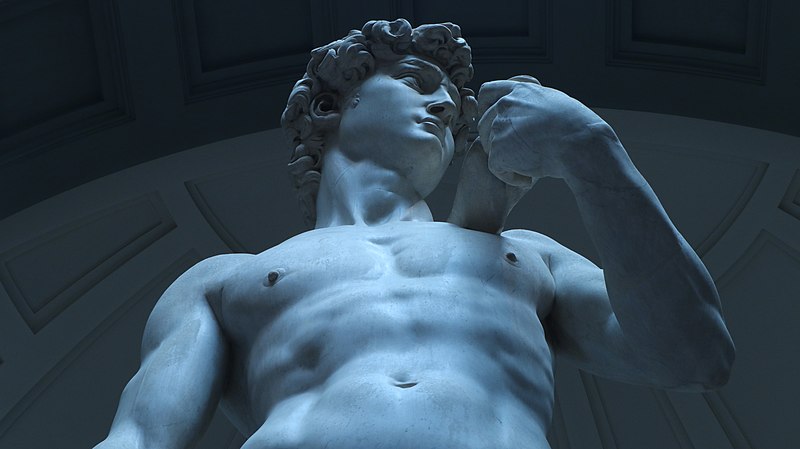
A Florida-friendly view of Michelangelo’s David. Source: Wikimedia Commons, CC-BY-SA-4.0 license.
The vestry committee agreed the statue was too beautiful — and also too large — to hoist to some place way above street level. Another committee was convened to find the best place to display David. This second group included Florentine officials and notable artists such as Leonardo da Vinci, Sandro Botticelli, and Giuliano da Sangallo. (And yes, it’s widely recorded that da Vinci thought the David should have had a loincloth.) Eventually this committee settled on the Piazza della Signoria, the main square of the city of Florence. This was only a half mile from Michelangelo’s workshop/courtyard, but it took 40 men four days to move the massive statue. It would remain on the Piazza della Signoria until 1873, when it was moved to its current location in the Galleria dell’ Accademia. A replica was made to stand in the Piazza della Signoria where the original stood.
The Story of David
Michelangelo chose to depict the young David who slew the giant Goliath. This is a story told in the Jewish Nevi’im and the Christian Old Testament, 1 Samuel 17. The story tells us that the Israelites and Philistines were at war. The armies were facing each other across a valley. Among the Philistines was a massive man named Goliath, who stood “six cubits and a span,” or nearly eight feet tall. Goliath came out every day to taunt the Israelites and challenge someone to fight him. “Choose a man and have him come down to me,” Goliath the Philistine said. “If he is able to fight and kill me, we will become your subjects; but if I overcome him and kill him, you will become our subjects and serve us.” This went on for forty days. No one dared take on Goliath.
David was a young man whose three older brothers served in the army of the Israelites. David stayed home to tend his father’s sheep. But one day the father told David to take food to his brothers, so he went to the front line. David couldn’t understand why no one dared take on Goliath. When he offered to do the job himself, at first the other men ignored him. But David persisted, and at last he got permission from King Saul to go forth to slay the giant. Saul dressed David in his own armor, and gave him a sword. But David found the battle gear too confining. He took off the armor and left the sword behind. He walked out to face the giant with only five stones and a sling.
And then, after some mutual taunting and shade throwing, David put one stone into the sling and hurled it toward the giant. The stone smacked Goliath in the middle of his forehead and killed him. David would eventually become king and write many psalms.
The Composition
Previous depictions of David the Goliath killer in art usually captured David in his moment of triumph, after Goliath had been slain. These scenes often included Goliath’s severed head. But Michelangelo chose to depict the moment before David hurled the fatal rock. David grasps the sling with his left hand (note that Michelangelo was left handed), and he is beginning to take a step forward with his left foot. His eyes are fixed on what we assume is Goliath. His face is confident and alert. His life and the future of Israel were at stake.
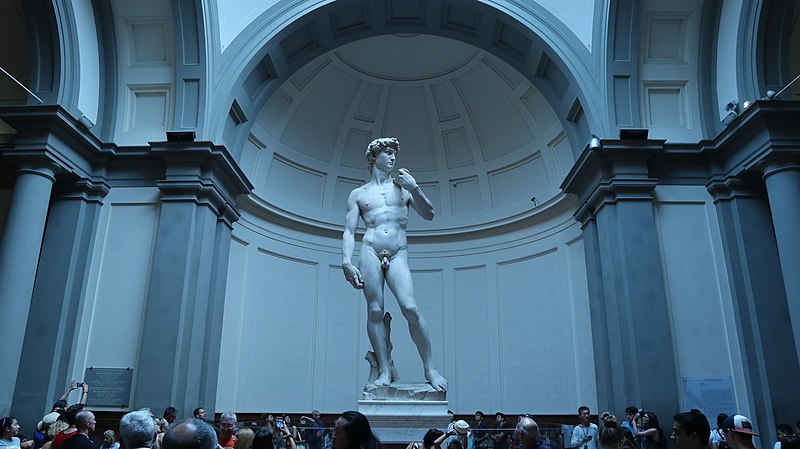
The entire Michelangelo’s David, being viewed in the Galleria dell’ Accademia. Source: Wikimedia Commons, CC-BY-SA-4.0 license.
Although you may not notice it immediately, David’s head and hands are carved on a slightly larger scale than the rest of his body. Michelangelo assumed the statue would be placed on a roof someday. People would be looking up at it from some distance. Michelangelo wanted to be sure people could see the face and hands.
After the statue was in place in the Piazza della Signoria, Michelangelo added some gilding to parts of the masterpiece, although this has since worn off.
Public Reception, Plus Fig Leaves
David made its public debut during a particular interlude in the history of Florence. The infamous Medici family ruled Florence between the years 1434 to 1737, most of the time. But in 1494 the Medici were driven out of Florence, temporarily, by people who favored a republic. Florentines informally adopted the giant David as a symbol and protector of a city freed from tyranny. Still, shortly after the statue’s installation in the city square in 1504 a mob gathered and threw stones at it. Were they Medici supporters? Or art critics? Sadly, the republicans were defeated in 1512, putting the Medici back in power. From 1527 to 1530 the republicans made a brief comeback. When pro- and anti-Medici mobs rioted in the Piazza della Signoria in 1527, someone threw a bench at the David, breaking the left arm in three pieces. Obviously, it was repaired.
Later in the 16th century a metal loincloth of 28 fig leaves was strategically draped around the statue. It’s not clear to me when the metal loincloth was removed.
Over the years many replicas of the statue exhibited around the world have caused no end of discomfort. A copy of David gifted to Queen Victoria so disturbed Her Majesty that a detachable fig leaf was made for it, used only when the Queen might view the statue. In 1995 Israel refused the gift of a David replica from Florence, opting for a replica of a clothed David by Verrocchio instead. A large plaster replica of David exhibited in St. Petersburg in 2016 drew so much criticism that organizers of the exhibition proposed a “dress David” contest. Many other replicas around the world have been forcibly clothed or “fig leafed” to appease local prudery. So it’s not just Florida.
And on April 1, 2011, Pope Benedict XVI declared the David must be clothed to end the “depravity and nudity celebrated by the morally corrupt.” And then His Holiness wished everyone a happy April Fool’s Day.
General Christian
Religious Art
Previous Post
March 31, 2023
The Story of Michelangelo's Pietà
Next Post
April 9, 2023 How the Italian Renaissance Began
Recent Comments
"Thank you for this grounded, deeply necessary perspective. Shifting our framework from moralistic binaries to ..."
What You May Not Know About ..."
"Nonviolence is the weapon of the mighty and the strong. Violence is the weapon of ..."
Thomas Aquinas on the Morality of ..."
"Regarding Barbara O'Brien's article "Is Empathy a Weakness?" My answer in song is an emphatic ..."
""A government, which to bigotry gives no sanction." How far our government has fallen from ..."
George Washington’s Letter to Touro Synagogue
Browse Our Archives
Select a Category Buddhism Christianity Daoism Hinduism Indigenous religions Islam Judaism Mysticism New Age Origins of religion Paganism Popes Popular Religious Movements Protestantism Psychology and religion Religion and current events Religion and folklore Religion and News Media Religion and politics Religious Art and Music Religious Freedom Religious mistakes Religious philosophy Religious scriptures Religious Violence science and religion Spiritualism Technology and religion The Catholic Church The Dalai Lama The Reformation Uncategorized
Select a Month September 2026 August 2026 July 2026 June 2026 April 2026 March 2026 February 2026 January 2026 December 2025 November 2025 October 2025 September 2025 August 2025 July 2025 June 2025 May 2025 April 2025 March 2025 February 2025 January 2025 December 2024 November 2024 October 2024 September 2024 August 2024 July 2024 June 2024 May 2024 April 2024 March 2024 February 2024 January 2024 December 2023 November 2023 October 2023 September 2023 August 2023 July 2023 June 2023 May 2023 April 2023 March 2023 February 2023 January 2023 December 2022 November 2022 October 2022 September 2022 August 2022
Follow Us!
TAKE THE
Religious Wisdom Quiz
Who was the Roman emperor during Jesus’ birth?
Select your answer to see how you score.
Tiberius Herod Nero Caesar Augustus
Related posts from The Religious History Nerd

The President and the Pope: An Unprecedented Rift
What Was the Avignon Papacy and Why Is...
Thomas Aquinas on the Morality of War

TRENDING AT PATHEOS History and Religion

Looking at the Largest Orthodox Cathedral on Earth
There is often a considerable amount of anger and, shall we...

The Problem with False Prophets
Miller’s Station UMC| 10/18/26| Anchor Verse: Jeremiah 23: 1, 9-23 I...

Emotion in Early Christianity by Andrew Crislip
Andrew Crislip’s Emotion in Early Christianity examines an often overlooked dimension of...

16 Spiritual Touchstones for a More Grounded Life
After decades of spiritual study, here are 16 principles I try...

Catholic Evangelization: Sharing Your Faith Every Day
Welcome back to the Graceful Awakening mini-series called, “From Faith to Mission.” ...

The Pillar of the Boatmen: the Ancient Monument...
The Pillar of the Boatmen is a Romano-Gaulish sculpture that dates from...
view all History and Religion blogs
What Are Your Thoughts?leave a comment
Ad-Free & Subscriber Log-In Subscription Support
- About Us
- 2026 Calendar
- Videos
- Podcasts
- Library of World Religions
- Faith In Media Tracker
- Advertise With Us
- Write for Us
- Privacy Policy
- Terms of Service
- Do Not Sell My Data
- Contact Us
- Radiant Digital
- Manage Newsletter Subscriptions
- Unsubscribe From Notifications
- Sitemap
Copyright 2008-2026, Patheos. All rights reserved.
Subscription Support Ad-Free & Subscriber Log-In
Follow Patheos