
BuddhistCatholicContemplativeEvangelicalGeneral ChristianHinduJewishLatter-day SaintMuslimNew VisionsProgressive Christian
Beliefs
- Buddhist
- Catholic
- Contemplative
- Evangelical
- General Christian
- Hindu
- Jewish
- Latter-day Saint
- More Voices
- Muslim
- New Visions
- Pagan
- Progressive Christian
Topics
- Religion News
- Food and Religion
- Sports and Religion
- Religious Art
- Religious Music and Entertainment
- Religious Events
- History and Religion
- Style and Religion
- Politics and Religion
- Women in Religion
- Recreation Outdoors and Religion
- Business Finance and Religion
- Careers Workplace and Religion
- Education and Religion
- Family Parenting and Religion
- Health Fitness and Religion
- Home and Religion
- Relationships and Religion
- Technology and Religion
- Travel and Religion
Columnists
- Buddhist Columnists
- Business Finance and Religion Columnists
- Careers Workplace and Religion Columnists
- Catholic Columnists
- Contemplative Columnists
- Education and Religion Columnists
- Evangelists Columnists
- Family Parenting and Religion Columnists
- General Christian Columnists
- Health Fitness and Religion Columnists
- Hindu Columnists
- History and Religion Columnists
- Home and Religion Columnists
- Jewish Columnists
- More Voices Columnists
- Latter Day Columnists
- Muslim Columnists
- New Visions Columnists
- Nonreligious Columnists
- Pagan Columnists
- Politics and Religion Columnists
- Progressive Columnists
- Recreation Outdoors and Religion Columnists
- Relationships and Religion Columnists
- Religion News Columnists
- Religious Art Columnists
- Religious Events Columnists
- Religious Music and Entertainment Columnists
- Sports and Religion Columnists
- Style and Religion Columnists
- Technology and Religion Columnists
- Travel and Religion Columnists
- Women in Religion Columnists
Resource Library
- 2026 Calendar
- Library of World Religions
- The 100 Most Holy Places on Earth
- Patheos Answers
- Podcasts
- Videos
- Faith Leaders Database
- Anglican Episcopalian
- Bahai
- Baptist
- Buddhism
- Christianity
- Confucianism
- Eastern Orthodoxy
- Hinduism
- Holiness and Pentecostal
- ISKCON
- Islam
- Judaism
- Lutheran
- Methodist
- The Church of Jesus Christ of Latter-day Saints
- New Age
- Paganism
- Presbytarian and Reformed
- Protestantism
- Religion Behind the Scenes
- Roman Catholic
- Scientology
- Shia Islam
- Sikhism
- Sufism
- Sunni Islam
- Taoism
- Zen
- See all religions
Research Tools
 Ad-Free & Subscriber Log-In Subscription Support
Follow Patheos 

- Trending:
- Advent
- |
- Forgiveness
- |
- Thanksgiving
- |
- Election
- |
- Seasonal Holidays
- |
- Marriage

- Home
- General Christian
- History and Religion
- The Oneida Community: An Experiment in Perfectionism
The Oneida Community: An Experiment in Perfectionism
Last updated on: March 6, 2023 at 9:40 am by Barbara O'Brien
The Oneida Community: An Experiment in Perfectionism 2023-03-06T09:40:42-06:00 Barbara O'Brien
Patheos Explore the world's faith through different perspectives on religion and spirituality! Patheos has the views of the prevalent religions and spiritualities of the world.
The United States in the 19th century was a surprising place. Although it was marked by the Victorian era, famous for fuddy-duddiness, it was also a time for exploring mysteries (see, for example, the previous post, “Talking With the Dead in 19th Century America“) and trying on new ideas about culture, society, and religion. And if you’ve not heard much about the Oneida Community of 19th century New York before, prepare to be surprised.
The Second Great Awakening, with its boisterous camp meetings and cathartic revivals, swept through the U.S. from about 1795 to 1835. This completely changed the U.S. religious landscape. One of the ideas popularized by the Second Great Awakening was that humans were not hopelessly depraved and sinful. With some effort, they could be good. Some denominations of the time — the Quakers and Methodists, for example — even promoted an ideal of “Christian perfectionism.” To be perfect in this sense was to be freed from sin and to live a holy life, as Jesus lived.
Many of the Christian perfectionists also felt called to make the world a better place for everyone. They engaged in many charitable and social welfare causes, including abolitionism. See, for example, “When Evangelicals Were Liberal” and “Christianity and the Abolitionist Movement in the U.S.”
Origins of the Oneida Community
To put their new ideas into practice, many Americans organized themselves into self-contained utopian communities. The many Shaker communities that flourished in the 19th century are the best known of these today. A few communities were almost comically disasterous, such as the infamous Fruitlands founded by Charles Lane and Bronson Alcott in 1843, which lasted only seven months.
The Oneida Community was one of the more successful utopian communities, for a while, at least. It was founded in 1848 near Oneida, New York, by John Humphrey Noyes (1811–1886). Noyes had experienced a profound religious conversion at the age of 20 and decided to study theology and become a minister. While at his second year at Yale Theological Seminary he came to the startling conclusion that Jesus’ Second Coming had already happened, in the year 70 CE. The world had been living in a new age all that time, and didn’t know it.
Noyes became a passionate, and radical, perfectionist. His ideas about Christian perfectionism went way beyond the norm. He had completely accepted Jesus in his heart, and therefore he already was without sin for all time, he decided. His perfection was so perfect that the laws of the church or the state didn’t apply to him.
Yale expelled him from the divinity school.
The Original Community
Unemployable as a minster, John Noyes considered other ways to spread perfection. He was, after all, called to establish the Kingdom of Heaven on earth. He decided the way to plant the Kingdom of Heaven on earthly soil was to establish it in one community, from which it would surely spread. But he was in debt, jobless, and estranged from his parents. His fortunes were saved by a young woman named Harriet Holten, who was captivated by his ideas. She paid his debts and then married Noyes in 1838. At some point the pair mutually agreed they didn’t need to practice sexual exclusivity, since such rules no longer applied to them. They were perfect, after all.
John, Harriet, and small group of others began their first community in Putney, Vermont. Money and chores were communally shared. The group also adopted Noyes’s views on sexual non-exclusivity. By 1845 the little community had run out of the inheritance money that had kept it going, but then Harriet inherited $9,000, a considerable sum at the time. Reprieved, the group decided to be more businesslike. They formed a corporation with John Noyes at the head. All members of the corporation were to vow obedience to Noyes as “The Father and Overseer whom the Holy Ghost has set over us.”
In 1847 Noyes was arrested for adultery but released pending trial. When arrest warrants were issued for other members of the community, the corporation decided to leave Vermont. Quickly.
The Oneida Community
So it was that in 1848 the community in Oneida, New York, was formed. At its peak the Oneida Community had more than 300 members, and for a time there were satellite communities in Connecticut, New Jersey, and Vermont. The community supported itself through various industries. The most successful of these was a silverware company that survives to this day. (Yes, it’s that Oneida company.)
The one thing the Oneida Community is most remembered for, other than forks and spoons, is “complex marriage.” This means that every member of the community was married to every other member. This arrangement was not a free-for-all, however. For one thing, the community appears to have recognized only heterosexual sex. Historians have documented that sexual couplings were regulated by Noyes and other elders. No couple was allowed to become exclusive with each other. At puberty, young people were assigned to much older partners to learn the arts of love. To limit the number of children, men were supposed to discipline themselves to withhold ejaculation, and the young men “practiced” with postmenopausal women. All decisions about childbearing were supposed to be approved by a committee, although of course there were some surprises. Once toddlers were weaned from their mothers children were raised communally.
Another practice of the community was “mutual criticism.” The community met in groups to discuss each others’ faults, and records of these meetings were available to all other members. Noyes and his followers also rejected medical treatment for disease, believing that sickness came from spiritual impurity. Although life in the Oneida Community may sound ghastly, members did enjoy cultural activities — music, painting and poetry — and took part in organized games and sports. Noyes believed that life should be joyous, and so joyous they were, even if they had to work at it.
The End of the Community
Remarkably, the Oneida Community was not dissolved unil 1881. The community managed to survive quite a bit of adversity, but it could not survive without John Noyes. In 1879 Noyes got word that he’d been indicted for statutory rape, and he fled to Ontario, Canada. From Canada he wrote to the community that perhaps it should end the complex marriage.
Noyes also wanted his son (with Harriet Holten Noyes) Theodore Noyes (1841–1903) to take over leadership of the group, but it appears Theodore was more of an agnostic than a true believer. He also had a medical degree from Yale, which suggests he was fine with medical science. The community fell apart. John Noyes died in Canada in 1886 and is buried in the community cemetery in Oneida.
The surviving company, Oneida Limited, was headed with great business success by Pierrepont “P. B.” Noyes (1870–1959), another Noyes son born and raised in the Oneida Community. Pierrepont enjoyed a conventional marriage and exhibited no interest in taking up his father’s religious mission.
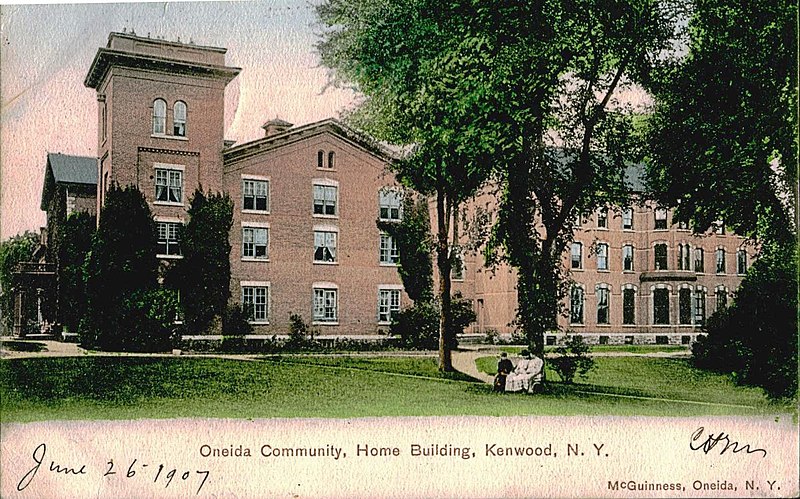
A 1907 postcard depicting the Oneida Community mansion, where all members lived together. Today the community buildings and grounds are a tourist attraction. Source: Wikimedia Commons, public domain.
General Christian
Previous Post
March 4, 2023
Talking With the Dead in 19th Century America
Next Post
March 11, 2023 The Buddhist Nun Controversy
Recent Comments
"Evil is indeed hard to pin down to any source other then what is reflected ..."
"Thank you for this grounded, deeply necessary perspective. Shifting our framework from moralistic binaries to ..."
What You May Not Know About ..."
"Nonviolence is the weapon of the mighty and the strong. Violence is the weapon of ..."
Thomas Aquinas on the Morality of ..."
"Regarding Barbara O'Brien's article "Is Empathy a Weakness?" My answer in song is an emphatic ..."
Browse Our Archives
Select a Category Buddhism Christianity Daoism Hinduism Indigenous religions Islam Jaina Judaism Mysticism New Age Origins of religion Paganism Popes Popular Religious Movements Protestantism Psychology and religion Religion and current events Religion and folklore Religion and News Media Religion and politics Religious Art and Music Religious Freedom Religious mistakes Religious philosophy Religious scriptures Religious Violence science and religion Spiritualism Technology and religion The Catholic Church The Dalai Lama The Reformation Uncategorized
Select a Month November 2026 October 2026 September 2026 August 2026 July 2026 June 2026 April 2026 March 2026 February 2026 January 2026 December 2025 November 2025 October 2025 September 2025 August 2025 July 2025 June 2025 May 2025 April 2025 March 2025 February 2025 January 2025 December 2024 November 2024 October 2024 September 2024 August 2024 July 2024 June 2024 May 2024 April 2024 March 2024 February 2024 January 2024 December 2023 November 2023 October 2023 September 2023 August 2023 July 2023 June 2023 May 2023 April 2023 March 2023 February 2023 January 2023 December 2022 November 2022 October 2022 September 2022 August 2022
Follow Us!
TAKE THE
Religious Wisdom Quiz
Rejoice in the Lord always. I will say it again: __!
Select your answer to see how you score.
Pray Rejoice Believe Hope
Related posts from The Religious History Nerd

I Watched the Towers Fall. Here's What You...

Barring Mamdani From 9/11 Lets the Enemy Win

Is 'Separation of Church and State' Really a...
The President and the Pope: An Unprecedented Rift
TRENDING AT PATHEOS History and Religion

The Darkening of the Sun, Moon, and Stars
The darkening of the sun and moon and the falling of stars...

Gratitude as the Parent of All Virtues
Giving thanks stems from gratitude. Cicero said that gratitude is the parent...

Make Thanksgiving Bring Family Closer
Written by Dr. David K. Ewen from Eternal Truth Bible College Start...

Ghosts, Spirits, and Wizards in Post-Puritan New England
As it is Thanksgiving, I have a seasonal post concerned with New...

Here are two Thanksgiving columns that I originally wrote for the...

Book III, Chapter 3: Christ "Classic" (Matt. 9:9-34)
Book III, Chapter 3: Christ "Classic" (Matt. 9:9-34) In honor of tomorrow's...
view all History and Religion blogs
What Are Your Thoughts?leave a comment
Ad-Free & Subscriber Log-In Subscription Support
- About Us
- 2026 Calendar
- Videos
- Podcasts
- Library of World Religions
- Faith In Media Tracker
- Advertise With Us
- Write for Us
- Privacy Policy
- Terms of Service
- Do Not Sell My Data
- Contact Us
- Radiant Digital
- Manage Newsletter Subscriptions
- Unsubscribe From Notifications
- Sitemap
Copyright 2008-2026, Patheos, part of the Radiant Digital network of media brands. All rights reserved.
Subscription Support Ad-Free & Subscriber Log-In
Follow Patheos