
BuddhistCatholicContemplativeEvangelicalGeneral ChristianHinduJewishLatter-day SaintMuslimNew VisionsProgressive Christian
Beliefs
- Buddhist
- Catholic
- Contemplative
- Evangelical
- General Christian
- Hindu
- Jewish
- Latter-day Saint
- More Voices
- Muslim
- New Visions
- Pagan
- Progressive Christian
Topics
- Religion News
- Food and Religion
- Sports and Religion
- Religious Art
- Religious Music and Entertainment
- Religious Events
- History and Religion
- Style and Religion
- Politics and Religion
- Women in Religion
- Recreation Outdoors and Religion
- Business Finance and Religion
- Careers Workplace and Religion
- Education and Religion
- Family Parenting and Religion
- Health Fitness and Religion
- Home and Religion
- Relationships and Religion
- Technology and Religion
- Travel and Religion
Columnists
- Buddhist Columnists
- Business Finance and Religion Columnists
- Careers Workplace and Religion Columnists
- Catholic Columnists
- Contemplative Columnists
- Education and Religion Columnists
- Evangelists Columnists
- Family Parenting and Religion Columnists
- General Christian Columnists
- Health Fitness and Religion Columnists
- Hindu Columnists
- History and Religion Columnists
- Home and Religion Columnists
- Jewish Columnists
- More Voices Columnists
- Latter Day Columnists
- Muslim Columnists
- New Visions Columnists
- Nonreligious Columnists
- Pagan Columnists
- Politics and Religion Columnists
- Progressive Columnists
- Recreation Outdoors and Religion Columnists
- Relationships and Religion Columnists
- Religion News Columnists
- Religious Art Columnists
- Religious Events Columnists
- Religious Music and Entertainment Columnists
- Sports and Religion Columnists
- Style and Religion Columnists
- Technology and Religion Columnists
- Travel and Religion Columnists
- Women in Religion Columnists
Resource Library
- 2026 Calendar
- Library of World Religions
- The 100 Most Holy Places on Earth
- Patheos Answers
- Podcasts
- Videos
- Faith Leaders Database
- Anglican Episcopalian
- Bahai
- Baptist
- Buddhism
- Christianity
- Confucianism
- Eastern Orthodoxy
- Hinduism
- Holiness and Pentecostal
- ISKCON
- Islam
- Judaism
- Lutheran
- Methodist
- The Church of Jesus Christ of Latter-day Saints
- New Age
- Paganism
- Presbytarian and Reformed
- Protestantism
- Religion Behind the Scenes
- Roman Catholic
- Scientology
- Shia Islam
- Sikhism
- Sufism
- Sunni Islam
- Taoism
- Zen
- See all religions
Research Tools
 Ad-Free & Subscriber Log-In Subscription Support
Ad-Free & Subscriber Log-In Subscription Support
Follow Patheos 

- Trending:
- Forgiveness
- |
- Marriage
- |
- Consciousness
- |
- Death Penalty
- |
- Election
- |
- Halloween

- Home
- Buddhism
- History and Religion
- The Buddhist Nun Controversy
The Buddhist Nun Controversy
Last updated on: March 13, 2023 at 11:23 am by Barbara O'Brien
The Buddhist Nun Controversy 2023-03-13T11:23:44-05:00 Barbara O'Brien
Patheos Explore the world's faith through different perspectives on religion and spirituality! Patheos has the views of the prevalent religions and spiritualities of the world.
The Buddhist nun controversy stems from the many barriers Buddhist women have faced in Asia. For example, the nuns’ orders of southeast Asia have been extinct for centuries. At the same time, the Buddhist establishment has resisted allowing the orders of nuns to be renewed. This means that many women who wish to live as nuns are denied full ordination.
On the other hand, in Taiwan there are more nuns than monks, and the nuns enjoy respect, authority, and full ordination. In Japan and Korea, recent generations of nuns have worked to change the power structure to come closer to equality with monks.
There are historical, social, and cultural reasons for the barriers to the nun’s orders. But in different parts of Asia they are not exactly the same reasons, and the barriers are not exactly the same barriers. I’d like to look a bit at the history of Buddhist nuns to explain why these barriers have been so intractable.
About Buddhist Monasticism
You’ll need some nerdy background to understand the Buddhist nun controversy. First, the English terms “monk” and “nun” are borrowed from Catholicism, of course. The original Buddhist monks were called “mendicants,” or bhikṣus in Sanskrit. The Sanskrit word for a Buddhist nun is bhikṣuni. “Monk” and “nun” will do. But Buddhist monastics — monks and nuns — are not exactly equivalent to Catholic monastics. Through most of Buddhist history Buddhist monastics have taken two levels of ordination, novice and full. After years of study and training, novice monastics receive full ordination, and then they have authority to teach, to officiate at ceremonies, and to ordain other monastics. In most Buddhist traditions a fully ordained Buddhist monk or nun is a priest, in other words.
The rules for ordination and training of monastics are preserved in a very old, and large, scripture called the Vinayapitaka, or Vinaya for short. The hundreds of rules in the Vinaya are attributed to the Buddha. However, today there are three complete versions of the Vinaya, which are similar but not identical. These are the Pali Vinaya, which is authoritative in the Theravada Buddhism of southeast Asia; the Mulasarvastivada Vinaya, which is authoritative in Tibetan Buddhism; and the Dharmaguptaka Vinaya, which is authoritative in China and east Asia generally. (And note that there are some traditions in Buddhism in which the clergy are no longer bound to any version of the Vinaya.)
All of these versions of the Vinaya call for fully ordained monastics to ordain new monastics, and so it’s said there are three separate, unbroken lineages of ordination that go back to the first ordinations given by the Buddha. In the case of nuns, the Vinaya has been interpreted to require the presence of a quorum of fully ordained nuns as well as monks to be present for full nuns’ ordinations. And this has created a major barrier in places where the nuns orders are extinct.
The First Buddhist Nuns
Buddhist scriptures tell us that the original orders of Buddhist monks and nuns were established by the Buddha, who is believed to have lived from about 563 BCE to 483 BCE. First there were just monks, the scriptures say, but the Buddha relented to ordaining women when his beloved aunt Pajapati (in most texts she is Mahapajapati, or Great Pajapati) asked to be ordained. The scripture records the Buddha saying that women are as capable of progressing on the Path as men. However, he also predicted that the ordination of women would cause his teachings to be forgotten in 500 years. Which didn’t happen. Further, he imposed eight “heavy” rules or Garudhammas that only women had to follow. These had the effect of keeping all nuns subordinate to monks.
We do not know if this story is historical. Indeed, much modern critical analysis of the text has found ahistorical elements and other indications that this story of the first ordination of nuns was a later interpolation. It’s very possible the Buddha had nothing to do with the discrepancy between nuns’ and monks’ rules. But there is no way to know for certain, and the rules have been in effect for a couple of millennia, at least. They are not lightly cast aside.
In the early scriptures thought to date to the life of the Buddha, there were many nuns. There is a section of the Pali Canon called the Therigatha — Verses of the Elder Nuns– that preserves wonderful poems of these early women disciples of the Buddha. In many early suttas the Buddha praised the wisdom of women disciples. See, for example, the Culavedalla Sutta (Majjhima Nikaya 44), in which the nun Dhammadinna thoroughly schooled her ex-husband. And in the Vajira Sutta (Samyutta Nikaya 5:10) the nun Vajira outwits a demon.
The Vanishing Nuns of Southeast Asia
Through the centuries, Buddhist monks carried the teachings into all parts of Asia. Buddhist nuns tended to not venture so far. Traveling is more dangerous for women. Even so, there is historical evidence of Buddhist nuns in Sri Lanka, possibly going back to as early as the 3rd century BCE. These nuns of Sri Lanka would have been nuns of the Theravada tradition, ordained according to the Pali Vinaya. However, as Theravada Buddhism spread through southeast Asia — Myanmar, Thailand, Laos, Cambodia, Malaysia — it’s less clear that nuns’ orders were ever established beyond India and Sri Lanka. They may have been, but opinions vary. Even if they were established, nuns vanished from southeast Asia centuries ago.
The order of Buddhist nuns in Sri Lanka appears to have ended in the 11th century during a time of war and deprivation. The monks’ order survived; the nuns’ order did not. Buddhism itself became nearly entirely extinct in India late in the 12th century. So it was that the lineage of nuns ordained according to the Pali Vinaya became extinct as well. And this created a great impasse. Full ordinations could not be given to nuns without the presence of fully ordained nuns, and there weren’t any.
But wait — through the centuries the lineage of nuns ordained according to the Dharmaguptaka Vinaya thrived in China, Taiwan, the Korean Peninsula, Vietnam, and Japan. So, in theory, one could import some fully ordained Taiwanese nuns to comply with the rules of the Vinaya. But the Buddhist establishments in southeast Asia have resisted this idea. Wrong Vinaya, you know. And those nuns are all Mahayana, which is a different tradition from Theravada. Think having Presbyterians officiate at a Catholic mass.
In recent years a number of southeast Asian nuns have received full ordination from east Asian nuns, often from Taiwan. Now the struggle is for these ordinations to be recognized by southeast Asian monks.
The Other Nuns
It appears nuns’ orders may not have ever reached Tibet, although some Buddhist teachers today insist they did. His Holiness the Fourteenth Dalai Lama has been very supportive of women’s ordinations. But as explained in my earlier series on the Dalai Lamas, there are limits to what the Dalai Lama can do without the cooperation of other high lamas. Even so, progress is being made toward full ordination of nuns in Tibetan Buddhism, I understand.
In 434 CE, nuns from Sri Lanka traveled to China to offer full ordination to their Chinese sisters. I believe this was the beginning of the nuns’ orders of China, which spread to Korea, Japan, Taiwan, and Vietnam. The Chinese monastic orders all follow the Dharmaguptaka Vinaya, with one revision. The Song emperor Taizu (927-976), a neoconfucian, believed it to be improper for men and women to associate outside the home. He declared that monks would not officiate at the ordinations of nuns; nuns could handle nuns’ ordinations by themselves. Freed of having to deal with The Patriarchy, the Dharmaguptaka lineage of nuns survives to this day. This does not mean the Dharmaguptaka nuns didn’t suffer from gender discrimination, however.
In the next post I want to go back to look at how women in southeast Asia have often lived as nuns outside the system. We’ll also look more closely at the effort being made to reconstitute full nun’s ordinations in Theravada Buddhism. See The Determined Buddhist Nuns of Sri Lanka.
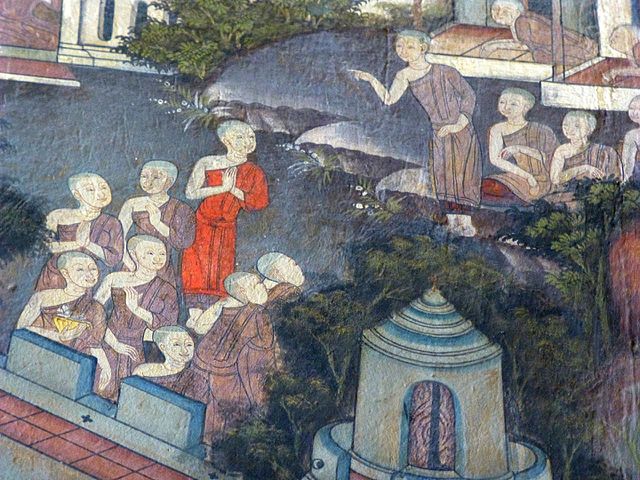
Mahapajapati and other early nuns are depicted in this painting at Wat Pho temple, Bangkok, Thailand. Source: Wikimedia Commons, CC-BY-2.0 license.
Buddhism
Women in Religion
Previous Post

March 5, 2023
The Oneida Community: An Experiment in Perfectionism
Next Post

March 12, 2023 The Determined Buddhist Nuns of Sri Lanka
Recent Comments
"Thank you for this grounded, deeply necessary perspective. Shifting our framework from moralistic binaries to ..."
What You May Not Know About ..."
"Nonviolence is the weapon of the mighty and the strong. Violence is the weapon of ..."
Thomas Aquinas on the Morality of ..."
"Regarding Barbara O'Brien's article "Is Empathy a Weakness?" My answer in song is an emphatic ..."
""A government, which to bigotry gives no sanction." How far our government has fallen from ..."
George Washington’s Letter to Touro Synagogue
Browse Our Archives
Select a Category Buddhism Christianity Daoism Hinduism Indigenous religions Islam Judaism Mysticism New Age Origins of religion Paganism Popes Popular Religious Movements Protestantism Psychology and religion Religion and current events Religion and folklore Religion and News Media Religion and politics Religious Art and Music Religious Freedom Religious mistakes Religious philosophy Religious scriptures Religious Violence science and religion Spiritualism Technology and religion The Catholic Church The Dalai Lama The Reformation Uncategorized
Select a Month September 2026 August 2026 July 2026 June 2026 April 2026 March 2026 February 2026 January 2026 December 2025 November 2025 October 2025 September 2025 August 2025 July 2025 June 2025 May 2025 April 2025 March 2025 February 2025 January 2025 December 2024 November 2024 October 2024 September 2024 August 2024 July 2024 June 2024 May 2024 April 2024 March 2024 February 2024 January 2024 December 2023 November 2023 October 2023 September 2023 August 2023 July 2023 June 2023 May 2023 April 2023 March 2023 February 2023 January 2023 December 2022 November 2022 October 2022 September 2022 August 2022
Follow Us!
TAKE THE
Religious Wisdom Quiz
What is the repeated phrase at the end of Psalm 136?
Select your answer to see how you score.
Let everything praise him Praise the Lord His love endures forever Blessed be the Lord
Related posts from The Religious History Nerd

Sarvastivada: An Extinct Buddhist Sect That's Still With...
A Goddess Who Swapped Bodies to Prove Gender...
The Beat Zen Movement: When Zen Became Cool
TRENDING AT PATHEOS History and Religion

Methodist Central Hall and Westminster Abbey
Situated on the same square is Methodist Central Hall and Westminster Abbey. ...

57th Dove Awards Honor Dolly Parton, Crown New...
On gospel music’s biggest night, the 57th annual GMA Dove Awards honored...

The First Eucharistic Controversy: Christ’s Real Presence
For Catholics, the Eucharist is the source and summit of the Christian...

What a Stop Sign Can Teach Us About...
How to Make a Decision When You Can't Hear God Main point:...

Archdiocese Hosts Military Marriage Retreat in Germany
RASTATT, Germany — The transient military lifestyle, with its frequent deployments and...

Nearly every morning, I make the drive to Detroit with my high-school-age...
view all History and Religion blogs
What Are Your Thoughts?leave a comment
Ad-Free & Subscriber Log-In Subscription Support
- About Us
- 2026 Calendar
- Videos
- Podcasts
- Library of World Religions
- Faith In Media Tracker
- Advertise With Us
- Write for Us
- Privacy Policy
- Terms of Service
- Do Not Sell My Data
- Contact Us
- Radiant Digital
- Manage Newsletter Subscriptions
- Unsubscribe From Notifications
- Sitemap
Copyright 2008-2026, Patheos. All rights reserved.
Subscription Support Ad-Free & Subscriber Log-In
Follow Patheos