
BuddhistCatholicContemplativeEvangelicalGeneral ChristianHinduJewishLatter-day SaintMuslimNew VisionsProgressive Christian
Beliefs
- Buddhist
- Catholic
- Contemplative
- Evangelical
- General Christian
- Hindu
- Jewish
- Latter-day Saint
- More Voices
- Muslim
- New Visions
- Pagan
- Progressive Christian
Topics
- Religion News
- Food and Religion
- Sports and Religion
- Religious Art
- Religious Music and Entertainment
- Religious Events
- History and Religion
- Style and Religion
- Politics and Religion
- Women in Religion
- Recreation Outdoors and Religion
- Business Finance and Religion
- Careers Workplace and Religion
- Education and Religion
- Family Parenting and Religion
- Health Fitness and Religion
- Home and Religion
- Relationships and Religion
- Technology and Religion
- Travel and Religion
Columnists
- Buddhist Columnists
- Business Finance and Religion Columnists
- Careers Workplace and Religion Columnists
- Catholic Columnists
- Contemplative Columnists
- Education and Religion Columnists
- Evangelists Columnists
- Family Parenting and Religion Columnists
- General Christian Columnists
- Health Fitness and Religion Columnists
- Hindu Columnists
- History and Religion Columnists
- Home and Religion Columnists
- Jewish Columnists
- More Voices Columnists
- Latter Day Columnists
- Muslim Columnists
- New Visions Columnists
- Nonreligious Columnists
- Pagan Columnists
- Politics and Religion Columnists
- Progressive Columnists
- Recreation Outdoors and Religion Columnists
- Relationships and Religion Columnists
- Religion News Columnists
- Religious Art Columnists
- Religious Events Columnists
- Religious Music and Entertainment Columnists
- Sports and Religion Columnists
- Style and Religion Columnists
- Technology and Religion Columnists
- Travel and Religion Columnists
- Women in Religion Columnists
Resource Library
- 2026 Calendar
- Library of World Religions
- The 100 Most Holy Places on Earth
- Patheos Answers
- Podcasts
- Videos
- Faith Leaders Database
- Anglican Episcopalian
- Bahai
- Baptist
- Buddhism
- Christianity
- Confucianism
- Eastern Orthodoxy
- Hinduism
- Holiness and Pentecostal
- ISKCON
- Islam
- Judaism
- Lutheran
- Methodist
- The Church of Jesus Christ of Latter-day Saints
- New Age
- Paganism
- Presbytarian and Reformed
- Protestantism
- Religion Behind the Scenes
- Roman Catholic
- Scientology
- Shia Islam
- Sikhism
- Sufism
- Sunni Islam
- Taoism
- Zen
- See all religions
Research Tools
 Ad-Free & Subscriber Log-In Subscription Support
Ad-Free & Subscriber Log-In Subscription Support
Follow Patheos 

- Trending:
- Forgiveness
- |
- Marriage
- |
- Consciousness
- |
- Death Penalty
- |
- Election
- |
- Halloween

- Home
- Buddhism
- History and Religion
- How the Meiji Era Changed Japanese Buddhism
How the Meiji Era Changed Japanese Buddhism
Last updated on: March 27, 2023 at 11:27 am by Barbara O'Brien
How the Meiji Era Changed Japanese Buddhism 2023-03-27T11:27:32-05:00 Barbara O'Brien
Patheos Explore the world's faith through different perspectives on religion and spirituality! Patheos has the views of the prevalent religions and spiritualities of the world.
The Meiji Era, which began in the late 19th century, utterly upended Japanese Buddhism. Sweeping changes enacted by the Meiji Emperor, Mutsuhito (1852–1912) had devastating impacts on Buddhism in Japan. Leaders of the various Buddhist schools responded with their own reforms, but in many ways Japanese Buddhism never recovered.
First, some historical background. Japan had been ruled by military leaders called shoguns since 1192. For centuries the emperors were figureheads with little real power. But the last shogun resigned in 1868 (a long story in itself). This restored the rule of the emperor who took the name Meiji, “enlightened rule.” This was the beginning of the Meiji Restoration. During the reign of the Meiji Emperor, Japan rapidly was transformed from a mostly feudalistic and agricultural nation to a modern and more industrialized nation. This was a remarkable achievement. But in this post we’ll be looking only at the policies that directly impacted Buddhism.
Buddhism Before the Meiji Restoration
Many centuries earlier, Japan had dealt with the rivalry between Buddhism and indigenous religious beliefs — loosely, what today we call Shinto — with the policy of shinbutsu shugo, or “unity of spirits and buddhas.” In effect, the government recognized indigenous beliefs and Buddhism as a single religion. In reality the two traditions were too dissimilar to merge in any substantial way. But Buddhist and Shinto temples and shrines often were linked and even shared.
Further, as explained in the last post, beginning in the 8th century most Buddhist monasteries in Japan abandoned the many monastic rules of the Vinaya Pitaka in favor of simplified rules mostly adapted from a scripture called the Mahayana Brahmajala Sutra. The new rules provided little guidance on some parts of monastic discipline, however. These included celibacy, head shaving, vegetarianism, and the proper wearing of robes. Over time various shoguns adopted policies that enforced these monastic practices and regulated Buddhism in many ways.
Further, during the Edo period, which began in 1603, the Tokugawa shoguns required everyone to be registered at their local Buddhist temple. Requiring everyone to be affiliated with a Buddhist temple began as a means to identify hidden Christians, after the Tokugawa shoguns banned Christianity. But it became a means for the shoguns to monitor and control people throughout Japan. This system, called danka, also became an important source of financial support for temples, especially small rural ones with little other income. People were required to give money to the temples, which in return were required to provide spiritual services.
Shinbutsu Bunri and Its Consequences
In 1868 the new Meiji government of Japan adopted a policy called shinbutsu bunri, which separated Buddhism and Shinto. This was done to enhance the status of the emperor. The indigenous beliefs could be used to claim the emperor was a divine being, a concept Buddhism didn’t support. Shinto in effect became what we would call the state religion of Japan, although in Japanese law Shinto was not considered a religion at all but a political duty or tradition. But this left Buddhism with no official government support. The danka system also was abolished.
Further, the government saw Japan’s Buddhist institutions as obstacles to modernization and began to suppress Buddhism. Many clergy were forcibly laicized, and monastery lands were confiscated. This touched off a series of violent attacks on temples, led by nativists and others resentful of Buddhism’s privileged position during the Tokugawa shogunate. Many temples were destroyed, along with the art in them. Although this violent period was short lived, it had long-term effects.
In 1872, the government abolished laws that regulated monasticism, including celibacy. The government announced that those living under monastic vows were free to marry. Japanese Buddhism would never be the same.
How the Meiji Era Changed Japanese Buddhism
In response to the upheaval, many denominational leaders of Buddhism stepped forward to offer their own reforms. New monastic rules were adopted. New centers of Buddhist clerical education and training were established. Some of these would evolve into universities. So, one could say Buddhism pulled itself together, to some extent.
The Meiji Emperor died in 1912, which officially ended the Meiji Era. But too much had changed for Buddhism to return to what it had been before. For example, the ending of celibacy caused small temples especially to became something like family businesses, with sons inheriting temples from fathers. More often than not these temples offered little else but funeral and memorial services to the local community. And over the years many temples in rural Japan have closed.
Another consequence was that Buddhist institutions entered the 20th century feeling an obligation to prove their loyalty to the emperor to avoid more punishment. And this was a problem as Japan’s military became more aggressive. In the early 20th century Japanese troops occupied Taiwan, Korea, a large part of China and other parts of east Asia. Buddhist clergy who spoke against the violence were subject to arrest and sometimes execution. It became more common for Buddhist institutions to betray Buddhist teachings and support war, until Japan faced defeat at the end of World War II.
Buddhism is deeply woven into Japan’s history and culture, and according to several sources there are at least 75,000 temples open in Japan today. But I understand that in many ways Japanese Buddhism is still struggling to find its way forward.
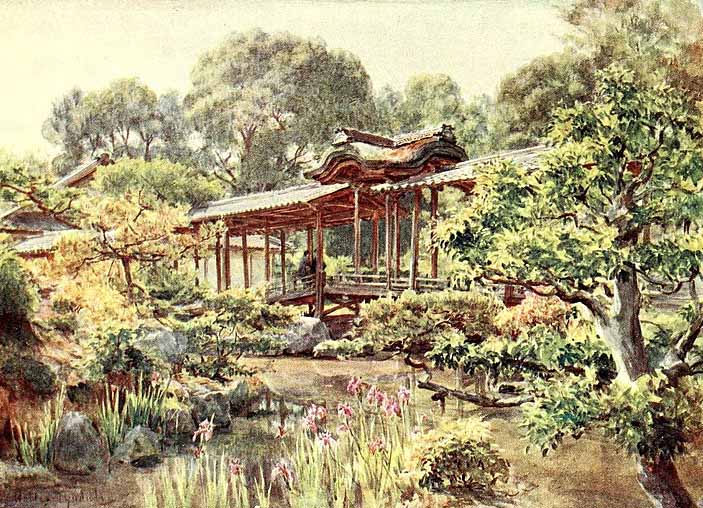
A Buddhist temple garden in Kyoto, Japan, painted in 1912. Source: Wikimedia Commons, public domain.
Buddhism
Previous Post
March 24, 2023
Buddhist Nuns of Japan vs. the Patriarchy
Next Post
March 29, 2023 The Surprising History of Leonardo da Vinci's The Last Supper
Recent Comments
"Thank you for this grounded, deeply necessary perspective. Shifting our framework from moralistic binaries to ..."
What You May Not Know About ..."
"Nonviolence is the weapon of the mighty and the strong. Violence is the weapon of ..."
Thomas Aquinas on the Morality of ..."
"Regarding Barbara O'Brien's article "Is Empathy a Weakness?" My answer in song is an emphatic ..."
""A government, which to bigotry gives no sanction." How far our government has fallen from ..."
George Washington’s Letter to Touro Synagogue
Browse Our Archives
Select a Category Buddhism Christianity Daoism Hinduism Indigenous religions Islam Judaism Mysticism New Age Origins of religion Paganism Popes Popular Religious Movements Protestantism Psychology and religion Religion and current events Religion and folklore Religion and News Media Religion and politics Religious Art and Music Religious Freedom Religious mistakes Religious philosophy Religious scriptures Religious Violence science and religion Spiritualism Technology and religion The Catholic Church The Dalai Lama The Reformation Uncategorized
Select a Month September 2026 August 2026 July 2026 June 2026 April 2026 March 2026 February 2026 January 2026 December 2025 November 2025 October 2025 September 2025 August 2025 July 2025 June 2025 May 2025 April 2025 March 2025 February 2025 January 2025 December 2024 November 2024 October 2024 September 2024 August 2024 July 2024 June 2024 May 2024 April 2024 March 2024 February 2024 January 2024 December 2023 November 2023 October 2023 September 2023 August 2023 July 2023 June 2023 May 2023 April 2023 March 2023 February 2023 January 2023 December 2022 November 2022 October 2022 September 2022 August 2022
Follow Us!
TAKE THE
Religious Wisdom Quiz
How did God stop the people from building the Tower of Babel?
Select your answer to see how you score.
Confused their language Sent a flood Struck them with blindness Destroyed the tower with fire
Related posts from The Religious History Nerd

Sarvastivada: An Extinct Buddhist Sect That's Still With...
A Goddess Who Swapped Bodies to Prove Gender...

The Beat Zen Movement: When Zen Became Cool
TRENDING AT PATHEOS History and Religion

Emotion in Early Christianity by Andrew Crislip
Andrew Crislip’s Emotion in Early Christianity examines an often overlooked dimension of...

16 Spiritual Touchstones for a More Grounded Life
After decades of spiritual study, here are 16 principles I try...

Catholic Evangelization: Sharing Your Faith Every Day
Welcome back to the Graceful Awakening mini-series called, “From Faith to Mission.” ...

The Pillar of the Boatmen: the Ancient Monument...
The Pillar of the Boatmen is a Romano-Gaulish sculpture that dates from...

In one sense walking into Westminster Abbey is like walking down the...

'Super Scam Me' Exposes AI Jon Bon Jovi...
Leslie Pickett believed she was in a relationship with Jon Bon Jovi....
view all History and Religion blogs
What Are Your Thoughts?leave a comment
Ad-Free & Subscriber Log-In Subscription Support
- About Us
- 2026 Calendar
- Videos
- Podcasts
- Library of World Religions
- Faith In Media Tracker
- Advertise With Us
- Write for Us
- Privacy Policy
- Terms of Service
- Do Not Sell My Data
- Contact Us
- Radiant Digital
- Manage Newsletter Subscriptions
- Unsubscribe From Notifications
- Sitemap
Copyright 2008-2026, Patheos. All rights reserved.
Subscription Support Ad-Free & Subscriber Log-In
Follow Patheos