
BuddhistCatholicContemplativeEvangelicalGeneral ChristianHinduJewishLatter-day SaintMuslimNew VisionsProgressive Christian
Beliefs
- Buddhist
- Catholic
- Contemplative
- Evangelical
- General Christian
- Hindu
- Jewish
- Latter-day Saint
- More Voices
- Muslim
- New Visions
- Pagan
- Progressive Christian
Topics
- Religion News
- Food and Religion
- Sports and Religion
- Religious Art
- Religious Music and Entertainment
- Religious Events
- History and Religion
- Style and Religion
- Politics and Religion
- Women in Religion
- Recreation Outdoors and Religion
- Business Finance and Religion
- Careers Workplace and Religion
- Education and Religion
- Family Parenting and Religion
- Health Fitness and Religion
- Home and Religion
- Relationships and Religion
- Technology and Religion
- Travel and Religion
Columnists
- Buddhist Columnists
- Business Finance and Religion Columnists
- Careers Workplace and Religion Columnists
- Catholic Columnists
- Contemplative Columnists
- Education and Religion Columnists
- Evangelists Columnists
- Family Parenting and Religion Columnists
- General Christian Columnists
- Health Fitness and Religion Columnists
- Hindu Columnists
- History and Religion Columnists
- Home and Religion Columnists
- Jewish Columnists
- More Voices Columnists
- Latter Day Columnists
- Muslim Columnists
- New Visions Columnists
- Nonreligious Columnists
- Pagan Columnists
- Politics and Religion Columnists
- Progressive Columnists
- Recreation Outdoors and Religion Columnists
- Relationships and Religion Columnists
- Religion News Columnists
- Religious Art Columnists
- Religious Events Columnists
- Religious Music and Entertainment Columnists
- Sports and Religion Columnists
- Style and Religion Columnists
- Technology and Religion Columnists
- Travel and Religion Columnists
- Women in Religion Columnists
Resource Library
- 2026 Calendar
- Library of World Religions
- The 100 Most Holy Places on Earth
- Patheos Answers
- Podcasts
- Videos
- Faith Leaders Database
- Anglican Episcopalian
- Bahai
- Baptist
- Buddhism
- Christianity
- Confucianism
- Eastern Orthodoxy
- Hinduism
- Holiness and Pentecostal
- ISKCON
- Islam
- Judaism
- Lutheran
- Methodist
- The Church of Jesus Christ of Latter-day Saints
- New Age
- Paganism
- Presbytarian and Reformed
- Protestantism
- Religion Behind the Scenes
- Roman Catholic
- Scientology
- Shia Islam
- Sikhism
- Sufism
- Sunni Islam
- Taoism
- Zen
- See all religions
Research Tools
 Ad-Free & Subscriber Log-In Subscription Support
Ad-Free & Subscriber Log-In Subscription Support
Follow Patheos 

- Trending:
- Forgiveness
- |
- Marriage
- |
- Consciousness
- |
- Death Penalty
- |
- Election
- |
- Halloween

- Home
- Catholic
- History and Religion
- The Mirror of Simple Souls
The Mirror of Simple Souls
Last updated on: February 19, 2023 at 4:56 pm by Barbara O'Brien
The Mirror of Simple Souls 2023-02-19T16:56:54-06:00 Barbara O'Brien
Patheos Explore the world's faith through different perspectives on religion and spirituality! Patheos has the views of the prevalent religions and spiritualities of the world.
The Mirror of Simple Souls is a classic work of medieval Christian mysticism that was lost for centuries. The book was originally written in Old French in about 1290 or so, possibly a few years later. It became popular and was translated into several languages. But Church authorities disapproved of it. The Inquisition burned every copy it could find and burned the author at the stake as well. The book was forgotten. But a few translations, copied without the author’s name, were hidden and survived.
In 1911 the British Library found a 15th-century English translation of The Mirror of Simple Souls in a collection of manuscripts it had just purchased. The text got the attention of Evelyn Underhill, a writer especially known for her work on mysticism. Underhill recognized that Mirror was something special and published a description of it. Soon a few other long-ignored copies of Mirror were found in the back stacks of academic libraries. But who was the author?
In 1946 a researcher found a dusty Latin text in the Vatican library and recognized it to be a translation of The Mirror of Simple Souls. Somehow, the Inquisition had missed that copy. And this copy of the book named the author — Marguerite Porete.
About Marguerite Porete
We know little about Marguerite Porete, whose name is sometimes written Marguerite de Porete. What little we do know was recorded by the Inquisition. She must have been born in the latter part of the 13th century. She was well educated, so she probably was born into an upper class family. It’s believed she was from Hainaut, a territorial lordship of the Holy Roman Empire that straddled what is now the border of France and Belgium.
The Inquisition identified Porete with the Beguines, a women’s religious movement that spread through 13th and 14th century Europe. The Beguines were not nuns and took no formal religious vows. Yet they wore habits and dedicated themselves to piety, chastity, and charity. Many lived in communities of women, very much as nuns did. Others were solitary and even itinerant. Because Beguines were not officially part of Catholic Church hierarchy, they weren’t under the thumb of patriarchal clerics. They also were free to leave the community and marry if they chose. You probably won’t be surprised to know that the Church did not approve of them, and some communities of Beguines were formally condemned for heresy. The Beguine movement declined after the 15th century, but a few small communities continued in Belgium and the Netherlands until the 20th century.
We don’t know how old Marguerite Porete was when she wrote The Mirror of Simple Souls, or how old she was when the Inquisitor of France arrested her for writing it. Inquisition records tell us she refused to withdraw or disown her book and was imprisoned for over a year. During that year she would not respond to the Inquisitor’s interrogations. Eventually a commission of theologians judged Mirror to be heresy. Marguerite Porete was burned at the stake on June 1, 1310. Some who watched her execution were moved to tears by her calm acceptance of death.
About The Mirror of Simple Souls
The full, original title of the book is Le Mirouer des simples âmes anienties et qui seulement demeurent en vouloir et désir d’amour, or The Mirror of the Simple Souls Who Are Annihilated and Remain Only in Will and Desire of Love. There are English translations available in book form. There is a PDF of a 1927 edition online here and what seems to be an updated translation with commentary here.
Much of the text is a conversation among Love, Reason, and the Soul. It’s not an easy thing to read. But the basic message is of an eventual perfection of the soul by means of love, and in that perfection individual identity and will are completely lost in union with God. It seems to me that at least some of what she is saying here is similar to what Augustine said in his famous Homily 7 on the First Epistle of John. Although it may be that in speaking of the annihilation of the individual soul in the union with God, Porete took things a bit further than Augustine did. Someone better steeped in Catholic theology than I am might need to address that.
Many commentaries on Mirror also say it shows much influence of Dionysius the Areopagite (the 1st century guy, not the “false Dionysius,” ca. 6th century). Some compare Porete’s work to that of another great mystic, Meister Eckhart (c. 1260–1328). Eckhart also was charged with heresy but died, presumably of natural causes, before he received a sentence.
About the Mirror
Very basically, to Porete the simple or clarified soul becomes a mirror “without blemish or obscurity.” To reflect what? Porete doesn’t use the word mirror all that much in the text. But this passage from Chapter VII might be helpful:
I have no joy of the one nor misease of the other, since my Beloved in this neither loseth nor winneth. All is one to me concerning him that is one; and this point maketh me one or else I should anon be twain. If my will were set on the one more than the other, whether of mercy or of righteousness, then were I ‘with’ myself, and so should I be twain. The Son of God is my mirror in this, for God the Father gave his Son our Saviour to be an ensample to us.
Here she seems to be saying that the simple soul as mirror perfectly reflects the Son of God; individual will, preferences, or concerns do not obstruct the reflection. That’s how I am reading it, anyway.
Why Was This Heresy?
The chief heresy seems to have been that such a union with God was possible. During Porete’s lifetime there was a widespread “Free Spirit” movement the Church was eager to stamp out. The Free Spirits didn’t all believe the same things. But a common proposal among them was autotheism, or the belief that a perfected soul was indistinguishably one with God. And, yes, Porete certainly was proposing that. The 14th century Church completely opposed the idea that a fallen, sinful, created being could be indistinguishable from God.
More than one recent scholar has proposed also that Porete represented a threat to the male-dominated authority of the Church. Although Porete writes in her prologue that some learned clerics did read the book and approve it before she released it, the fact that a laywoman released such a book and in French, not even in Latin, was way overstepping boundaries of the time.
The record tells us that Porete’s 14th century prosecutors saw in her work elements of antinomianism, or the view that people are saved by faith or grace but not by following moral laws. My impression is that Porete thought of moral laws as a starting point but that the clarified soul need not consult them because the clarified soul reflects God’s will; Augustine’s “love, and do what you will” comes to mind here.
In any event, enough people cared about Porete’s unique and courageous voice to copy her work and preserve it for us today.
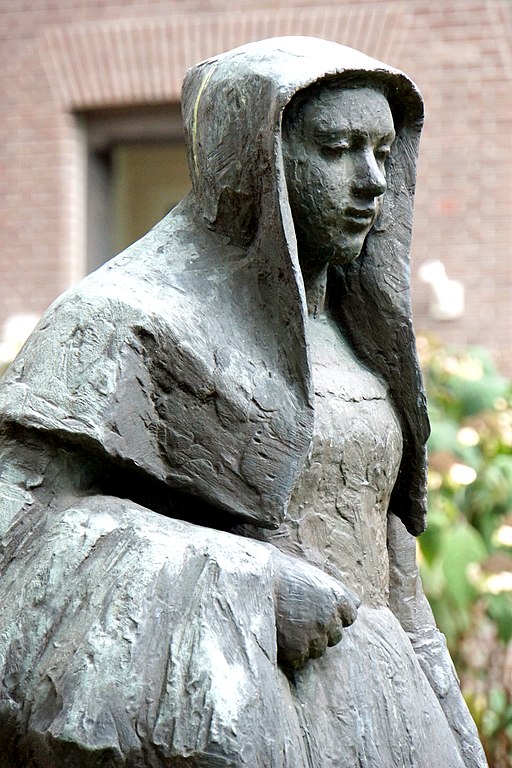
Statue in Amsterdam honoring the beguines by Dutch sculptor Margaretha de Goede-Taal. Source: Wikimedia Commons, cc-by-sa-2.0..
Catholic
Previous Post
February 17, 2023
How Hercules Reached Japan
Next Post
February 24, 2023 The Beguines: Independent Holy Women of the Middle Ages
Recent Comments
"Thank you for this grounded, deeply necessary perspective. Shifting our framework from moralistic binaries to ..."
What You May Not Know About ..."
"Nonviolence is the weapon of the mighty and the strong. Violence is the weapon of ..."
Thomas Aquinas on the Morality of ..."
"Regarding Barbara O'Brien's article "Is Empathy a Weakness?" My answer in song is an emphatic ..."
""A government, which to bigotry gives no sanction." How far our government has fallen from ..."
George Washington’s Letter to Touro Synagogue
Browse Our Archives
Select a Category Buddhism Christianity Daoism Hinduism Indigenous religions Islam Judaism Mysticism New Age Origins of religion Paganism Popes Popular Religious Movements Protestantism Psychology and religion Religion and current events Religion and folklore Religion and News Media Religion and politics Religious Art and Music Religious Freedom Religious mistakes Religious philosophy Religious scriptures Religious Violence science and religion Spiritualism Technology and religion The Catholic Church The Dalai Lama The Reformation Uncategorized
Select a Month September 2026 August 2026 July 2026 June 2026 April 2026 March 2026 February 2026 January 2026 December 2025 November 2025 October 2025 September 2025 August 2025 July 2025 June 2025 May 2025 April 2025 March 2025 February 2025 January 2025 December 2024 November 2024 October 2024 September 2024 August 2024 July 2024 June 2024 May 2024 April 2024 March 2024 February 2024 January 2024 December 2023 November 2023 October 2023 September 2023 August 2023 July 2023 June 2023 May 2023 April 2023 March 2023 February 2023 January 2023 December 2022 November 2022 October 2022 September 2022 August 2022
Follow Us!
TAKE THE
Religious Wisdom Quiz
True or False: Hebrews teaches that the blood of bulls and goats can take away sins.
Select your answer to see how you score.
TRUE FALSE
Related posts from The Religious History Nerd

The President and the Pope: An Unprecedented Rift
What Was the Avignon Papacy and Why Is...
A Goddess Who Swapped Bodies to Prove Gender...
Thomas Aquinas on the Morality of War
TRENDING AT PATHEOS History and Religion

The First Eucharistic Controversy: Christ’s Real Presence
For Catholics, the Eucharist is the source and summit of the Christian...

What a Stop Sign Can Teach Us About...
How to Make a Decision When You Can't Hear God Main point:...

Archdiocese Hosts Military Marriage Retreat in Germany
RASTATT, Germany — The transient military lifestyle, with its frequent deployments and...

Nearly every morning, I make the drive to Detroit with my high-school-age...

The Real AI Story Is Adoption Without Trust
Artificial intelligence has crossed a political threshold. It is no longer a...

A new article, written by Jeff Lindsay and Gale L. Pooley,...
view all History and Religion blogs
What Are Your Thoughts?leave a comment
Ad-Free & Subscriber Log-In Subscription Support
- About Us
- 2026 Calendar
- Videos
- Podcasts
- Library of World Religions
- Faith In Media Tracker
- Advertise With Us
- Write for Us
- Privacy Policy
- Terms of Service
- Do Not Sell My Data
- Contact Us
- Radiant Digital
- Manage Newsletter Subscriptions
- Unsubscribe From Notifications
- Sitemap
Copyright 2008-2026, Patheos. All rights reserved.
Subscription Support Ad-Free & Subscriber Log-In
Follow Patheos