
BuddhistCatholicContemplativeEvangelicalGeneral ChristianHinduJewishLatter-day SaintMuslimNew VisionsProgressive Christian
Beliefs
- Buddhist
- Catholic
- Contemplative
- Evangelical
- General Christian
- Hindu
- Jewish
- Latter-day Saint
- More Voices
- Muslim
- New Visions
- Pagan
- Progressive Christian
Topics
- Religion News
- Food and Religion
- Sports and Religion
- Religious Art
- Religious Music and Entertainment
- Religious Events
- History and Religion
- Style and Religion
- Politics and Religion
- Women in Religion
- Recreation Outdoors and Religion
- Business Finance and Religion
- Careers Workplace and Religion
- Education and Religion
- Family Parenting and Religion
- Health Fitness and Religion
- Home and Religion
- Relationships and Religion
- Technology and Religion
- Travel and Religion
Columnists
- Buddhist Columnists
- Business Finance and Religion Columnists
- Careers Workplace and Religion Columnists
- Catholic Columnists
- Contemplative Columnists
- Education and Religion Columnists
- Evangelists Columnists
- Family Parenting and Religion Columnists
- General Christian Columnists
- Health Fitness and Religion Columnists
- Hindu Columnists
- History and Religion Columnists
- Home and Religion Columnists
- Jewish Columnists
- More Voices Columnists
- Latter Day Columnists
- Muslim Columnists
- New Visions Columnists
- Nonreligious Columnists
- Pagan Columnists
- Politics and Religion Columnists
- Progressive Columnists
- Recreation Outdoors and Religion Columnists
- Relationships and Religion Columnists
- Religion News Columnists
- Religious Art Columnists
- Religious Events Columnists
- Religious Music and Entertainment Columnists
- Sports and Religion Columnists
- Style and Religion Columnists
- Technology and Religion Columnists
- Travel and Religion Columnists
- Women in Religion Columnists
Resource Library
- 2026 Calendar
- Library of World Religions
- The 100 Most Holy Places on Earth
- Patheos Answers
- Podcasts
- Videos
- Faith Leaders Database
- Anglican Episcopalian
- Bahai
- Baptist
- Buddhism
- Christianity
- Confucianism
- Eastern Orthodoxy
- Hinduism
- Holiness and Pentecostal
- ISKCON
- Islam
- Judaism
- Lutheran
- Methodist
- The Church of Jesus Christ of Latter-day Saints
- New Age
- Paganism
- Presbytarian and Reformed
- Protestantism
- Religion Behind the Scenes
- Roman Catholic
- Scientology
- Shia Islam
- Sikhism
- Sufism
- Sunni Islam
- Taoism
- Zen
- See all religions
Research Tools
 Ad-Free & Subscriber Log-In Subscription Support
Ad-Free & Subscriber Log-In Subscription Support
Follow Patheos 

- Trending:
- Forgiveness
- |
- Marriage
- |
- Consciousness
- |
- Death Penalty
- |
- Election
- |
- Halloween

- Home
- Pagan
- History and Religion
- How Hercules Reached Japan
How Hercules Reached Japan
Last updated on: February 19, 2023 at 11:03 am by Barbara O'Brien
How Hercules Reached Japan 2023-02-19T11:03:36-06:00 Barbara O'Brien
Patheos Explore the world's faith through different perspectives on religion and spirituality! Patheos has the views of the prevalent religions and spiritualities of the world.
Heracles was a hero of ancient Greek mythology. He’s better known to most of us by his Roman name, Hercules. Hercules was a favorite subject of Greek and Roman art. His muscular likeness was so widespread in the ancient world that it influenced Buddhist temple art in far-away China and Japan. This is the story of how Hercules reached Japan.
This story begins with Alexander the Great (356–323 BCE), king of Macedonia. Before Alexander was born, Macedonia had conquered Greece and absorbed Greek culture. The young Alexander was tutored by Aristotle himself. Alexander was only 20 when he succeeded his father to the throne. Alexander then spent most of the next ten years marching his army from Greece to northwest India, with a detour into Egypt.
After Alexander died the vast empire he had gained was divided up among four of his generals, and those empires lasted several more years. Hellenistic culture was introduced into large parts of Asia. Greek became a common language throughout western and central Asia. The influence of Greek art spread, also.
The Kushan Empire
Seleucus I Nicator (c. 358–281 BCE) was a general of Alexander the Great who became head of a vast territory that stretched from the Mediterranean to the Indus Valley (see map). This was called the Seleucid Empire. Seleucus I Nicator lost part of his territory in a war with the Mauryan Empire of India, which took over much of what is now Pakistan and Afghanistan (see map). The third Mauryan emperor, Ashoka the Great, was a convert to Buddhism. Ashoka reigned from about about 268 to 232 BCE, and much of his focus was on spreading Buddhism throughout his empire and beyond. Because of Ashoka’s efforts, by the 1st century CE Buddhism was one of the dominant religions in much of central Asia, especially what is now Pakistan and Afghanistan.


From the 1st through 3rd century much of Ashoka’s western empire became what was called the Kushan Empire. At its peak the Kushan Empire took in most of modern-day Uzbekistan, Afghanistan, Pakistan, and northern India. The Kushan Empire was at a center point of the network of trade routes that came to be called the Silk Road. By the 1st century the Silk Road connected the Roman Empire in the West to China in the East. The Kushan Empire was a place where Greek, Roman, Persian, and Indian cultural influences mingled freely.
The Kushan Empire also was very much a Buddhist empire. Buddhism was introduced into China mostly by Buddhist monks of Kushan who followed Silk Road traders into China. The Kushan kings and wealthy nobility built Buddhist temples and invested in Buddhist art. Some of the best art of this period is associated with Gandhara, the ancient name of an area that is now in northern Pakistan. The artists of Gandhara made many beautiful representations of the Buddha and iconic bodhisattvas in a style that was unmistakably influenced by Greece.
Sculpting Vajrapani
This takes us to Vajrapani, or Vajirapāṇin in Pali, who is what we might call a recurring character from early Buddhist scriptures. The name Vajrapani could be translated as “vajra in hand.” A vajra (Sanskrit) or vajira (Pali) is a ritual weapon associated with Indra in the Vedas, the most ancient scriptures of Hinduism. This weapon combines qualities of a diamond and of lightening. Vajrapani is identified in early Buddhist scriptures as a yaksha (Sanskrit) or yakkha (Pali), a kind of nature spirit, usually but not always benevolent, often associated with water and woodlands. Yakshas emerged from ancient south Asian folklore and have a wide variety of characteristics.
As far as Vajrapani is concerned, we don’t have much in the way of a description from scriptures. In the Pali Canon he pops into visibility when someone argues with the Buddha. For example, in the Cula-Saccaka Sutta (Majjhima Nikaya 35), Vajrapani is “poised in the air” above the person challenging the Buddha. Other than that, it just says he is carrying a vajra. In the Pali scriptures it’s said he is visible only to the Buddha and his challenger, and Vajrapani may threaten to split the challenger’s head into seven pieces if he fails three times to respond to a reasonable question. I don’t believe the threat is ever carried out, however.
We might assume that someone who can float in the air is a feathery or airy sort of creature. But at least some artists of Gandhara, challenged to sculpt Vajrapani, decided he must be something like the Buddha’s bodyguard and modeled him after Hercules. In Greek and Roman art, Hercules is most often depicted naked, carrying a club and a lion skin. For example, here is a Greek Heracles on the left, and a Gandhara artist’s depiction of the Buddha and Vajrapani on the right.
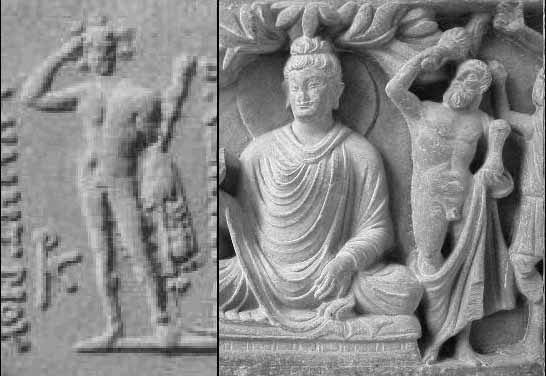
A Greek Heracles, left; the Buddha and Vajrapani, right, from Gandhara, 2nd century CE. Source: Wikimedia Commons, public domain.
Here is another depiction of the Buddha and Vajrapani, from Gandhara, 2nd century CE.
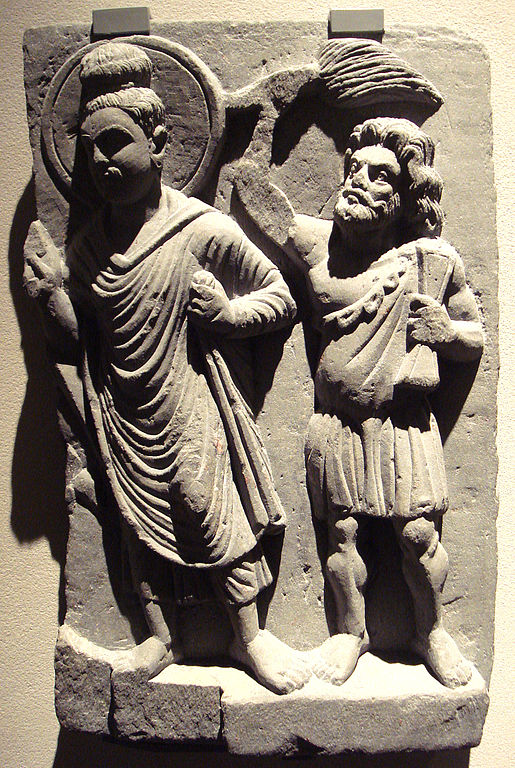
The Buddha and Vajrapani, from Gandhara, 2nd century. Source: Wikimedia Commons, public domain.
Vajrapani in Mahayana Buddhism
In Mahayana Buddhism, the form of Buddhism that dominates east Asia and is the basis of Tibetan Buddhism, Vajrapani became a bodhisattva, an enlightened being who vows to bring all beings to enlightenment. Some bodhisattvas are iconic characters of Buddhist art and literature who represent various virtues and powers, such as diligence or healing. Vajrapani is often depicted as one of the three protective deities surrounding the Buddha. These are Avalokiteshvara, who manifests the Buddha’s compassion; Manjusri, who manifests the Buddha’s wisdom; and Vajrapani, who manifests the Buddha’s power.
He is also a dharmapala, or protector spirit of the dharma. In Tibetan and Chinese Buddhist temples he and other dharma protectors are often depicted as big, fierce, even monstrous, because their job is to drive away evil. So they have to be bigger and badder than evil.
And in Japan Vajrapani morphed into characters called Nio, or “benevolent kings.” The Nio are sculptures of big, scowling, muscle-bound giants that often stand outside Buddhist temples as guardians. There are several different Nio, but they are all emanations of Vajrapani. And that’s how Hercules reached Japan.
You can read more about the art and history of Gandhara in my book The Circle of the Way: A Concise History of Zen from the Buddha to the Modern World (Shambhala, 2019).
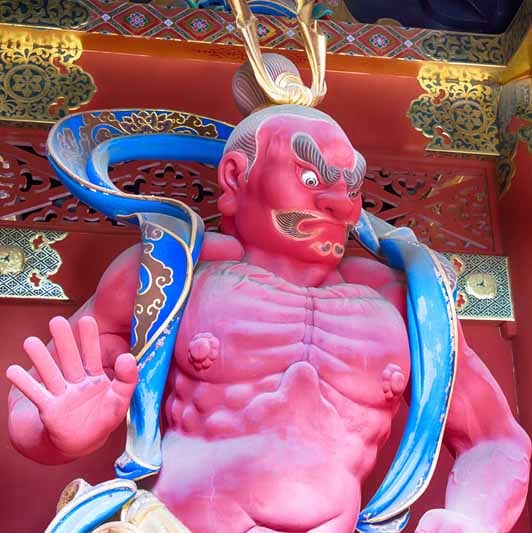
Nio statue at Taiyuin Mausoleum in Nikko, Tochigi, Japan. This statue is from the Edo period (1603-1867). Source: ID 189811042 © Beibaoke1 | Dreamstime.com
Pagan
Buddhism
Religious Art
Previous Post

February 12, 2023
Tibet's Declaration of Independence and the Thirteenth Dalai Lama
Next Post

February 19, 2023 The Mirror of Simple Souls
Recent Comments
"Thank you for this grounded, deeply necessary perspective. Shifting our framework from moralistic binaries to ..."
What You May Not Know About ..."
"Nonviolence is the weapon of the mighty and the strong. Violence is the weapon of ..."
Thomas Aquinas on the Morality of ..."
"Regarding Barbara O'Brien's article "Is Empathy a Weakness?" My answer in song is an emphatic ..."
""A government, which to bigotry gives no sanction." How far our government has fallen from ..."
George Washington’s Letter to Touro Synagogue
Browse Our Archives
Select a Category Buddhism Christianity Daoism Hinduism Indigenous religions Islam Judaism Mysticism New Age Origins of religion Paganism Popes Popular Religious Movements Protestantism Psychology and religion Religion and current events Religion and folklore Religion and News Media Religion and politics Religious Art and Music Religious Freedom Religious mistakes Religious philosophy Religious scriptures Religious Violence science and religion Spiritualism Technology and religion The Catholic Church The Dalai Lama The Reformation Uncategorized
Select a Month September 2026 August 2026 July 2026 June 2026 April 2026 March 2026 February 2026 January 2026 December 2025 November 2025 October 2025 September 2025 August 2025 July 2025 June 2025 May 2025 April 2025 March 2025 February 2025 January 2025 December 2024 November 2024 October 2024 September 2024 August 2024 July 2024 June 2024 May 2024 April 2024 March 2024 February 2024 January 2024 December 2023 November 2023 October 2023 September 2023 August 2023 July 2023 June 2023 May 2023 April 2023 March 2023 February 2023 January 2023 December 2022 November 2022 October 2022 September 2022 August 2022
Follow Us!
TAKE THE
Religious Wisdom Quiz
Not by might nor by power, but by my Spirit, says the Lord Almighty. What seemingly impossible task will be accomplished?
Select your answer to see how you score.
Defeating Israel's enemies Rebuilding Jerusalem Completing the temple The Gathering of Israel
Related posts from The Religious History Nerd

Sarvastivada: An Extinct Buddhist Sect That's Still With...
A Goddess Who Swapped Bodies to Prove Gender...

The Beat Zen Movement: When Zen Became Cool
TRENDING AT PATHEOS History and Religion

'Super Scam Me' Exposes AI Jon Bon Jovi...
Leslie Pickett believed she was in a relationship with Jon Bon Jovi....

The Brazilian Remake of Kendricks' 'Flywheel' Opens in...
“Flywheel,” the story that launched the Kendrick Brothers’ filmmaking career is getting...

The Dangers of Gradual Accommodation (Winking at Sin)
Recently, the “law of gradualness” resurfaced during the opening of a weeklong,...

The Iron Gates and the Lion of the...
Yesterday, I didn't finish my report about, well, yesterday. So I'll...

The Image: On the Horror of Capitalism and...
The Image Then went the Pharisees, and took counsel how they might...

We are approaching the date of our new American national holiday: October...
view all History and Religion blogs
What Are Your Thoughts?leave a comment
Ad-Free & Subscriber Log-In Subscription Support
- About Us
- 2026 Calendar
- Videos
- Podcasts
- Library of World Religions
- Faith In Media Tracker
- Advertise With Us
- Write for Us
- Privacy Policy
- Terms of Service
- Do Not Sell My Data
- Contact Us
- Radiant Digital
- Manage Newsletter Subscriptions
- Unsubscribe From Notifications
- Sitemap
Copyright 2008-2026, Patheos. All rights reserved.
Subscription Support Ad-Free & Subscriber Log-In
Follow Patheos