
BuddhistCatholicContemplativeEvangelicalGeneral ChristianHinduJewishLatter-day SaintMuslimNew VisionsProgressive Christian
Beliefs
- Buddhist
- Catholic
- Contemplative
- Evangelical
- General Christian
- Hindu
- Jewish
- Latter-day Saint
- More Voices
- Muslim
- New Visions
- Pagan
- Progressive Christian
Topics
- Religion News
- Food and Religion
- Sports and Religion
- Religious Art
- Religious Music and Entertainment
- Religious Events
- History and Religion
- Style and Religion
- Politics and Religion
- Women in Religion
- Recreation Outdoors and Religion
- Business Finance and Religion
- Careers Workplace and Religion
- Education and Religion
- Family Parenting and Religion
- Health Fitness and Religion
- Home and Religion
- Relationships and Religion
- Technology and Religion
- Travel and Religion
Columnists
- Buddhist Columnists
- Business Finance and Religion Columnists
- Careers Workplace and Religion Columnists
- Catholic Columnists
- Contemplative Columnists
- Education and Religion Columnists
- Evangelists Columnists
- Family Parenting and Religion Columnists
- General Christian Columnists
- Health Fitness and Religion Columnists
- Hindu Columnists
- History and Religion Columnists
- Home and Religion Columnists
- Jewish Columnists
- More Voices Columnists
- Latter Day Columnists
- Muslim Columnists
- New Visions Columnists
- Nonreligious Columnists
- Pagan Columnists
- Politics and Religion Columnists
- Progressive Columnists
- Recreation Outdoors and Religion Columnists
- Relationships and Religion Columnists
- Religion News Columnists
- Religious Art Columnists
- Religious Events Columnists
- Religious Music and Entertainment Columnists
- Sports and Religion Columnists
- Style and Religion Columnists
- Technology and Religion Columnists
- Travel and Religion Columnists
- Women in Religion Columnists
Resource Library
- 2026 Calendar
- Library of World Religions
- The 100 Most Holy Places on Earth
- Patheos Answers
- Podcasts
- Videos
- Faith Leaders Database
- Anglican Episcopalian
- Bahai
- Baptist
- Buddhism
- Christianity
- Confucianism
- Eastern Orthodoxy
- Hinduism
- Holiness and Pentecostal
- ISKCON
- Islam
- Judaism
- Lutheran
- Methodist
- The Church of Jesus Christ of Latter-day Saints
- New Age
- Paganism
- Presbytarian and Reformed
- Protestantism
- Religion Behind the Scenes
- Roman Catholic
- Scientology
- Shia Islam
- Sikhism
- Sufism
- Sunni Islam
- Taoism
- Zen
- See all religions
Research Tools
 Ad-Free & Subscriber Log-In Subscription Support
Ad-Free & Subscriber Log-In Subscription Support
Follow Patheos 

- Trending:
- Forgiveness
- |
- Marriage
- |
- Consciousness
- |
- Death Penalty
- |
- Election
- |
- Halloween

- Home
- Buddhism
- History and Religion
- Will Ancient Gandharan Scrolls Change Buddhist History?
Will Ancient Gandharan Scrolls Change Buddhist History?
Last updated on: December 3, 2022 at 3:17 pm by Barbara O'Brien
Will Ancient Gandharan Scrolls Change Buddhist History? 2022-12-03T15:17:05-06:00 Barbara O'Brien
Patheos Explore the world's faith through different perspectives on religion and spirituality! Patheos has the views of the prevalent religions and spiritualities of the world.
The Gandharan scrolls are ancient scrolls, mostly in fragments, that in recent years have been turning up in northwestern Pakistan and eastern Afghanistan. The scrolls are Buddhist, and it’s suspected they all came from one monastery’s library. They are written in a language called Gandhari and date from the 1st century BCE to the 3rd century CE. They are the oldest extant Buddhist manuscripts in the world. Scholars have been restoring and deciphering the Gandharan scrolls while expecting they might shine new light on Buddhist history.
Buddhism was introduced to this area during the reign of Ashoka the Great, roughly 268 to 232 BCE. Ashoka’s empire spanned from what is now Bangladesh, through central and northern India, across Pakistan and Afghanistan and into Iran. Ashoka was a convert to Buddhism. And from records engraved on rocks and pillars, we know that Ashoka sent Buddhist missionaries into the western part of his empire, which included the area where the ancient scrolls were found. For more on Ashoka and his devotion to Buddhism, see The Mystery of the Pillars of Ashoka and The Edicts of Ashoka.
About Gandhara
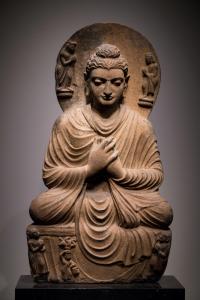
Buddha of the Kushan Empire, 2nd – 3rd century CE, found in Pakistan. ID 197195782 © Gumpanat Thavankitdumrong | Dreamstime.com
Gandhara was the ancient name of an area west of the Punjab that included the Peshawar and Swat valleys of today’s Pakistan. For a time long before Ashoka, it was part of the Persian Empire. After Ashoka, Gandhara was conquered by armies from Bactria, a Hellenic kingdom that was spread across what is now northern Afghanistan and parts of Tajikistan and Uzbekistan. At least one of the Bactrian rulers, Menander I, is believed to have converted to Buddhism.
In the 1st century BCE the territory was taken over by Indo-Scythians, and then Indo-Parthians. In the 1st century CE it became the Kushan Empire, a Buddhist kingdom that flourished until the 3rd century CE. The beautiful Buddhist art produced by the Kushans is often identified as art of Gandhara. For more on Buddhism in Gandhara, see my book The Circle of the Way: A Concise History of Zen from the Buddha to the Modern World (Shambhala, 2019).
What’s most important to know about what we might call Greater Gandhara — which extended into present-day northern Afghanistan and Pakistan — is that it was a crossroads of the ancient world. A major route of the Silk Road went through it, beginning in the 2nd century BCE, and it became a place where the cultures of Greece, Rome, Persia, and India mingled. Thanks in part to Silk Road trade it was very prosperous. And we know it was important to the development and spread of Buddhism. Many of the first monks to take Buddhism into China and Tibet were from Gandhara, for example. But there is a great deal about Gandharan Buddhist history that’s a big blank.
The Gandharan Scrolls
The incredibly fragile scroll fragments were were made of sections of birch bark glued together to form long strips. The text was written in black ink with a reed pen. Many of the fragments were found inside clay pots. It’s suspected that many more of these fragments than we know about have come to light over the years but were destroyed by careless handling. It’s remarkable that any of it survived, frankly.
For example, in 2003, the U.S. Library of Congress acquired Ghandaran scroll fragments from a private collector. “It arrived, in pieces, in an ordinary pen case, accompanied by a handwritten note: ‘Extremely fragile, do not open unless necessary,'” the LOC website says. The writing on the scrolls is being digitized to make it available for scholars.
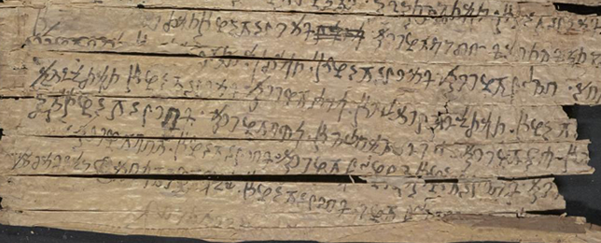
Fragment of a Gandharan scroll digitized by the U.S. Library of Congress.
Why the Gandharan Scrolls Are Significant
There is little known for certain about early Buddhist history. Most of the records that we have were written many years after the events they describe, often by people with sectarian axes to grind. There is very little, if any, of the earliest records that can be accepted uncritically. This includes what we know of the life of the Buddha. According to tradition the teacher who came to be called the Buddha lived in what is now northern India from 563 to 483 BCE. But modern scholars suspect he might have lived as much as a century later. And, occasionally, someone will claim he lived in an earlier time, or dispute that he lived in northern India at all.
It’s believed that the Buddha’s teachings were not recorded in writing during his lifetime. Instead, the teachings were memorized and chanted to preserve them. This was not unheard of in ancient cultures. Eventually there came to be chanting lineages in different Prakrits, the several vernacular Indo-Aryan languages related to Sanskrit that were spoken at the time. One major collection of the Buddha’s teachings, the Pali Canon (in the Pali language) is said to have been committed to writing in the 1st century BCE. But the oldest extant manuscript we have of the Pali Canon is not nearly that old. It dates to the 5th or 6th century CE, or about a thousand years after the life of the Buddha.
Other early chanting lineages, including some in Sanskrit and probably Gandhari as well, survive today only because they were translated into Chinese during the 4th to 6th centuries CE, and the translations survived. And when one compares the Chinese and Pali versions of the same sermon of the Buddha, sometimes there is close resemblance, but sometimes there isn’t. So, initially it was hoped that the Gandharan scrolls might shed some light on which version of the scriptures might be closer to a presumed original.
What Do the Gandharan Scrolls Reveal?
Scholars had assumed that the various versions of the Buddha’s teachings all came from the same original. But the Gandharan scrolls threw this notion into doubt. What has been extracted from them so far contains versions of existing scripture and some texts never seen before, but there is nothing that hints at the Pali or Chinese or any other extant canon as a source. Scholars now believe that none of the existing collections of early Indian Buddhist scriptures can be assumed to be the most authentic or original words of the Buddha. Instead, they’ve been compared to a braided river, a river with many channels separated by islands and bars of dry land. The many channels sometimes converge and sometimes separate. (See Linda Heuman, “Whose Buddhism Is Truest?” Tricycle, Summer 2011.)
Scholars also originally hoped that the Gandharan scrolls would reveal something about the origins of Mahayana Buddhism. Mahayana is one of the two major doctrinal/philosophical branches of Buddhism; the other is called Theravada. Theravada is dominant in southeast Asia — Sri Lanka, Myanmar, Thailand, Laos, and Cambodia — while Mahayana is the doctrinal basis of the schools of Buddhism in Tibet, China, Korea, Japan, Taiwan, and Vietnam. It has been speculated that much of Mahayana developed in Gandhara, possibly as a result of Greek or Persian influence. But the scrolls translated so far reveal a Theravada perspective. There were other early schools of Buddhism in the region at the time that might have been Mahayana, but the record is murky.
It’s been determined that the scrolls belonged to a Dharmaguptaka community. Dharmaguptaka was a school of early Buddhism that may have existed as late as the 7th century CE. It was one of the group of early Buddhist schools most closely related to modern-day Theravada. Its biggest influence on today’s Buddhism comes from the Dharmaguptaka Vinaya. The Vinaya is the part of the early scriptures that provides the rules for Buddhist monasticism. There are three extant versions of the Vinaya; the Pali, followed in Theravada Buddhism; the Mulasarvastivada, followed in Tibetan Buddhism; and the Dharmaguptaka, which became the standard Vinaya in China and Mahayana schools of east Asia.
What Is and Isn’t Important
Given the apparently haphazard way the Buddha’s teachings were preserved, what’s most remarkable about the Gandharan scrolls is how unremarkable the scrolls are in their presentation of Buddhist teachings. Although the words in the scrolls may be new to us, the doctrines they present are consistent with those of today’s Theravada Buddhism and with the basic, foundational teachings of Buddhism of all schools.
The scholar Richard Salomon wrote that while the details in the scrolls may vary from those in canonical texts today, “the broad textual framework and the main doctrinal principles are familiar.” (Richard Salomon, “How the Gandharan Manuscripts Change Buddhist History,” Lion’s Roar, January 20, 2020.) There’s nothing in them — so far — that might cause us to question how the Buddha’s teachings are understood today.
It’s important to understand that Buddhism has a different relationship with its scriptures than that of the Abrahamic religions — Judaism, Christianity, and Islam — which hold scriptures believed to be the Word of God in great reverence. Buddhist scriptures are not the Word of God. They are considered guides to truth, not truth-in-itself. Buddhism does not require believing anything on the authority of a venerable book. Instead it provides a practice for realizing the truth of the teachings for ourselves.
Buddhism
Previous Post

November 28, 2022
The Surprising History of Handel's Messiah
Next Post
December 7, 2022 The History of Budai, the Laughing Buddha
Browse Our Archives
Select a Category Buddhism Christianity Daoism Hinduism Indigenous religions Islam Judaism Mysticism New Age Origins of religion Paganism Popes Popular Religious Movements Protestantism Psychology and religion Religion and current events Religion and folklore Religion and News Media Religion and politics Religious Art and Music Religious Freedom Religious mistakes Religious philosophy Religious scriptures Religious Violence science and religion Spiritualism Technology and religion The Catholic Church The Dalai Lama The Reformation Uncategorized
Select a Month September 2026 August 2026 July 2026 June 2026 April 2026 March 2026 February 2026 January 2026 December 2025 November 2025 October 2025 September 2025 August 2025 July 2025 June 2025 May 2025 April 2025 March 2025 February 2025 January 2025 December 2024 November 2024 October 2024 September 2024 August 2024 July 2024 June 2024 May 2024 April 2024 March 2024 February 2024 January 2024 December 2023 November 2023 October 2023 September 2023 August 2023 July 2023 June 2023 May 2023 April 2023 March 2023 February 2023 January 2023 December 2022 November 2022 October 2022 September 2022 August 2022
Follow Us!
TAKE THE
Religious Wisdom Quiz
What did God place on Jeremiah’s mouth as a sign of his calling?
Select your answer to see how you score.
A staff Burning coal His words A scroll
Related posts from The Religious History Nerd

Sarvastivada: An Extinct Buddhist Sect That's Still With...

A Goddess Who Swapped Bodies to Prove Gender...

The Beat Zen Movement: When Zen Became Cool
TRENDING AT PATHEOS History and Religion

'Super Scam Me' Exposes AI Jon Bon Jovi...
Leslie Pickett believed she was in a relationship with Jon Bon Jovi....

The Brazilian Remake of Kendricks' 'Flywheel' Opens in...
“Flywheel,” the story that launched the Kendrick Brothers’ filmmaking career is getting...

The Dangers of Gradual Accommodation (Winking at Sin)
Recently, the “law of gradualness” resurfaced during the opening of a weeklong,...

The Iron Gates and the Lion of the...
Yesterday, I didn't finish my report about, well, yesterday. So I'll...

The Image: On the Horror of Capitalism and...
The Image Then went the Pharisees, and took counsel how they might...

We are approaching the date of our new American national holiday: October...
view all History and Religion blogs
Ad-Free & Subscriber Log-In Subscription Support
- About Us
- 2026 Calendar
- Videos
- Podcasts
- Library of World Religions
- Faith In Media Tracker
- Advertise With Us
- Write for Us
- Privacy Policy
- Terms of Service
- Do Not Sell My Data
- Contact Us
- Radiant Digital
- Manage Newsletter Subscriptions
- Unsubscribe From Notifications
- Sitemap
Copyright 2008-2026, Patheos. All rights reserved.
Subscription Support Ad-Free & Subscriber Log-In
Follow Patheos