
BuddhistCatholicContemplativeEvangelicalGeneral ChristianHinduJewishLatter-day SaintMuslimNew VisionsProgressive Christian
Beliefs
- Buddhist
- Catholic
- Contemplative
- Evangelical
- General Christian
- Hindu
- Jewish
- Latter-day Saint
- More Voices
- Muslim
- New Visions
- Pagan
- Progressive Christian
Topics
- Religion News
- Food and Religion
- Sports and Religion
- Religious Art
- Religious Music and Entertainment
- Religious Events
- History and Religion
- Style and Religion
- Politics and Religion
- Women in Religion
- Recreation Outdoors and Religion
- Business Finance and Religion
- Careers Workplace and Religion
- Education and Religion
- Family Parenting and Religion
- Health Fitness and Religion
- Home and Religion
- Relationships and Religion
- Technology and Religion
- Travel and Religion
Columnists
- Buddhist Columnists
- Business Finance and Religion Columnists
- Careers Workplace and Religion Columnists
- Catholic Columnists
- Contemplative Columnists
- Education and Religion Columnists
- Evangelists Columnists
- Family Parenting and Religion Columnists
- General Christian Columnists
- Health Fitness and Religion Columnists
- Hindu Columnists
- History and Religion Columnists
- Home and Religion Columnists
- Jewish Columnists
- More Voices Columnists
- Latter Day Columnists
- Muslim Columnists
- New Visions Columnists
- Nonreligious Columnists
- Pagan Columnists
- Politics and Religion Columnists
- Progressive Columnists
- Recreation Outdoors and Religion Columnists
- Relationships and Religion Columnists
- Religion News Columnists
- Religious Art Columnists
- Religious Events Columnists
- Religious Music and Entertainment Columnists
- Sports and Religion Columnists
- Style and Religion Columnists
- Technology and Religion Columnists
- Travel and Religion Columnists
- Women in Religion Columnists
Resource Library
- 2026 Calendar
- Library of World Religions
- The 100 Most Holy Places on Earth
- Patheos Answers
- Podcasts
- Videos
- Faith Leaders Database
- Anglican Episcopalian
- Bahai
- Baptist
- Buddhism
- Christianity
- Confucianism
- Eastern Orthodoxy
- Hinduism
- Holiness and Pentecostal
- ISKCON
- Islam
- Judaism
- Lutheran
- Methodist
- The Church of Jesus Christ of Latter-day Saints
- New Age
- Paganism
- Presbytarian and Reformed
- Protestantism
- Religion Behind the Scenes
- Roman Catholic
- Scientology
- Shia Islam
- Sikhism
- Sufism
- Sunni Islam
- Taoism
- Zen
- See all religions
Research Tools
 Ad-Free & Subscriber Log-In Subscription Support
Ad-Free & Subscriber Log-In Subscription Support
Follow Patheos 

- Trending:
- Forgiveness
- |
- Marriage
- |
- Consciousness
- |
- Death Penalty
- |
- Election
- |
- Halloween

- Home
- Jewish
- History and Religion
- Salamone Rossi, Jewish Composer of the Renaissance
Salamone Rossi, Jewish Composer of the Renaissance
Last updated on: December 24, 2022 at 10:08 am by Barbara O'Brien
Salamone Rossi, Jewish Composer of the Renaissance 2022-12-24T10:08:58-06:00 Barbara O'Brien
Patheos Explore the world's faith through different perspectives on religion and spirituality! Patheos has the views of the prevalent religions and spiritualities of the world.
There are several Jewish composers among the greats of classical music — Copland, Bernstein, Mahler, Bloch, and many more. But one you may not have heard of was the first Jewish composer to become a notable part of classical music history. He was Salamone Rossi (ca. 1570-1630), a composer of the Italian Renaissance.
Salamone Rossi was the first composer known to compose original music set to Hebrew words in the style of the music of his time, not the traditional style of Jewish liturgical music. His sacred music was set to words from the Psalms, Leviticus, Isaiah, and Jewish liturgy. For example, here he wrote music for the prayer “Adon Olam” (“Eternal Lord”). The words are sung in Hebrew by a double chorus. He is remembered especially for a collection of songs published in either 1622 or 1623 with the title The Songs of Solomon. This is believed to be the first printed collection of Hebrew songs. Here is “Elohim Hashiveinu” (“Oh God, Restore Us”) from that collection.
Salamone Rossi’s instrumental compositions are considered innovative for his time. He was a transitional figure, bridging the Renaissance and Baroque periods. Here is his Sonata quarta sopra l’aria di Ruggiero, composed in 1613.
The Life of Salamone Rossi
Salamone Rossi stepped into history in 1587, when he entered the service of the Duke of Mantua, Vincenzo Gonzaga (1562-1612). The Duke was a great patron of the arts, and the teenage Rossi already was an accomplished violinist (or, possibly, a viola player) and singer. The Duke was known to have many musicians and composers on his payroll. Among these was Claudio Monteverdi, with whom Rossi would sometimes collaborate. However, as a Jew, Rossi was paid for work performed and did not receive a stipend.
For Jews, Mantua was liberal by European standards of the time, although possibly less so than Venice. Jews were allowed to mix freely with non-Jews, and Jewish writers, musicians and artists influenced the city’s culture. Records tell us that in the Gonzaga court Salamone Rossi was not required to wear a yellow badge indicating his status as a Jew, a privilege extended in 1612 by Duke Vincenzo’s successor, Francesco IV. This tells us his work was especially valued. It’s known he also received financial support and protection from prominent members of Mantua’s Jewish community.
Salamone Rossi served the court of Mantua from 1587 to 1628, providing music for weddings, banquets, theater productions, operas, and other events. Rossi became the court’s concert master. Rossi’s sister, who went by the name Madame Europa, was a celebrated soprano who often performed at the court also. She may have been the first Jewish woman to be a professional opera singer.
Salamone Rossi’s Jewish Music
Salamone Rossi’s greatest contribution to Judaism was his 1622 (or 1623) collection, Ha-Shirim Asher li-Shelomo, “The Songs of Solomon.” (Note this title is a play on the composer’s name. The poems of the Song of Songs attributed to King Solomon are not included.) Rossi’s collection contains 33 Psalms, hymns, and other liturgical poems composed for a small vocal ensemble for festive synagogue occasions. After 400 years the collection is still in print, and the songs are still being performed and (now) recorded. And please do enjoy Rossi’s “Halleluyah” (Psalm 146) sung by the Zamir Chorale of Boston.
The use of such nontraditional music was endorsed by Rossi’s friend, Rabbi Leon (Judah Aryeh) Modena (1571-1648). Such music previously would not have been allowed in a synagogue, but in 1605 the Rabbi issued a rabbinic ruling approving such choral works for his synagogue in Ferrara.
Salamone Rossi disappeared from historical records in 1628, the year a war began over control of Mantua that ended the Gonzaga court. It’s believed Salamone Rossi and his sister were both killed in 1630, either in the sacking of Mantua or in the epidemic of plague that accompanied the war. Some Jews of Mantua escaped to the safety of Venice, but there is no record that the composer was among them. According to one account, Jewish musicians of Mantua carried Salamone Rossi’s music with them when they escaped, and they performed Salamone Rossi’s music at the Spanish Synagogue in Venice. Here a video of a recent commemorative performance at that same synagogue.
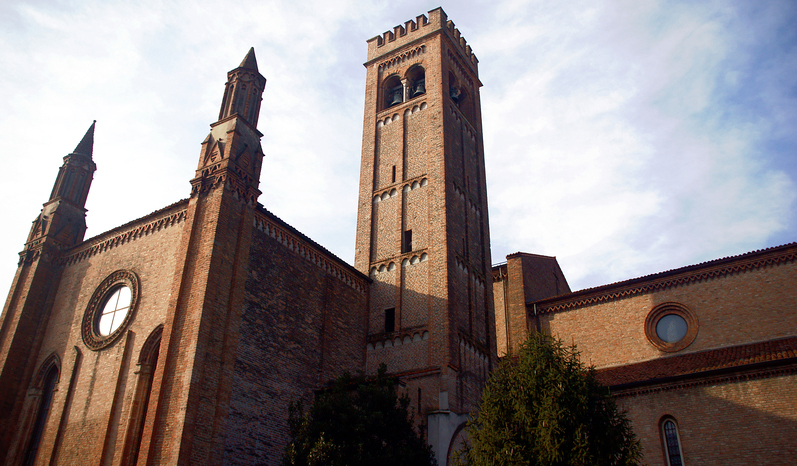
Part of the Ducal Palace in Mantua, once home of the ruling Gonzaga family. Photo 28865984 / Ducal Palace Mantua © Grzegorz Kordus | Dreamstime.com
Jewish
Previous Post

December 17, 2022
An Appreciation of Jewish Cantors
Next Post

December 23, 2022 The Christmas Truce of 1914
Browse Our Archives
Select a Category Buddhism Christianity Daoism Hinduism Indigenous religions Islam Judaism Mysticism New Age Origins of religion Paganism Popes Popular Religious Movements Protestantism Psychology and religion Religion and current events Religion and folklore Religion and News Media Religion and politics Religious Art and Music Religious Freedom Religious mistakes Religious philosophy Religious scriptures Religious Violence science and religion Spiritualism Technology and religion The Catholic Church The Dalai Lama The Reformation Uncategorized
Select a Month September 2026 August 2026 July 2026 June 2026 April 2026 March 2026 February 2026 January 2026 December 2025 November 2025 October 2025 September 2025 August 2025 July 2025 June 2025 May 2025 April 2025 March 2025 February 2025 January 2025 December 2024 November 2024 October 2024 September 2024 August 2024 July 2024 June 2024 May 2024 April 2024 March 2024 February 2024 January 2024 December 2023 November 2023 October 2023 September 2023 August 2023 July 2023 June 2023 May 2023 April 2023 March 2023 February 2023 January 2023 December 2022 November 2022 October 2022 September 2022 August 2022
Follow Us!
TAKE THE
Religious Wisdom Quiz
Who preached the first Christian sermon on Pentecost in Acts?
Select your answer to see how you score.
James Peter Paul Philip
Related posts from The Religious History Nerd

George Washington's Letter to Touro Synagogue
What Became of the Conversos of Spain?
The Ten Commandments: Back to School?

The Ancient Origins of the Great Flood Story
TRENDING AT PATHEOS History and Religion

Jad Gillies on New Hillsong Worship Songs and...
For worship leader Jad Gillies, Hillsong Worship’s next chapter is not about...

Looking at the Largest Orthodox Cathedral on Earth
There is often a considerable amount of anger and, shall we...

The Problem with False Prophets
Miller’s Station UMC| 10/18/26| Anchor Verse: Jeremiah 23: 1, 9-23 I...

Emotion in Early Christianity by Andrew Crislip
Andrew Crislip’s Emotion in Early Christianity examines an often overlooked dimension of...

16 Spiritual Touchstones for a More Grounded Life
After decades of spiritual study, here are 16 principles I try...

Catholic Evangelization: Sharing Your Faith Every Day
Welcome back to the Graceful Awakening mini-series called, “From Faith to Mission.” ...
view all History and Religion blogs
Ad-Free & Subscriber Log-In Subscription Support
- About Us
- 2026 Calendar
- Videos
- Podcasts
- Library of World Religions
- Faith In Media Tracker
- Advertise With Us
- Write for Us
- Privacy Policy
- Terms of Service
- Do Not Sell My Data
- Contact Us
- Radiant Digital
- Manage Newsletter Subscriptions
- Unsubscribe From Notifications
- Sitemap
Copyright 2008-2026, Patheos. All rights reserved.
Subscription Support Ad-Free & Subscriber Log-In
Follow Patheos