
BuddhistCatholicContemplativeEvangelicalGeneral ChristianHinduJewishLatter-day SaintMuslimNew VisionsProgressive Christian
Beliefs
- Buddhist
- Catholic
- Contemplative
- Evangelical
- General Christian
- Hindu
- Jewish
- Latter-day Saint
- More Voices
- Muslim
- New Visions
- Pagan
- Progressive Christian
Topics
- Religion News
- Food and Religion
- Sports and Religion
- Religious Art
- Religious Music and Entertainment
- Religious Events
- History and Religion
- Style and Religion
- Politics and Religion
- Women in Religion
- Recreation Outdoors and Religion
- Business Finance and Religion
- Careers Workplace and Religion
- Education and Religion
- Family Parenting and Religion
- Health Fitness and Religion
- Home and Religion
- Relationships and Religion
- Technology and Religion
- Travel and Religion
Columnists
- Buddhist Columnists
- Business Finance and Religion Columnists
- Careers Workplace and Religion Columnists
- Catholic Columnists
- Contemplative Columnists
- Education and Religion Columnists
- Evangelists Columnists
- Family Parenting and Religion Columnists
- General Christian Columnists
- Health Fitness and Religion Columnists
- Hindu Columnists
- History and Religion Columnists
- Home and Religion Columnists
- Jewish Columnists
- More Voices Columnists
- Latter Day Columnists
- Muslim Columnists
- New Visions Columnists
- Nonreligious Columnists
- Pagan Columnists
- Politics and Religion Columnists
- Progressive Columnists
- Recreation Outdoors and Religion Columnists
- Relationships and Religion Columnists
- Religion News Columnists
- Religious Art Columnists
- Religious Events Columnists
- Religious Music and Entertainment Columnists
- Sports and Religion Columnists
- Style and Religion Columnists
- Technology and Religion Columnists
- Travel and Religion Columnists
- Women in Religion Columnists
Resource Library
- 2026 Calendar
- Library of World Religions
- The 100 Most Holy Places on Earth
- Patheos Answers
- Podcasts
- Videos
- Faith Leaders Database
- Anglican Episcopalian
- Bahai
- Baptist
- Buddhism
- Christianity
- Confucianism
- Eastern Orthodoxy
- Hinduism
- Holiness and Pentecostal
- ISKCON
- Islam
- Judaism
- Lutheran
- Methodist
- The Church of Jesus Christ of Latter-day Saints
- New Age
- Paganism
- Presbytarian and Reformed
- Protestantism
- Religion Behind the Scenes
- Roman Catholic
- Scientology
- Shia Islam
- Sikhism
- Sufism
- Sunni Islam
- Taoism
- Zen
- See all religions
Research Tools
 Ad-Free & Subscriber Log-In Subscription Support
Follow Patheos 

- Trending:
- Advent
- |
- Forgiveness
- |
- Thanksgiving
- |
- Election
- |
- Seasonal Holidays
- |
- Marriage

- Home
- Contemplative
- History and Religion
- Hildegard of Bingen, Medieval Christian Mystic
Hildegard of Bingen, Medieval Christian Mystic
Last updated on: December 28, 2022 at 3:53 pm by Barbara O'Brien
Hildegard of Bingen, Medieval Christian Mystic 2022-12-28T15:53:23-06:00 Barbara O'Brien
Patheos Explore the world's faith through different perspectives on religion and spirituality! Patheos has the views of the prevalent religions and spiritualities of the world.
Hildegard of Bingen (1098-1179; also called Hildegard von Bingen) was a nun, an author, a composer, and a mystic. Today she is probably best remembered for her music, which is still performed. For example, here is her “O Quam Mirabilis.” Her Ordo Virtutum is an early example of liturgical drama. It may be the oldest surviving morality play. But music was just one of her talents. Among her many books was one on natural science, Physica, and another called Causae et Curae, which was about medicine and remedies. It would be a stretch to call Hildegard of Bingen a scientist in the modern sense of the word. But her observations of the natural world and practical applications of herbs and tinctures to treat disease earned her a respectable place in science history.
Hildegard was the tenth child born into a noble German family. It was a custom of the time to tithe a tenth child to the Church, so when she was eight she was sent to live with a community of Benedictine nuns, attached to a monastery in Disibodenberg. She took the veil herself when she was fifteen. Eventually she became abbess of the community. In 1148 Hildegarde declared her intention to leave the monastery and establish a convent for herself and her daughter nuns at Rupertsberg, near Bingen. She had a fight on her hands to establish the convent’s independence from the monks. But with the protection of the Archbishop of Mainz and eventually the Emperor Frederick I Barbarossa, she succeeded. The new convent was established in 1150. In 1165 she founded a second convent for Benedictine nuns at Eibingen.
About Medieval Christian Mysticism
Hildegard of Bingen is also remembered as a mystic. Mysticism is a word that causes some people to grab their coats and head for the exits. It’s often assumed to be flimflam, associated with such things as séances and fortune telling. And sometimes it is flimflam, but it’s quite a lot of other things as well.
The Stanford Encyclopedia of Philosophy defines mysticism as “a constellation of distinctive practices, discourses, texts, institutions, traditions, and experiences aimed at human transformation, variously defined.” It is often described as engaging in practices to enable a direct experience of the divine, a union with God, or a realization of ultimate reality. In her book The English Mystics of the Fourteenth Century (1991), Karen Armstrong wrote that mystics “encounter a reality in the depths of the self,” and that this reality “gives meaning and value to human life, is ineffable, transcending our limited words and concepts.”
Mysticism has been part of Christianity from its earliest history. Mystical experience (arguably) is expressed in the letters of Paul and the Gospel of John, for example. In Catholic Europe, the medieval period saw a great flowering of mysticism, both within and without monasteries and convents, beginning in the 12th century. The medieval Christian mystics left us descriptions of a variety of experiences and perspectives. Emilie Zum Brunn and Georgette Epiney-Burgard wrote in their book Women Mystics in Medieval Europe (Paragon House, 1998, translated from the French by Sheila Hughes), “But the feature that is most worthy of attention remains the one we have already stressed in our authors: the inner orientation, the impetus which urges the soul to overpass herself in order to be lost in the simplicity of the Divine Being.”
Hildegard of Bingen’s Mysticism
Mystical experiences come in endless shapes and sizes, so to speak. They don’t all involve visions or anything sensory but may be more like a profound paradigm shift, a sudden shattering of assumptions. Hildegard, however, had visions, beginning in her childhood. One wonders if that was another reason why her family gave her to nuns at such a young age.
Among the nuns she kept her visions to herself, revealing them only to her primary teacher and a monk named Volmar, who was her confessor. At about the age of 43 she began to believe she was called to share her visions with the world. She wrote to Bernard of Clairvaux — now Saint Bernard — and to the abbot of Disibodenberg monastery for advice. In part because of the influence of Bernard she received permission to publish accounts of her visions. However, someone decided that her grasp of Latin was not strong enough to write this by herself, and a Benedictine monk named Guibert of Gembloux was assigned to her as a “secretary.” Oddly, she had no trouble writing other books. One suspects the monk’s real purpose was to be sure Hildegard’s visions did not challenge Christian orthodoxy. Today, even her admirers admit that her visions did not go beyond the conceptions of her age. But we can’t know how much of the accounts of her visions are hers, and how much are the work of Guibert of Gembloux.
Some more recent neurologists have suggested Hildegard suffered from extreme migraines, or perhaps from temporal lobe epilepsy, causing her to see “sparkling flames or clouds moving in a pure air.”
Hildegard von Bingen’s Music
It is through her music that Hildegard speaks to us in her own voice. She is one of the earliest identifiable composers of music. But her compositions went unnoticed for centuries until they were discovered late in the 20th century. In 1979 the New London Consort, a Renaissance and Baroque music ensemble, gave what were probably the first English performances of four of Hildegard’s songs. In 1983 another British ensemble, Gothic Voices, released an album of Hildegard’s music called “A Feather On The Breath Of God.” The album was a success, and suddenly Hildegard of Bingen was trendy. Now there are hundreds of recordings of Hildegard’s music. She also is the subject of several biographies, novels, popular histories, and documentaries. Her life was dramatized in a German film, Vision: Aus dem Leben der Hildegard von Bingen, released in 2009. She has been hailed as an early feminist and New Age icon.
As a composer, Hildegard favored free, wide ranging melodies. Many of her songs are set to her own Latin words, and the words have been compared to a “divine stream-of-consciousness.” Maybe she was allowed to write the words by herself. Here is a performance of her “Caritas abundant in Omnia” — love is abundant in all things.
Hildegard of Bingen often is called Saint Hildegard, but it’s not clear to me that her sainthood is official. She was beatified by the Catholic Church centuries ago, and in 2012 Pope Benedict XVI named her a Doctor of the Church. Her relics are housed at her pilgrimage church in Eibingen.
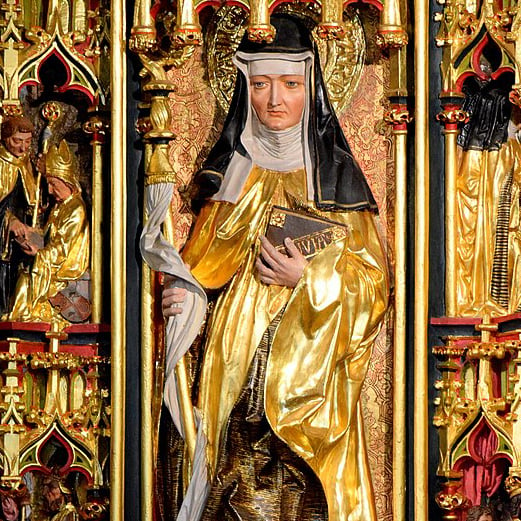
An image of Hildegard of Bingen in the Chapel of St. Roch, Bingen, Germany. Source: Wikimedia Commons CC-BY-SA-4.0 license.
Contemplative
Catholic
Previous Post

December 23, 2022
The Christmas Truce of 1914
Next Post

December 30, 2022 A Brief History of China's Shaolin Temple
Browse Our Archives
Select a Category Buddhism Christianity Daoism Hinduism Indigenous religions Islam Jaina Judaism Mysticism New Age Origins of religion Paganism Popes Popular Religious Movements Protestantism Psychology and religion Religion and current events Religion and folklore Religion and News Media Religion and politics Religious Art and Music Religious Freedom Religious mistakes Religious philosophy Religious scriptures Religious Violence science and religion Spiritualism Technology and religion The Catholic Church The Dalai Lama The Reformation Uncategorized
Select a Month November 2026 October 2026 September 2026 August 2026 July 2026 June 2026 April 2026 March 2026 February 2026 January 2026 December 2025 November 2025 October 2025 September 2025 August 2025 July 2025 June 2025 May 2025 April 2025 March 2025 February 2025 January 2025 December 2024 November 2024 October 2024 September 2024 August 2024 July 2024 June 2024 May 2024 April 2024 March 2024 February 2024 January 2024 December 2023 November 2023 October 2023 September 2023 August 2023 July 2023 June 2023 May 2023 April 2023 March 2023 February 2023 January 2023 December 2022 November 2022 October 2022 September 2022 August 2022
Follow Us!
TAKE THE
Religious Wisdom Quiz
What did God create on the first day according to Genesis?
Select your answer to see how you score.
Light Plants Animals Man
Related posts from The Religious History Nerd
The President and the Pope: An Unprecedented Rift
What Was the Avignon Papacy and Why Is...
A Goddess Who Swapped Bodies to Prove Gender...
Thomas Aquinas on the Morality of War
TRENDING AT PATHEOS History and Religion

Jesus explicitly mentions the book of Jonah twice, but he retells the...

Peggy Sue Got Married: Coppola’s Always Been Like...
I enjoyed Megalopolis (2024). It’s a mess, but I enjoyed it. The...

My dissertation The Place of Mysticism in the Late Middle Ages concerns...

God and the Contingency of This World
The great Catholic philosopher Aquinas and the great Lutheran philosopher Leibniz developed...

Pope Francis and The Devil – A Pagan...
According to his private diaries, Pope Francis saw visions of the devil...

Rock N' Roll-- Morphing into/for a New Generation...
Well, should we be grateful, or is rock n' roll just dead? ...
view all History and Religion blogs
Ad-Free & Subscriber Log-In Subscription Support
- About Us
- 2026 Calendar
- Videos
- Podcasts
- Library of World Religions
- Faith In Media Tracker
- Advertise With Us
- Write for Us
- Privacy Policy
- Terms of Service
- Do Not Sell My Data
- Contact Us
- Radiant Digital
- Manage Newsletter Subscriptions
- Unsubscribe From Notifications
- Sitemap
Copyright 2008-2026, Patheos, part of the Radiant Digital network of media brands. All rights reserved.
Subscription Support Ad-Free & Subscriber Log-In
Follow Patheos